Medium fluorescence describes a diamond that shows a clearly visible reaction under ultraviolet (UV) light, sitting in the middle of the GIA, IGI, and GCAL fluorescence scale between Faint and Strong. Despite reacting more noticeably under a UV lamp than a faint-fluorescence stone, medium fluorescence rarely produces any visible effect under normal, everyday lighting, which makes it a low-risk grade that carries, at most, a modest price discount rather than the more meaningful pricing dynamics tied to Strong and Very Strong grades.
Where Medium Fluorescence Sits on the Scale
| Grade | Visibility under UV | Typical effect on appearance |
|---|---|---|
| None | No visible reaction | No effect; baseline appearance |
| Faint | Barely perceptible reaction | Essentially no visible effect under any normal lighting |
| Medium | Clearly visible reaction under UV | Rarely affects face-up appearance under normal light |
| Strong | Strongly visible reaction under UV | Usually negligible; can slightly soften warmth in lower color grades; rare haze risk in high-color stones |
| Very Strong | Intensely visible reaction under UV | Higher (though still uncommon) chance of visible haziness, especially in D-F color stones |
Medium fluorescence marks the point on the scale where the UV reaction becomes unmistakably visible to the eye under a blacklight — a meaningfully stronger reaction than Faint. What doesn't change proportionally, though, is real-world risk: medium fluorescence sits well below the intensity threshold where fluorescence starts genuinely interacting with a diamond's face-up appearance under ordinary lighting, which is why the trade treats it as a low-consequence grade rather than one requiring extra scrutiny.
Does Medium Fluorescence Affect a Diamond's Appearance?
In the overwhelming majority of cases, no. Under typical indoor lighting — incandescent, most LED, and standard retail lighting, all of which carry little UV content — a medium-fluorescence diamond looks the same as a non-fluorescent stone of identical color and clarity. The reaction becomes visible specifically under UV-rich conditions, most commonly bright outdoor daylight, where a medium-fluorescence stone can show a very subtle interaction with its body color. That interaction at the medium intensity level is generally too faint to register to an untrained eye and essentially never approaches the hazy or "overblue" look that's occasionally associated with the far stronger reactions seen in Strong and Very Strong fluorescence, high-color combinations.
Medium Fluorescence and Color Grade
| Color grade range | Effect of medium fluorescence |
|---|---|
| D-F (colorless) | Very low risk; occasional extremely subtle interaction in strong daylight, rarely noticeable |
| G-I (near colorless) | Negligible effect; essentially indistinguishable from a non-fluorescent equivalent |
| J-M (faint yellow) | Can mildly counteract warmth under UV-rich light; occasionally viewed as a subtle benefit |
This is a useful contrast to Strong and Very Strong fluorescence, where the D-F color range is specifically where haze risk concentrates and where extra buying caution is genuinely warranted. At the medium intensity level, even D-F color stones carry only a very low, largely theoretical risk — nowhere near the level that would justify the same degree of scrutiny recommended for higher-intensity fluorescence in colorless stones.
Medium Fluorescence and Pricing
Medium fluorescence typically carries a modest price discount in some markets relative to a non-fluorescent stone of the same specifications — smaller and less consistent than the discount seen on Strong or Very Strong fluorescence stones, and in many transactions negligible enough to barely register as a pricing factor at all. Because the visual risk at this intensity is so limited, that modest discount, where it exists, often represents legitimate relative value for buyers comfortable with a certificate showing a clearly measurable, but practically inconsequential, UV reaction.
| Grade | Naked-eye risk | Typical price impact |
|---|---|---|
| None | None | No discount (often the baseline reference point) |
| Faint | Effectively none | Little to no discount |
| Medium | Very low | Modest discount in some markets |
| Strong | Low overall; concentrated in high-color stones | Moderate discount, more pronounced in D-F color |
| Very Strong | Higher, still concentrated in high-color stones | Larger discount, most pronounced in D-F color |
Medium Fluorescence vs. Faint Fluorescence
The practical gap between Faint and Medium fluorescence is small but real: Faint fluorescence is functionally equivalent to no fluorescence at all, while Medium fluorescence is a clearly measurable reaction under UV that most buyers still won't notice in day-to-day wear. A jeweler comparing two otherwise identical stones, one Faint and one Medium, is generally on solid ground telling a client that both are low-risk purchases, with Medium carrying a very slightly higher (though still low) chance of a subtle daylight interaction and, in some markets, a somewhat larger discount worth factoring into a value comparison.
Medium Fluorescence vs. Strong Fluorescence
The real jump in both risk and reward on the fluorescence scale happens between Medium and Strong, not between Faint and Medium. Strong fluorescence produces a noticeably more intense UV reaction, carries a larger, more consistent price discount, and is where the narrow but real "overblue" haze risk in high-color stones actually becomes relevant. Medium fluorescence sits comfortably below that threshold — a buyer choosing between a Medium- and Strong-fluorescence stone at the same color and clarity is trading a smaller discount for meaningfully lower even-theoretical risk, which is a reasonable trade for a risk-averse buyer, though not one required by the underlying visual data for most color grades.
Why Medium Fluorescence Still Gets Full Disclosure
Fluorescence is reported on every GIA, IGI, and GCAL certificate as a measured, objective physical property, independent of whether a given intensity level produces a visible practical effect. Medium fluorescence is disclosed with the same rigor as None, Faint, Strong, or Very Strong precisely because certified grading reports exist to document what's measurably true about a stone, leaving buyers and the market to decide what matters to them rather than having the lab pre-filter which readings are worth reporting.
What Causes Medium Fluorescence
Fluorescence results from trace elements incorporated into a diamond's crystal structure — most commonly boron in natural stones — that cause the diamond to emit visible light when exposed to UV radiation. The concentration of that trace element correlates with intensity: a moderate concentration produces the clearly visible, but not intense, reaction that earns a Medium grade, positioned between the barely-there reaction of Faint and the strongly visible reaction of Strong. CVD lab-grown diamonds can also show medium fluorescence, tied to growth-process factors rather than trace boron specifically, but graded on the identical scale and disclosed identically on the certificate.
Medium Fluorescence in Lab-Grown vs. Natural Diamonds
Medium fluorescence occurs in both CVD lab-grown and natural diamonds and is assessed using the same scale and the same practical guidance regardless of origin. A buyer comparing a lab-grown and a natural stone at similar color, clarity, and carat weight shouldn't weight a Medium fluorescence grade any differently based on which type of diamond it appears on — the low, largely theoretical risk profile at this intensity level is origin-neutral.
How to Check Medium Fluorescence Yourself
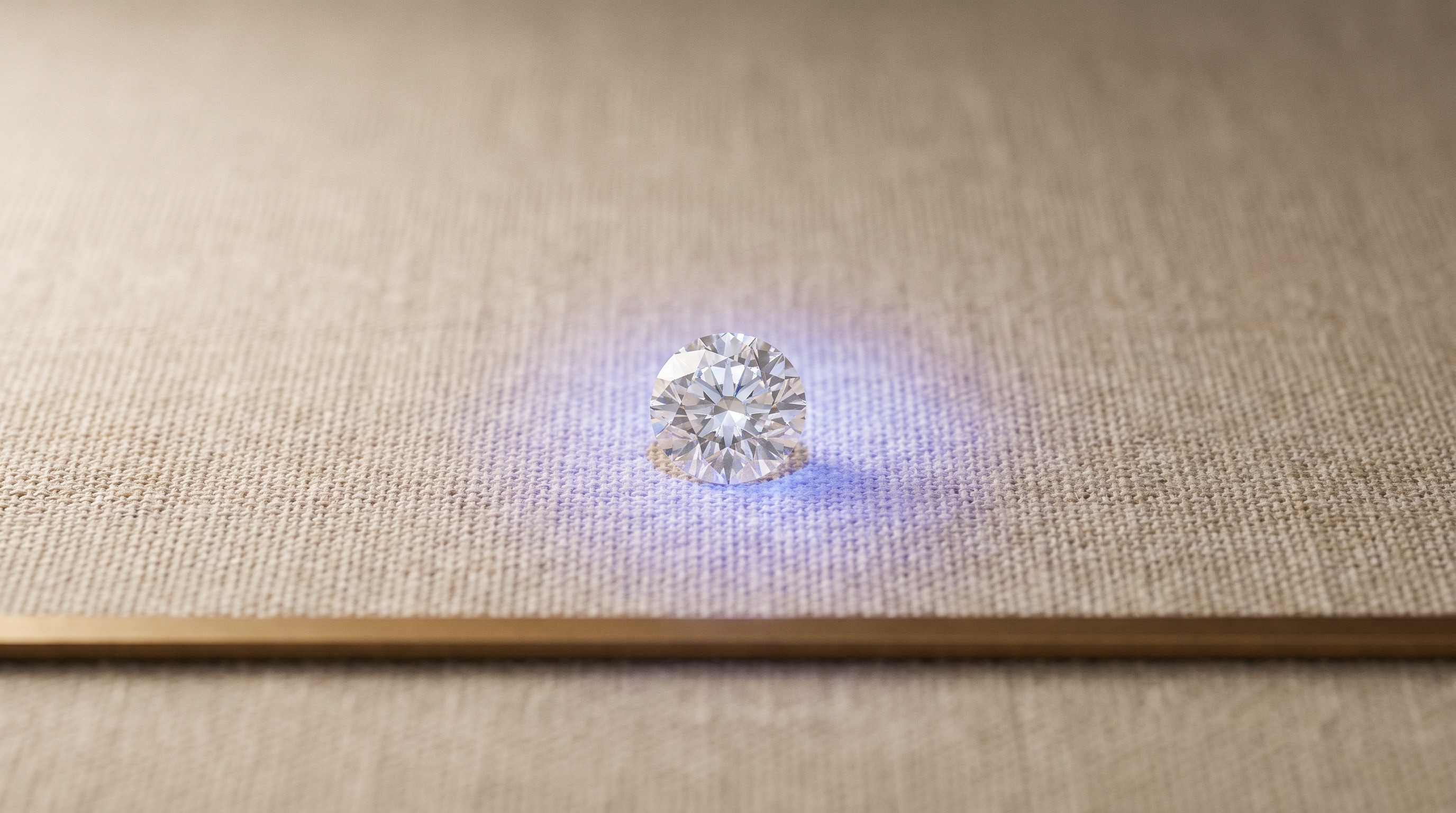
A standard long-wave UV flashlight lets a buyer or jeweler observe fluorescence directly and get a feel for where a specific stone sits on the scale beyond the grade name alone. Under such a light, a medium-fluorescence stone shows a clear, unmistakable glow — more pronounced than a faint-fluorescence stone's barely-there reaction, but noticeably less intense than the strong glow produced by a Strong or Very Strong stone under the same light source. This side-by-side comparison is a useful tool for jewelers walking a client through what the grade actually means physically, distinct from what it means for the stone's everyday appearance.
Common Misconceptions About Medium Fluorescence
- "Medium fluorescence means the diamond will look hazy or cloudy." The haze risk associated with fluorescence is concentrated narrowly in Strong and Very Strong grades on high-color stones — Medium fluorescence carries essentially none of that risk.
- "Medium fluorescence and Strong fluorescence carry roughly the same discount." Medium typically carries a smaller, more modest discount than Strong or Very Strong, which have historically traded at larger, more consistent discounts.
- "Any visible reaction under a blacklight means the stone will glow in daylight." A clearly visible UV-lamp reaction, which is what defines Medium fluorescence, is not the same as a visible effect in ordinary or even outdoor lighting — most Medium-fluorescence stones show no noticeable effect in either setting.
- "Fluorescence intensity tells you something about clarity or color." Fluorescence is graded and reported entirely independently of clarity and color, with no inherent relationship between them.
A Practical Buying Framework Across the Fluorescence Scale
| Situation | Recommendation |
|---|---|
| None or Faint fluorescence | No practical difference; buy based on other factors — color, clarity, cut, and price |
| Medium fluorescence, any color grade | Very low risk; proceed with the normal buying process |
| Strong or Very Strong, G-M color | Generally safe, often good relative value given the price discount |
| Strong or Very Strong, D-F color | Request daylight video or in-person review before committing |
Medium fluorescence sits comfortably in the "proceed normally" tier of this framework across every color grade, including D-F — a meaningfully different recommendation than the extra scrutiny warranted at Strong and Very Strong intensities in the same color range. This is the single most useful anchor point for a jeweler explaining why a Medium grade shouldn't cause the same hesitation a client may have read about regarding fluorescence generally.
Talking to Customers About Medium Fluorescence
The most useful way to frame Medium fluorescence for a client is to separate what it means on a UV lamp from what it means in the piece they'll actually wear: it's a clearly measurable reaction under specialized lighting, but one that essentially never shows up in the mirror, in a restaurant, or outdoors. Clients who've read general warnings about diamond fluorescence online are often relieved to learn that those warnings are really about Strong and Very Strong grades in colorless stones, a narrower and more specific concern than fluorescence as a category — Medium fluorescence doesn't fall into that higher-risk zone.
Fluorescence Color at the Medium Intensity Level
Blue is the most common fluorescence color at every intensity level, including Medium, though yellow, orange, and white fluorescence occur occasionally as well. At the Medium intensity, fluorescence color has only a minor practical bearing on appearance — the reaction is visible enough that a very subtle interaction with body color is theoretically possible in strong UV-rich light, but far less pronounced than the same color-and-intensity combination would produce at Strong or Very Strong. Color of fluorescence becomes a more consequential variable specifically as intensity climbs past Medium.
Should Medium Fluorescence Change a Buying Decision?
For nearly all buyers, no — Medium fluorescence should factor into a purchase decision only marginally, mostly as a minor value consideration where a modest discount is available rather than as a genuine appearance concern. The exception is the same narrow group relevant at every fluorescence grade: buyers with a specific personal preference for minimal or no measurable fluorescence on the certificate itself, often tied to resale-market perception. For everyone else, a well-vetted Medium-fluorescence stone can be prioritized based on cut, color, clarity, and carat weight without fluorescence meaningfully entering the decision.
Medium Fluorescence and Diamond Photography
Buyers occasionally notice a diamond's fluorescence in professional photography before ever seeing the stone in person, since some product photography setups use lighting with more UV content than typical indoor viewing conditions, or photograph stones under a UV lamp specifically to document fluorescence for a listing. A medium-fluorescence stone photographed this way may show a visible glow in that specific image that has little bearing on how the stone will actually look worn day to day under ordinary lighting. Buyers evaluating a stone primarily through photography are better served asking specifically how a photo was lit, particularly if a stone's fluorescence grade is Medium or higher, rather than assuming any glow visible in a photo will carry over to real-world wear.
Fluorescence Stability Over Time
Fluorescence is a fixed physical property, set at formation for natural diamonds and during growth for CVD lab-grown diamonds, and it does not change with age, cleaning, or wear. A diamond graded Medium fluorescence on its original certificate will carry that same rating indefinitely — a useful fact for buyers evaluating an older certificate or fielding a client's question about whether a stone's fluorescence could shift over years of ownership.
Medium Fluorescence by Diamond Shape
| Shape | Fluorescence visibility consideration |
|---|---|
| Round brilliant | Medium fluorescence has no notable visible effect regardless of shape; facet structure isn't a significant factor at this intensity |
| Emerald / Asscher (step cuts) | Step cuts generally reveal optical characteristics more readily, but medium fluorescence remains too weak at this intensity to produce anything worth flagging |
| Cushion, oval, pear, radiant | Same as round brilliant — shape isn't a meaningful variable at the medium intensity level |
This is a useful point of contrast with Strong and Very Strong fluorescence, where step-cut shapes in particular warrant a closer look in high-color stones. At the medium intensity level, shape simply doesn't change the practical guidance in any meaningful way — there's no optical effect substantial enough for facet structure to reveal or mask.
Medium Fluorescence in Antique vs. Modern Cut Diamonds
Antique cuts like old mine and old European, with their deeper pavilions and larger, more open facets, can interact with light somewhat differently than a modern ideal-cut round, which occasionally leads buyers to wonder whether fluorescence behaves differently in these cuts. In practice, medium fluorescence's low-risk profile holds regardless of cut style — the intensity level itself, not the specific facet arrangement, is what determines whether a visible interaction is even plausible, and medium sits well below that threshold across cut styles. A buyer specifically drawn to antique cuts shouldn't weigh a medium fluorescence grade any more cautiously than they would on a modern round brilliant of comparable color and clarity.
How Trade Professionals Typically View Medium Fluorescence
Within the trade, medium fluorescence is generally treated as a data point worth noting on a certificate rather than a factor that meaningfully changes how a stone is bought, sold, or presented. Dealers pricing a parcel of stones will typically apply, at most, a small adjustment for medium fluorescence relative to a non-fluorescent equivalent, reserving more significant pricing adjustments for the strong and very strong grades where the market's caution is more consistently reflected in actual trading behavior. This trade-level treatment is a useful signal for buyers trying to gauge how seriously to weigh a medium fluorescence grade in their own decision-making — the market itself treats it as a minor factor.
Frequently Asked Questions
Does medium fluorescence affect how a diamond looks in normal light?
Rarely. Under typical indoor lighting, a medium-fluorescence diamond looks essentially the same as a non-fluorescent stone of the same color and clarity. Any subtle interaction with body color is limited to UV-rich conditions like outdoor daylight, and even then it's usually too faint to notice.
Does medium fluorescence lower a diamond's price?
Sometimes, modestly. Medium fluorescence can carry a small discount in some markets, but it's typically less than the discount seen on Strong or Very Strong fluorescence stones, and in many transactions it's negligible.
Is medium fluorescence worse than faint fluorescence?
Not meaningfully in terms of appearance — both carry very low practical risk. Medium fluorescence does produce a more clearly visible reaction under a UV lamp specifically, and can carry a somewhat larger discount in some markets, but the everyday visual difference is negligible for the large majority of stones.
Should I avoid a diamond with medium fluorescence?
There's generally no reason to. Medium fluorescence is a low-risk grade across essentially every color range, including D-F, and doesn't carry the narrow haze risk associated with Strong and Very Strong fluorescence in high-color stones.
Is medium fluorescence the same in lab-grown and natural diamonds?
Yes — both are graded on the identical GIA/IGI/GCAL scale, and medium fluorescence carries the same low practical risk regardless of origin.
Can medium fluorescence make a diamond look whiter?
In lower color grades, a mild whitening effect is possible under UV-rich light, similar to (though less pronounced than) the effect sometimes seen with Strong fluorescence in warmer-colored stones. It's a subtle, occasional benefit rather than something to count on.
How can I check a diamond's fluorescence myself?
A standard long-wave UV flashlight will show a medium-fluorescence stone reacting clearly and visibly, more than a faint-fluorescence stone but less intensely than a strong or very-strong one — a useful, quick way to understand where a stone sits on the scale beyond its certificate grade name.
Medium Fluorescence and Certificate Comparison Across Labs
Because fluorescence intensity is assessed using calibrated UV light sources under controlled conditions rather than purely by subjective visual judgment, medium fluorescence grades are generally consistent when comparing certificates from GIA, IGI, and GCAL on similar stones. A buyer comparing several certified stones from different labs shouldn't expect meaningful fluorescence-grading discrepancies specifically at the medium intensity level — the grade name and its practical implications carry over consistently across all three major labs, unlike some of the more genuinely lab-specific differences that show up in areas like cut-grading philosophy.
Building a Diamond Comparison Around Medium Fluorescence
When a client is comparing two otherwise similar stones and one happens to carry medium fluorescence, the most useful approach is to treat it as a minor line item rather than a deciding factor — checking whether a modest discount is reflected in price, confirming the color grade falls in a range where fluorescence poses essentially no risk (which, at the medium intensity, is every color range), and then moving on to compare the stones on cut, clarity, and overall value. This keeps the comparison focused on the factors that actually drive a stone's appearance and price, rather than letting a low-consequence fluorescence grade consume more attention than it warrants in the decision.
Sourcing Diamonds Across the Fluorescence Spectrum from Guru Diam
Every certified stone in Guru Diam's inventory, natural and CVD lab-grown alike, ships with full GIA, IGI, or GCAL documentation including fluorescence grade, so buyers and jewelers can evaluate a stone's complete profile rather than guessing at how a given grade will present in a finished piece. For clients specifically comparing Medium fluorescence against Faint or Strong alternatives at a similar price point, our team can walk through the practical tradeoffs stone by stone, and for higher-color stones under consideration, we can arrange direct or video review under daylight-equivalent conditions before a commission moves forward.
In-stock inventory ships same-day from New York before 6pm EST or Los Angeles before 4pm PST, and our custom jewelry program finishes commissioned pieces in 4-6 days. Trade accounts can review our full certified diamond program across every color, clarity, and fluorescence combination through the wholesale hub or a trade partner account, and our certified loose diamond catalog lists fluorescence grade alongside the full 4Cs for every stone so a jeweler can confirm a specific stone's profile before presenting it to a client. We also carry a dedicated selection of fancy color loose diamonds and matching pairs for jewelers sourcing beyond standard white diamond inventory.