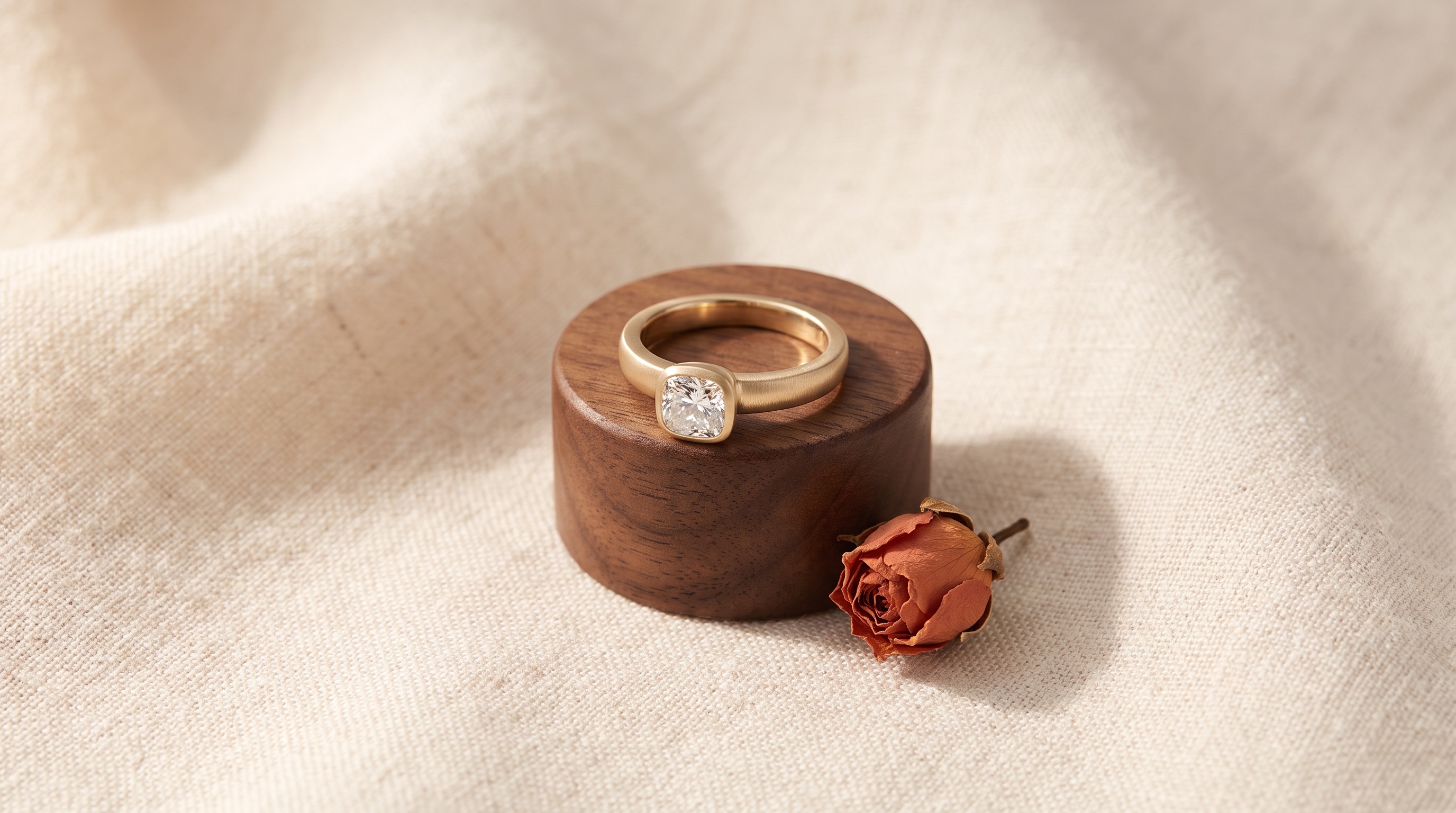
A low-profile engagement ring sets the center stone close to the finger rather than lifted high above the band, trading some visual prominence for better everyday durability and comfort — a construction choice driven by prong or bezel height, not by carat weight, shape, or the stone's own quality grade. For jewelers building or expanding an engagement ring line, understanding setting-height tradeoffs is essential to sourcing mountings that match how customers actually wear their rings day to day.
This guide covers what determines setting height, the durability and comfort tradeoffs involved, and what a wholesale buyer should evaluate when sourcing low-profile mountings for a retail engagement ring program.
What "Setting Height" Actually Means
Setting height refers to how far the center stone sits above the finger, determined primarily by the height of the prongs (or, in a bezel setting, the height of the metal rim securing the stone) and the basket or gallery structure holding the stone in place. A high-profile setting typically lifts the stone 4-6mm or more above the band, maximizing light entry from all angles and giving the stone a prominent, dramatic presence. A low-profile setting brings that height down closer to 2-3mm or less, tucking the stone nearer to the finger. Neither is inherently "correct" — the choice is a genuine tradeoff between appearance and daily-wear practicality that varies by customer lifestyle and preference.
Low Profile vs. High Profile: A Comparison
| Factor | Low Profile | High Profile |
|---|---|---|
| Typical setting height | 2-3mm or less above the band | 4-6mm or more above the band |
| Durability for active daily wear | Higher — less exposed to snagging or impact | Lower — more exposed to knocks, catches, and prong damage |
| Light performance | Slightly reduced light entry from the sides | Maximizes light entry from all angles, generally more brilliance |
| Visual prominence | More subdued, understated look | More dramatic, attention-drawing look |
| Comfort under gloves or tight-fitting work | Better — less likely to catch on fabric or equipment | Worse — more prone to catching |
| Best suited to | Active lifestyles, manual work, minimalist aesthetic preference | Customers prioritizing maximum sparkle and stone visibility |
Prong Height and Construction
Prong-set low-profile rings use shorter prongs and a more compact basket structure, which reduces the stone's exposure to catching on clothing, hair, or equipment while still allowing meaningful light entry from the sides and top of the setting. The tradeoff is that shorter prongs have slightly less metal available to securely grip the stone compared to a taller basket, which means precise craftsmanship in prong placement and tip shaping matters more at low height — a poorly executed short prong is more likely to wear thin or loosen over years of daily wear than a poorly executed tall prong, simply because there's less margin for error in the metal itself.
Bezel Settings: The Lowest-Profile Option
A full bezel setting, where a continuous metal rim surrounds the entire stone's girdle, represents the lowest-profile construction commonly available and offers the strongest physical protection of any setting style, since the stone has no exposed prong tips that can catch, bend, or wear down over years of daily use. The tradeoff is a meaningful reduction in light entry from the sides, since the metal rim blocks light that would otherwise reach the stone's pavilion from that angle — a bezel-set diamond generally shows somewhat less overall brilliance than the same stone in an open prong setting, though a well-executed bezel with a thinner rim profile narrows this gap considerably compared to a thick, heavy bezel.
Durability Considerations for Everyday-Wear Programs
Retailers building a program around active-lifestyle customers — healthcare workers, tradespeople, parents of young children, or anyone whose hands see frequent daily impact — should weight low-profile and bezel construction more heavily in their sourcing mix, since these customers report meaningfully fewer prong-repair and stone-loss incidents over the life of the ring compared to high-profile settings worn in the same conditions. This is a genuine, verifiable durability difference rather than a marketing claim: shorter prongs and bezel rims are simply less exposed to the kinds of impacts (catching on a doorframe, a tool, a child's clothing) that bend or chip taller prong settings over years of wear.
Light Performance Tradeoffs and How to Minimize Them
A jeweler sourcing low-profile mountings can partially offset the reduced light entry by pairing the setting with a well-cut stone — a diamond with an Excellent or Very Good cut grade compensates for some of the light-entry reduction inherent to a lower setting, since a well-proportioned stone is more efficient at returning whatever light does reach it. See our diamond cut chart guide for how cut grade affects light return, since pairing cut quality with setting height is a more effective way to maximize sparkle in a low-profile piece than compensating with a larger or higher-color stone alone.
Sourcing Considerations for Wholesale Buyers
| What to Evaluate | Why It Matters |
|---|---|
| Prong tip thickness at low height | Thinner prongs at reduced height need precise craftsmanship to avoid premature wear |
| Bezel rim thickness and finish | A thinner, well-polished rim balances protection against light-performance loss better than a thick, heavy rim |
| Basket/gallery construction quality | A well-built low basket maintains structural integrity despite reduced height |
| Compatibility with wedding band pairing | Low-profile rings generally pair more easily flush against a wedding band than high-profile settings |
| Custom build turnaround | Confirm realistic lead time for a low-profile custom build versus a standard-height stock design |
Pairing Low-Profile Rings With Wedding Bands
A practical, often underappreciated advantage of low-profile engagement rings is easier pairing with a wedding band worn alongside it — a high-profile setting's tall basket can create a visible, sometimes uncomfortable gap or interference with a straight wedding band, while a low-profile setting generally sits flush enough for a wedding band to rest comfortably against it without requiring a custom-contoured or curved band design. Retailers should factor this into how they present low-profile options to customers who've indicated they plan to wear their engagement ring and wedding band stacked together daily, since it's a genuine functional benefit beyond the aesthetic and durability considerations.
Shape-Specific Setting Height Considerations
Setting height interacts differently with different diamond shapes — a round brilliant or cushion cut generally adapts well to a low-profile basket design, while an emerald or asscher cut's larger, more exposed table can look and feel different at a reduced height since step cuts already show a distinctive, more subdued light pattern that a low setting can further mute. Buyers sourcing low-profile mountings across a range of shapes should evaluate each shape's specific interaction with reduced height rather than assuming a single basket design translates equally well across every shape in the catalog. See our engagement ring shapes guide for a broader comparison of how different shapes behave across various settings.
Cathedral and Low-Set Combinations
Some low-profile designs pair a reduced setting height with cathedral-style shoulders — arched metal supports rising from the band toward the setting — which can visually lift and frame the stone somewhat without meaningfully increasing the stone's actual exposed height above the finger. This combination gives retailers a middle-ground option for customers who want some of the visual presence associated with a taller setting while retaining most of the durability benefit of a genuinely low setting height. See our cathedral setting guide for more on how this shoulder style is constructed and where it fits alongside other setting choices.
Building a Balanced Low-Profile Product Range
A retailer expanding into low-profile and bezel construction doesn't need to replace their existing high-profile catalog — the two serve different customer priorities and can coexist as complementary options within the same broader engagement ring line. A practical approach is offering a low-profile or bezel variant of a retailer's best-selling high-profile designs (same shape and stone-size range, adapted setting height) rather than treating low-profile as an entirely separate product category, since this lets sales staff present it as a natural alternative within a familiar design rather than an unrelated, harder-to-position option. Retailers who track which specific designs customers request in a low-profile variant, rather than assuming demand is evenly spread across the catalog, can prioritize which existing designs to adapt first.
How to Talk to Customers About the Tradeoff
The most effective approach sales staff use when presenting low-profile options is framing the choice honestly as a genuine tradeoff rather than positioning one style as objectively superior — a customer choosing a low-profile or bezel setting for an active job or lifestyle benefits from understanding exactly what they're gaining (durability, comfort, easier band pairing) and what they're trading (some light performance and visual drama), so they can make a confident, informed decision rather than feeling talked into a compromise. Customers who understand the reasoning behind their choice at the point of sale also tend to report higher satisfaction with the piece over years of wear, since they aren't later comparing their setting unfavorably against a friend's higher-profile ring without understanding why theirs looks different.
Common Misconceptions About Low-Profile Rings
A common misconception is that a low-profile setting automatically makes a diamond look smaller than the same stone in a high-profile mounting — in practice, a well-designed low basket that properly frames the stone's spread (its visible top-down diameter) preserves apparent size well, since perceived size is driven far more by the stone's diameter and proportions than by how far it's lifted above the band. A second misconception is that bezel settings are only appropriate for smaller stones; a well-constructed bezel can accommodate a wide range of carat weights, though very large center stones in a full bezel do require careful proportion planning to avoid an overly bulky look.
Why Demand for Low-Profile Settings Has Grown
Retailers have reported growing customer interest in low-profile and bezel engagement rings over recent years, driven by several converging factors: increased workforce participation among ring-wearing professionals in hands-on fields (healthcare, manual trades, hospitality), broader consumer awareness of prong-damage repair costs and frequency, and a general aesthetic shift toward more minimalist, understated jewelry among younger buyers compared to the maximalist, high-drama settings that dominated engagement ring marketing a decade earlier. Retailers who've historically stocked a catalog weighted heavily toward high-profile solitaire and halo designs may find real, previously underserved demand by expanding their low-profile and bezel offering rather than treating it as a niche request.
Metal Choice and Low-Profile Construction
Metal choice interacts with setting height in a few practical ways worth factoring into a sourcing decision: platinum's density and strength allow slightly thinner prongs or bezel rims at a given durability level compared to gold, which can preserve a bit more light entry in a low-profile design without sacrificing security. White gold and platinum both show a bezel rim's reflective surface more prominently against a colorless stone than yellow or rose gold would, which is a purely aesthetic consideration some customers weigh when choosing between a bezel and an open-prong low setting. Retailers should be prepared to discuss these metal-specific nuances with customers comparing options, since the "best" metal choice for a low-profile build isn't identical across every customer's priorities.
Sizing and Resizing Considerations
Low-profile and bezel rings generally resize using the same standard jewelry techniques as any other ring, but bezel-set stones in particular require a more careful resizing process, since the bezel rim's fit around the stone must remain precisely secure after the band's shank is cut and rejoined — a resizing job that stretches or compresses the shank near the setting itself carries slightly more risk of disturbing the bezel's fit than the same job on a standard prong setting, where the basket is more structurally separate from the band. Retailers should confirm with their manufacturing or repair partner that resizing work on bezel-set pieces is handled by someone experienced with that specific construction, since a resizing error on a bezel setting is more likely to require a full re-setting of the stone than the equivalent error on a prong setting.
CAD and Manufacturing Considerations for Custom Low-Profile Builds
Jewelers designing a custom low-profile build through CAD software need to model prong or bezel height with more precision than a standard high-profile design allows, since there's less structural margin to compensate for a design error before the stone sits either too loose or so tight it's difficult to set without risk of damage. A manufacturing partner experienced specifically in low-profile and bezel construction can flag potential structural issues at the CAD-review stage — before a wax or metal casting is made — saving the cost and turnaround delay of a failed physical prototype. Retailers sourcing custom low-profile builds should ask a prospective manufacturing partner directly about their specific experience with this construction type, not just their general custom-ring capability.
Insurance and Appraisal Notes for Low-Set Stones
An appraiser assessing a low-profile or bezel-set stone for insurance purposes needs clear access to view and, where possible, remove the stone for independent verification of its certificate match — a very tightly fitted bezel can make this more time-consuming than a standard prong setting, which is worth mentioning to customers as a minor but real practical tradeoff of the style. This doesn't affect the underlying insurability of the piece, but retailers should set accurate expectations that an appraisal appointment for a bezel-set ring may take somewhat longer than for an equivalent prong-set piece, simply due to the extra care required to inspect a fully enclosed stone.
Retail Merchandising Tips for Low-Profile Rings
Because low-profile rings show less dramatic light performance under typical retail lighting compared to high-profile pieces, retailers benefit from merchandising them with messaging that leads with durability and everyday-wear practicality rather than competing head-to-head on sparkle against a high-profile display piece nearby. Photography and in-store display under angled, focused lighting (rather than flat overhead lighting) helps a low-profile piece show its best light performance, since the reduced light-entry angle benefits more from a deliberate light source than a high-profile piece would. Sales staff trained to proactively explain the durability tradeoff, rather than waiting for a customer to ask why a lower-profile piece looks a bit different under the case lighting, tend to convert more confidently on this category.
Sourcing Low-Profile Engagement Ring Settings Through Guru Diam
Guru Diam is a trade-only, B2B wholesale diamond supplier with locations in New York and Los Angeles, sourcing custom engagement ring settings including low-profile prong and bezel construction, alongside a full catalog of CVD lab-grown diamonds, natural diamonds, and certified loose stones across standard, antique, and fancy shapes. Custom engagement rings, including low-profile and bezel builds, are finished in 4-6 days once a stone and setting specification are confirmed. As with the rest of Guru Diam's catalog, center stones are cut and polished at the company's India workshop before final grading and shipment from the New York and Los Angeles locations. Retailers building or expanding a low-profile program can browse current settings and stones at the custom jewelry category or apply for a trade account through trade partner to discuss prong height, bezel construction, and metal specifications for a specific build before placing an order.
A Note on Terminology Variants
Buyers researching this topic will encounter several closely related phrasings — "low set engagement ring," "low profile diamond ring," "low profile bezel set engagement ring," and "low profile cathedral setting" among them — all describing essentially the same underlying construction concept from slightly different angles (general setting height, a specific bezel variant, or a specific shoulder-style variant). Retailers writing their own product descriptions or fielding customer questions should recognize these as functionally interchangeable in customer intent, even though each phrasing emphasizes a slightly different construction detail, so a single well-built product page or FAQ section can reasonably address all of them together rather than requiring separate content for each variant, keeping the retailer's own catalog language consistent even as customers arrive using different search phrasing to describe the same underlying request.
Frequently Asked Questions
What makes an engagement ring "low profile"?
A low-profile ring sets the center stone close to the finger, typically 2-3mm or less above the band, using shorter prongs or a bezel rim, rather than the 4-6mm-plus height common in high-profile settings.
Are low-profile engagement rings more durable?
Generally yes — a lower setting height means less exposure to catching, knocking, or bending, which reduces prong-repair and stone-loss incidents over years of daily wear compared to a high-profile setting worn in the same conditions.
Do low-profile settings reduce a diamond's sparkle?
Somewhat — reduced light entry from the sides means slightly less overall brilliance compared to an equivalent high-profile setting. Pairing a low-profile mounting with a well-cut stone (Excellent or Very Good cut grade) helps offset most of this difference.
Is a bezel setting the same as a low-profile setting?
A bezel is one specific way to achieve a low profile — a continuous metal rim fully surrounding the stone — but low profile can also be achieved with shorter prongs in an open basket. Bezel settings offer the strongest physical protection of the low-profile options.
Do low-profile engagement rings pair better with wedding bands?
Often yes — a low-profile ring's shorter basket generally sits flush enough for a straight wedding band to rest comfortably against it, while a high-profile setting's taller basket can require a custom-contoured band to avoid a visible gap.
Does setting height affect how big a diamond looks?
Not significantly — perceived size is driven mainly by the stone's visible diameter and proportions, not by how far it's lifted above the band. A well-designed low basket that properly frames the stone's spread preserves apparent size well.
Is resizing harder on a low-profile or bezel ring?
Bezel-set rings require somewhat more care during resizing, since the shank work near the setting can affect the bezel's precise fit around the stone. Standard low-profile prong settings resize using the same techniques as most other prong settings.
Should a retailer replace high-profile designs with low-profile ones?
Not necessarily — the two serve different customer priorities and work well as complementary options. A practical approach is offering low-profile or bezel variants of best-selling high-profile designs rather than treating it as a separate, unrelated category.