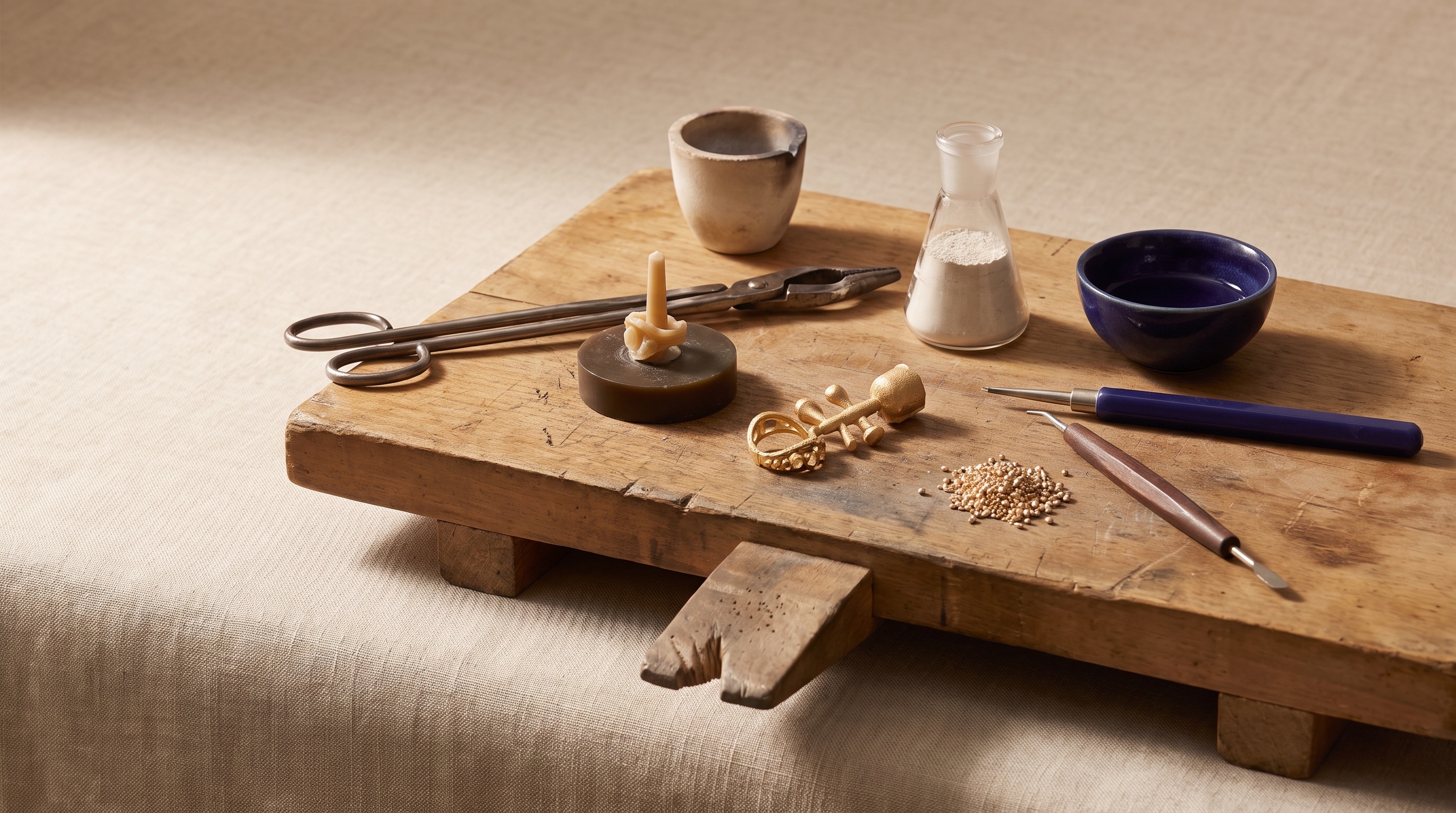
Lost wax casting is a manufacturing process that produces a metal jewelry piece by first carving or printing the design in wax, encasing that wax model in a heat-resistant investment material, then melting ("losing") the wax out and replacing it with molten metal poured into the resulting cavity. It's the dominant production method behind the large majority of cast fine jewelry made today, from simple wedding bands to complex diamond-set mountings.
This guide walks through how the process actually works step by step, the materials involved, where it differs from hand fabrication and 3D-printed alternatives, the defects that show up most often in cast jewelry, and what a jeweler or manufacturer evaluating a casting partner (in-house or outsourced) should know before committing production volume to it.
What Lost Wax Casting Actually Is
The "lost wax" name describes the defining step of the process: a wax version of the final piece is created first, then destroyed (lost) during casting so that molten metal can take its exact place inside a mold. This is different from die-striking or stamping, which forms metal directly from sheet or wire stock under pressure, and different from hand fabrication, which builds a piece from soldered metal components without a mold step at all. Lost wax casting sits between those two approaches — it can reproduce far more geometric complexity than stamping, and far more consistency across repeat units than hand fabrication, which is why it became the standard method for producing cast jewelry at any meaningful volume.
The Lost Wax Casting Process, Step by Step
1. Creating the Master Model
Every casting run starts with a master model of the design, traditionally hand-carved in wax by a model maker and today more often produced as a 3D-printed wax or resin pattern from CAD (computer-aided design) files. The master model needs to be dimensionally exact and fully finished in every detail the final piece should carry, since the casting process reproduces the model faithfully, including any flaws present in it.
2. Building the Wax Tree
For production runs, multiple wax copies of the design (injected from a rubber mold made off the master, or printed directly) are attached by their sprues to a central wax stem, forming what's called a "tree." Building a tree lets a caster produce dozens of identical pieces in a single casting cycle rather than one at a time, which is the main efficiency advantage lost wax casting has over hand fabrication at volume.
3. Investing the Tree
The wax tree is placed inside a metal flask, and a plaster-like investment material (a mix of gypsum-bonded plaster and silica) is poured around it, filling the flask completely and encasing every wax piece. Once the investment sets and hardens, it holds the exact negative shape of every detail on every piece in the tree.
4. Burnout
The filled flask goes into a burnout kiln and is heated gradually to a high temperature (typically 1,350–1,400°F), a process that can take 8-12 hours on a controlled ramp schedule. This step melts and vaporizes the wax completely out of the investment, leaving a network of empty cavities in the exact negative shape of the wax tree — this is the "lost" step the process is named for.
5. Casting the Metal
Molten metal — gold, silver, platinum, or palladium alloy, heated to its specific casting temperature — is introduced into the still-hot investment mold, most commonly using centrifugal or vacuum-assisted casting equipment that forces the metal into every fine cavity, including thin prongs and detailed engraving, before it solidifies. Timing and technique here matter enormously: metal that's too cool or introduced too slowly won't fill fine details, producing incomplete castings.
6. Quenching and Investment Removal
Once the metal has solidified and cooled somewhat, the flask is quenched in water, which both cools the metal further and breaks apart the now-brittle investment material, freeing the metal tree from its mold. The tree at this stage looks rough — dull, matte-surfaced, and still connected at the sprues.
7. Cutting Down, Finishing, and Polishing
Individual pieces are cut from the tree, the sprue stubs are filed or ground flush, and the piece goes through progressive finishing — filing, sanding, and polishing — to bring it to the smooth, reflective surface expected of finished jewelry. This stage also includes quality inspection for casting defects before a piece moves on to stone setting.
Casting Methods Compared
| Method | Best For | Design Complexity Ceiling | Unit Cost at Volume |
|---|---|---|---|
| Lost wax (investment) casting | Repeatable production runs, complex mountings | High — fine prongs, filigree, undercuts all reproduce well | Low per unit once tooling exists |
| Hand fabrication | One-off custom pieces, structural repairs | Limited by what can be soldered/formed by hand | High — labor-intensive per piece |
| Die striking / stamping | Very high-volume simple shapes (plain bands, findings) | Low — struggles with deep undercuts or 3D complexity | Very low, but only at very high volume (die cost is steep upfront) |
| Direct metal 3D printing | Rapid prototyping, very short runs, extreme design complexity | Very high, but surface finish typically needs more post-processing | High per unit; equipment cost is the barrier, not labor |
Materials Involved in the Process
Casting wax itself comes in several formulations — carving waxes for hand work, and injection waxes formulated to flow cleanly into rubber molds under pressure without cracking as they cool. Investment material is typically a gypsum-bonded plaster mixed with silica flour and water in carefully controlled ratios, since the mix's expansion and porosity characteristics directly affect how cleanly fine detail reproduces and how easily gas escapes the mold during the pour. On the metal side, karat gold, sterling and fine silver, platinum, and palladium alloys are all commonly cast, each with its own casting temperature, shrinkage rate, and alloy-specific handling requirements that a caster needs to account for in flask and sprue design.
Where Diamond Setting Fits Into the Casting Timeline
For diamond-set jewelry, the casting process typically produces the mounting — the shank, head, prongs, or channel structure — as a bare metal piece before any stones are set. Some designs cast with small "cups" or seats pre-formed for the stones, which the setter then opens and fits to the exact stone; more precise or delicate designs are cast slightly undersized in the setting area and hand-finished by the setter to fit each stone individually, since diamonds vary slightly even within a stated size and shape. Melee-heavy designs (pavé, channel, and cluster settings in particular) usually need this level of hand adjustment at the setting stage regardless of how precisely the piece was cast, because setting dozens of small stones cleanly along a curved or contoured surface is inherently a hand-finishing task, not something casting alone can complete.
Common Lost Wax Casting Defects and What Causes Them
| Defect | Typical Cause |
|---|---|
| Porosity (small internal or surface voids) | Trapped gas during solidification, often from metal poured too cool or an investment mix with poor gas permeability |
| Incomplete fill (missing detail, especially fine prongs) | Metal introduced too slowly or at too low a temperature to reach thin cavities before solidifying |
| Shrinkage porosity / pitting | Metal contracting as it cools without enough reservoir metal (from the sprue) to compensate |
| Investment inclusions (grit embedded in the surface) | Investment material breaking down or cracking during the pour and mixing into the molten metal |
| Warping or distortion | Uneven cooling, often from a poorly designed sprue system or an overcrowded tree |
Most of these defects trace back to variables in flask preparation, burnout schedule, or pour technique rather than the wax model itself, which is why casting quality varies meaningfully between manufacturers even when they're working from identical CAD files. A buyer sourcing cast mountings should ask a manufacturing partner directly about their defect rate and inspection process rather than assuming all cast product is equivalent.
CAD and 3D-Printed Wax Patterns vs. Traditional Hand Carving
Most production jewelry today starts as a CAD file rather than a hand-carved wax master, with the design printed directly in castable wax or resin on a specialized 3D printer before it ever enters the investment stage. This shift hasn't changed the fundamental casting process described above — burnout, pour, and finishing all work the same way regardless of how the wax pattern was made — but it has dramatically shortened the time from design to first sample, made minor design revisions far cheaper (a file edit and reprint versus recarving by hand), and improved repeatability across a production run since every printed wax from the same file is dimensionally identical. Hand carving hasn't disappeared entirely; it remains the standard for certain one-off custom pieces and for master models with organic, freehand detailing that's still faster to carve than to model in CAD.
In-House vs. Outsourced Casting: What Jewelers and Manufacturers Should Weigh
A jeweler or brand building a private-label or custom line has to decide whether to cast in-house or work with an outside casting house, and the tradeoff comes down to volume, quality control, and turnaround. In-house casting gives direct control over defect rates, alloy sourcing, and turnaround time, but requires meaningful equipment investment (burnout kilns, casting machines, flask handling equipment) and skilled staff to run it well. Outsourcing to a specialized casting house lowers the upfront investment and can be the more practical choice at lower volumes, but shifts quality control to the vendor relationship and typically adds shipping time between design approval and finished castings landing back with the jeweler for setting and finishing. Manufacturers running consistent, higher volumes generally find in-house casting pays for itself through both cost control and faster turnaround, since the finishing and setting stages that follow casting can start immediately rather than waiting on an outside vendor's own production queue.
Sustainability Considerations in Lost Wax Casting
Lost wax casting generates two recoverable byproducts worth factoring into how a manufacturer thinks about waste: sprue and tree metal cut away during finishing is standard scrap that gets remelted and reused in future casting runs, and unused injection wax can often be reclaimed and reinjected. Investment material itself is not reusable — it's broken apart and discarded after each casting cycle — but the metal recovery loop is a meaningful, well-established part of how casting houses manage material cost and reduce reliance on constantly purchasing fresh raw metal for every run.
Cost Factors in Lost Wax Casting Production
Per-unit casting cost is driven primarily by metal weight and current market price, casting labor and equipment overhead, and the complexity of the mold and finishing work a design requires — a simple plain band costs far less to cast and finish than an intricate antique-style mounting with filigree detail and multiple prong configurations. Tooling cost (the rubber mold made from a master model) is a one-time expense amortized across however many units get cast from it, which is why casting becomes dramatically more cost-efficient at higher production volumes and why a one-off custom piece, cast without a reusable rubber mold, costs meaningfully more per unit than the same design produced as part of a hundred-unit run.
Centrifugal vs. Vacuum-Assisted Casting Equipment
The two most common ways to force molten metal into an investment mold are centrifugal casting, which spins the flask at high speed so centrifugal force pushes metal outward through the sprue system and into every cavity, and vacuum-assisted casting, which instead pulls a vacuum on the flask from below to draw metal in and evacuate trapped air ahead of it. Centrifugal machines are the more widely used equipment in small-to-mid-size casting operations because they're mechanically simpler and less expensive to maintain, while vacuum-assisted systems tend to produce more consistent results on trees with very fine detail or a large number of pieces, since the vacuum more reliably reaches every branch of a crowded tree rather than relying purely on spin geometry. Larger production casting houses frequently run both types of equipment side by side, matching each casting job to whichever method suits that specific tree's design complexity and piece count.
Choosing an Alloy for Casting Durability
Alloy selection affects more than color — it directly changes how a design casts and how durable the finished piece is in daily wear. Higher-karat gold (18k) is softer and more prone to prong wear over time than 14k, which is why many manufacturers default to 14k for pieces expected to see daily wear (engagement rings, wedding bands) and reserve 18k for pieces valued more for color depth than structural demands. White gold alloys also vary in nickel content, which affects both castability and whether a piece needs rhodium plating to achieve a bright white finish, while platinum, despite being denser and more wear-resistant than gold, requires meaningfully higher casting temperatures and different flask handling, which is part of why platinum casting commands a price premium over comparable gold work. A manufacturer specifying alloy for a new design should weigh expected wear pattern and finish requirements together, rather than choosing purely on raw material cost.
A Brief History of Lost Wax Casting
Lost wax casting is one of the oldest metalworking techniques in human history, with archaeological evidence of the process in bronze artifacts dating back roughly 6,000 years across multiple independent civilizations, long before it was applied specifically to precious-metal jewelry. The core principle — carve a model, encase it, melt it out, replace it with metal — has remained essentially unchanged since antiquity; what's changed is the precision of the tools involved, from hand-carved beeswax and centrifugal casting machines in the 20th century to today's CAD-driven, 3D-printed wax patterns and computer-controlled casting equipment.
Quality Control Checkpoints a Manufacturer Should Build Into the Process
The most effective quality control for cast jewelry happens at three checkpoints rather than only at final inspection: verifying the wax pattern itself is defect-free before investing (since any flaw in the wax reproduces exactly in metal), checking burnout kiln logs to confirm the correct temperature ramp was followed for that specific flask, and inspecting cast pieces under magnification immediately after cutting down from the tree, before any polishing hides surface porosity that would otherwise be visible. A manufacturer or jeweler evaluating a casting partner should ask specifically about these three checkpoints rather than accepting a general assurance of "quality castings," since defect rates vary meaningfully based on whether a caster actually enforces process discipline at each stage.
Sourcing Cast Mountings and Custom Jewelry Manufacturing
Guru Diam handles casting, setting, and polishing in-house as part of its custom jewelry manufacturing, producing finished custom engagement rings and other cast mountings in 4-6 days from design approval — a fraction of the 2-6 week turnaround typical of manufacturers relying on outside casting houses for each step. Because casting, stone setting, and finishing all happen under one roof, defect screening and setting fit can be checked and corrected within the same production run rather than shipped back and forth between separate vendors. Jewelers and designers building a custom piece can start at custom jewelry, and trade accounts sourcing loose diamonds or melee to set into cast mountings elsewhere can browse certified stock at certified diamonds or matched melee at matching pairs. New trade accounts can apply through trade partner, with current program terms at the wholesale hub.
Frequently Asked Questions
What is lost wax casting used for in jewelry?
Lost wax casting is used to produce the metal mounting of a jewelry piece — rings, earrings, pendants, and bracelet components — by carving or printing the design in wax, encasing it in investment material, melting the wax out, and casting metal into the resulting cavity. It's the standard method for producing cast fine jewelry at any meaningful volume.
How long does the lost wax casting process take?
A full cycle — investing, burnout, casting, and cooling — typically takes one to two days depending on flask size and burnout schedule, not counting the wax pattern creation before it or the cutting-down, finishing, and polishing that follow. Burnout alone commonly takes 8-12 hours on a controlled temperature ramp.
What metals can be cast using the lost wax method?
Karat gold (10k-18k, in white, yellow, and rose alloys), sterling and fine silver, platinum, and palladium are all commonly cast using lost wax casting, each requiring its own specific casting temperature and alloy handling.
Is lost wax casting used for CAD-designed jewelry?
Yes — most production jewelry today starts as a CAD file, with the design 3D-printed in castable wax or resin before entering the same investment, burnout, and casting steps as a traditionally hand-carved wax model. The underlying casting process is identical regardless of how the wax pattern was created.
What causes porosity in cast jewelry?
Porosity is most often caused by trapped gas during solidification, typically from metal poured too cool or an investment mix with poor gas permeability. It shows up as small internal or surface voids and is one of the most common defects caught during post-cast inspection.
Is lost wax casting better than hand fabrication?
Neither is universally "better" — lost wax casting is more efficient and consistent for production runs and complex mounting geometry, while hand fabrication remains the better choice for true one-off custom pieces and structural repairs that don't justify building a mold.
What's the difference between centrifugal and vacuum casting?
Centrifugal casting spins the flask to force metal into the mold using centrifugal force, while vacuum-assisted casting pulls a vacuum from below to draw metal in and evacuate trapped air. Both are widely used; vacuum-assisted equipment tends to handle very fine detail or crowded trees more consistently.
Should I cast jewelry in-house or outsource it?
It depends on volume and control needs — in-house casting gives direct control over defect rates and turnaround but requires equipment investment, while outsourcing lowers upfront cost but adds shipping time and shifts quality control to the vendor. Manufacturers running consistent volume generally find in-house casting pays for itself in both cost and speed.
Guru Diam is a trade-only wholesale diamond supplier with locations in New York and Los Angeles, handling casting, stone setting, and polishing in-house for custom jewelry manufacturing alongside its certified loose diamond and melee catalog. Start a custom design at custom jewelry or apply for a trade account through trade partner.