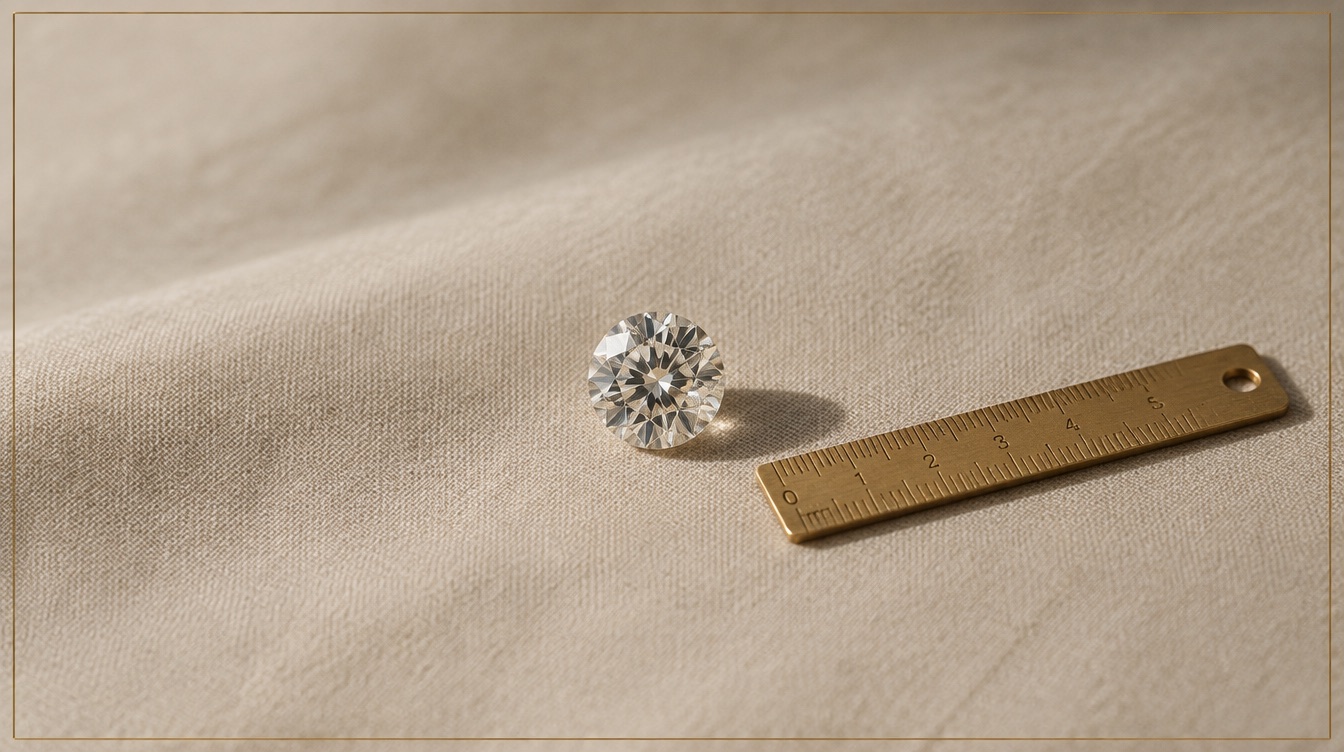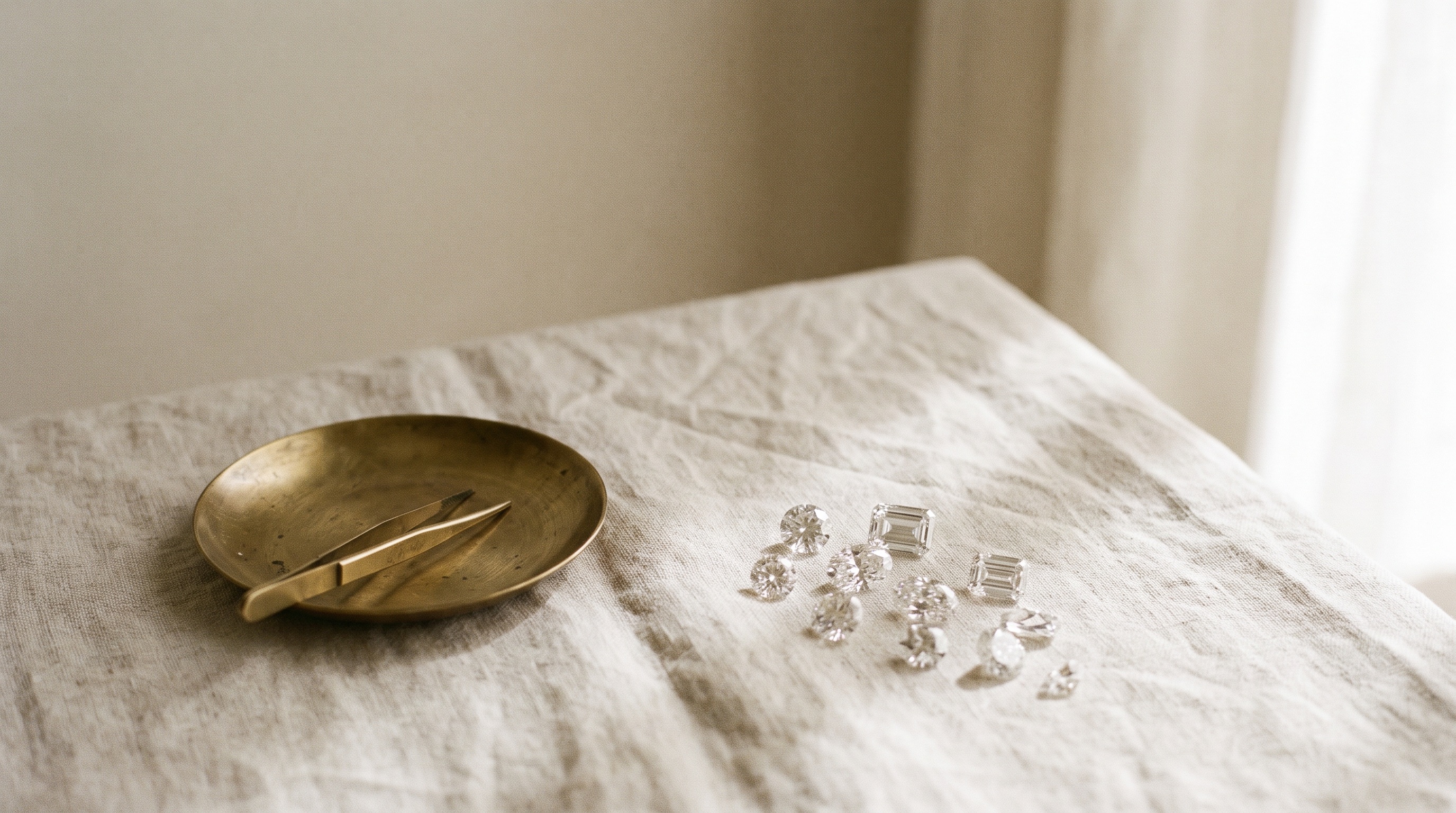
Loose diamonds for jewelry making are unset, unmounted stones — melee, accent, and center-weight sizes — sourced by jewelers, designers, and manufacturers specifically to be set into a finished piece, as distinct from loose stones bought purely as an investment or collector's item. Sourcing them well means matching the right combination of size, shape, and quality tier to a production workflow, not simply buying "the best diamond" in isolation.
This guide covers loose diamond sourcing from a production standpoint: what makes a stone suitable for setting rather than just for grading-report bragging rights, how melee sourcing differs from center-stone sourcing, what certification actually means at each size tier, the practical tradeoffs between lab-grown and natural stones for a production line, and how a jeweler, designer, or small manufacturer should actually structure a wholesale sourcing relationship for loose stones used in ongoing production.
What "Loose Diamonds for Jewelry Making" Actually Means
The phrase covers a wide range of very different sourcing situations. A bench jeweler setting a single center stone into a custom engagement ring has a completely different sourcing need than a manufacturer buying thousands of melee-sized accent stones by the parcel for a production run of eternity bands. Both are "loose diamonds for jewelry making" in the broad sense, but the sourcing channel, certification approach, and quality-control process differ substantially between them.
Broadly, loose diamonds bought for setting fall into two categories: melee (small accent stones, typically under about 0.18 carats and often sourced by the parcel rather than stone-by-stone) and center or side stones (individually selected and usually individually certified from roughly 0.30 carats upward). Understanding which category a given project calls for is the first real sourcing decision, since it determines almost everything downstream — how the stones are priced, how they're quality-checked, and how they're actually purchased.
Melee Diamonds: Sourcing for Volume Production
Melee-sized stones are the accent diamonds that surround a center stone, line a band, or fill a pavé setting — small enough that individually grading and certifying each stone isn't practical at scale. Instead, melee is bought and sold as parcel goods against an agreed color-and-clarity baseline (commonly a DEF+/VS+ standard among quality-focused suppliers), with quality control performed on a representative sample of the parcel rather than stone-by-stone.
For a jeweler or manufacturer setting melee into production pieces — pavé bands, halo settings, accent lines on a mounting — parcel consistency matters more than any single stone's individual grade. A parcel with a tight, reliable color-and-clarity spread lets a setter work efficiently without constantly re-sorting stones mid-production to match neighboring melee, while a loosely graded or inconsistent parcel creates real production friction and visible inconsistency in the finished piece. Melee is available in round brilliant as the most common shape, along with fancy calibrated shapes — emerald, radiant, pear, marquise, and other calibrated cuts on request — sized to fit standard setting specifications.
Center and Side Stones: Sourcing for Individual Selection
Above roughly 0.30 carats, loose diamonds intended for jewelry making are typically sourced and evaluated individually rather than by parcel, since at this size a stone's specific cut, color, and clarity characteristics have a much more visible effect on the finished piece, and buyers reasonably want to see or specify each stone's actual grading report before committing. This is the tier most engagement ring center stones, statement pendant stones, and larger accent stones for side settings fall into.
Sourcing at this tier means working from an actual grading report — carat weight, cut grade, color grade, clarity grade, and additional characteristics like fluorescence and proportions — rather than a parcel-level quality baseline. A jeweler or designer selecting a center stone for a specific client commission is typically comparing individual stones against each other on these specifics, which is a fundamentally different sourcing motion than pulling melee from an on-hand parcel.
Lab-Grown vs. Natural: What Changes for a Production Workflow
CVD lab-grown diamonds and natural diamonds are chemically, optically, and physically identical diamond material — the distinction is origin, not composition — and both are widely used across modern jewelry manufacturing. For a jeweler or manufacturer sourcing loose stones specifically for setting into finished pieces, the practical differences that matter are availability, price point at a given size and grade, and what a given client base expects or requests.
Lab-grown material generally offers more consistent availability at larger carat weights and higher clarity grades relative to price, since natural rough capable of yielding a large, high-clarity stone is genuinely scarce, while CVD growth conditions can be tuned toward a target size and quality tier more predictably. Natural diamonds carry a different market position and remain the default expectation for some client segments and price tiers. Neither is inherently "better" for jewelry making from a technical setting standpoint — a well-cut CVD stone sets exactly like a well-cut natural stone of the same specifications — so the choice for a production workflow usually comes down to sourcing economics and client expectations rather than any difference in how the stone performs once set.
Cut Quality Matters More for Set Stones Than for Loose Storage
A stone destined for setting has different practical priorities than one being evaluated purely as a graded asset. Cut proportions determine how much brilliance and fire a stone shows once mounted, and a setting itself can slightly change how a stone reads — a bezel setting covers more of the girdle and can mute brilliance at the edges, while a prong or pavé setting exposes more of the stone to light. Buyers sourcing loose diamonds specifically for jewelry making should weigh cut grade heavily, since a stone that photographs and performs beautifully loose in a parcel can read differently once it's actually set into a finished mounting.
Girdle thickness is a related, sometimes overlooked factor specific to setting: a girdle that's too thin is more vulnerable to chipping during the setting process itself, particularly with prong settings that apply direct pressure near the girdle edge, while an excessively thick girdle can add unwanted bulk and hide weight without adding visible size. A bench jeweler evaluating stones for a specific setting style benefits from checking girdle thickness alongside the standard 4Cs, not as an afterthought.
Certification and Documentation for Production Use
For individually sourced center and side stones, a grading report from GIA, IGI, or GCAL gives both the jeweler and the eventual retail buyer a shared, independently verified reference point for the stone's characteristics — increasingly important as more clients ask to see documentation before committing to a custom piece. All three labs are widely recognized across the wholesale trade, and consistency between the report and the quoted specification is one of the more important things to verify when comparing quotes from different sources for the same specification.
Melee-sized stones follow a different documentation model: since individual certification isn't practical at that scale, melee is quality-checked against an agreed parcel baseline rather than certified stone-by-stone, and a supplier's stated baseline (color/clarity range) functions as the documentation a buyer relies on rather than a per-stone report. Buyers sourcing melee for jewelry making should confirm what baseline a supplier is actually quoting against before assuming "certified" language applies — melee is never individually or parcel-certified in the same sense as loose center stones, and claiming otherwise is a red flag rather than a selling point.
| Sourcing Tier | Typical Size Range | How It's Documented | Typical Use in a Finished Piece |
|---|---|---|---|
| Melee | ~0.8mm-9.0mm / under ~0.18ct | Parcel baseline (e.g., DEF+/VS+), not individually certified | Pavé, halo, accent lines, side settings |
| Small side stones | ~0.18ct-0.30ct | Often parcel-quoted, sometimes individually graded near the upper end | Larger accent stones, three-stone side settings |
| Center / statement stones | ~0.30ct and up | Individual grading report (GIA/IGI/GCAL) | Engagement ring centers, pendant centers, statement pieces |
Matching Melee for Pairs and Multi-Stone Settings
A specific production challenge worth calling out separately: side stones and accent pairs used in symmetrical settings — three-stone rings, stud earrings, matched side-stone pairs flanking a center stone — need to visually match each other, not just meet a general quality baseline individually. Two stones can each independently meet a DEF+/VS+ specification and still look noticeably mismatched side by side if they land at opposite ends of that range. Sourcing matched pairs and sets specifically, rather than pulling two stones independently from a general parcel, is the more reliable way to get a consistent look for these settings.
This matters more the larger the individual stones get within a multi-stone setting. A slight color or clarity mismatch between two 1mm melee stones set close together is far less noticeable than the same mismatch between two 0.25ct side stones flanking a larger center stone, simply because there's more surface area for the eye to register a difference. Buyers sourcing side stones above roughly 0.10ct for a symmetrical setting should generally request stones matched specifically for that pair or set, rather than assuming a general melee parcel baseline will produce a visually consistent result on its own.
Shape Selection for Setting Compatibility
Not every diamond shape suits every setting style equally well, which matters when sourcing loose stones with a specific piece already in mind. Round brilliant remains the most flexible shape for nearly any setting style and is the most widely available melee shape. Fancy calibrated shapes — emerald, radiant, pear, marquise — bring more design character but require more precise setting work to protect vulnerable points, particularly on step cuts like emerald where an open culet or corner is more exposed to chipping than on a brilliant-faceted shape. Antique cuts — Old Mine, Old European, Kite, Trillion, and similar historically inspired shapes — bring distinctive character to a design and are a genuine category strength for suppliers who stock them consistently, though they're a smaller, more specialized sourcing category than standard modern shapes.
Pricing Structure: What Actually Drives Cost at This Tier
For melee, pricing is driven primarily by the parcel's color-and-clarity baseline, shape, and total carat weight of the parcel, with per-carat pricing typically dropping somewhat at higher purchase volumes. For individually sourced center and side stones, pricing follows the standard 4Cs interaction — cut, color, and clarity each move price independently, with carat weight acting as a multiplier on top rather than the sole driver. A buyer sourcing for production, rather than for a one-off retail sale, generally gets the most reliable and repeatable pricing by working from a fixed specification (shape, size range, color/clarity baseline) against an established wholesale account rather than shopping each purchase individually.
Building a Reliable Sourcing Relationship for Ongoing Production
A jeweler or manufacturer buying loose diamonds repeatedly for jewelry making — as opposed to a one-time purchase for a single client — benefits disproportionately from an established wholesale relationship over shopping each order independently. Consistency in grading interpretation, parcel quality, and turnaround time matters more the more frequently a buyer is ordering, since inconsistency compounds across a production schedule in a way it doesn't for a single purchase. An established trade account also typically opens the door to net terms over time, which materially helps cash flow for a business buying loose stones as a recurring input cost rather than a one-time purchase.
Minimum order requirements and available quantities are also worth confirming upfront specifically for production use — a supplier that can reliably deliver the same melee baseline order after order is more valuable to a manufacturer than one offering a marginally lower price on a single parcel with no guarantee of matching quality on the next order.
Quality Control Practices Worth Confirming Before Ordering
For melee parcels specifically, ask a prospective supplier how they actually sample and verify a parcel before it ships, rather than taking a stated color-and-clarity baseline at face value. A supplier who can describe a concrete sampling process — how many stones are pulled from a given parcel size, how sampling is distributed across the parcel rather than concentrated at the top, and how a parcel that fails to meet the stated baseline is handled — is generally a more reliable long-term partner than one who simply states a baseline without describing how it's verified. This matters more for production buyers than for a one-time purchase, since a single bad parcel early in a supplier relationship is a minor inconvenience, while the same problem recurring across repeat orders becomes a real production liability.
For individually certified center and side stones, quality control is more straightforward in one sense — the grading report itself is the primary verification — but buyers should still confirm that a supplier's physical stone matches its accompanying report exactly, including any inscription number etched on the girdle that ties the physical stone to its certificate. Discrepancies here are uncommon with reputable suppliers but worth a quick verification step as standard practice, particularly for higher-value individual stones where the cost of an error is more consequential.
Lead Time and Inventory Planning for Production Buyers
Production schedules depend on predictable lead times, and loose diamond sourcing is one of the more variable inputs in a jewelry manufacturing workflow if not planned for deliberately. In-stock inventory at a wholesale supplier can typically ship same-day or within a few days, while a specification outside current stock — an unusual melee baseline, a less common fancy shape, or a center stone at a specific rare combination of grade and size — may require a longer sourcing lead time the supplier has to fill from elsewhere in their own supply chain.
Buyers running a recurring production schedule benefit from building a standing relationship where common specifications are either kept in reliable stock or have a known, consistent lead time communicated in advance, rather than discovering availability gaps only when a production run is already underway. For less common or highly specific stone requests — an unusual antique cut shape at a particular size, for instance — confirming current availability before committing a piece's design to that exact specification avoids a late-stage sourcing scramble that can delay an entire production run over a single input.
Seasonal demand is also worth factoring into a production sourcing calendar. Bridal and engagement-related demand typically peaks around major gifting periods, and melee and center-stone availability at a given specification can tighten industry-wide during those windows as more buyers compete for the same inventory. A manufacturer planning production well ahead of a seasonal peak, rather than sourcing reactively once demand has already picked up, generally has an easier time securing consistent supply at a stable price.
Common Mistakes When Sourcing Loose Diamonds for Production
- Treating melee and center-stone sourcing as the same process. Parcel-baseline sourcing and individual certified-stone sourcing follow different documentation, pricing, and quality-control logic — conflating them leads to unrealistic expectations on either side.
- Skipping girdle-thickness checks for stones going into prong settings. A girdle that's too thin is more vulnerable during setting, and this is easy to overlook when evaluating a stone primarily on the standard 4Cs.
- Sourcing side-stone pairs independently rather than as matched sets. Two individually acceptable stones can still look mismatched side by side in a symmetrical setting.
- Not confirming a supplier's actual sampling process for melee parcels. A stated baseline is only as reliable as the verification process behind it.
- Sourcing reactively instead of planning around seasonal demand. Availability at a given specification can tighten industry-wide during peak bridal and gifting seasons.
Sourcing Loose Diamonds at Guru Diam
Guru Diam is a trade-only wholesale diamond supplier carrying loose diamonds across the full range jewelry making calls for — melee and calibrated fancy shapes for production settings, individually certified loose center and side stones from GIA, IGI, or GCAL, natural and CVD lab-grown material, and standard, antique, and exotic shape options in one catalog rather than a narrow single-category offering. Buyers building matched pairs or symmetrical settings can source specifically for that need through matching pairs, and certified individual stones for center-weight and side-stone use are available through certified diamonds.
With locations in New York and Los Angeles, in-stock loose diamond inventory ships same-day when ordered before 6pm EST from New York or 4pm PST from Los Angeles — a meaningful advantage for a jeweler or manufacturer working against a production schedule or a client deadline rather than sourcing well in advance. Trade accounts can review current terms at the wholesale hub or apply through trade partner, and buyers sourcing a stone with a specific finished piece already in mind can work directly through custom jewelry to move from loose stone to finished setting in one relationship.
Frequently Asked Questions
What size loose diamonds are used for jewelry making?
It depends on the piece. Melee-sized stones (roughly 0.8mm-9.0mm, generally under about 0.18 carats) are used for pavé, halo, and accent settings, while individually selected stones from about 0.30 carats up are typically used as center or statement stones.
Are loose diamonds for jewelry making certified?
Individually sourced center and side stones from roughly 0.30 carats up are typically certified by a lab like GIA, IGI, or GCAL. Melee-sized stones are not individually or parcel-certified in that sense — they're quality-checked against an agreed color-and-clarity baseline instead, since individually grading every small stone in a parcel isn't practical.
Is it cheaper to buy loose diamonds wholesale for jewelry making than through a retailer?
Generally yes for a business buying repeatedly for production, since a wholesale trade account works closer to a stone's underlying cost basis than a retail markup structure, and an established account can also move toward net terms over time, which retail purchasing doesn't offer.
Can lab-grown loose diamonds be used the same way as natural diamonds in jewelry making?
Yes. Lab-grown and natural diamonds are chemically and physically identical, and a well-cut stone of either origin sets and performs the same way once mounted. The sourcing difference is availability and price at a given size and grade, not how the stone behaves in a finished piece.
What should a jeweler check before buying melee for a production run?
Confirm the parcel's stated color-and-clarity baseline, the shape and calibrated sizing, and whether the supplier can reliably repeat that same baseline on future orders — consistency across orders matters more for production than the price on any single parcel.
Guru Diam is a trade-only wholesale diamond supplier with locations in New York and Los Angeles, offering CVD lab-grown, natural, and certified loose diamonds — including melee, matched pairs, and antique and exotic shapes — alongside finished jewelry, with IGI, GIA, and GCAL certification available. Apply for a trade account through trade partner or browse current inventory at the wholesale hub.