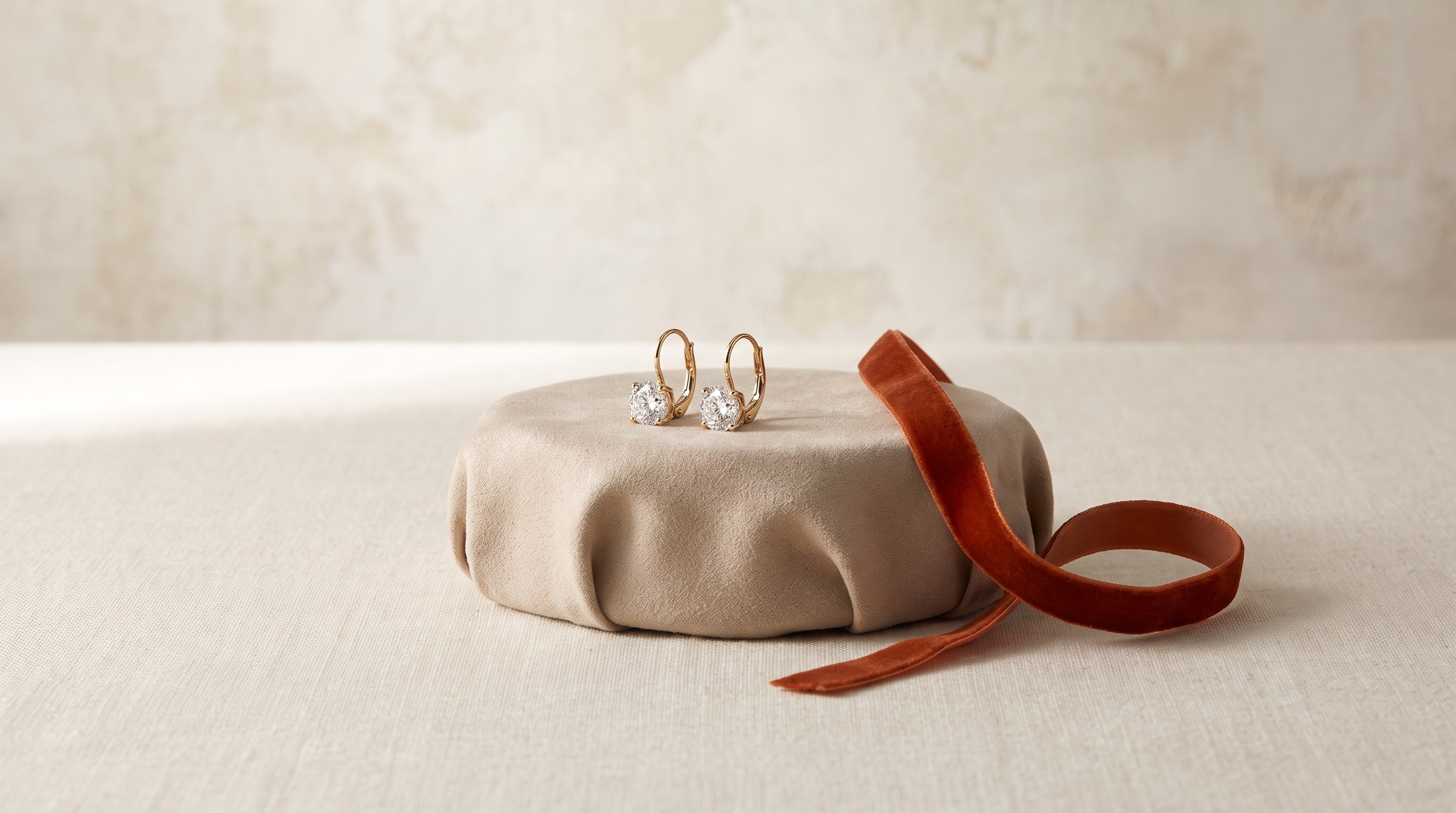
Lever-back diamond earrings use a hinged wire that swings down through the ear and locks into place against a curved arm, rather than a threaded screw or a friction-fit clutch, to hold the earring securely in place. For jewelers, lever backs are the standard mounting for drop and dangle earrings specifically — designs that hang below the earlobe and would swing or twist with a simple post-and-clutch mounting — because the hinge locks the earring's orientation in a way a plain post can't.
This guide covers how the lever-back mechanism is built, when to spec it over the alternatives, what drives cost in a wholesale build, what to check for quality, and how to think about stocking a lever-back program rather than one-off pairs — the mechanism turns up across drop earrings, dangles, and even hoops and huggies, so understanding it well pays off across more of a jeweler's case than any single style might suggest.
How a Lever-Back Mechanism Works
A lever-back earring has a hinged wire attached to the earring's top that passes through the ear and swings down, then locks against a curved metal arm running along the back of the earring's mounting. The customer opens the hinge, inserts the wire through the ear, and folds it closed against the arm, where it stays secured by spring tension in the hinge itself rather than by threading or friction. Because the wire is fixed to the earring's mounting at a specific point and locks in a specific closed position, the whole assembly — post, hinge, and drop — holds a consistent orientation once closed, which is the core reason lever backs are the default mounting for earrings that hang or dangle rather than sit flush against the lobe.
The hinge itself is typically a small spring-loaded mechanism built into the metal at the point where the wire meets the earring's top, and hinge quality is the single most important build detail in this category: a well-built hinge closes with a clean, positive snap and holds firmly under normal wear, while a poorly built one either loosens over time (letting the earring swing open unexpectedly) or becomes stiff and difficult to open and close without applying more force than the wire and hinge are rated for.
Why Jewelers Spec Lever Backs Over the Alternatives
| Backing Type | Best Suited For | Security Profile |
|---|---|---|
| Lever back | Drop, dangle, and hoop-adjacent designs where orientation matters | High — hinge locks orientation and resists accidental opening |
| Screw back | Studs carrying meaningful stone weight (0.50ct+ per ear) | High — threaded disc resists sliding off under normal wear |
| Friction (push) back | Lightweight studs and everyday-wear pieces | Moderate — relies on clutch tension alone |
A drop or dangle earring mounted on a simple post-and-clutch backing tends to swing and rotate unpredictably through the day, since nothing fixes the piece's orientation relative to the ear beyond the clutch's friction against the post. The lever-back's hinge solves this directly by locking the wire's angle once closed, keeping the drop hanging in its intended orientation through normal movement — which is why jewelers specify lever backs by default for any earring style with meaningful drop length or an asymmetric silhouette, rather than defaulting to friction backs across the whole earring case.
Lever Back vs. French Wire and Fishhook Backings
Lever backs are sometimes confused with French wire (fishhook) backings, which also use a curved wire through the ear, but the two mechanisms behave very differently in practice. A French wire backing has no locking hinge — the wire simply hooks through the ear and relies on the earring's own weight and the wire's curve to stay in place, which works for lightweight designs but offers meaningfully less security than a lever back's spring-locked hinge. Jewelers building a higher-value drop earring line, or any design intended for active daily wear rather than occasional dress-up use, should specify a true lever back rather than a French wire mounting specifically for the added security the locking hinge provides.
Construction and Metal Considerations
The lever-back wire and hinge are typically built in 14k or 18k gold or platinum, matched to the earring's head metal, with the wire itself needing enough spring temper to close with a firm, reliable snap without becoming brittle over repeated use. Because the hinge is a moving mechanical part rather than a static setting, it's more prone to wear-related failure over years of use than a plain post, which makes hinge metal quality and manufacturing tolerance a more important cost and durability lever in this category than it is for simpler backing types.
What Drives Cost in a Lever-Back Build
Lever-back mechanisms carry a modest labor premium over simple friction backs, since the hinge itself is a small precision-manufactured component rather than a stamped or cast simple post, and that premium is a fixed per-pair cost largely independent of the drop earring's overall design or stone content. Retailers evaluating a wholesale quote should confirm whether the lever-back hardware is priced as a separate line item or bundled into the overall per-pair price, since a bundled quote makes it harder to isolate where cost is coming from when comparing two otherwise similar drop earring designs from different suppliers.
Diamond Content and Setting Styles Common to Lever-Back Designs
Diamond-Set Drop
A line of melee or a small cluster set along a drop element suspended below the lever-back hinge, with the diamond content sitting entirely below the ear rather than at the mounting point itself.
Diamond-Accented Hinge Top
A small accent stone or pavé cluster set at the earring's top, near the hinge, in addition to a diamond drop below — giving continuous sparkle from the earlobe down through the full length of the piece.
Hoop-Style Lever Back
Small diamond hoops that use a lever-back closure instead of a traditional hoop's own snap-closure wire, offering the same secure, orientation-locked wear with a hoop's circular silhouette rather than a vertical drop.
Certification Approach
As with most earring categories built around melee-set drops, the diamonds along a lever-back drop typically ship as graded parcel goods against a stated commercial standard, commonly DEF+/VS+, following standard matched-pair melee practice. A design with a single larger feature stone at the drop's terminus or at the hinge top can have that specific stone individually certified through IGI, GIA, or GCAL if it's 0.30ct or above, with the surrounding melee still following the standard parcel-grading approach. Because lever-back drops are worn as a matched pair, consistent color and size matching across the two earrings' melee is at least as important to the finished look as any single stone's individual grade.
Natural vs. Lab-Grown Diamonds for Lever-Back Earrings
Lever-back drop and dangle designs vary widely in total carat weight depending on drop length and pavé density, so the dollar impact of choosing CVD lab-grown over natural melee scales with the specific design rather than following a single fixed pattern for the category. Lab-grown material remains the more common choice across accessible and mid-tier drop earring price points for the same reason it dominates most melee-driven categories — it lets a retailer offer a fuller, more finished-looking design at a price point that fits typical gifting and everyday-wear budgets for this segment.
What to Ask a Supplier When Sourcing Lever-Back Earrings
- Is hinge tension independently tested across a production run, and what's the supplier's stated failure rate or warranty policy on the hinge mechanism specifically?
- Is the lever-back wire priced as a separate hardware line item or bundled into the overall per-pair price, so cost drivers can be isolated when comparing quotes?
- Can the supplier match melee consistently across both earrings in a pair, given that lever-back drops are worn and evaluated as a matched set?
- What gold or platinum karat is used for the hinge and wire specifically, since hinge longevity depends more on this than on the head metal's karat alone?
Quality Checks Before Stocking a Lever-Back Program
Before committing to a wholesale order, a retailer should physically open and close the hinge on a sample pair repeatedly to confirm it snaps firmly closed without excessive force and doesn't loosen noticeably after repeated cycles. The wire should sit flush against the ear's back without an uncomfortable gap or pressure point, and the hinge's closed position should hold the drop element hanging straight and centered rather than tilted, which would indicate the hinge is fixed at an incorrect angle relative to the drop's weight distribution. As with other mechanical-backing categories, checking a small sample from each production batch rather than relying solely on a single pre-production sample is the more reliable way to catch batch-level hinge inconsistencies before a shipment reaches the sales floor.
Comparing Lever Backs to Other Earring Backings for Sourcing Purposes
| Backing Type | Mechanism Complexity | Typical Price Premium |
|---|---|---|
| Friction (push) back | Low — simple clutch | None — baseline |
| Screw back | Moderate — threaded post and disc | Modest, for added stud security |
| Lever back | Moderate-high — spring-loaded hinge | Modest to moderate, for orientation-locking security |
The price premium for lever backs is generally comparable to or slightly above a screw-back mechanism, reflecting the similar precision-manufacturing requirement of a small moving mechanical part, though the specific premium varies by supplier and by how the hardware is priced relative to the overall design.
Repair and Warranty Considerations
Because the lever-back hinge is a moving mechanical part, it's the most likely point of eventual repair need in an otherwise well-built drop earring — a hinge that's loosened or lost tension after years of wear can typically be re-tensioned or replaced without affecting the earring's head or stones, provided the repair technician has access to matching wire stock. Retailers offering a lever-back program should confirm with their manufacturing partner whether replacement hinge components are available as a standalone repair part, since a design where the hinge is fused inseparably to the rest of the mounting turns a simple hinge repair into a full earring rebuild.
Hinge Placement and Drop Balance
Because a lever-back drop hangs from a fixed hinge point rather than swinging freely, the earring's overall weight distribution has to be planned relative to that hinge before manufacturing rather than adjusted afterward. A drop element that's too heavy relative to the hinge and wire's rated tolerance can gradually loosen the hinge's spring action over time, or, in the more immediate term, cause the finished earring to hang at a slightly forward or backward tilt rather than straight down. Manufacturers designing a new lever-back drop style should confirm the hinge and wire gauge specified are rated for the finished piece's actual weight, including any pavé or feature stone content, rather than using one standard hinge across every drop design regardless of how much weight it's expected to carry.
Lever-Back Earrings for Everyday vs. Occasion Wear
Lever backs sit in an unusual middle position in the earring category: secure enough for confident daily wear, unlike a simple French wire, but without the fully "locked in" feel of a screw back, which some customers specifically prefer for a piece they plan to wear all day without thinking about it. Retailers should position lever-back drop earrings accordingly in merchandising and sales conversations — as a secure, comfortable option for regular wear that also suits special-occasion dressing, rather than exclusively as either a delicate everyday piece or a rare special-occasion item, since the mechanism genuinely supports both use cases well.
Common Manufacturing Defects to Screen For
Beyond hinge tension and drop balance, a receiving inspection for lever-back earrings should check that the wire's finish is smooth where it passes through the ear, since a poorly finished or insufficiently polished wire can cause discomfort or irritation with regular wear in a way that isn't always obvious from a visual inspection alone. The hinge's closed position should also be checked for consistent closure force across a sample from each production batch — a hinge that closes with noticeably more or less force than the rest of the batch suggests a manufacturing tolerance issue that's likely to show up as a warranty claim once the piece reaches a customer's daily wear pattern.
Packaging and Point-of-Sale Presentation
Lever-back mechanisms are less immediately familiar to many customers than a simple push-back or screw-back, so a brief demonstration or a clear point-of-sale card showing how the hinge opens and closes helps reduce hesitation at the point of purchase and, more importantly, reduces the likelihood of a customer damaging the hinge by forcing it open incorrectly on their first few uses at home. Retailers who train sales staff to demonstrate the opening and closing motion directly, rather than assuming customers will intuitively understand a mechanism they may not have encountered before, see fewer early-wear damage claims tied to improper hinge handling.
Building a Lever-Back Earring Line Across Price Tiers
A well-built lever-back line typically spans a delicate single-stone or small-cluster drop for accessible everyday wear, a mid-tier design with a fuller melee-set drop, and a premium tier that adds a certified feature stone at the drop's terminus. Sourcing melee for the whole tier structure through one supplier relationship, as with other melee-driven categories, keeps grading and certification language consistent across every price point a customer might compare side by side, while also simplifying the matched-pair sourcing that lever-back drops depend on for a clean finished look.
Lever-Back Hoops and Small Huggies
Beyond drop and dangle designs, lever-back closures also appear on small diamond hoops and huggie-style earrings as an alternative to a hoop's own integrated snap-closure wire. This use case trades a small amount of the hoop's minimalist profile for a more secure, easier-to-operate closure, which is a reasonable tradeoff for a retailer's everyday-wear hoop line — customers who find a standard hoop's thin snap wire fiddly to operate one-handed often prefer a lever-back hoop specifically for the larger, easier-to-grip hinge mechanism, even on a design where security isn't the primary design driver the way it is for a longer drop.
Sourcing Considerations for a First Lever-Back Order
A retailer placing a first wholesale order in this category should request a physical sample of the exact hinge and wire gauge intended for production, not just a rendering or a sample of a similar but not identical prior design, since hinge feel and tension are difficult to evaluate accurately from a drawing or photo alone. It's also worth asking whether the supplier manufactures the hinge component in-house or sources it from a third-party findings supplier, since a manufacturer with in-house hinge production generally has more flexibility to adjust wire gauge or hinge tension to a specific design's weight requirements than one reselling a third party's standard findings catalog.
Men's Lever-Back Earrings
Lever-back mechanisms appear in men's diamond earring lines as well, typically on single-stud or small drop designs where a customer wants the added security of a locking closure without the more overt, always-visible profile of a screw back's disc sitting flush against the lobe. Retailers building a men's earring assortment should consider offering a lever-back option alongside standard friction and screw-back studs specifically for customers who've expressed a preference for a more secure, easy-to-operate closure over the category's more common backing types.
Frequently Asked Questions
What is a lever-back earring?
An earring backing that uses a hinged wire, which swings down through the ear and locks against a curved arm on the earring's mounting, rather than a threaded screw or a simple friction clutch — commonly used for drop and dangle earring designs.
Why are lever backs used for drop earrings specifically?
The hinge locks the wire's angle once closed, keeping a drop or dangle design hanging in its intended orientation through normal movement — a plain post-and-clutch mounting doesn't fix orientation the same way and lets the piece swing or twist unpredictably.
Is a lever back the same as a French wire (fishhook) back?
No. A French wire hooks through the ear with no locking mechanism, relying on the earring's weight and the wire's curve to stay in place. A lever back has a spring-loaded hinge that locks closed, offering meaningfully more security for drop and dangle designs worn through a full day.
Are lever-back earrings more expensive than screw-back or friction-back earrings?
Lever backs carry a modest labor premium over simple friction backs, generally comparable to a screw-back mechanism, reflecting the precision manufacturing required for the small hinge component.
Can a lever-back hinge be repaired if it wears out?
Yes, in most cases — a hinge that's lost tension can typically be re-tensioned or replaced without affecting the rest of the earring, provided the manufacturer or repair technician has access to matching hinge and wire stock for that specific design.
Should lever-back earring diamonds be lab-grown or natural?
Either works well; lab-grown melee is more common at accessible and mid-tier price points since it lets a retailer offer a fuller-looking drop design within typical gifting and everyday-wear budgets for this category.
Are lever backs suitable for hoops as well as drop earrings?
Yes — small diamond hoops and huggies sometimes use a lever-back closure instead of a hoop's own snap-closure wire, trading a small amount of minimalist profile for an easier, more secure closure that some customers prefer.
Sourcing Diamonds for a Lever-Back Earring Line Wholesale
Guru Diam supplies calibrated CVD lab-grown and natural melee matched-pair sets for lever-back drop and dangle earring construction, alongside loose feature stones for premium-tier designs, with IGI, GIA, and GCAL certification available at 0.30ct and above. Trade buyers can review current melee and matched-pair inventory through matching pairs and certified diamonds, and work with Guru Diam's custom jewelry team on hinge and hardware specifications through custom jewelry. In-stock inventory ships same-day from Guru Diam's New York and Los Angeles locations. New trade accounts can apply through trade partner, with current terms available at the wholesale hub. For related sourcing fundamentals, see our screw-back diamond earrings guide and diamond drop earrings guide.
Guru Diam is a trade-only wholesale diamond supplier with locations in New York and Los Angeles, supplying calibrated CVD lab-grown and natural melee alongside certified loose diamonds, with IGI, GIA, and GCAL certification available, for jewelers building earring and finished jewelry lines. Browse current inventory in matching pairs or apply for a trade account through trade partner.