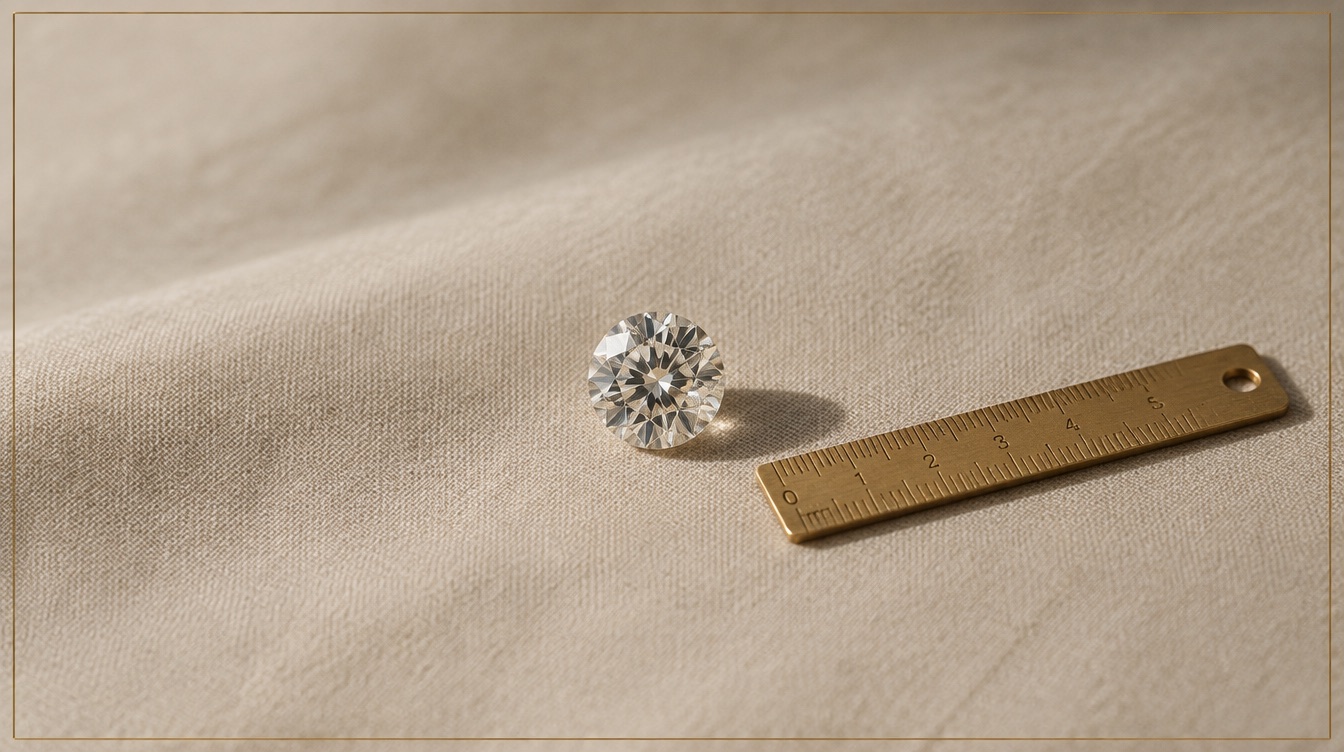
A lab-grown diamond's cost per carat is not a fixed number — it's a starting reference point that moves sharply based on carat weight, cut, color, clarity, shape, and certification, and it has also fallen substantially in absolute terms over the past several years as CVD production has scaled. As a rough anchor, wholesale per-carat pricing for a well-cut, eye-clean, near-colorless CVD diamond in the most common bridal sizes runs a small fraction of an equivalent natural stone's per-carat price, and that gap widens further at larger carat weights. This guide breaks down what actually drives lab-grown diamond cost per carat, how it differs across carat tiers, why the "per carat" framing can be misleading on its own, and how a wholesale buyer should use per-carat pricing as a tool rather than a single lookup number.
"How much do lab-grown diamonds cost per carat" is one of the most common pricing questions in the trade, but it's also one of the easiest to answer badly — a single number thrown out without context (carat weight, quality tier, shape) is close to meaningless, because per-carat price scales non-linearly and quality-tier price gaps can be larger than carat-weight price gaps. This guide is meant to give a buyer or retailer a genuinely useful framework: real per-carat price ranges by carat tier, an explanation of why the "price per carat" number isn't flat even for the same weight of stone, and what to actually ask a supplier for instead of a bare per-carat quote.
Why "Price Per Carat" Isn't One Number
Diamond pricing has always been quoted on a per-carat basis rather than a flat per-stone price, which makes sense for comparing stones of different weights — but it creates a common misunderstanding: buyers assume a "$X per carat" figure should scale linearly, so a 2-carat stone should cost roughly twice a 1-carat stone's total price. In practice it almost never does. Larger, rarer combinations of carat weight and top-tier color/clarity command a higher per-carat rate than smaller stones of the same quality, because supply of larger rough (or, for lab-grown, larger clean crystal growth runs) is thinner and demand at bridal center-stone weights is concentrated. This is true for both natural and lab-grown diamonds, though the effect is more muted in lab-grown because production scales more predictably than natural rarity does.
How Lab-Grown Diamond Cost Per Carat Has Changed Over Time
CVD lab-grown diamond pricing has fallen substantially since wholesale-scale production ramped up, driven by more growth chambers coming online, faster and more reliable growth cycles, and increasing competition among growers. A carat weight and quality combination that priced at a meaningful premium several years ago now often prices at a fraction of that figure, and the decline has been steepest in the most commoditized categories — round brilliants in common bridal sizes and standard color/clarity grades. This is the single most important context for any per-carat cost question: a number quoted even a year or two ago is very likely stale, and buyers comparing lab-grown cost against older price references should expect today's real number to be meaningfully lower.
The Three Layers Behind a Lab-Grown Per-Carat Quote
A wholesale lab-grown per-carat price is built from three layers stacked together, and understanding each helps a buyer sanity-check a quote rather than just comparing bottom-line numbers:
- Production cost — the cost of growing the rough crystal and then cutting and polishing it into a finished stone. This is the layer that has fallen fastest as growth technology has scaled and cutting workflows have become more efficient.
- Certification cost — IGI, GIA, or GCAL grading adds a roughly fixed per-stone fee regardless of the stone's own value, which is why certification represents a proportionally larger share of cost on smaller, lower-value stones than on larger ones.
- Trade margin — the supplier's markup, which is where genuine price differentiation between wholesalers actually shows up. A transparent, consistent margin across a catalog is a healthy sign; a margin that swings wildly stone to stone with no clear reason is worth questioning.
Guru Diam's diamonds are cut and polished in India before final grading and shipment from our New York and Los Angeles locations — a large part of why lab-grown production cost has room to keep falling even as growth-chamber costs stabilize is that cutting and finishing efficiency continues to improve alongside the growing side of the process, not despite it.
Illustrative Cost-Per-Carat Ranges by Carat Weight
These ranges are illustrative and directional, not a live price feed — actual quotes move with market conditions, exact quality grade, and shape, and a buyer should always confirm current pricing directly with a supplier rather than treating any published range as a locked number. What the table below is useful for is understanding the shape of the curve: how per-carat cost moves as carat weight increases, holding quality roughly constant at a common near-colorless, eye-clean bridal grade.
| Carat Weight | Relative Per-Carat Cost | Typical Buyer | Notes |
|---|---|---|---|
| Under 0.30ct (melee) | Lowest per-carat, parcel-priced | Setting programs, pavé, accent stones | Sold by parcel, not individually certified |
| 0.30ct – 0.99ct | Entry certified tier | Side stones, smaller centers | Certification cost is a larger share of total price at this size |
| 1.00ct – 1.99ct | Baseline bridal reference tier | Engagement ring centers, studs | Deepest inventory and most stable per-carat benchmarks |
| 2.00ct – 2.99ct | Meaningful step up per carat | Statement centers, upgrade purchases | Per-carat rate begins climbing faster than weight alone would suggest |
| 3.00ct – 4.99ct | Premium per-carat tier | Larger centers, showcase pieces | Thinner inventory; sourced-to-order more often than stocked |
| 5.00ct+ | Specialty per-carat tier | Investment-grade and showcase pieces | Quoted individually rather than from a standing price list |
How the 4Cs Move the Per-Carat Number at a Fixed Weight
Even at the same carat weight, per-carat price can vary by a wide margin depending on color, clarity, and cut grade. A D-color, VVS-clarity, excellent-cut round brilliant at 1 carat prices well above a J-color, SI2-clarity stone of the identical weight — the carat number is only the starting reference, not the price itself. Cut grade in particular has an outsized effect relative to how often it's discounted by buyers shopping on price alone: a poorly cut stone can look smaller and duller than its carat weight suggests, which is a false economy even when the per-carat number looks attractive.
Shape and Its Effect on Cost Per Carat
Round brilliant is the most efficient shape to cut from rough or from a grown crystal, which keeps round brilliant per-carat pricing at the low end of the shape spectrum. Fancy shapes — oval, pear, cushion, emerald, marquise — carry a modest premium because more of the growth material is lost to faceting waste and because cutting a clean, well-proportioned fancy shape takes more skilled labor per stone. Antique cuts — Old Mine, Old European, Trillion, Kite, Hexagonal, and similar true antique-style cuts — sit at the premium end of the shape spectrum because far fewer cutters are trained in the specific faceting patterns these cuts require, and inventory depth is inherently thinner than for standard modern shapes.
Fluorescence and Its Small But Real Effect on Price
Strong blue fluorescence typically prices at a modest discount relative to an otherwise identical stone with no fluorescence, because a segment of buyers prefer to avoid it even though it's rarely visible to the naked eye at most color grades. This is a smaller lever than carat, color, clarity, or cut, but it's worth knowing about specifically because it can make an otherwise premium stone available at a meaningfully lower per-carat cost without any visible tradeoff for most buyers.
Lab-Grown vs. Natural: The Per-Carat Gap
The per-carat cost gap between lab-grown and natural diamonds of comparable quality remains substantial, and it has widened rather than narrowed as lab-grown production cost has continued to fall while natural diamond supply constraints have kept natural pricing comparatively stable. This gap is largest at bigger carat weights, where natural rarity compounds most strongly, and smallest at melee sizes, where natural supply is relatively more abundant. Buyers building a mixed natural-and-lab-grown program should expect the per-carat comparison to shift meaningfully depending on the exact size and quality tier being compared, not to hold at one fixed ratio across the board.
Why a Bare Per-Carat Quote Can Be Misleading
A supplier quoting "$X per carat" without specifying the exact carat weight, color, clarity, cut grade, shape, and certifying lab is giving a number that can't actually be compared against another supplier's quote for a different stone. Two stones both quoted "per carat" at the same headline number can end up at very different total prices once carat weight is applied, and two "1 carat" stones at the same total price can carry very different quality specs. The only useful comparison is stone-to-stone on a full, matched spec sheet — carat, color, clarity, cut, shape, fluorescence, and lab — not headline per-carat rate alone.
What to Ask a Supplier Instead of "What's Your Per-Carat Price"
A more useful question set for a wholesale buyer is: what's the per-carat price at this specific carat weight, color, and clarity combination; is that price for round brilliant or does shape change it; which lab issues the certificate; and is there a visible discrepancy between the stated grade and how the stone actually presents under a loupe. A supplier who can answer all of these clearly and consistently, stone to stone, is giving a real quote rather than a marketing number.
Buying in Parcels vs. Individually Certified Stones
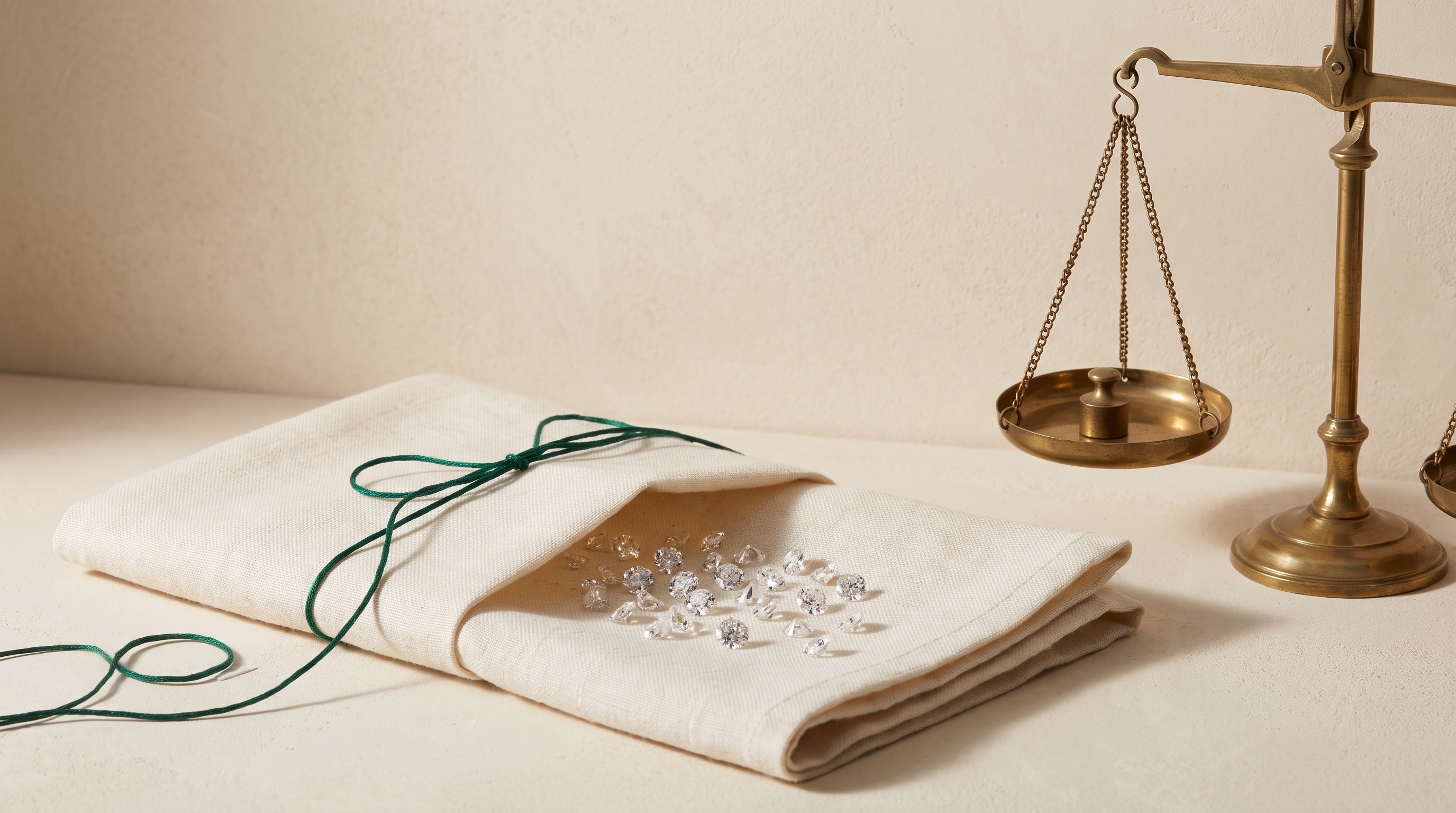
Melee-sized lab-grown diamonds under roughly 0.30ct are typically sold as uncertified parcels against a quality control baseline (commonly DEF+/VS+) rather than individually certified and priced per stone. Parcel pricing is quoted per carat for the whole parcel rather than per individual stone, which changes how "cost per carat" should be interpreted at that size range — it's describing an average across many stones, not a single graded stone's price.
Common Mistakes When Comparing Cost Per Carat
The most common mistake is treating a single per-carat figure pulled from an old reference, a competitor's marketing page, or a general web search as current and applicable to a specific stone. A close second is comparing per-carat price across different shapes without adjusting for the shape premium or discount involved. A third is ignoring certification lab differences — a per-carat price built around a less widely recognized lab's grading standard isn't directly comparable to one built around GIA, IGI, or GCAL grading, even at the same nominal grade.
Reading a Wholesale Quote Sheet Line by Line
A proper wholesale quote sheet lists each stone with carat weight, shape, color, clarity, cut grade, fluorescence, certifying lab and report number, and the per-carat and total price side by side. When a supplier sends a quote that's missing any of these fields — most commonly fluorescence or the exact cut grade — it's worth asking for the complete spec before comparing the price against anything else, because a missing field is often hiding the exact detail that explains why a price looks unusually low or high. A complete quote sheet also lets a buyer sort a batch of stones by true per-carat cost efficiency rather than by total price alone, which matters most when building out a multi-stone order across several sizes at once.
How Order Volume Affects Per-Carat Pricing
Wholesale per-carat pricing typically improves modestly with order volume and with standing account status, though the effect is smaller than many first-time buyers expect — a single stone and a ten-stone order of the same spec usually price within a narrow band of each other, because certification and cutting costs don't scale down meaningfully at small volumes. Where volume genuinely moves the per-carat number is in melee parcels, where a supplier buying a full standard parcel size gets a better blended rate than a buyer requesting a small custom cut from a larger parcel, and in recurring-account pricing, where a jeweler placing regular orders over time can negotiate a standing discount off list that a one-time buyer typically can't access on a first order.
Seasonal and Market-Wide Price Movement
Lab-grown per-carat cost doesn't move in a straight line down — it responds to broader market conditions including new grower capacity coming online, shifts in raw material and energy costs for growth chambers, and demand cycles tied to bridal season and major trade shows. A buyer locking in pricing ahead of a known demand spike, or timing a larger purchase around a period of new capacity entering the market, can capture a meaningfully better per-carat rate than buying reactively. This is a secondary factor next to the 4Cs and carat weight, but it explains why the same spec stone can quote differently by a noticeable margin at two different points in the same year.
Per-Carat Cost for Fancy Color Lab-Grown Diamonds
Fancy color lab-grown diamonds — yellow, pink, blue, and green — price on a different per-carat curve than colorless stones, driven by the color-treatment or color-inducing growth process rather than the standard D-to-Z color scale. Depth and evenness of color saturation move price more than carat weight alone at this end of the category, and per-carat cost for a strong, even fancy color can exceed a colorless stone of the same carat weight even though production volume for fancy color is smaller. A buyer sourcing fancy color inventory should expect per-carat benchmarking to work differently than it does for standard white diamonds, and should ask specifically about color grading methodology rather than assuming the standard color scale applies.
Why Published Price Lists Go Stale Quickly
Any printed or posted lab-grown price list — including illustrative ranges like the ones in this guide — represents a snapshot, not a live feed, and lab-grown per-carat cost has historically moved enough within a single quarter that a list more than a few months old should be treated as directional rather than authoritative. The most reliable way to work with current pricing is a dated quote pulled directly from a supplier at the time of a specific order, cross-checked against at least one other supplier's current quote for the same spec, rather than a bookmarked reference page.
Sourcing Lab-Grown Diamonds at Wholesale Through Guru Diam
Guru Diam supplies CVD lab-grown diamonds across the full carat range — melee through investment-grade sizes — plus antique and regular fancy cuts, natural diamonds, certified loose stones, and finished jewelry, all backed by IGI, GIA, and GCAL certification depending on the stone. Same-day shipping applies to in-stock inventory ordered before 6pm EST from New York or 4pm PST from Los Angeles, and custom engagement rings are finished in 4–6 days. Buyers building or refreshing a per-carat price benchmark should request a current, dated quote sheet rather than relying on any published range, including this one, since lab-grown pricing continues to move.
Building a Per-Carat Benchmark for Your Own Buying Program
A jeweler or designer buying lab-grown diamonds regularly benefits from keeping a simple internal benchmark sheet — current per-carat cost at the two or three carat weights and quality tiers ordered most often, refreshed at least quarterly — rather than re-negotiating from scratch on every order or relying on memory of a past quote. This turns "is this a good price" from a guess into a quick comparison against a buyer's own recent, real purchase history, which is a far more reliable reference than any published industry range, including the one in this guide. Suppliers who are transparent about how their per-carat pricing is structured, and who don't resist a buyer keeping this kind of internal record, are generally the ones worth building a recurring relationship with.
Frequently Asked Questions
How much does a 1 carat lab-grown diamond cost per carat?
It depends heavily on color, clarity, cut grade, and shape, but 1 carat sits at the deepest-inventory bridal benchmark size, which generally gives it the most stable and competitive per-carat pricing across the carat range. See Guru Diam's dedicated 1 carat lab-grown diamond price guide for a full breakdown by quality tier.
Why do larger lab-grown diamonds cost more per carat, not just more in total?
Larger clean crystal growth runs are less abundant than smaller ones, and certification, cutting precision, and market demand for statement-size centers all concentrate at bigger weights, pushing the per-carat rate up rather than keeping it flat as weight increases.
Is lab-grown diamond cost per carat still falling?
Yes, generally — production efficiency has continued to improve as more growers and larger-scale facilities have come online, and that trend has kept per-carat cost trending down over the past several years, though the pace of decline varies by carat weight and quality tier.
Does shape affect lab-grown diamond cost per carat?
Yes. Round brilliant is typically the least expensive per carat because it's the most efficient shape to cut with the least material loss. Fancy shapes carry a modest premium, and true antique cuts like Old Mine, Old European, and Trillion carry a larger premium due to specialized cutting skill and thinner inventory.
How does lab-grown cost per carat compare to natural diamond cost per carat?
Lab-grown diamonds price well below natural diamonds of comparable carat weight and quality, and the gap widens at larger carat weights where natural rarity has the biggest effect on price. The exact ratio varies by size and quality tier rather than holding at one fixed multiple.
Why do two suppliers quote different per-carat prices for a "1 carat lab-grown diamond"?
Unless the full spec — exact carat weight, color, clarity, cut grade, shape, fluorescence, and certifying lab — matches exactly, two "1 carat" quotes aren't actually describing the same stone, so a price difference usually reflects a quality or certification difference rather than one supplier simply being cheaper.
Related Reading
For deeper dives into specific carat weights, see Guru Diam's 1 carat, 2 carat, and 3 carat lab-grown diamond price guides, or the broader wholesale lab-grown diamonds guide for supplier-evaluation guidance and how diamond pricing actually works for the mechanics behind any diamond price, natural or lab-grown.
Explore Guru Diam's certified diamonds and wholesale hub, or learn more about our trade partner program and custom jewelry services.