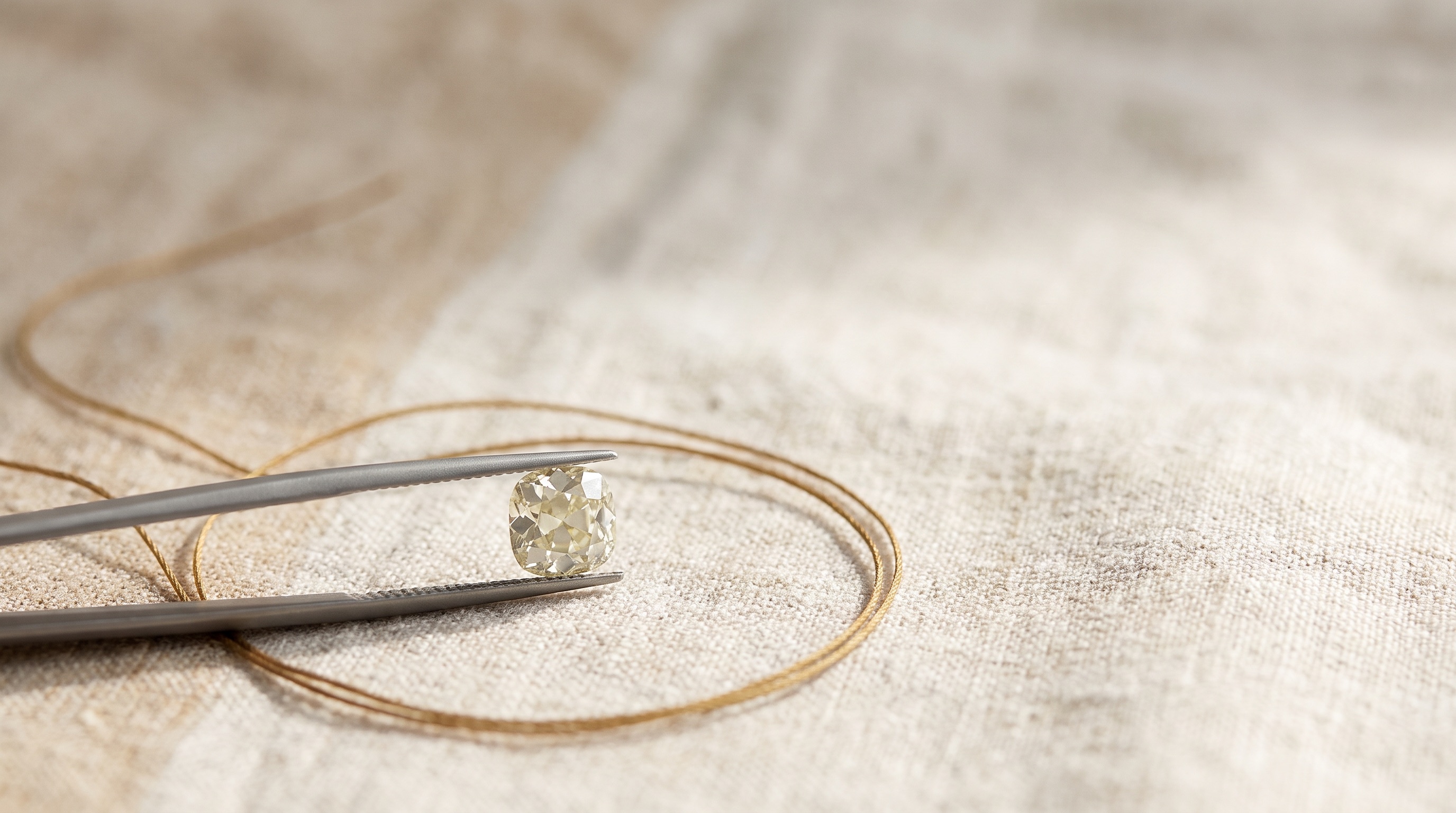
J color is a near-colorless diamond grade on the GIA scale, sitting at the warmer end of the near-colorless range (G-J) just before color becomes noticeable to most unaided eyes. A J color diamond has a faint, detectable warmth — typically a light yellow or brown tint — that's usually only visible when compared directly against a whiter stone, especially in larger sizes or in a yellow-gold setting where the warm tint blends in rather than standing out. It's one of the most consistently recommended "smart value" color grades in the trade, because the price drop from G or H down to J is substantial while the visible difference, in the right setting and shape, is often minor.
Where J Color Sits on the GIA Scale
| Range | Grades | Description |
|---|---|---|
| Colorless | D, E, F | No detectable color, even to a trained grader without a comparison stone |
| Near-colorless | G, H, I, J | Color is present but difficult to detect unless compared side by side with a higher grade; J is the warmest grade in this range |
| Faint | K, L, M | Faint yellow or brown tint becomes noticeable, especially in larger stones |
| Very Light | N-R | Light color clearly visible to the naked eye |
| Light | S-Z | Noticeable color throughout; beyond Z, stones are graded as fancy color |
J is deliberately positioned at the bottom edge of the near-colorless category rather than the top of the faint category, and that placement matters in practice: J diamonds are graded by GIA as still belonging to the "looks white in normal viewing conditions" tier, even though it's the warmest grade that still earns that classification. One step down, at K, most graders and buyers agree the tint becomes more readily apparent without a side-by-side comparison stone.
What J Color Actually Looks Like
Color grading happens by comparing a stone face-down against a set of master stones under controlled lighting — a process specifically designed to catch differences that are much harder to see once a diamond is set and viewed face-up in normal light. This is the most important practical fact about J color: face-up, in a mounted setting, under everyday lighting, a J color diamond typically looks white or very close to white on its own. The warmth becomes apparent mainly in three situations: direct side-by-side comparison against a colorless (D-F) or higher near-colorless (G-H) stone; larger carat sizes, where more material means more visible body color; and certain fancy shapes — particularly emerald, asscher, and other step cuts — that show color more readily than brilliant cuts do, for the same optical reasons they show clarity inclusions more readily.
Settings That Help (and Settings That Don't)
The metal a J color diamond is set in has a real, well-documented effect on how its warmth reads:
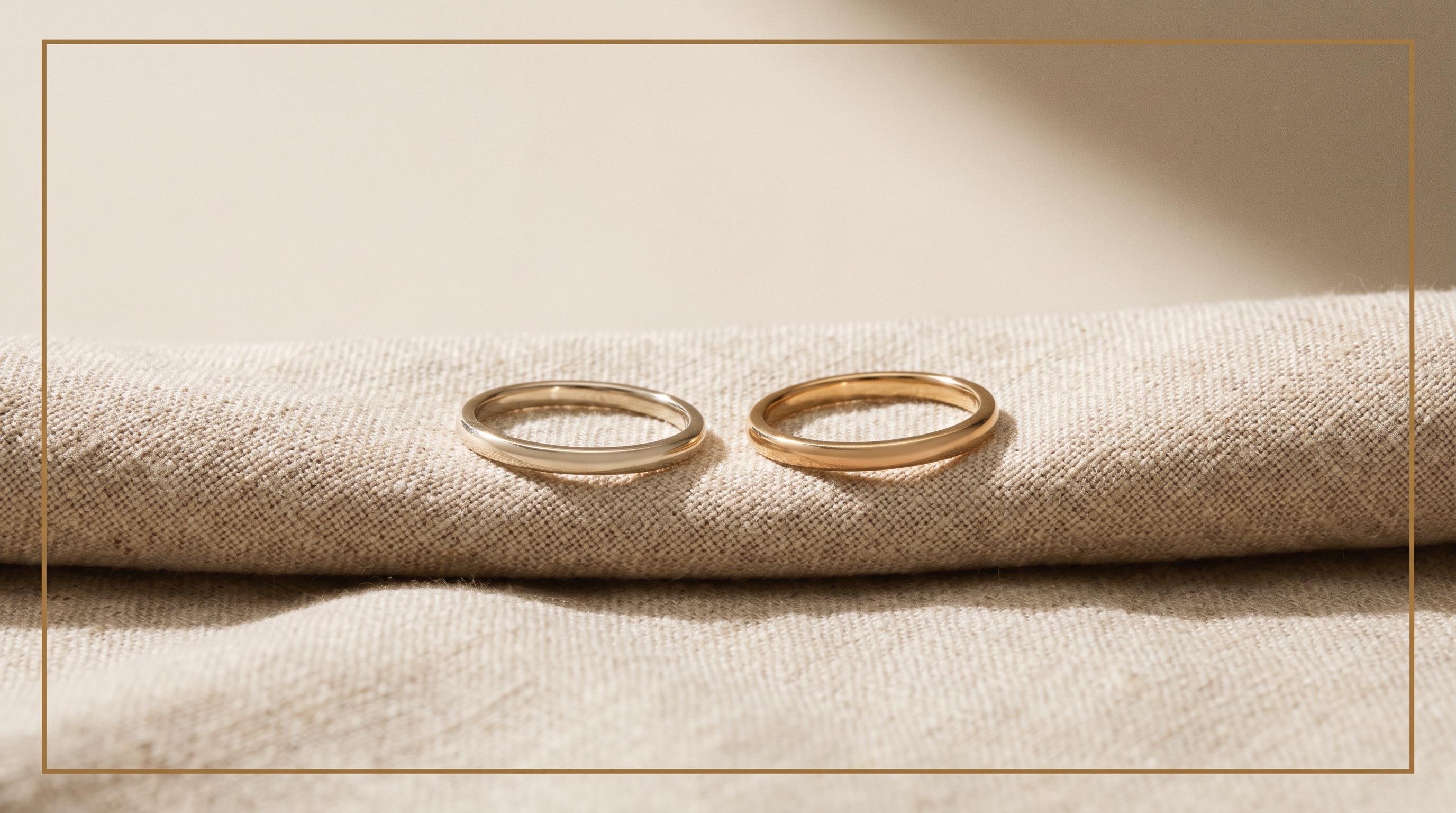
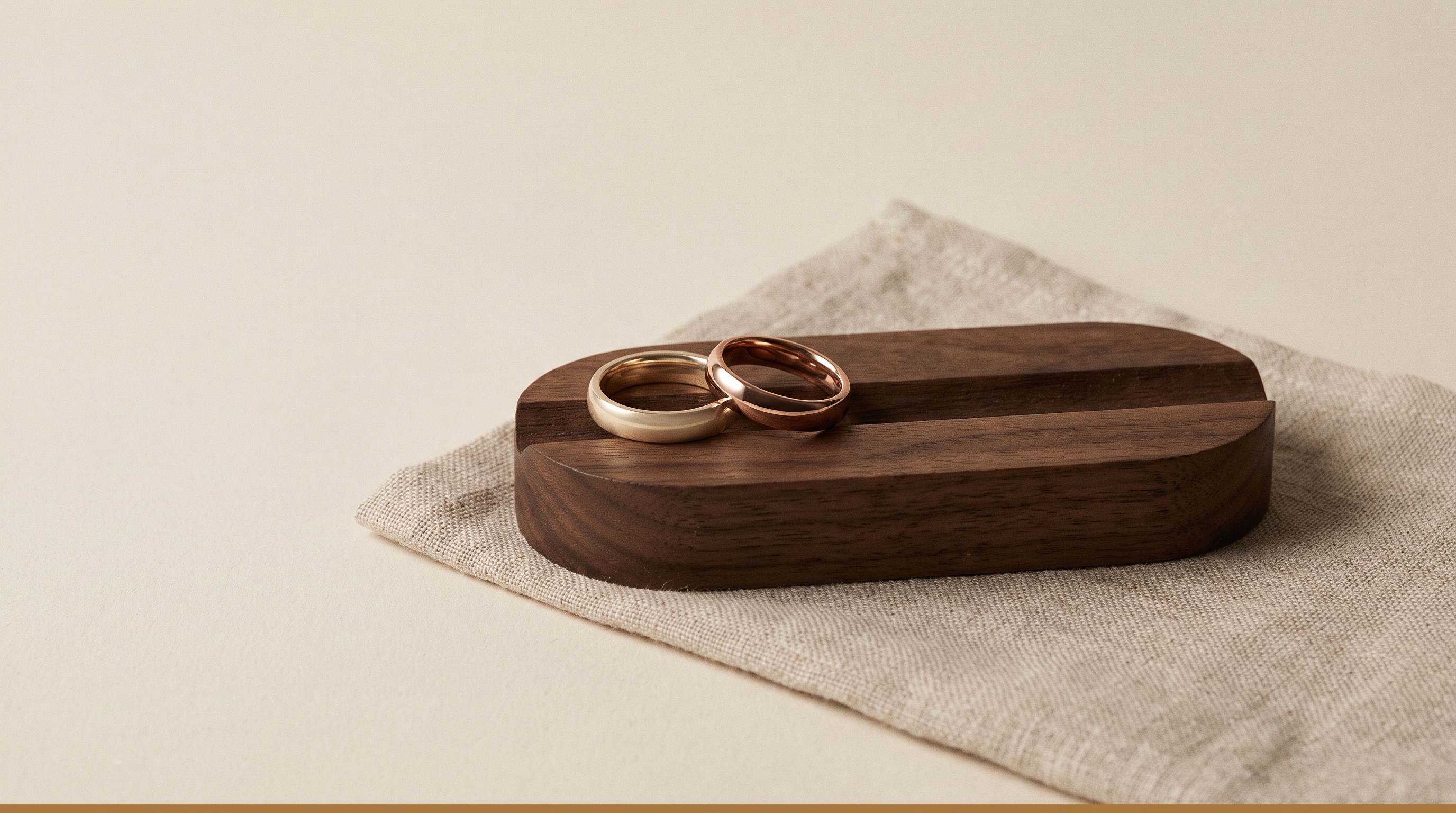
- Yellow gold and rose gold are the most flattering settings for J color. The warm metal tone reflects into the stone and blends with its own slight warmth, making the color grade far less noticeable — this is precisely why J and even lower grades were the traditional default for yellow gold jewelry for decades before white metal settings became more dominant.
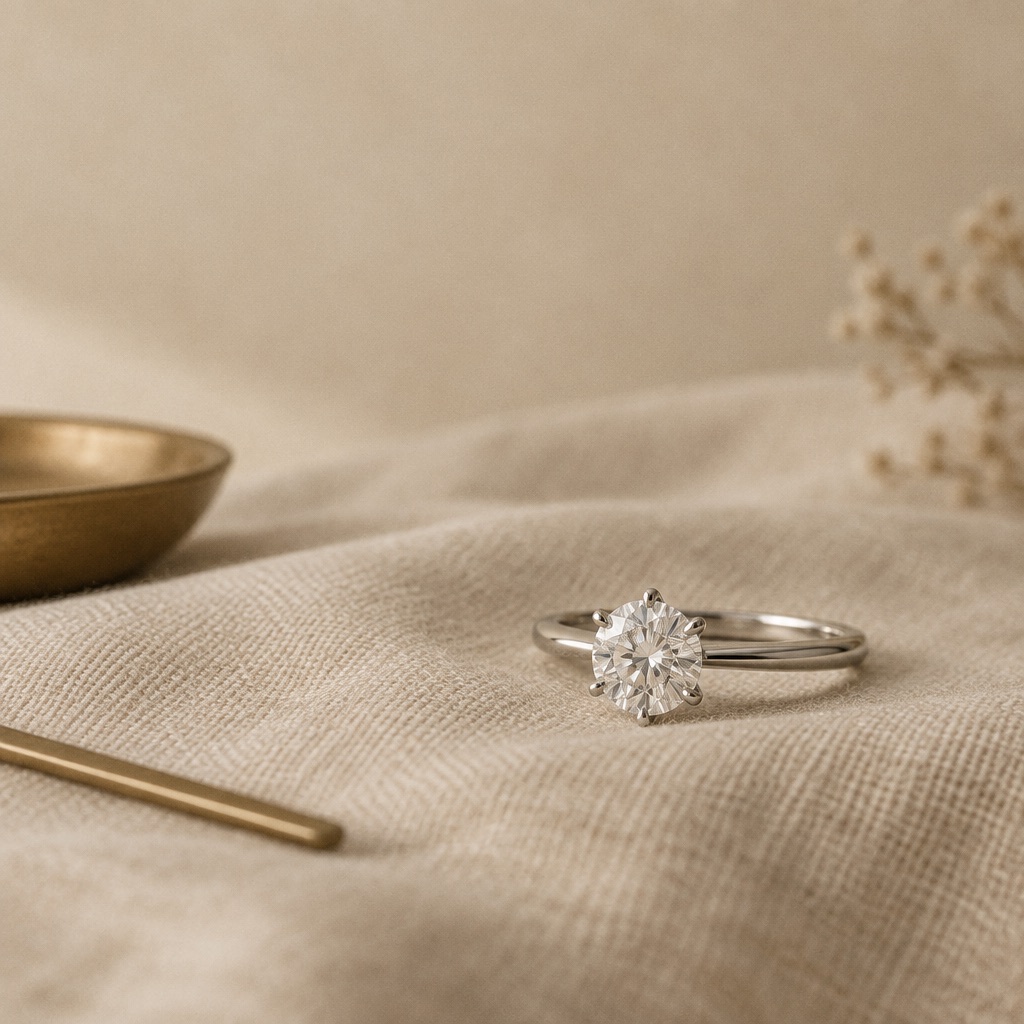
- White gold and platinum create more contrast against a warmer stone, since the cool-toned metal doesn't share any of the diamond's tint. J color is still generally acceptable in white settings for most buyers, but the color becomes somewhat more noticeable than it would in yellow or rose gold, particularly around the setting's edge where metal and stone meet directly.
- Halo settings using smaller white melee around a J color center stone can either help or hurt depending on the melee's own color grade — pairing J with much whiter melee can actually make the center stone's warmth more apparent by contrast, so matching or closely coordinating melee color to the center stone is worth considering specifically for J color pieces in a white metal halo.
J Color vs. Higher Near-Colorless Grades
| Grade | Face-up appearance | Best setting | Value position |
|---|---|---|---|
| G | Colorless in virtually all conditions | Any metal, including white gold and platinum | Premium |
| H | Near-colorless, very safe default | Any metal | Strong value |
| I | Near-colorless; minor warmth possible in larger stones | Any metal, slight preference for warm tones at larger sizes | Better value |
| J | Near-colorless with faint detectable warmth | Yellow or rose gold strongly recommended; white metal workable | Best value in the near-colorless range |
Carat Size and J Color: Why Bigger Stones Show More Warmth
Color is a body characteristic — light travels through more diamond material in a larger stone, which means any tint present has a longer path to accumulate visible color before reaching the eye. A 0.30ct J color diamond and a 3.00ct J color diamond carry the identical grade, but the larger stone will show noticeably more warmth in practice, simply because there's more material for the tint to express through. This is the single most important scaling factor to communicate to a client considering J color for a larger center stone: the grade that looked perfectly fine in a friend's 0.75ct ring may read distinctly warmer in a 2.5ct stone of the same technical grade.
| Carat range | J color experience |
|---|---|
| Under 0.75ct | Warmth is subtle, often not noticeable without direct comparison; safe across most settings |
| 0.75-1.50ct | Warmth becomes somewhat more apparent; yellow or rose gold setting recommended |
| 1.50-3.00ct | Warmth is more readily visible face-up; strongly consider warm-tone metal or moving up to grade I or H |
| 3.00ct+ | Color becomes a primary visual factor at this size; J may read closer to the faint (K-M) range in practice |
J Color vs. Fluorescence: A Related Consideration
Fluorescence — a stone's tendency to emit a soft glow under UV light — has an occasionally useful interaction with warmer color grades. Strong or very strong blue fluorescence can, in some stones, make a warmer color grade appear slightly whiter face-up in daylight or UV-rich lighting, since the blue glow can visually offset yellow body color. This effect is inconsistent and depends heavily on the individual stone — it isn't a reliable strategy on its own — but it's worth knowing about when evaluating a specific J color stone that also happens to carry strong fluorescence, since the combination can occasionally outperform what the color grade alone would suggest.
Is J Color Diamond Good for an Engagement Ring?
For the right setting and size, yes, genuinely. J color's reputation as a smart-value grade isn't a compromise framing — in a yellow or rose gold setting, under roughly 1.5 carats, in a brilliant cut shape, a J color diamond reads as a clean, attractive white stone to the vast majority of viewers, including the wearer. The savings compared to G or H color are substantial enough to meaningfully upgrade carat weight, cut quality, or clarity elsewhere in the purchase — trade-offs that often have a bigger visible impact on the finished piece than the last increment of color grade does. Where J becomes a genuinely riskier choice is in a white metal setting with a large center stone in a step-cut shape — that specific combination is where J's warmth is most likely to become a source of buyer's remorse.
J Color in Lab-Grown vs. Natural Diamonds
Color grading methodology and the D-to-Z scale are identical between CVD lab-grown and natural diamonds, applied by the same major labs using the same master stone comparison process. J color lab-grown diamonds are graded to the same standard as natural J color stones, and the buying guidance above — favor warm-tone settings, be more cautious at larger sizes and in step cuts — applies equally to both.
A Practical Framework for Recommending J Color
For jewelers advising clients on where color grade fits into their budget, J color earns a strong recommendation specifically when: the setting is yellow or rose gold, the shape is a brilliant cut rather than a step cut, and the carat weight is under roughly 1.5 carats. Outside that combination — white metal, step cuts, or larger stones — moving up to grade I or H buys more real, visible insurance against noticeable warmth. This mirrors the same logic used for clarity grade recommendations: match the grade floor to the specific shape, size, and setting combination in front of you, rather than applying one fixed color recommendation to every commission regardless of context.
Common Misconceptions About J Color
- "J color always looks yellow." In the right setting and size, J reads as a clean white stone to most viewers — the warmth is faint, not obvious, which is exactly why it remains in the near-colorless category rather than the faint category.
- "Color grade matters more than cut for how white a diamond looks." Cut quality has a significant effect on perceived brightness and can make a well-cut J look livelier and whiter-reading than a poorly cut grade higher up the scale — color and cut interact, they don't operate independently.
- "All J color stones look identical." Color grading, like clarity grading, involves professional judgment within a defined range — two J color stones can sit at slightly different points within that range, and individual comparison against master stones or against each other can reveal subtle differences a spec sheet alone won't show.
How Color Grading Actually Works
GIA color grading is performed by trained graders comparing an unmounted diamond, viewed table-down, against a set of master stones with known, verified color grades, under controlled daylight-equivalent lighting. This face-down, unmounted viewing condition is deliberately the most revealing way to assess color — it's also exactly why a diamond's grading-condition appearance and its real-world, face-up, mounted appearance can differ meaningfully. Master stones anchor each grade boundary, and a grader determines where a candidate stone falls by direct comparison, often needing to distinguish between grades that are only subtly different from each other even under ideal viewing conditions. Reputable labs — GIA, IGI, and GCAL among them — typically use more than one grader to reach a consensus on borderline stones, which is part of why a certified color grade carries more trust in the trade than an uncertified seller's own assessment.
It's worth understanding that color grading captures body color specifically — the diamond's own tint — separate from fluorescence, which is graded and reported independently even though the two occasionally interact visually, as covered above. A grading report lists color and fluorescence as separate fields precisely because they're independent characteristics that happen to sometimes influence how a stone reads together.
Why J Sits Where It Does: The Near-Colorless Boundary
The near-colorless range (G-J) exists as a deliberate middle category between colorless (D-F) and faint (K-M) precisely because color perception isn't a hard cutoff — it's a gradient, and graders needed workable category boundaries within that gradient. J earns its place at the bottom of near-colorless rather than the top of faint because, under standard face-up viewing without a direct comparison stone, its warmth remains subtle enough that most observers still perceive the stone as "white" rather than "tinted." This is a meaningfully different practical claim than saying J has no visible color at all — it has detectable color under grading conditions, but that detection threshold is stricter than normal, everyday viewing conditions call for. Understanding this distinction is the key to explaining confidently to a client why a technically graded J color stone can still look like a clean white diamond once it's set and worn.
J Color and Cut Quality: A Bigger Lever Than Most Buyers Realize
Cut quality affects perceived color more than most buyers expect. A diamond cut to strong proportions returns more light back through the top of the stone, creating brightness and scintillation that can visually offset a warmer body color — sometimes described in the trade as a well-cut stone "reading whiter" than its technical grade. Conversely, a poorly cut stone, even at a colorless grade like F, can look duller and allow more of its color to become visible through a larger, less lively table facet. For a J color diamond specifically, prioritizing strong cut quality (an Excellent or Ideal cut grade, where available) does more to keep the stone looking bright and white than squeezing the color grade up by one more letter would. This is a genuinely useful piece of buying advice: when budget is limited, spending on cut quality before spending on color grade upgrades past J tends to deliver a better-looking finished stone for the money.
Comparing J Color Across Different Diamond Shapes
Beyond the general brilliant-versus-step-cut distinction already covered, some shapes handle J color specifically better or worse within the brilliant category itself:
- Round brilliant is the most forgiving shape for color, with the most effective light-scattering facet pattern of any cut, helping mask warmth most effectively.
- Cushion and oval perform well, generally close to round in how they handle J color, though very large ovals can show slightly more color concentration toward the pointed ends.
- Princess cut tends to hold color somewhat more visibly in its corners than round or cushion, worth a closer look for larger princess-cut J color stones specifically.
- Pear and marquise can show a concentration of color at their pointed tips, a detail worth checking directly on the specific stone rather than assuming uniform color distribution across the shape.
J Color for Side Stones vs. Center Stones
Color-matching between a center stone and its side or accent stones matters more than the absolute grade of either individually. A J color center stone paired with noticeably whiter (G-H) side stones can actually make the center stone's warmth more apparent by direct contrast — the same principle covered earlier regarding halo settings. A more visually cohesive approach either matches side stone color closely to the center stone, or deliberately uses a warm-tone metal that unifies the whole piece regardless of small color variations between stones. For melee and pavé work specifically, color grade often relaxes further than it would for a center or side stone, since very small facets minimize how much body color is visible regardless of the underlying grade.
Frequently Asked Questions
Can you tell a J color diamond apart from a colorless one?
Usually only in direct side-by-side comparison, especially in a brilliant cut under about 1.5 carats. Face-up and mounted on its own, most viewers cannot reliably distinguish J from a whiter grade.
What's the best setting for a J color diamond?
Yellow gold or rose gold, which blend with the stone's warm undertone and make it read whiter than it would in a white metal setting.
Is J color diamond a good value?
Yes, particularly for brilliant-cut shapes under roughly 1.5 carats in warm-tone metal settings, where the price savings versus G or H color rarely come with a visible tradeoff.
Does J color look worse in a larger diamond?
Warmth becomes more visible as carat size increases, since light travels through more material. J color that looks perfectly white at 0.75 carats may read noticeably warmer at 2.5 carats.
Is J color diamond bad for white gold settings?
Not necessarily bad, but the contrast between cool-toned white metal and the stone's warmth makes J's tint somewhat more noticeable than it would be in yellow or rose gold. It's still a workable, popular choice in white metal for many buyers.
How does J color compare in price to G or H color?
J typically carries a meaningful price advantage over G and H, reflecting the broader trade pattern where color grade drives a steady price gradient across the near-colorless range.
Sourcing J Color from Guru Diam
Guru Diam stocks the full near-colorless range, including J, across our certified loose diamond inventory, CVD lab-grown with IGI, GIA, and GCAL certification available. Our team can help match color grade to setting metal and carat weight for a specific commission — particularly useful for larger center stones or step-cut shapes where the color-grade decision carries more weight. In-stock inventory ships same-day from New York or Los Angeles, our custom jewelry program finishes pieces in 4-6 days from CAD approval, and trade accounts can review our full color and shape matrix through the wholesale hub or a trade partner account.
Every stone in our inventory, J color included, ships with its full GIA, IGI, or GCAL grading report, and our team can pull side-by-side comparison images against higher color grades on request — the most direct way to show a client exactly what they'd be trading off before committing to a specific grade. For commissions where the setting metal, shape, and carat weight all interact with the color decision — a large step-cut center stone in white gold, for instance — we can walk through the specific combination directly rather than applying a one-size-fits-all color recommendation.