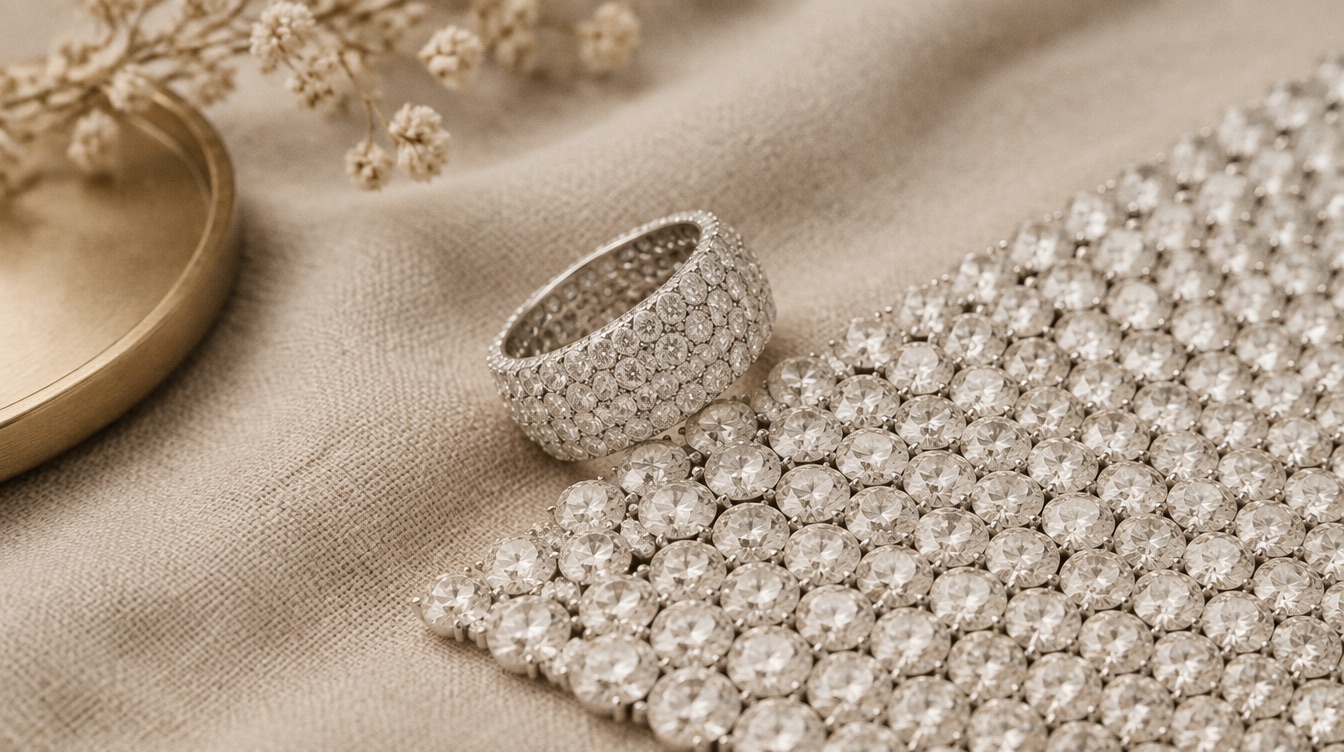
Invisible setting is a technique in which diamonds are cut with fine grooves along their girdle edges and slid into a thin metal rail grid from underneath, so the stones sit edge to edge with no visible prongs, beads, or bezel walls showing between them from above. The result is an unbroken, carpet-like field of diamonds where the metal structure holding everything together is hidden entirely beneath the surface.
Because that surface reads as pure stone with no metal interruption at all, invisible setting is frequently confused with pavé or channel setting from a photo, even though the underlying mechanics are entirely different. This guide covers what invisible setting actually is at the mechanical level, how the grooved-rail system differs from pavé, channel, and bezel construction, why the technique is considered one of the more difficult and labor-intensive ways to set diamonds, the durability and repair tradeoffs that come with it, which stone shapes and grades work best, where the technique shows up in real jewelry, and what a trade buyer should know before sourcing calibrated stones for an invisible-set project.
What Invisible Setting Actually Is, Mechanically
The defining feature of invisible setting is not how it looks from above — it's what's cut into the stone itself. Each diamond going into an invisible-set surface has one or two fine parallel grooves cut into its girdle, just below the crown, running along opposite edges of the stone. Those grooves are milled to an exact width and depth so that the stone can slide sideways onto a thin metal rail — sometimes described as a track or channel rail, distinct from a channel-setting wall — that forms part of a rail grid built into the underlying mounting.
The rails run in a grid beneath the stones, out of sight from the top and usually from the sides as well once the piece is finished. Each stone is threaded onto its rail from underneath, and adjacent stones are set edge to edge so tightly that their girdles nearly touch, leaving no visible gap or metal for the eye to catch. Because the rails do the holding — not prongs reaching over the crown, not beads pinching the girdle from the top, not a bezel wall wrapping the outside edge — nothing metal shows on the face of the piece at all. That is the entire premise of the technique: hide the support structure completely by moving it underneath the stones rather than around them.
How the Groove-and-Rail System Is Built
Building an invisible-set surface starts with the mounting, not the stones. A setter or CAD designer lays out a metal framework — typically a grid of thin rails running in one or two directions depending on the design — sized to the exact footprint of the finished piece, whether that's a ring's face, a band's surface, or a pendant's front. Every stone that will go into that grid then has to be cut with grooves that match the rail's exact width, at the exact position along the girdle where it will sit in the finished layout.
This is the step that makes invisible setting fundamentally different from every other setting style: the stone is modified to fit a specific position in a specific piece, rather than the setting being built or adjusted to fit an already-finished stone. Once every stone's grooves are cut, each one is slid onto its rail from the underside of the mounting, and the stones are pushed together edge to edge until the entire surface reads as continuous. The rails are typically finished flush with or slightly below the stones' girdles, and because they sit beneath the stones rather than at the surface, they stay out of view even when the piece is examined closely from most angles.
Invisible Setting vs. Pavé, Channel, and Bezel Setting
Buyers and even some retail sales staff routinely lump invisible setting in with pavé or channel work because all three can produce a dense field of small stones. Mechanically, though, invisible setting is its own category, and the distinctions matter for anyone specifying or evaluating a piece:
- Pavé setting holds stones with small raised metal beads or shared prongs sitting on the surface between stones — the metal is visible, just minimized. Invisible setting has no beads, prongs, or visible metal contact points anywhere on the surface.
- Channel setting holds a row of stones between two parallel metal walls that grip each stone's girdle from the sides, with the walls themselves visible as a continuous metal border running along both edges of the row. Invisible setting has no visible walls at all — the holding structure is a grid of rails hidden underneath the stones, not walls bordering them.
- Bezel setting wraps a metal rim fully or partially around a single stone's outer edge, with that rim clearly visible as a frame. Invisible setting has no rim or frame around any stone; each stone's outer edges butt directly against its neighbors.
- Flush (gypsy) setting recesses each stone into its own individually drilled socket in solid metal, with a visible ring of metal surrounding each stone at the surface. Invisible setting groups stones into one continuous field with no metal border around any individual stone.
The core mechanical difference worth remembering: every other multi-stone technique attaches metal to the outside or top of a standard-cut stone. Invisible setting instead cuts a feature directly into the stone's girdle so the stone itself becomes part of the mechanical joint, and the metal disappears entirely beneath the stones rather than around them.
| Setting Style | Where the Metal Sits | Relative Durability | Relative Cost | Repairability | Visual Effect |
|---|---|---|---|---|---|
| Invisible | Hidden rail grid beneath the stones — none visible from above | Good if undamaged, but a compromised rail or chipped groove is a serious repair issue | Highest — custom stone-cutting and precision bench work per stone | Difficult — each stone is cut to a specific position; damaged stones typically require a custom-matched replacement | Solid, seamless "carpet" of color with zero visible metal |
| Pavé | Small beads or shared prongs on the surface, between stones | Moderate — individual beads can wear or loosen over time | Moderate | Straightforward — a jeweler can re-tip a bead or reset a single stone without disturbing the rest | Dense sparkle with visible texture from beads/prongs |
| Channel | Two parallel walls bordering the row | High — enclosed walls protect stone edges well | Moderate | Moderate — channel must be reopened to service one stone, but the technique itself is well established | Clean row with visible metal border along both sides |
| Bezel | Full or partial rim around each stone | Highest — the most protective common setting style | Low-to-moderate | Straightforward — single stone, single rim, easiest to service | Framed, protected look with a visible metal edge |
Why Invisible Setting Is Considered a Premium, Difficult Technique
Invisible setting is widely regarded as one of the more demanding techniques in fine jewelry making, and the reasons are almost entirely mechanical rather than aesthetic preference. Every stone in an invisible-set surface has to be custom-grooved to a precise width and depth, matched to the exact rail it will sit on, and typically calibrated to a specific position within the overall layout rather than being interchangeable with its neighbors. That means the stone-cutting step cannot be outsourced to generic parcel-cutting the way a standard round or fancy shape can be — grooving has to happen with the specific mounting's rail dimensions already known.
Tolerances are tight in both directions. A groove cut too shallow or too narrow won't seat the stone securely on the rail; one cut too deep or too wide risks weakening the stone at exactly the point where it's under the most mechanical stress. Because the visual payoff of invisible setting depends entirely on the stones sitting edge to edge with no visible gap, the calibration also has to be extremely consistent across every stone in the piece — a size mismatch that would be barely noticeable in a pavé or channel design becomes an obvious visible seam in an invisible-set surface. This combination of custom per-stone cutting, tight tolerances, and the need for a closely matched, calibrated set of stones is what makes invisible setting slower on the bench and more expensive per finished piece than most other setting styles, and why it's generally reserved for higher-end work rather than standard production jewelry.
Durability and Everyday Wear Considerations
An intact, well-executed invisible-set piece can hold up reasonably well in normal wear — the stones are supported on multiple sides by their neighbors and by the underlying rail grid, and there are no raised prongs to bend or catch. But the technique does carry wear risks that are different in character from other setting styles, and worth being direct about with a customer rather than glossing over.
- Grooved girdles are a structural weak point. Cutting a groove into a diamond's girdle removes material at exactly the point where the stone is thinnest and most vulnerable to chipping. A hard knock that a standard-cut stone would shrug off can chip or crack a stone at its groove.
- A single damaged stone can affect its neighbors. Because stones sit edge to edge on a shared rail system, a chip or crack in one stone is more likely to disturb the fit of stones directly next to it than would happen in settings where each stone is independently secured.
- The technique is generally better suited to lower-impact wear. Pieces meant for genuinely hard daily use — manual work, frequent knocks against surfaces — carry more risk with invisible setting than with a more impact-tolerant style like bezel or channel setting. It's a legitimate consideration to raise with a customer choosing between an invisible-set design and a more conservative alternative for a ring they intend to wear constantly.
- Underside cleaning and inspection are harder. Because the rail structure sits beneath the stones rather than at the surface, a jeweler checking an invisible-set piece for wear can't simply glance at exposed prongs the way they would on a prong-set ring — inspection typically requires more specialized handling.
Repair and Reset Challenges
Repair is the area where invisible setting's tradeoffs are most pronounced. Because each stone is cut to fit a specific rail position in a specific piece, a damaged or lost stone generally can't simply be swapped for any other stone of the same size and grade the way it often can in pavé or channel work — the replacement stone has to be cut with matching grooves at the correct position, and closely matched in color, clarity, and dimensions to the surrounding stones so it doesn't stand out in an otherwise seamless field. That custom-cutting step has to be done by a bench capable of the same precision groove work the original piece required, which is a narrower set of jewelers than can perform a standard reset.
In some cases, a section of the rail grid itself may need to be disassembled or rebuilt to service one damaged stone, since the rails aren't independent per stone the way a channel or a row of individual prongs would be. This is why invisible-set pieces intended for repeated resizing, frequent stone changes, or an owner who's hard on jewelry are a more involved commitment than most other setting styles — the tradeoff for the completely seamless, no-visible-metal look is a real reduction in how easily the piece can be serviced down the line. None of this makes invisible setting impractical, but it's a genuine tradeoff worth setting expectations around before a piece is ordered or sold, not an afterthought discovered at the first repair visit.
Stone Requirements: Shapes, Sizes, and Grades That Work
Invisible setting places more demanding requirements on the stones themselves than almost any other setting style, because the technique depends on precise, repeatable calibration across every stone in the piece.
- Calibrated sizing is non-negotiable. Every stone needs to match its neighbors closely enough in dimension that the finished surface reads as continuous with no visible gaps — loose parcel goods with normal size variation aren't suitable without additional calibration work.
- Fancy shapes with straight or gently curved edges calibrate especially well. Emerald, radiant, and other rectangular or square-cornered calibrated shapes tessellate cleanly edge to edge, which is part of why invisible setting is strongly associated with square and rectangular layouts. Rounds, pear, and marquise shapes can also be invisible-set, though the geometry of fitting curved edges together edge to edge without visible gaps is more demanding than fitting straight edges.
- Color and clarity consistency across the full set matters as much as cutting precision. Because there's no metal breaking up the visual field, any stone that reads slightly warmer, cooler, or less clean than its neighbors is immediately obvious in a way it wouldn't be in a more broken-up setting style.
- Melee-range stones are the most common scale for invisible work, though the same principles apply to larger calibrated stones used in bolder invisible-set layouts.
Guru Diam's own melee program — round and calibrated fancy shapes including emerald, radiant, pear, and marquise, in the 0.8mm–9.0mm range, DEF+ color and VS+ clarity, CVD lab-grown only — is built around exactly this kind of calibrated consistency, which is the baseline any invisible-set project needs regardless of where the stones are sourced. It's worth being precise about certification here: melee at this scale ships as uncertified parcel goods evaluated against that DEF+/VS+ quality baseline, not as individually or parcel-certified stones — certification at the stone level applies to loose diamonds at 0.30ct and above, a separate tier from calibrated melee.
| Shape | Suitability for Invisible Setting | Notes |
|---|---|---|
| Round Brilliant | Workable | Curved edges make edge-to-edge fitting more demanding than straight-edged shapes; common in smaller-scale or specialty layouts |
| Emerald / Radiant | Excellent | Straight edges and consistent corner geometry tessellate cleanly — the shapes most strongly associated with invisible-set surfaces |
| Pear | Workable | Used in graduated or fan-style invisible layouts; requires precise per-position cutting given the asymmetric outline |
| Marquise | Workable | Pointed ends require careful groove placement to avoid weakening the stone at its narrowest points |
Common Applications and Where Invisible Setting Shows Up
Invisible setting is most often reached for specifically because a design calls for a solid, uninterrupted block of color or light with zero visible metal — a different design goal than maximizing sparkle (pavé's strength) or maximizing durability (channel or bezel's strength).
- Engagement ring shoulders and shanks. A run of invisible-set emerald or radiant-cut melee along a shoulder gives a seamless color block leading into the center stone, without the visible metal border a channel would show.
- Wedding and eternity-style bands. Invisible-set bands read as a continuous ribbon of stone, which is part of why the technique is used for pieces specifically marketed on that "no visible metal" quality.
- Statement rings and cocktail pieces. Because the technique reads as solid color from a distance, it's a natural fit for bolder pieces built around color-block design rather than individual stone sparkle.
- Fancy color work. Invisible setting is particularly effective for fancy color stones specifically because it removes any visible metal that could otherwise interrupt or dilute a saturated color block across a surface.
Metal Considerations for the Hidden Rail Grid
Because the rail grid carries the entire mechanical load of an invisible-set surface with no prong or bezel backup, the metal used for the rails matters more here than in styles where a visible structural element can be inspected and reinforced. Platinum's density and strength make it a common choice for invisible-set rail work, since the rails need to hold their precise shape and grip under years of wear without deforming. 18k gold is also used and can perform well, generally with attention to slightly heavier rail gauge than an equivalent platinum design would need to achieve the same long-term security. Because the rails are invisible once the piece is finished, the metal choice here is a purely structural decision rather than a visual one — unlike pavé or channel work, where metal color visibly affects the finished look.
What to Check Before Ordering an Invisible-Set Piece
- Bench experience specific to invisible setting. This is not a technique every setter performs regularly — confirming a bench has real invisible-setting experience, not just general setting skill, is worth doing explicitly before committing to a custom piece.
- Stone calibration plan. Confirming upfront how the stones will be calibrated and matched to each other, not just to a general grade specification, avoids surprises in the finished piece's visual consistency.
- Repair and resizing expectations set in advance. Given the technique's repair complexity, discussing what a future repair or a size adjustment would actually involve — and roughly how it differs from servicing a simpler setting — is worth doing before a piece is finalized, not after a problem comes up.
- Realistic wear expectations for the intended use. A piece meant for daily, hands-on wear carries different risk with invisible setting than an occasional-wear piece, and it's worth having that conversation directly with the end customer.
A Brief History and Context
Invisible setting emerged from French high jewelry workshops in the first half of the 20th century, developed as jewelers pushed to eliminate visible metal from densely set surfaces entirely rather than merely minimizing it, as pavé had already done. The technique required precision stone-cutting equipment and bench skill that weren't widely available outside a small number of specialized workshops for much of the 20th century, which is part of why invisible setting remained — and largely remains today — a technique associated with higher-end, made-to-order work rather than standard production jewelry. Advances in precision cutting equipment have made the technique somewhat more accessible over recent decades, but the fundamental requirement of custom-grooving each stone to its specific position hasn't changed, which is why invisible setting has stayed a slower, more specialized technique relative to pavé, channel, or bezel work even as those other styles have become more automated at scale.
Sourcing Calibrated Diamonds for Invisible-Set Work at Wholesale
An invisible-set piece is only as good as the calibration and consistency of the stones going into it — the technique has essentially zero tolerance for the color, clarity, or sizing outliers that a more forgiving setting style could absorb without anyone noticing. Guru Diam's calibrated melee program covers round and fancy calibrated shapes — including emerald, radiant, pear, and marquise — in the 0.8mm–9.0mm range at DEF+ color and VS+ clarity, CVD lab-grown only, which is the kind of matched, closely graded stock invisible-set work depends on. As noted above, this melee ships as uncertified parcel goods evaluated against that quality baseline rather than as individually certified stones, which is standard practice at this scale across the trade.
For designers and jewelers building invisible-set pieces as finished jewelry rather than sourcing loose stones for their own bench, Guru Diam's custom engagement ring and jewelry program handles cutting, setting, and polishing in-house, with finished pieces delivered in 4-6 days — a genuinely fast turnaround for made-to-order work at this level of technical difficulty. That program is also available white-label, so pieces can be finished unbranded for a jeweler to resell as their own. Matched, calibrated stone sets for invisible-set layouts can be reviewed through the matching pairs category, with fancy color options for color-block invisible-set designs available through fancy color loose diamonds. Individually certified center or accent stones for pieces that pair an invisible-set surface with a larger graded stone are available through certified diamonds. Trade accounts can review terms at the wholesale hub, and jewelers or designers looking to place a custom invisible-set order can apply through trade partner or start a build directly through custom jewelry.
Frequently Asked Questions
What makes a setting "invisible" specifically?
Invisible setting refers to a technique where each stone is cut with fine grooves along its girdle so it can slide onto a thin metal rail hidden beneath the surface. Because the rails sit under the stones rather than around or over them, no prongs, beads, bezel walls, or channel borders are visible from above — the metal structure is completely hidden.
How is invisible setting different from pavé setting?
Pavé holds stones with small metal beads or shared prongs sitting on the surface between stones, so some metal is always visible even though it's minimized. Invisible setting has no visible metal at all — each stone is cut with grooves that engage a hidden rail grid beneath the surface, which is a fundamentally different mechanical system, not just a denser or more refined version of pavé.
Is invisible setting more durable than channel setting?
Not generally, no. Channel setting encloses each stone's girdle within solid metal walls on both sides, which is quite protective. Invisible setting cuts grooves directly into each stone's girdle, removing material at the stone's most vulnerable point, and a chip at that groove is a more serious problem than typical wear on a channel-set stone. Channel setting is usually considered the more durable choice for hard daily wear.
Can a single stone be replaced in an invisible-set piece?
Yes, but it's more involved than most other setting styles. A replacement stone has to be custom-cut with matching grooves for that exact rail position, and closely matched in color, clarity, and size to the surrounding stones so it doesn't stand out. In some cases part of the rail grid may need to be disassembled to service the affected area.
What diamond shapes work best for invisible setting?
Emerald and radiant cuts are the most commonly used shapes, since their straight edges and consistent corner geometry fit together edge to edge with minimal visible gap. Round, pear, and marquise shapes can also be invisible-set, though their curved or pointed outlines make precise edge-to-edge fitting more demanding.
Is invisible setting a good choice for an everyday engagement ring?
It depends on the wearer's lifestyle. Invisible setting looks striking and reads as a completely seamless field of stone, but the grooved girdles are a genuine wear vulnerability compared to more protective styles like bezel or channel setting. For an active daily-wear piece, it's worth discussing that tradeoff directly rather than assuming the finished look tells the whole durability story.