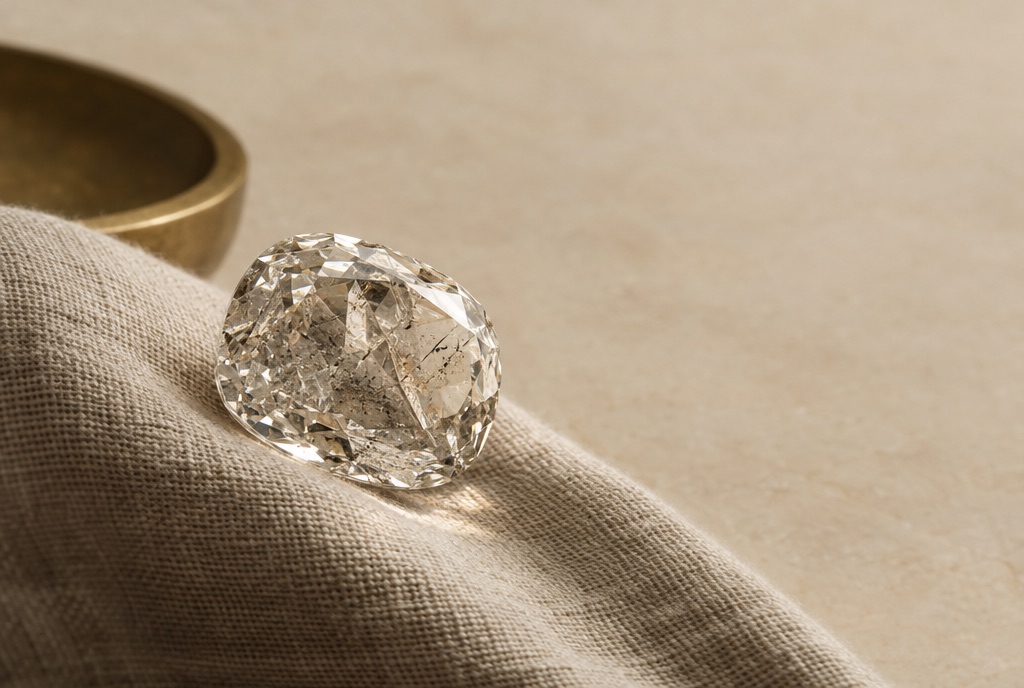
An included diamond is a stone graded I1, I2, or I3 on the GIA, IGI, and GCAL clarity scale — the tier below SI2, where inclusions are typically visible to the naked eye without magnification, not just under a jeweler's loupe. Included diamonds sit at the value end of the clarity scale: meaningfully lower cost per carat than eye-clean grades, at the tradeoff of visible internal characteristics that can affect both appearance and, in some cases, durability.
Where Included Clarity Sits on the Scale
| Grade | Meaning | Naked-eye visibility |
|---|---|---|
| VS1 / VS2 | Very Slightly Included | Not visible without magnification |
| SI1 | Slightly Included, first tier | Usually not visible, especially in brilliant cuts |
| SI2 | Slightly Included, second tier | Occasionally visible, particularly in larger stones |
| I1 | Included, first tier | Typically visible; usually the least obtrusive of the I grades |
| I2 | Included, second tier | Clearly visible; inclusions more numerous, larger, or more contrasty than I1 |
| I3 | Included, third tier | Prominently visible; can affect transparency and, in some cases, durability |
"Included" describes a real, meaningful step down from SI2 rather than a minor continuation of it — the defining line between SI and I grades is naked-eye visibility itself, which is the single biggest jump on the entire clarity scale in terms of how a stone is actually perceived by a buyer looking at the finished piece rather than examining it under magnification.
What Inclusions Look Like at Each Included Grade
I1 diamonds carry inclusions that are visible without magnification but are often manageable in appearance — light feathers, small crystals, or minor clouding that a buyer might notice on close inspection but that doesn't necessarily dominate the stone's face-up look, particularly in smaller carat weights or brilliant cut shapes that help scatter attention away from a single inclusion.
I2 diamonds step up in either the number, size, or contrast of visible inclusions, to the point where they're noticeable at a normal viewing distance rather than only on close inspection. Clouding, larger feathers, and included crystals are common, and transparency can begin to show a slightly hazy or less crisp quality in some stones.
I3 represents the bottom of the standard clarity scale. Inclusions at this tier are prominent and can be extensive enough to noticeably reduce a stone's brilliance and transparency. In some I3 stones, inclusions reach close enough to the surface, or are large enough in relation to the stone, to raise a genuine durability consideration under impact — a factor that doesn't meaningfully apply at higher clarity tiers.
Why Someone Buys an Included Diamond
- Melee and accent work. Small side and pavé stones, where individual inclusion visibility matters far less than in a center stone, are the most common home for included-clarity material in the broader market.
- Maximizing carat weight on a fixed budget. Included clarity is the single biggest lever for buying more visible size per dollar, since clarity drops in price faster than color or cut as it descends the scale.
- Industrial and technical use. A meaningful share of I2 and I3 material never enters jewelry at all, going instead into cutting tools, abrasives, and other industrial diamond applications where optical clarity is irrelevant.
- Statement pieces prioritizing size over precision. Large fashion pieces or costume-adjacent jewelry sometimes intentionally use lower clarity stones where scale, not per-stone perfection, is the design goal.
Included Diamonds in Center Stones: A Careful Case
Using I-clarity material as a center stone is possible but requires real care and, ideally, a hands-on look at the specific stone rather than relying on the certificate alone. I1 in a round brilliant under roughly half a carat can, in some individual stones, present a reasonably clean face-up appearance depending on inclusion type and placement — but this is stone-specific, not something the grade guarantees the way SI1 reliably does. I2 and especially I3 as a center stone is a much harder case to make: at that point, visible inclusions are typically a defining feature of the stone's appearance rather than an occasional exception, and buyers should go in expecting that, not hoping otherwise.
Step-cut shapes — emerald, asscher — make included clarity considerably more visible than brilliant cuts do, for the same reason they make SI1 and SI2 more visible: broad, open facets act like windows rather than breaking up the view the way a brilliant's smaller facets do. An included stone in a step cut is close to a worst-case pairing for anyone hoping the setting or shape will minimize visible inclusions.
Included Clarity and Durability
| Grade | Durability relevance |
|---|---|
| I1 | Generally low; occasional feathers worth a quick visual check but rarely a structural concern |
| I2 | Low to moderate; larger or surface-reaching inclusions occasionally warrant a closer look before setting |
| I3 | Can be meaningful; inclusions reaching or near the surface, or large relative to the stone, may present real durability risk under impact and are worth having a grader or jeweler assess directly |
This is one of the few places on the clarity scale where the grade genuinely touches structural integrity rather than appearance alone. A jeweler working with I3 material — particularly for a ring meant for daily wear rather than an occasional-wear piece — should look specifically at whether visible inclusions reach the surface (increasing chip risk at that point) before setting, not just at how the stone looks face-up.
Included vs. SI2: The Real Decision Point
| Grade | Naked-eye result | Price position | Typical use |
|---|---|---|---|
| SI2 | Usually eye-clean; occasional visible inclusions, review recommended | Meaningful step up from I1 | Budget center stones with individual review |
| I1 | Typically visible but often manageable | Below SI2 | Smaller center stones, melee, budget-first buyers |
| I2 | Clearly visible | Below I1 | Melee, accent stones, size-over-clarity fashion pieces |
| I3 | Prominently visible; possible durability factor | Lowest on the standard scale | Melee, industrial use, rarely center stones |
For most buyers weighing SI2 against I1 specifically, the honest framing is that SI2 still carries a real shot at an eye-clean result with individual review, while I1 generally does not — the grade line between them tracks closely with the practical line between "probably fine, worth checking" and "expect visible inclusions as a defining feature."
Included Diamonds and Melee: How the Trade Actually Uses Them
Included-clarity material is closely associated with melee — the small, calibrated stones (roughly 0.8mm-9.0mm) used in pavé, halo, and channel-set work — but it's worth being precise about where the trade's quality floor typically sits. Melee is generally sold as uncertified parcel goods against a stated quality baseline rather than individually graded, and reputable baselines for pavé and halo work commonly sit at VS+ clarity rather than I-clarity, since even small stones in a dense pavé arrangement can show visible dullness or haziness at true I-grade in aggregate. I-clarity material more commonly serves lower-cost fashion melee, industrial use, or larger accent stones in designs where a bit of visible character is an accepted tradeoff for size and cost.
Lab-Grown and Natural Included Diamonds
Clarity grading methodology is identical across CVD lab-grown and natural diamonds — the same FL-to-I3 scale, the same 10x-magnification standard for grading, applied by the same major labs. An I1 lab-grown diamond and an I1 natural diamond carry the same visible characteristics for the same reasons; origin doesn't change how a given clarity grade presents. The buying guidance in this guide — favor brilliant cuts, review individual stones directly rather than trusting the grade alone, treat I3 with extra durability scrutiny — applies equally to both.
How to Evaluate an Included Stone Before Buying
Because included clarity varies so widely stone to stone even within a single grade, a few concrete steps go a long way: request the certificate's plotting diagram to see exactly where inclusions sit and how large they are; ask specifically whether any inclusion reaches or comes close to the surface, particularly for I2/I3; request magnified photography or video rather than relying on the grade letter; and, for a center stone specifically, view the actual stone in person if at all possible rather than buying sight-unseen. None of this is necessary at SI1 or above the way it is here — included clarity is the tier of the scale where individual stone review stops being optional advice and becomes genuinely important.
Setting Choices That Help (and Don't Help) Included Diamonds
A bezel or halo setting can meaningfully soften an included stone's visible flaws by adding surrounding brilliance and directing attention outward from the center stone's surface, which is one reason included-clarity center stones are more commonly paired with halo designs than with a plain solitaire prong setting. Warmer metal tones (yellow or rose gold) can also help mask certain inclusion colors better than white metal does, depending on the specific inclusion. None of this changes the underlying clarity grade, but thoughtful setting choices are a genuinely useful, low-cost tool for buyers committed to an included-clarity center stone on a budget.
Included Clarity and Resale Value
Clarity affects resale less than color or carat weight in general, but included stones are the exception where it matters more directly, since visible inclusions are immediately apparent to any secondary buyer or appraiser without needing to reference the certificate. An I1 or I2 stone with genuinely well-placed, unobtrusive inclusions holds value reasonably in line with its grade; a stone whose inclusions are unusually prominent for its stated grade, or that shows durability-relevant characteristics, can see real resale friction beyond what the certificate alone would suggest. This is part of why individual stone review matters more for resale planning at the included tier than at any higher clarity grade.
How Much You Actually Save with Included Clarity
The price gap between eye-clean and included clarity is often larger than buyers expect, and it grows faster than the equivalent gap at higher clarity tiers — moving from VS2 to SI1 typically costs far less per carat than moving from SI2 to I1, and the SI2-to-I1 gap is itself smaller than the I1-to-I2 or I2-to-I3 steps in relative terms. This accelerating discount is precisely why included clarity is such an effective lever for buyers trying to maximize visible carat weight on a fixed budget: a buyer willing to accept I1 clarity, carefully selected for favorable inclusion placement, can often afford a meaningfully larger stone than the same budget would buy at SI1 or SI2, which is a real and rational tradeoff for buyers who prioritize size over per-stone perfection.
This math shifts somewhat by shape and carat size. In small stones (well under half a carat), the absolute price difference between clarity tiers narrows considerably, since there's simply less total value at stake — which is part of why included clarity is so common in melee and small accent work specifically, where the discount barely moves the needle on a large piece's total cost but matters considerably for a two- or three-carat center stone.
I1 vs. I2 vs. I3: A Closer Comparison
| Grade | Typical inclusion character | Face-up impression | Common role |
|---|---|---|---|
| I1 | Feathers, small crystals, light clouding; fewer or smaller than I2 | Visible on inspection; sometimes manageable at a glance in small brilliant cuts | Budget center stones (with review), larger melee |
| I2 | More numerous or larger inclusions; occasional haze | Noticeable at normal viewing distance | Melee, accent stones, size-focused fashion pieces |
| I3 | Extensive; may include surface-reaching feathers | Prominent; can visibly reduce brilliance | Lowest-cost melee, industrial use; rarely center stones |
The distance between I1 and I3 is considerably larger than a three-step jump might suggest — I1 stones, individually selected, can still function reasonably as smaller center stones for cost-conscious buyers, while I3 is a fundamentally different proposition, closer to a specialty or industrial-grade material than a mainstream jewelry clarity choice. Treating "included" as one undifferentiated bucket, rather than three distinct tiers with meaningfully different practical implications, is a common and costly buying mistake.
Included Diamonds in Fancy Color Stones
Clarity's importance shifts somewhat for fancy color diamonds compared to colorless stones, since a fancy color diamond's value and visual impact are driven primarily by its color saturation and hue rather than clarity — buyers and graders alike weight color far more heavily in the overall assessment of a fancy color stone. This means included clarity is a more commonly accepted tradeoff in fancy color diamonds than in colorless ones, particularly when a strong, saturated color effectively distracts the eye from clarity characteristics that would be more noticeable in a colorless stone of the same grade. This doesn't eliminate clarity's relevance entirely — a fancy color stone with inclusions affecting transparency or brilliance still loses some visual impact — but the bar for "acceptable" clarity in a fancy color context is genuinely different from the bar in a colorless diamond.
Included Diamonds in Estate and Vintage Jewelry
Older pieces, particularly from eras before modern grading standards were widely applied at the point of sale, turn up included-clarity center stones more often than contemporary retail jewelry does, since historical buying decisions weighted carat size and visible presence more heavily relative to certified clarity than current buying patterns typically do. When evaluating or reselling an estate piece with an unclarified or included-clarity center stone, getting a current certification is worth doing before pricing the piece, since the stone's actual grade — and whether its specific inclusions affect durability, particularly in older prong settings that may have loosened over decades of wear — meaningfully changes both value and any repair or resetting recommendations.
Photographing and Presenting Included Stones for Sale
Retailers and wholesalers selling included-clarity material benefit from presenting it honestly and specifically rather than relying on generic product photography that can inadvertently oversell the stone's appearance. Close-up, well-lit photography that shows the stone's actual face-up character — rather than heavily diffused or filtered images that mask visible inclusions — sets accurate buyer expectations and reduces post-sale disputes and returns. Pairing an honest photo with the certificate's plotting diagram and a brief, plain-language explanation of what the buyer is looking at (rather than assuming they'll interpret the grade abbreviation correctly on their own) is a genuinely effective sales practice for this tier of the clarity scale specifically, where buyer expectations and the actual product are most likely to diverge without that context.
Included Clarity Across Different Diamond Sizes
| Approximate size | Included clarity practical impact |
|---|---|
| Under 0.25ct | Inclusions often minimally noticeable even at I1-I2 due to small overall facet area |
| 0.25-0.75ct | I1 often manageable with selection; I2-I3 increasingly visible |
| 0.75-1.50ct | Individual review strongly recommended at any included grade |
| 1.50ct+ | Included clarity generally not recommended for a primary center stone without extensive individual review and realistic expectations |
This size relationship compounds the same principle that applies across the clarity scale generally — a larger facet area gives any given inclusion more visible room to register — but it's especially pronounced at the included tier, where the underlying inclusions are already larger, more numerous, or more contrasty than at higher grades. A buyer set on a larger center stone with a limited budget is often better served examining a genuinely well-selected SI2 than assuming a similarly-priced larger included stone will deliver a comparable look; the size gain frequently isn't large enough to offset the added visibility of the inclusions themselves.
Included Clarity and Certification: Why It Still Matters
It might seem like certification matters less for included-clarity stones, since the visible inclusions are apparent without needing a lab report to identify them — but certification remains genuinely valuable at this tier for a different reason: it documents precisely what those inclusions are, where they sit, and how large they are, which is exactly the information a buyer needs to judge whether a specific included stone is a reasonable purchase or a risky one, particularly for I3 material where durability is a real consideration. An uncertified included stone leaves a buyer guessing at exactly the details that matter most at this clarity tier, which is the opposite of what's actually needed when buying at the value end of the clarity scale.
Frequently Asked Questions
What does "included" mean for a diamond's clarity grade?
Included (I1, I2, I3) is the clarity tier where inclusions are typically visible to the naked eye, not just under 10x magnification. It's the lowest tier on the standard GIA, IGI, and GCAL clarity scale.
Are included diamonds bad quality?
Not inherently — clarity is one of four independent grading factors, and an included diamond can still have excellent cut and color. It simply means visible inclusions are more likely, which matters more for a center stone than for melee or accent work.
Can an I1 diamond look eye-clean?
Occasionally, in specific smaller stones with well-placed inclusions, but it's not something the grade guarantees the way SI1 or higher does. Individual stone review is recommended before assuming an I1 center stone will read as clean.
Is it safe to wear a diamond with I3 clarity?
Usually, but I3 is the one clarity tier where a real durability check is worth doing, since some I3 stones carry inclusions large or close enough to the surface to present chip risk under impact. Have a jeweler or grader assess the specific stone before setting it for daily wear.
Are included diamonds used in melee?
Some are, but reputable melee quality baselines for pavé and halo work commonly sit at VS+ clarity rather than true I-grade, since visible haziness in aggregate across many small stones is more noticeable than in a single stone. I-clarity material more often goes to lower-cost fashion melee or industrial use.
Do lab-grown included diamonds look different from natural ones?
No — clarity grading and the visible result at a given grade are identical between CVD lab-grown and natural diamonds, since both are graded on the same scale by the same labs.
Sourcing Diamonds Across the Clarity Spectrum from Guru Diam
Guru Diam stocks certified loose diamonds across the clarity spectrum, CVD lab-grown with IGI, GIA, and GCAL certification available, alongside natural diamonds and finished jewelry. For melee and accent work specifically, our program holds to a DEF+/VS+ quality baseline rather than sourcing at I-clarity, reflecting how visible small-stone quality actually reads in finished pavé and halo pieces rather than treating melee as a place to absorb the lowest available clarity. For center stones where a client is specifically evaluating included-clarity material for budget or size reasons, our team can pull plotting diagrams and magnified imagery for any specific stone under consideration.
In-stock inventory ships same-day from New York or Los Angeles, our custom jewelry program finishes pieces in 4-6 days from CAD approval, and trade accounts can review our full clarity and shape matrix through the wholesale hub or a trade partner account. Our certified loose diamond catalog and matching pairs program cover the higher clarity tiers most commonly chosen for center and accent stones alike.