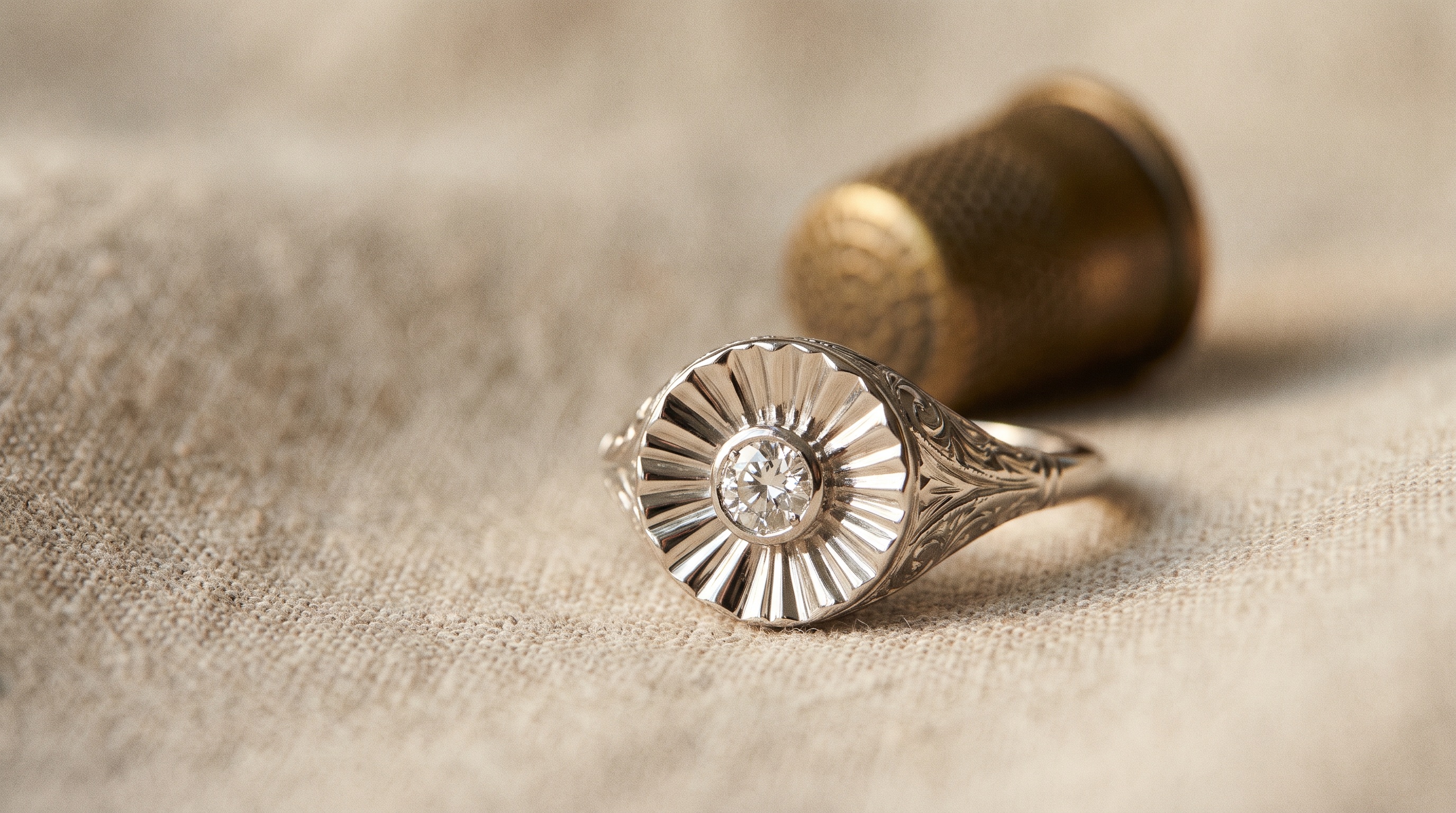
An illusion setting is a ring mounting where a small diamond sits inside a specially cut and engraved metal plate — often faceted or mirrored — shaped and polished to visually extend the stone's apparent size. Unlike a halo, which surrounds a center stone with real accent diamonds, an illusion setting fakes the size boost with engraved metal alone. It was especially popular for engagement rings from roughly the 1930s through the 1950s, when smaller center stones were common and this technique offered an affordable way to make them read larger at a glance.
How an Illusion Setting Physically Works
The mechanism is straightforward once you see it up close. A jeweler starts with a flat or slightly domed metal plate — typically white gold or platinum, since a bright white metal reads best against a diamond and helps the illusion hold up under normal room light. A recess is cut into the plate's center to seat the diamond, and the surrounding surface is engraved with a pattern of facets, grooves, or a scalloped/serrated edge radiating outward from the stone. That engraved surface is then polished to a high reflective finish, so it catches and bounces light in a way that reads, from a normal viewing distance, as an extension of the stone itself rather than as separate metal.
The visual trick relies on two things working together: the metal's color (bright white, so it doesn't visually separate itself from the diamond the way yellow gold would) and its faceting (cut at angles that catch light similarly to the diamond's own facets, rather than sitting flat and dull). Viewed from across a room or in a photograph at typical resolution, the eye tends to read the whole engraved area as one continuous sparkling surface — the diamond plus its metal halo blur together into a single, larger-looking point of light. Get close, tilt it under a loupe, or look at raking light across the surface, and the difference between stone and metal becomes obvious: the diamond throws bright, sharp flashes of light through its facets, while the engraved metal gives a duller, more uniform glitter that doesn't behave the same way optically.
This is sometimes called a "cut-down" illusion head in trade terminology, referencing the way the metal is cut down and engraved around the stone rather than built up as a separate ring of stones. Some jewelers and collectors also describe it as a precursor to the halo setting, since the visual goal — a bigger-looking center of sparkle — is identical, only the method of achieving it differs.
Illusion Setting vs. True Halo Setting: The Core Difference
This is the single most important distinction to get right, since the two are frequently confused at a glance and even in casual jewelry marketing copy. A halo setting surrounds the center stone with a ring of small, real diamonds (or occasionally other gemstones), each individually set and each contributing genuine sparkle and genuine extra diamond weight to the piece. An illusion setting surrounds the center stone with engraved, faceted metal — there are no accent diamonds at all in the illusion portion. Every bit of the size-extension effect in an illusion setting comes from metalwork, not from additional gem material.
The practical consequences follow directly from that difference. A halo setting adds real carat weight and real diamond sparkle around the center stone, at a real material cost. An illusion setting adds the visual impression of size at essentially the cost of extra engraving labor on the metal itself, with no additional diamond material. This makes illusion setting meaningfully cheaper to produce for the size-boosting effect it delivers, but also means the "extra size" is not diamond at all — a fact that matters a great deal at appraisal or resale, covered in more detail below.
The History and Heyday of the Illusion Setting
Illusion setting rose to real prominence in the 1920s through the 1950s, with its strongest popularity generally placed in the 1930s and 1940s. Several forces converged to make it a practical, appealing choice during that window. Diamonds — genuinely rare, mined stones at the time — were expensive relative to household incomes, and a couple carrying a modest budget for an engagement ring often could only afford a small center stone on its own. Metalworking and engraving techniques, meanwhile, were well established and relatively inexpensive compared to sourcing and setting additional small diamonds one at a time. An engraved illusion plate let a jeweler take a genuinely small diamond — sometimes well under a quarter carat — and mount it in a way that made it read as a noticeably larger stone in the setting most people would actually see it in: a ring on a hand, at conversational distance, not under a jeweler's loupe.
The style fell out of favor gradually over the following decades, for reasons tied to shifts in both diamond availability and consumer taste. As diamond mining, cutting, and distribution scaled up through the mid-to-late 20th century (and later, as lab-grown diamond production expanded the supply of genuine stones further), small real diamonds became meaningfully more accessible and affordable relative to income than they had been in the illusion setting's heyday. That shift reduced the economic pressure that had made a "fake it with metal" technique attractive in the first place — a couple with a similar budget today has an easier time affording actual small accent diamonds than their counterpart did a century ago. At the same time, consumer taste shifted toward wanting genuine diamond weight and genuine diamond sparkle in every visible part of a ring, a preference the modern halo setting satisfies directly. As halo settings became cheaper and more available to produce at scale, they largely displaced illusion setting as the "make a small center stone look bigger" solution of choice, and illusion setting settled into its current status: a recognizable, historically important vintage technique rather than a mainstream modern default.
Illusion Setting vs. Halo Setting vs. Solitaire: A Comparison
The table below lines up illusion setting against the two mounting styles it's most often confused with or compared against, across the dimensions that matter most to a buyer or jeweler deciding between them.
| Factor | Illusion Setting | True Halo Setting | Plain Solitaire |
|---|---|---|---|
| How size boost is achieved | Engraved/faceted metal plate around the stone | Ring of real accent diamonds around the stone | No size boost — stone shown at true size |
| Adds real diamond weight? | No | Yes | No |
| Relative cost for the effect | Lowest (labor/engraving only) | Higher (extra diamond material) | N/A |
| Durability of the effect over decades | Can dull — engraving wears and loses reflectivity | Stable — diamonds don't lose sparkle from wear | N/A — nothing to wear down |
| Era/style association | 1920s-1950s vintage, revival/vintage-inspired builds today | Popular from mid-20th century onward, dominant today | Timeless, all eras |
| Resale/appraisal treatment | Valued on center stone only; metalwork has no gem value | Valued on center stone plus each accent stone | Valued on center stone only |
| Close-up/loupe scrutiny | Reveals metal vs. stone clearly | Holds up — accents are genuine diamonds | N/A |
Pros and Cons of an Illusion Setting
Weighed on its own merits rather than against a halo, illusion setting has a real, still-relevant set of advantages alongside its tradeoffs.
Advantages
The core advantage is budget: an illusion setting lets a smaller center diamond present visually larger without the added material cost of accent stones, which matters to buyers working within a fixed budget who want to maximize apparent size per dollar spent on the diamond itself. It also carries genuine period authenticity for vintage and antique-style builds — a Retro or mid-century-style ring built with a true illusion head reads as more historically accurate than one built with a modern halo dressed up in vintage styling cues. And because the technique is pure metalwork rather than stone-setting, it doesn't require sourcing any additional matched melee at all, which can simplify production for a one-off custom piece.
Disadvantages
The most commonly cited drawback is candor: some buyers feel a setting whose entire purpose is to make a stone look bigger than it is amounts to "faking" size, and modern buyers who research setting styles before purchasing increasingly want a straightforward answer about how much actual diamond they're getting for their money. Illusion setting requires that conversation more than most other styles do. The engraved plate's reflective quality can also degrade over years of wear (detailed below), which is a durability tradeoff a halo's genuine diamond accents don't share. And because taste has shifted toward "real diamond weight" as the modern preference for a size-boosting setting, illusion setting today reads to many buyers as an intentionally retro or budget choice rather than a neutral default — a fine outcome for someone wanting that specific look, but a mismatch for someone who wants a size boost without a vintage association attached to it.
Durability and Maintenance of an Illusion Plate
An illusion plate's entire visual effect depends on its engraved surface staying sharply cut and highly polished, and that surface is genuinely vulnerable to wear in a way a diamond's own facets are not. Over decades of daily wear, the fine engraved grooves and facet edges on the metal plate can gradually soften and round off from repeated contact with skin, clothing, and incidental knocks — the same kind of surface wear that dulls any engraved metal pattern over time, but with an added consequence here: as the engraving softens, the plate's ability to catch and reflect light the way it did when freshly cut diminishes, and the size-extending illusion weakens along with it. This is a specific, well-known issue on antique illusion-set pieces reaching a jeweler's bench today; many decades-old illusion rings show visibly duller, less defined plate engraving than they had when new, even when the diamond itself is in perfect condition.
The plate's structure can also accumulate grime in its engraved grooves over time, similar to how any finely detailed engraved metal surface traps residue more readily than a plain polished surface — routine professional cleaning matters more for an illusion setting than for a plain prong head, since buildup in the grooves directly undercuts the reflective effect the whole design depends on. Refreshing a worn illusion plate is possible: a skilled bench jeweler can re-engrave and re-polish the plate to restore sharper faceting and better reflectivity, though on a genuinely antique piece this is a judgment call, since re-cutting the plate does alter original period metalwork, which matters more to some collectors and appraisers than to others depending on the piece's intended use.
How to Identify a Genuine Illusion-Set Piece
Being able to tell a true illusion setting apart from a halo — or from a plain setting with some decorative engraving that isn't actually functioning as an illusion — matters for appraisal, resale, and antique buying, where accurately describing what's actually there affects both value and buyer expectations. A few practical checks help:
- Look for a single stone, no accent diamonds. An illusion setting has exactly one diamond — the center stone. If there are additional small stones set individually around it, it's a halo (or a halo-illusion hybrid, occasionally seen where a small illusion plate sits inside a genuine halo of accents), not a pure illusion setting.
- Check whether the "extra sparkle" is metal or stone under magnification. Under a loupe or macro photo, engraved metal shows a duller, more uniform glitter and visible tool marks or facet edges cut directly into a continuous piece of metal. Real accent diamonds show sharp, bright, distinctly stone-like flashes and are each set into their own individual seat, with visible prongs, beads, or channels separating one stone from the next.
- Look for a recessed, engraved plate rather than raised prongs holding separate stones. An illusion head is typically a single continuous piece of engraved metal with the center stone recessed into it — there's no separate under-gallery of individually set small stones the way a halo has.
- Check the era and overall design language. A ring with Retro or mid-century styling cues (bold geometric metalwork, a smaller center stone relative to the overall ring's visual footprint) built with this single-stone-plus-engraved-plate structure is a strong candidate for a genuine period illusion setting.
- When in doubt, have it appraised. An experienced appraiser familiar with vintage construction techniques can confirm the setting type definitively and note it accurately on any appraisal document, which matters for both insurance replacement value and resale representation.
Which Shapes and Eras Commonly Used Illusion Setting
Illusion setting was applied predominantly to round brilliant and old European cut center stones, since a circular engraved plate reads most naturally as a size extension around a round outline — the engraved edge can radiate outward symmetrically from the stone in a way that's harder to pull off convincingly around a more angular or elongated shape. It shows up almost exclusively on smaller center stones, typically well under half a carat, since the entire point of the technique is to make a modest stone read as more substantial; a larger center stone has no real need for the illusion effect and rarely appears in an illusion mounting historically.
Era-wise, illusion setting is most strongly associated with Retro-era jewelry (roughly the 1930s through 1940s) and carries into early mid-century pieces from the 1950s, often paired with the bold, architectural yellow or rose gold metalwork typical of Retro design, though white metal illusion plates on an otherwise Retro-style ring are also common, precisely because white metal makes the plate-to-stone color match closer and the illusion more convincing. It becomes progressively rarer in mainstream production from the 1960s onward as halo setting and larger, more affordable diamond supply reduced the need for the technique, though it never disappeared completely and remains a recognized option for vintage-reproduction and revival-style builds today.
Sourcing and Design Considerations for a Jeweler Today
Illusion setting still comes up in current trade work in two fairly distinct contexts, and each calls for a different approach. The first is restoration or reset work on an inherited or estate piece that already carries a genuine antique illusion head — here the main decisions are around whether to preserve, restore, or re-engrave the existing plate, and whether the center stone itself (often a small old European or old mine cut) should be kept in place or reset into new metalwork, questions best worked through alongside a bench jeweler experienced with period construction rather than treated as a standard remount.
The second context is a client requesting the illusion look deliberately for a new build — usually someone wanting genuine period-correct vintage styling, or a client working within a tighter budget who wants a small center stone to present as visually larger without paying for a full accent-diamond halo. For this second group, it's worth walking through the tradeoff directly and transparently rather than assuming the choice: a genuine illusion plate delivers the vintage look and the lowest incremental cost, but adds zero diamond weight and carries the durability consideration of an engraved surface that can dull over decades; a small genuine halo build costs more but adds real diamond weight, holds its sparkle over time without the same wear-related dulling, and is the setting most buyers researching engagement rings today expect when they picture a "bigger-looking" small center stone. Presenting both options with their honest tradeoffs, rather than defaulting to whichever is easier to produce, tends to serve the client better and avoids the resale/appraisal confusion covered above further down the line.
Guru Diam supports both paths from a sourcing standpoint. For a genuine vintage-style illusion build, old European and old mine cut center stones sized for this kind of mounting are available as certified loose stones (IGI, GIA, and GCAL certification all offered), and jewelers can source the center stone and build the custom setting — illusion plate or otherwise — through the same account. For a client who ultimately prefers a genuine small halo instead, matched melee for the halo ring is sourced the same way, keeping stone sourcing and the finished setting under one relationship rather than split across separate vendors. Custom rings, including illusion-style or halo builds, are finished in 4-6 days and shipped unbranded by default so retailers can resell as their own.
Sourcing Through Guru Diam
Browse certified loose stones — including old European and old mine cuts suited to a vintage illusion build — through certified diamonds. Matched melee for a genuine halo alternative can be found under matching pairs, and fancy color center stones for a colored-diamond vintage build are available under fancy color loose diamonds. Start a custom illusion-style or halo build through custom jewelry, review general wholesale inventory at the wholesale hub, or set up a trade account through trade partner.
Frequently Asked Questions
What is an illusion setting on a ring?
An illusion setting is a mounting where a small diamond sits inside an engraved, faceted metal plate shaped to visually extend the stone's apparent size. The engraved metal catches light in a way that blends with the diamond at normal viewing distance, making the stone read as larger than it actually is.
What is the difference between an illusion setting and a halo setting?
An illusion setting uses engraved metal alone to create the appearance of a bigger stone, with no additional diamonds. A halo setting surrounds the center stone with a ring of real small diamonds, adding genuine carat weight and sparkle rather than simulating it with metalwork.
Are illusion settings still made today?
Yes, though they're now mostly a deliberate vintage or revival choice rather than a mainstream default, since real halo settings became more affordable and more popular from the mid-20th century onward. Jewelers still build genuine illusion plates for period-accurate restorations and vintage-style custom pieces.
Do illusion settings make a diamond look bigger in photos too, or only in person?
Illusion settings can read as larger in photos as well, especially at typical online-listing resolution, since the engraved metal's sparkle can visually blend with the stone's in a photo the same way it does to the naked eye at a normal viewing distance. Close-up macro photography or in-person inspection under magnification generally reveals the difference between stone and metal much more clearly.
Does an illusion setting lower a diamond ring's resale value?
An illusion setting doesn't lower the center diamond's own value, since the stone is graded and appraised on its own merits regardless of setting style. But the setting itself doesn't add diamond value the way a halo's accent stones would, and a buyer or appraiser needs to correctly identify the setting as illusion rather than mistake it for a halo to value the piece accurately.
Can an old illusion setting be restored if the engraving has worn down?
Yes — a bench jeweler experienced with period construction can typically re-engrave and re-polish a worn illusion plate to restore sharper faceting and better reflectivity. On a genuine antique piece, this is worth discussing first, since re-cutting the plate changes original period metalwork in a way some owners and appraisers weigh differently depending on the piece's intended use.