A "fake" diamond usually means one of two things: a simulant — a different material entirely, like cubic zirconia or moissanite, made to resemble a diamond — or a genuine diamond misrepresented about its origin, treatment, or grade. Spotting either requires different checks: simulants can often be screened with simple physical and optical tests, while confirming a genuine diamond's actual grade and origin reliably requires a lab certificate, not a home test. Understanding which question you're actually trying to answer is the first step to testing correctly.
What "Fake Diamond" Actually Covers
The term gets used loosely, but it covers a few genuinely different situations, each requiring a different kind of check:
- Simulants — materials like cubic zirconia (CZ), moissanite, and glass, which are not diamond at all but are cut and set to resemble one.
- Undisclosed lab-grown diamonds sold as natural — a genuine diamond, chemically and optically identical to a natural stone, but misrepresented about its origin. See our lab-grown vs. natural diamond guide for how these differ and how they're properly disclosed.
- Undisclosed treatments — a genuine diamond that has been clarity-enhanced (laser drilled or fracture filled) or color-treated without disclosure, misrepresenting its true, untreated grade.
- Misrepresented grading — a genuine, untreated diamond sold with an inflated or fabricated grade, without a legitimate certificate to back it up.
A simple physical test can help rule out the first category (simulants). It cannot reliably catch the other three — those require checking documentation and, when in doubt, independent lab verification.
The Fog Test
Breathe on the stone the way you'd fog a mirror, then watch how quickly the fog clears. Diamond conducts heat extremely efficiently, so fog dissipates almost instantly — typically within a second or two. A simulant like CZ or glass holds the fog noticeably longer, since it doesn't dissipate heat as quickly. This test is easy to do anywhere and can be a useful first screen, but it isn't definitive on its own: moissanite, a common and increasingly convincing simulant, also has excellent thermal conductivity and can pass a fog test similarly to a real diamond, which is why this test alone won't distinguish diamond from moissanite specifically.
The Water Test
Drop a loose stone into a glass of water. A genuine diamond, due to its high density, will sink quickly. A stone that floats or hovers near the surface is likely a lower-density simulant like glass or certain plastics. This test works reasonably well for ruling out the lowest-quality simulants, but it isn't reliable for distinguishing diamond from CZ or moissanite, both of which are dense enough to sink similarly. It also only works on a loose stone — it tells you nothing about a stone already mounted in a setting.
The Loupe or Magnification Check
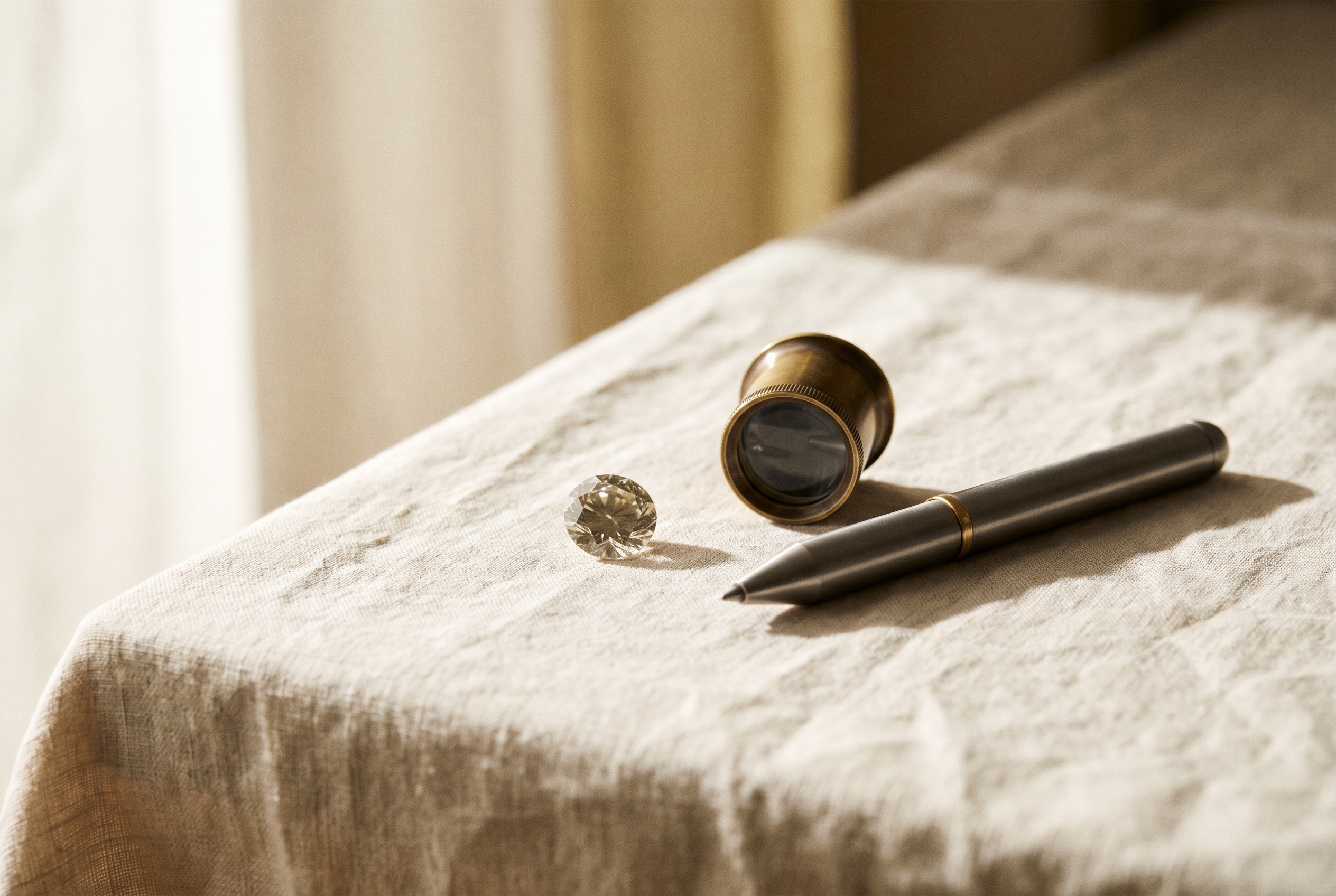
Viewing a stone under 10x magnification can reveal characteristics that differ between diamond and common simulants. Natural and lab-grown diamonds typically show at least some internal characteristics (inclusions or growth features) at high magnification, even in high-clarity stones, while CZ is often perfectly clean with no internal characteristics at all — a stone that looks "too perfect" under magnification is worth a second look. This isn't foolproof either: a genuinely flawless or internally flawless diamond exists and is completely clean under magnification, and a lower-quality simulant can still contain manufacturing inclusions. Magnification is best used alongside other checks, not as a standalone test.
The Sparkle and Fire Test
Diamond has a distinctive combination of brilliance (white light reflection) and fire (flashes of spectral color) that differs from most simulants when compared side by side under strong light. Moissanite, notably, often shows more fire than a diamond of comparable cut — sometimes described as excessive rainbow flash — which is itself a giveaway for a trained eye, since it actually shows more colorful sparkle than a genuine diamond rather than less. Cubic zirconia typically shows less overall brilliance and a duller, more uniform sparkle. This test requires a comparison stone or significant experience to apply reliably, since sparkle characteristics are genuinely difficult to judge from a single stone in isolation without a reference point.
The Diamond Tester (Thermal or Electrical Conductivity)
A dedicated diamond tester — a handheld device measuring thermal or electrical conductivity — is considerably more reliable than any of the home tests above for screening out most simulants. A basic thermal tester reliably distinguishes diamond from CZ and glass but historically struggled to distinguish diamond from moissanite, since moissanite also conducts heat well; more advanced dual thermal-and-electrical testers address this by also checking electrical conductivity, where diamond and moissanite behave differently. Neither tester type, however, distinguishes a natural diamond from a lab-grown one — both are chemically identical diamond and register identically on a conductivity tester. A tester answers "is this diamond or a simulant," not "is this diamond natural or lab-grown," and it's important not to conflate the two questions.
UV Fluorescence Check
Under longwave UV light, some diamonds fluoresce (most commonly blue, though other colors occur), while most common simulants either don't fluoresce or fluoresce differently. This isn't a reliable standalone test, though, since a meaningful share of genuine diamonds show no fluorescence at all, and fluorescence characteristics vary enough that a UV check alone can mislead as easily as it can confirm. It's best treated as one small data point alongside other checks rather than a determinative test on its own.
What Home Tests Can and Can't Tell You
| Test | Good For | Doesn't Reliably Detect |
|---|---|---|
| Fog test | Ruling out low-conductivity simulants (glass, some CZ) | Moissanite (also conducts heat well) |
| Water/density test | Ruling out very low-density simulants | CZ, moissanite (similar density range) |
| Loupe/magnification | Spotting a "too clean" stone typical of CZ | High-clarity genuine diamonds; some simulant inclusions |
| Sparkle/fire comparison | Spotting moissanite's excess fire, CZ's dullness | Reliable without a comparison stone or experience |
| Diamond tester (thermal + electrical) | Reliably distinguishing diamond from most simulants | Natural vs. lab-grown origin |
| UV fluorescence | One minor supporting data point | Anything definitive on its own |
Why Home Tests Can't Catch Origin or Treatment Misrepresentation
This is the most important limitation to understand: every test above is designed to answer whether a stone is diamond or a non-diamond simulant. None of them can tell you whether a genuine diamond is natural or lab-grown, or whether it has undergone an undisclosed treatment. Lab-grown diamonds are chemically, optically, and physically identical to natural diamonds — the difference is entirely one of origin, not composition — so no home test, tester, or loupe check can distinguish them. The same is true for many treatments: a laser-drilled or fracture-filled stone is still genuine diamond and will pass every physical test above, even though its true clarity and value differ from what an untreated stone of the same visual clarity would command. Reliably confirming origin and treatment status requires a legitimate grading report from a recognized lab, not a physical test.
Reading a Diamond's Certificate Correctly
A genuine GIA, IGI, or GCAL report will explicitly state whether a stone is natural or laboratory-grown, and will disclose any clarity or color treatments in a comments or treatment section. Buyers should check specifically for this language rather than assuming a "certified" stone is automatically natural and untreated — a legitimately certified lab-grown diamond is not a "fake," provided it's disclosed as such, but a natural-only claim contradicted by the certificate's own language is a genuine red flag. See our GIA report guide and how-to-read-a-diamond-certificate guide for a full walkthrough of where this information appears on a standard report.
Verifying a Stone Against Its Certificate
Most certified diamonds carry a laser inscription — typically the report number, sometimes with a brand mark — etched onto the girdle. Checking this inscription under 10x magnification against the number printed on the accompanying report is one of the fastest ways to confirm a specific stone matches the document being presented alongside it, rather than a different (possibly lower-grade) stone being substituted for the one actually described on the certificate. This check is especially worth doing on any secondhand, estate, or loose-stone purchase where the stone and paperwork may have changed hands separately at some point.
When to Get Professional Verification
For any purchase above a modest value, or any situation involving uncertainty about a stone's authenticity, origin, or treatment status, professional verification is worth the modest cost involved. An independent gemologist or a recognized grading lab can confirm a stone's identity, origin, and treatment status definitively — something no combination of home tests can fully replicate. This is particularly important for estate purchases, private-party sales, or any transaction where the seller can't or won't provide a legitimate, verifiable certificate.
Red Flags Beyond the Stone Itself
Beyond physical testing, a few situational red flags are worth taking seriously: a price significantly below typical market rates for the claimed specifications, reluctance or inability to provide a legitimate certificate from a recognized lab, a certificate from an unfamiliar or unverifiable lab, or pressure to complete a purchase quickly without time to verify documentation. None of these guarantee a problem on their own, but any of them combined with uncertainty about the stone itself is a reasonable basis to request independent verification before completing a purchase.
Cubic Zirconia vs. Moissanite: Why They Behave Differently in Testing
The two most common diamond simulants respond differently enough to testing that it's worth understanding each on its own terms rather than treating "simulant" as a single category. Cubic zirconia is a relatively soft, dense, optically simple material that shows less brilliance and fire than diamond, doesn't conduct heat well, and is reliably caught by a basic thermal tester, the fog test, and often a trained eye comparing sparkle side by side. Moissanite is considerably more diamond-like across nearly every physical test: it conducts heat efficiently enough to pass a fog test similarly to diamond, and its hardness is close enough to diamond's that it doesn't feel obviously different to the touch. Moissanite's main tell is actually excess fire — more colorful flash than a diamond of comparable cut shows — and reliably distinguishing it from diamond with a device requires a tester that checks electrical conductivity specifically, not just thermal conductivity. See our lab-grown diamond vs. moissanite guide for a fuller comparison of how the two differ across price, appearance, and durability.
Fake Diamonds in Online and Marketplace Purchases
Buying loose stones or jewelry through an online marketplace or an unfamiliar seller introduces risks beyond what physical testing alone can address, since the buyer often can't inspect the actual stone before purchase. Photos and video can be staged or sourced from a different stone entirely than the one that ships, and a seller's own description of a stone's grade carries no more weight than any other unverified claim unless backed by an actual certificate from a recognized lab, checked against the physical stone's laser inscription on arrival. Buyers purchasing significant stones online should specifically request the certificate in advance, verify it independently by checking the report number against the issuing lab's own database where available, and confirm return policy explicitly before completing a purchase, since resolving a misrepresented online purchase after the fact is considerably harder than verifying it beforehand.
What to Do If You Suspect You've Bought a Fake or Misrepresented Diamond
If a physical test or a documentation mismatch raises concern about a stone already purchased, the most reliable next step is independent verification by a gemologist or an accredited lab not affiliated with the original seller — bringing both the stone and any paperwork provided at the time of sale. If the stone turns out to be misrepresented, the specific facts (a written description or listing claiming a grade the stone doesn't have, a certificate that doesn't match the physical stone, or a simulant sold as diamond) matter for any refund, chargeback, or consumer protection claim, so documenting the original purchase listing, receipt, and any correspondence with the seller before pursuing a resolution is worth doing early rather than after the fact.
Fake Diamond Concerns Specific to Antique and Estate Jewelry
Estate and antique jewelry purchases carry their own version of this concern: a piece's stone may have been replaced at some point in its history with a lower-value stone or simulant, without this being disclosed or even necessarily known by the current seller. Because antique-cut stones (Old Mine, Old European, and similar historical cuts) have proportions that differ meaningfully from modern cuts, a knowledgeable appraiser can often assess whether a stone's cutting style is period-consistent with the piece's apparent age — a modern round brilliant in a piece styled as 1920s estate jewelry, for instance, is a legitimate red flag worth investigating further. Buyers sourcing estate or antique pieces without an accompanying grading report should factor independent appraisal into the purchase process specifically for this reason, rather than relying on the piece's apparent age or styling alone as proof of the stone's authenticity.
Insurance Appraisals as an Ongoing Verification Check
An independent insurance appraisal, obtained after purchase, serves a dual purpose worth noting here: beyond setting a replacement value for coverage, a qualified independent appraiser will re-verify the stone against its accompanying certificate as a normal part of the appraisal process, providing a second, independent checkpoint beyond the original point of sale. This is particularly useful for buyers who didn't have the opportunity to verify a stone thoroughly at the time of purchase — an estate piece bought quickly, a gift received without documentation review, or a purchase made before the buyer was familiar with what to check. Scheduling an independent appraisal within a reasonable window after any significant diamond purchase adds a layer of verification beyond the seller's own representations, and creates a documented record that's useful both for insurance purposes and for confirming the stone matches what was originally represented.
Training Retail Staff to Field Customer Questions About Authenticity
Jewelers and retail staff regularly field authenticity questions from their own customers, particularly around gifted pieces, estate purchases, or general curiosity after seeing a home-testing video online. Staff equipped to explain clearly what a fog test or diamond tester can and can't actually prove — and to confidently point a concerned customer toward certificate verification and, where appropriate, professional appraisal — build more customer trust than staff who either dismiss the question or overstate what an in-store tester alone can confirm. Retailers can use this as a genuine service differentiator: offering a quick, honest tester check alongside a clear explanation of its real limitations, rather than presenting an in-store test as definitive proof one way or the other.
A Practical Checklist Before Buying Any Diamond
Pulling the checks above together, a practical pre-purchase routine looks like this: confirm a legitimate certificate from a recognized lab (GIA, IGI, or GCAL) exists and matches the stone's laser inscription; read the certificate's origin and treatment disclosures explicitly rather than assuming based on price or seller claims; use simple physical tests only as a rough first screen, not a final answer, especially where moissanite is a realistic possibility; and, for any higher-value or uncertain purchase, get independent professional verification before finalizing. This sequence catches the overwhelming majority of authenticity and disclosure problems a buyer is likely to encounter, and it takes meaningfully less time than resolving a dispute after a purchase has already been completed.
Why Certificate Verification Matters More Than Ever
As lab-grown diamond production has scaled and simulant technology has improved, physical appearance alone has become a progressively less reliable way to judge a stone's origin or grade — the gap between what a home test can prove and what a legitimate certificate can prove has, if anything, widened rather than narrowed. This makes documentation review, not visual inspection, the foundation of any reliable authenticity check today, with physical tests serving a supporting role at most. Buyers who treat a certificate as a formality to skim rather than the primary source of truth about a stone are the ones most exposed to misrepresentation, regardless of how many home tests they've run beforehand.
How Guru Diam Approaches Certification and Disclosure
Guru Diam supplies certified diamonds — lab-grown CVD and natural — with IGI, GIA, and GCAL certification all available depending on the stone, and clear disclosure of origin on every certified stone sold. Guru Diam's CVD lab-grown catalog is disclosed as such throughout, never blended with or misrepresented as natural inventory, and natural melee is sourced and sold as a distinct, separately disclosed catalog. Buyers sourcing certified stock through Guru Diam can rely on accurate origin and grading documentation rather than needing to independently verify claims after the fact.
Browse certified diamonds through certified diamonds, or set up a trade account through trade partner to review inventory and documentation directly. For general wholesale sourcing, start at the wholesale hub.
Frequently Asked Questions
How can I tell if a diamond is fake at home?
Simple tests — the fog test, water/density test, and viewing under a loupe — can help screen out common simulants like cubic zirconia and glass, but none of them are fully reliable on their own, and none can detect an undisclosed lab-grown diamond or an undisclosed treatment, since those are genuine diamond.
Can a diamond tester tell the difference between a real diamond and moissanite?
A basic thermal-only tester often cannot, since moissanite also conducts heat efficiently. A dual thermal-and-electrical tester is more reliable, since diamond and moissanite behave differently under electrical conductivity testing.
Does the fog test work to detect a fake diamond?
It works reasonably well against glass and some cubic zirconia, since a real diamond clears fog almost instantly due to superior heat conductivity. It does not reliably distinguish diamond from moissanite, which also disperses fog quickly.
Can a home test tell if a diamond is lab-grown or natural?
No. Lab-grown (CVD) diamonds are chemically and physically identical to natural diamonds — the difference is origin, not composition — so no physical home test can distinguish them. Only a legitimate grading report will state a stone's origin explicitly.
What's the most reliable way to confirm a diamond is genuine and accurately represented?
A certificate from a recognized lab (GIA, IGI, or GCAL) checked against the stone's laser inscription, combined with professional verification for higher-value or uncertain purchases, is the most reliable approach — more reliable than any combination of home tests.
Is a lab-grown diamond a "fake" diamond?
No. A lab-grown diamond is a genuine diamond, chemically and optically identical to a natural one, grown in a controlled lab environment rather than mined. It's only a problem if sold without proper disclosure of its origin.