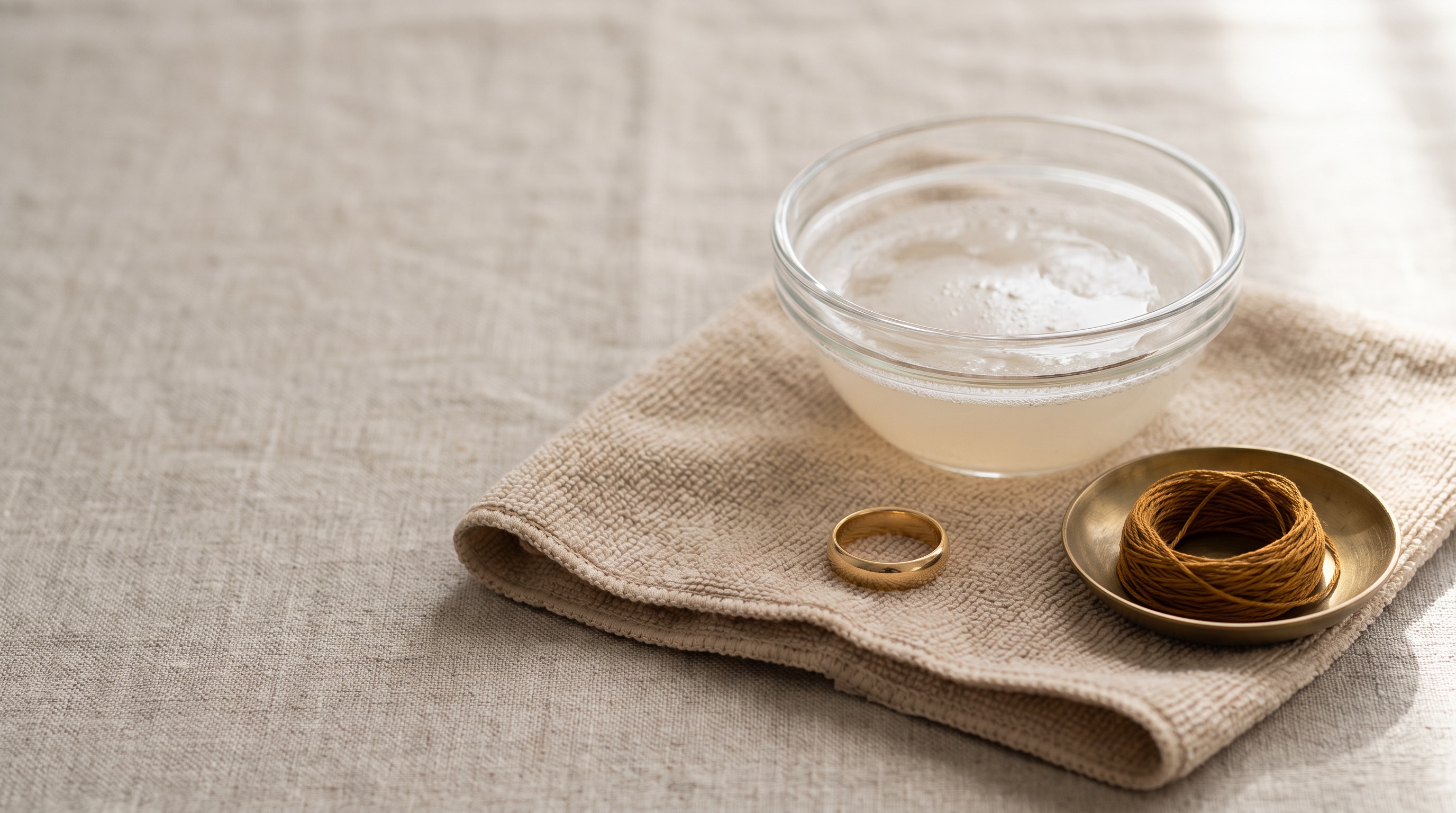
Gold jewelry can be cleaned safely at home with warm water, a few drops of mild dish soap, and a soft-bristled brush — soak for 10-15 minutes, brush gently along the setting and in crevices, rinse under warm running water, and dry with a lint-free cloth. That basic method is safe for plain gold and for most gold jewelry set with diamonds. It is not safe for every gemstone or every finish, and knowing the exceptions is exactly where most at-home cleaning mistakes happen.
The Safe At-Home Method, Step by Step
For solid gold jewelry — rings, chains, bracelets, earrings — with no gemstones or with diamonds only, this method works reliably:
- Mix the solution. A few drops of mild, ammonia-free dish soap in a bowl of warm (not hot) water.
- Soak. 10-15 minutes is enough to loosen everyday oils, lotion residue, and light grime. Heavily soiled pieces can soak up to 30 minutes.
- Brush gently. A soft-bristled brush — a clean, unused baby toothbrush works well — focused on settings, prong bases, and any engraved or textured detail where residue collects. Avoid scrubbing flat polished surfaces aggressively, which can create fine scratches over time.
- Rinse thoroughly. Warm running water, held over a closed drain stopper or a cloth-lined sink to avoid losing a stone or the piece itself down the drain.
- Dry completely. A soft, lint-free cloth. Don't let gold jewelry air-dry in a jewelry box, since trapped moisture can affect other pieces or promote tarnish on mixed-metal items stored nearby.
Gold Karat: Does It Change the Cleaning Approach?
Higher-karat gold (18k, 22k) is softer and more pliable than lower-karat gold (10k, 14k), because it contains a higher percentage of pure gold relative to the hardening alloy metals mixed in. In practice, this means:
| Karat | Gold content | Cleaning consideration |
|---|---|---|
| 10k | ~41.7% gold | Most scratch-resistant; standard soap-and-water method is very safe |
| 14k | ~58.3% gold | Standard method safe; still reasonably durable |
| 18k | 75% gold | Softer surface; use a lighter brushing touch to avoid fine surface scratches |
| 22k/24k | 91.6-99.9% gold | Very soft; avoid brushing polished surfaces at all, soak-and-rinse only |
The alloy metals mixed into gold to raise its hardness — typically copper, silver, zinc, or nickel depending on whether the piece is yellow, white, or rose gold — are what give lower-karat gold its extra scratch resistance. This is also why 18k and 22k pieces show wear (thin scratches, softened edges on prongs) faster than 14k pieces under identical use, independent of how they're cleaned. It's also worth knowing that karat alone doesn't tell you everything about a piece's durability — the specific alloy mix varies by manufacturer and region, so two 18k rings from different sources can wear slightly differently even at the same stated purity. When in doubt about how a specific piece will hold up to regular cleaning, the gentler end of the recommended approach for its karat tier is always the safer default.
For jewelers fielding care questions from customers who don't know their piece's karat, a quick visual and stamp check settles it — legitimate gold jewelry sold in the US is required to be stamped with its karat purity (10K, 14K, 18K, or a numeric equivalent like 417, 585, 750) somewhere inconspicuous, usually inside a ring band or on a clasp. Customers who can't find or read a stamp should default to the gentlest cleaning approach until a jeweler can confirm the karat directly.
What NOT to Use on Gold Jewelry
Several common household products and habits damage gold jewelry, gemstones, or both:
- Chlorine bleach and chlorinated pool water. Chlorine actively weakens gold alloys over repeated exposure and can cause pitting or discoloration, especially on lower-karat gold with higher alloy content. Always remove gold jewelry before swimming in a chlorinated pool or cleaning with bleach-based products.
- Ultrasonic cleaners on fracture-filled or heavily included stones. Ultrasonic vibration can worsen existing fractures or loosen fillings in treated stones. Fine for most solid gold-and-diamond pieces, but not universally safe — see the gemstone section below.
- Abrasive toothpaste or baking soda scrubs. A surprisingly common home remedy, but the mild abrasives in toothpaste are formulated for enamel, not polished gold, and will dull the surface finish over repeated use.
- Paper towels for drying or polishing. Paper towels are mildly abrasive at a microscopic level and can leave fine scratches on soft, high-karat gold. Use a proper jewelry cloth or a soft cotton cloth instead.
- Commercial jewelry cleaning dips with unknown chemical composition. Many contain ammonia or other chemicals that are unsafe for specific gemstones (see below) even when marketed as "all-purpose."
Cleaning Gold Jewelry With Gemstones: It Depends on the Stone
The soap-and-water method above is safe for diamonds specifically, which are extremely hard and chemically stable. It is not universally safe for other gemstones commonly paired with gold settings:
| Gemstone | Home cleaning safety | Notes |
|---|---|---|
| Diamond | Safe | Hardest natural material; soap-and-water and gentle ultrasonic cleaning are both fine for untreated, unfractured stones |
| Sapphire / ruby | Generally safe | Very durable, but check for fracture-filling or heat treatment disclosures before ultrasonic cleaning |
| Emerald | Avoid soaking and ultrasonic | Almost always oil-treated to mask inclusions; soaking or ultrasonic cleaning can strip the oil and expose fractures. Wipe with a soft, barely damp cloth only |
| Pearl | Avoid soap and soaking entirely | Porous and soft; wipe with a dry or barely damp soft cloth after wear, never submerge |
| Opal | Avoid soaking | Contains water content and can crack from temperature shock or drying out; wipe gently only |
| Turquoise / coral / other porous stones | Avoid soap and chemicals | Porous materials absorb liquids and chemicals, which can permanently discolor the stone |
When a piece mixes gold with a stone that isn't diamond-safe, clean to the standard of the most delicate material in the piece, not the metal. A gold-and-emerald ring gets the emerald's gentle-wipe treatment, not the gold's soap-and-soak treatment, even though the gold itself could technically handle more.
Gold-Filled and Gold-Plated: A Different Set of Rules
Solid gold and gold-plated or gold-filled jewelry are not the same material, and treating them the same way at home is a common mistake:
- Gold-filled has a thick layer of real gold bonded to a base metal core — durable enough for the same soap-and-water method as solid gold, though prolonged soaking should still be avoided as a precaution.
- Gold-plated has a much thinner gold layer over a base metal, and aggressive cleaning, brushing, or soaking can wear through that layer over time, exposing the base metal underneath. Wipe gently with a soft, barely damp cloth instead of soaking or brushing.
This distinction matters for independent jewelers fielding customer care questions: a customer who bought a solid gold piece and a gold-plated piece from two different sources may reasonably assume the same care routine applies to both, and giving blanket "soak and brush" advice without confirming which they're wearing risks damaging the plated piece.
How Often Should Gold Jewelry Be Cleaned?
For daily-worn pieces like engagement rings and wedding bands, a quick soap-and-water clean every one to two weeks keeps lotion, oil, and soap residue from building up in settings, where it dulls a stone's brilliance well before it becomes visible as obvious grime. Occasional-wear pieces need less frequent attention — a clean before and after wearing is generally sufficient. Pieces worn during workouts, gardening, or other activities with heavy sweat or dirt exposure benefit from cleaning immediately after, since sweat's salt and acid content can accelerate tarnish on lower-karat gold alloys over time.
When to Send a Piece to a Professional Instead
Home cleaning has real limits. Refer a piece to a jeweler for professional cleaning and inspection rather than continued home cleaning when:
- A stone feels loose or the setting shows visible wear on prongs — cleaning won't fix a structural issue and soaking a loose stone risks losing it.
- The piece has heirloom or antique value where the risk of even minor home-cleaning damage outweighs the convenience.
- Visible tarnish, discoloration, or a cloudy film persists after a proper home clean, which can indicate a chemical reaction, a treatment breaking down, or an alloy issue that needs professional assessment.
- The piece combines gold with a mix of stone types where the safest cleaning approach isn't obvious — professional ultrasonic and steam cleaning equipment lets a jeweler treat each material correctly in one pass.
A quick annual professional check and clean, even for pieces cleaned regularly at home, also catches loose prongs and early setting wear before they become a lost-stone problem — a service independent jewelers can proactively offer to their customers as a low-cost, high-trust touchpoint that also brings people back into the store between purchases.
This kind of low-friction, recurring service point is worth building into a customer relationship deliberately rather than leaving it to chance. A short reminder at the one-year mark after a sale — timed to an anniversary, a birthday, or simply a calendar note — framed as a complimentary inspection and clean rather than a sales pitch, does more for repeat business and referrals than most paid marketing, precisely because it reads as genuine care for the piece rather than an upsell attempt. Jewelers who build this into their standard post-sale process consistently report it as one of their highest-trust, lowest-cost customer retention tools.
Cleaning Gold Chains and Bracelets: A Few Extra Steps
Chains and bracelets collect debris differently than rings do, mostly because of the links and clasp mechanism rather than the metal itself. A few things worth doing specifically for chain-style pieces:
- Soak longer, brush less. Fine link chains trap oils and lint between links in a way a flat band never does. A longer soak (up to 20-30 minutes for a heavily worn chain) does more of the cleaning work than brushing, which risks bending delicate links if done too aggressively.
- Pay special attention to the clasp. Spring-ring and lobster clasps have small moving parts where grime accumulates and can eventually stiffen the mechanism. A soft brush worked gently around the clasp hinge, followed by a thorough rinse, keeps it operating smoothly.
- Lay flat to dry, don't hang. Hanging a wet chain to dry can cause water to pool at the lowest link or clasp point; laying it flat on a cloth distributes drying evenly and reduces the chance of water spots on polished links.
- Check for kinks before storing. A kinked link is a weak point that's prone to breaking under normal wear. Gently work out any kinks by hand (never with pliers on a piece still being worn) before putting a cleaned chain back into rotation.
Storage Habits That Reduce How Often Cleaning Is Needed
How gold jewelry is stored between wears has a real, cumulative effect on how quickly it needs cleaning again:
- Separate compartments or soft pouches prevent pieces from scratching each other in a jewelry box, which both preserves the polish and avoids creating tiny surface scratches that trap grime more easily over time.
- Keep gold away from direct sunlight and heat sources — not because gold itself degrades from light, but because nearby gemstones (especially treated or porous ones) can be affected, and because a warm environment accelerates tarnish-causing reactions on lower-karat alloys.
- Remove jewelry before applying lotion, perfume, or hairspray, and let those products fully dry before putting jewelry back on. This single habit change reduces buildup in settings more than any cleaning routine can compensate for after the fact.
- Store silver-alloy rose or white gold pieces away from rubber or latex, which can cause a chemical reaction that tarnishes silver-containing alloys faster than normal air exposure would.
Cleaning Two-Tone and Mixed-Metal Pieces
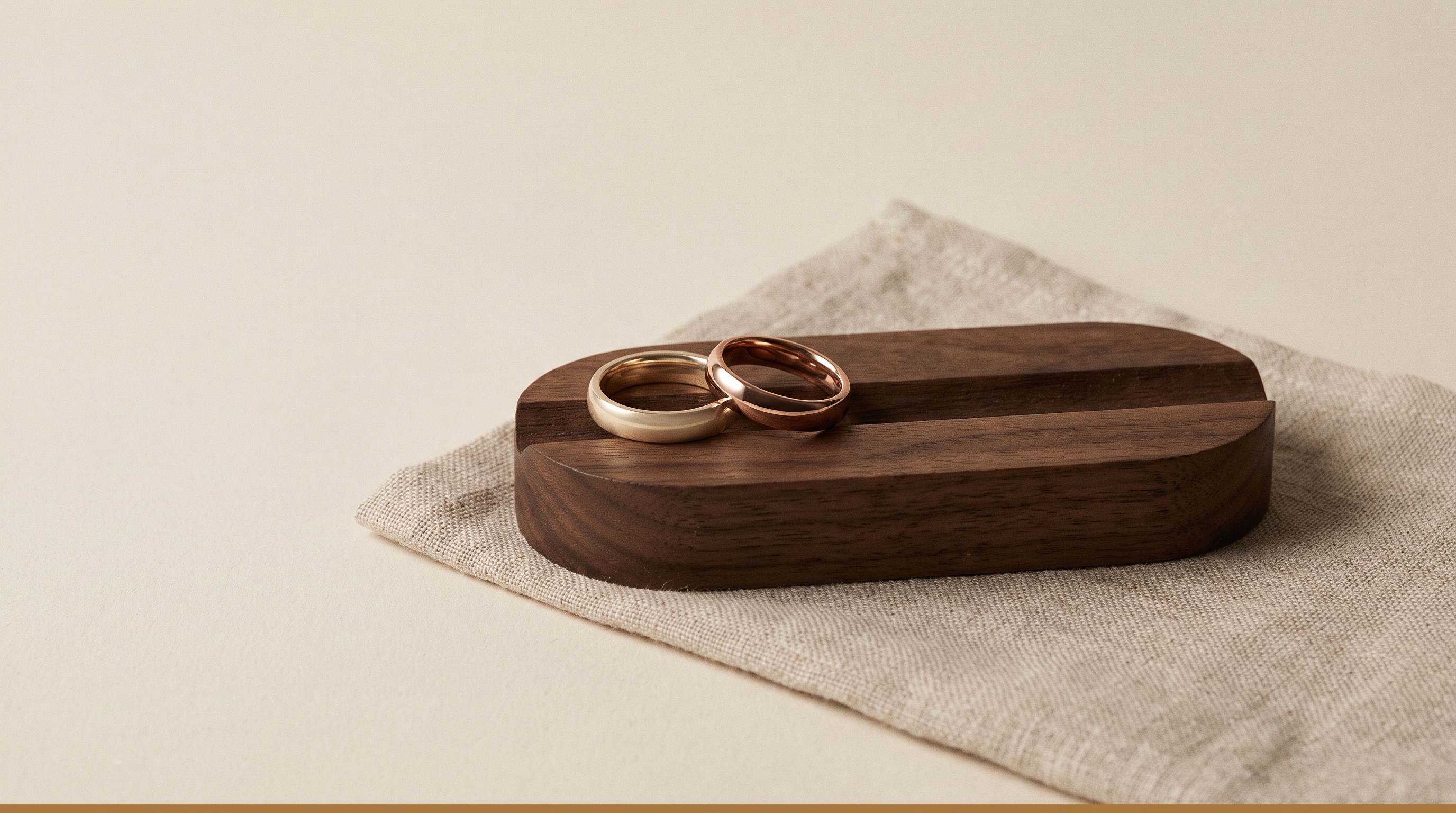
A ring or bracelet that combines yellow gold with white gold, rose gold, or platinum accents needs the same soap-and-water base method, but with one extra consideration: different metals can develop slightly different surface characteristics over time even when cleaned identically. White gold, for instance, is typically rhodium-plated to achieve its bright white finish, and that plating wears thinner with cleaning and daily wear regardless of how gently it's done — eventually revealing the warmer, slightly yellow-grey tone of the white gold alloy underneath. This isn't a cleaning mistake; it's a normal, expected part of white gold ownership, and re-plating every 12-18 months (a quick, inexpensive service most jewelers offer) restores the original bright finish. Yellow and rose gold don't have this plating layer to wear through, so a two-tone piece will often need rhodium re-plating on its white-gold sections well before the yellow or rose portions show any comparable change, even though both were cleaned exactly the same way the entire time.
For pieces that combine gold with platinum, note that platinum develops a soft, brushed-looking surface called a patina with wear, which some customers like and others prefer polished away — worth mentioning proactively so a first-time platinum-and-gold piece owner doesn't mistake normal patina development for cleaning residue.
Common Myths About Cleaning Gold Jewelry
A few pieces of cleaning advice circulate widely despite being inaccurate or risky:
- "Gold doesn't tarnish, so it doesn't need cleaning." Pure gold (24k) doesn't tarnish, but almost no jewelry-grade gold is 24k — the alloy metals mixed in to add durability (copper, silver, zinc) can tarnish or discolor over time, particularly with sweat, lotion, or chlorine exposure.
- "Any jewelry cleaner is safe for any piece." Commercial dip cleaners are formulated for specific materials, and using an all-purpose dip on a piece with emerald, pearl, opal, or other sensitive stones can cause real, sometimes irreversible damage.
- "More scrubbing means cleaner jewelry." Past a certain point, more aggressive scrubbing just adds fine surface scratches without meaningfully improving cleanliness — soak time does more of the actual work than brush pressure.
- "Boiling water sanitizes and cleans jewelry better." Sudden temperature extremes can stress-crack certain gemstones (opal especially) and isn't necessary for cleaning — warm, not hot or boiling, water is both safer and sufficient.
Frequently Asked Questions
Can I use toothpaste to clean gold jewelry?
It's not recommended. Toothpaste contains mild abrasives designed for tooth enamel, which are harder than a polished gold surface and will dull the finish with repeated use. Mild soap and warm water is a safer, equally effective alternative.
Is it safe to clean gold jewelry with baking soda?
No — baking soda is abrasive enough to scratch soft, high-karat gold over time, and it's not necessary given how effective plain soap and water already is for everyday grime.
Can I clean gold jewelry with vinegar?
Avoid it. Vinegar is acidic and can react with certain metal alloys used in gold jewelry, and it's unsafe for porous or treated gemstones like emerald, pearl, and turquoise. Stick to mild dish soap and warm water.
How do I clean gold jewelry that has turned black or green?
Discoloration usually comes from a reaction between skin oils, lotions, or sweat and the alloy metals in lower-karat gold, or from a plating layer wearing through. A gentle soap-and-water clean often helps, but persistent discoloration is worth a professional evaluation to rule out an allergy reaction or plating wear.
Is ultrasonic jewelry cleaning safe for gold rings at home?
It's safe for solid gold with diamonds and most untreated hard gemstones, but not for emeralds, pearls, opals, or fracture-filled stones. If you're not certain what treatments a stone has had, skip the ultrasonic cleaner and use the gentler soap-and-water method instead.
How do I dry gold jewelry without scratching it?
Use a soft, lint-free cloth rather than paper towels or regular bath towels, both of which can leave fine surface scratches on soft, high-karat gold over repeated use.
Quick Reference by Piece Type
| Piece | Recommended method | Frequency |
|---|---|---|
| Plain gold band (no stones) | Standard soap-and-water soak and brush | Every 2-4 weeks, or as needed |
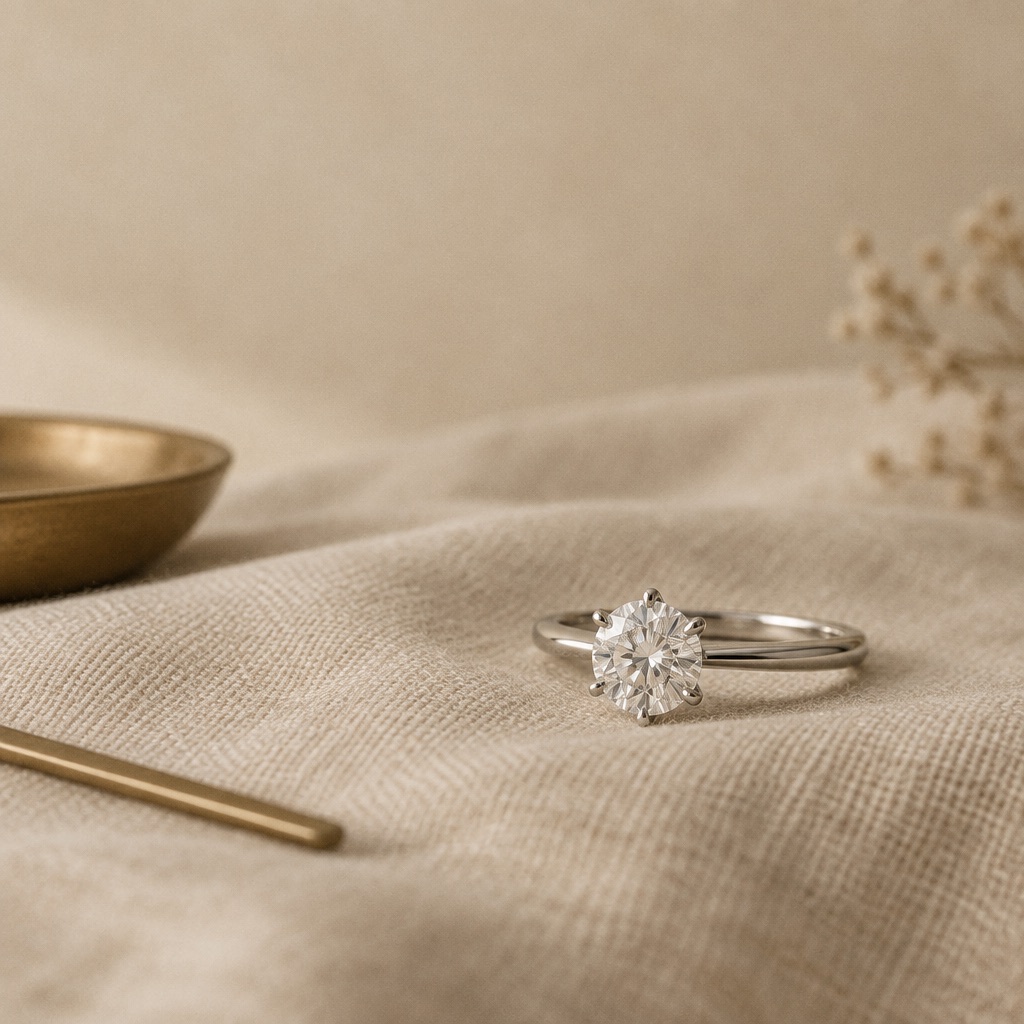
| Diamond engagement ring | Standard soap-and-water soak and brush, ultrasonic OK if untreated | Every 1-2 weeks |
| Gold chain, fine links | Longer soak, minimal brushing, lay flat to dry | Every 3-4 weeks |
| Gold with emerald, pearl, or opal | Soft damp-cloth wipe only, no soaking or ultrasonic | After each wear |
| Gold-plated jewelry | Gentle damp-cloth wipe only | As needed, avoid frequent soaking |
| White gold (rhodium-plated) | Standard method; schedule professional re-plating separately | Clean as normal; re-plate every 12-18 months |
This table is a starting point, not a substitute for checking the specific gemstone and treatment combination on a given piece — when a piece's exact composition isn't known with certainty, defaulting to the gentlest applicable method and asking a jeweler at the next opportunity avoids irreversible mistakes.
A Note From Guru Diam
Guru Diam supplies independent jewelers with loose diamonds and finished jewelry across our full certified diamond range, and our custom jewelry program finishes engagement rings and other pieces in 4-6 days once a design is approved. For jewelers building out customer-care resources — care guides, cleaning instructions, warranty terms — accurate, karat- and gemstone-specific guidance like the above builds real trust with customers and reduces avoidable damage claims. Trade accounts sourcing consistently through our wholesale hub or trade partner program can request co-brandable care-guide language for their own customer materials.
Getting care guidance right also protects against a specific, recurring source of customer friction: a piece damaged by improper at-home cleaning can look, to an unhappy customer, indistinguishable from a manufacturing or setting defect, especially when the damage (a scratched finish, a stripped plating layer, a clouded treated stone) shows up weeks or months after purchase. Clear, specific care instructions handed to the customer at the point of sale — not just a generic "clean with soap and water" line — measurably reduce the number of warranty and defect claims that actually trace back to a cleaning mistake rather than a real product issue.