
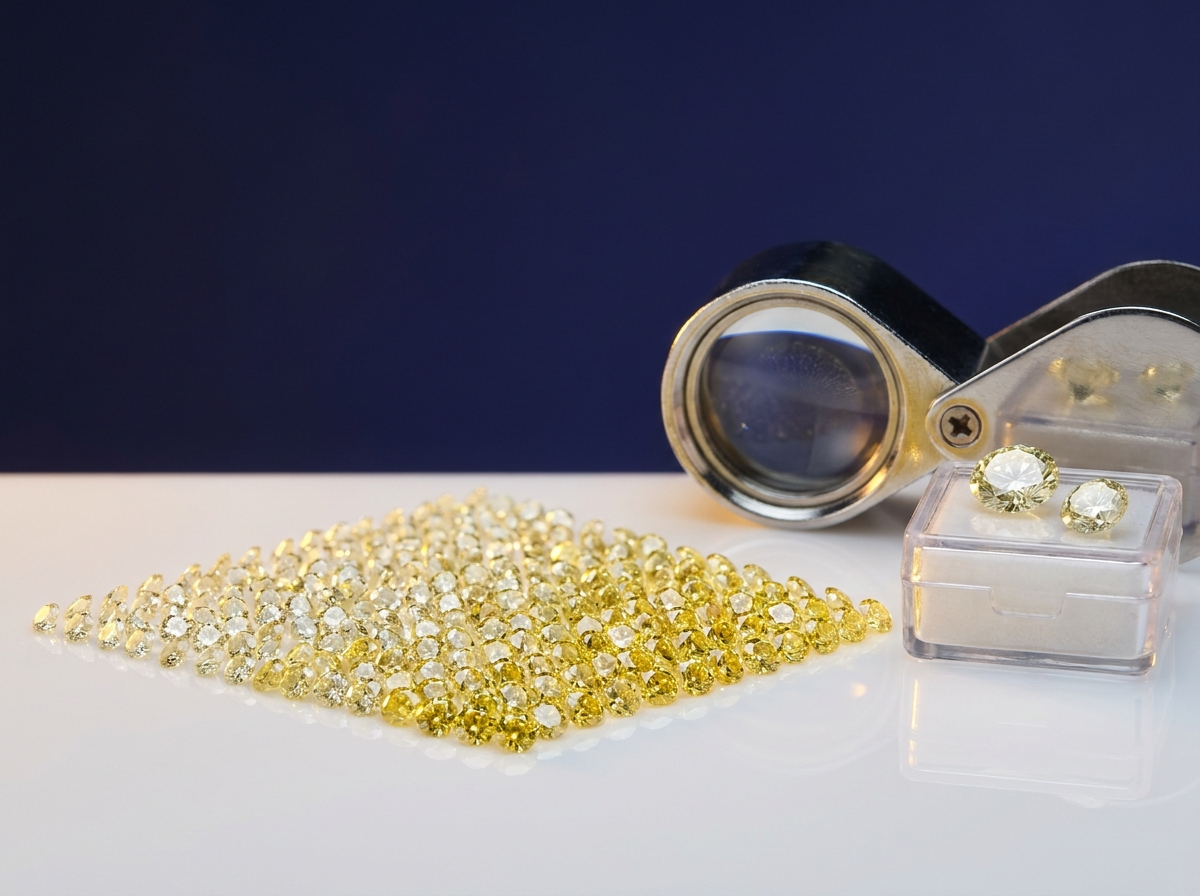
Fancy color melee is matched by sorting stones against reference master stones under controlled light to hold a defined color range — for example, Fancy Yellow to Fancy Intense Yellow — while calibration gauges hold size to a tight millimeter tolerance. Individual melee stones aren't certified; the parcel is QC'd against that color and size baseline, IGI-gradable on request. This matching discipline, not the ability to grade a single stone, is what separates wholesalers who can actually deliver a usable fancy color melee parcel from ones who only claim to carry the category.
Any wholesaler can list "fancy color melee" on a website. Far fewer can put a hundred yellow accents on a bench that all read as the same yellow under the same light. This page covers how that matching actually happens, and what to check before committing to a parcel.
This is a process breakdown, not a product overview — for a general look at what's in the fancy color melee line, see the fancy color melee overview. Here we're covering the mechanics: how a sorter reads a stone against a reference set, how a color band gets set and held, how batch sorting actually moves a color-developed run into a boxed, sellable parcel, what quality floor sits underneath the color match, and what to specify when you request a quote.
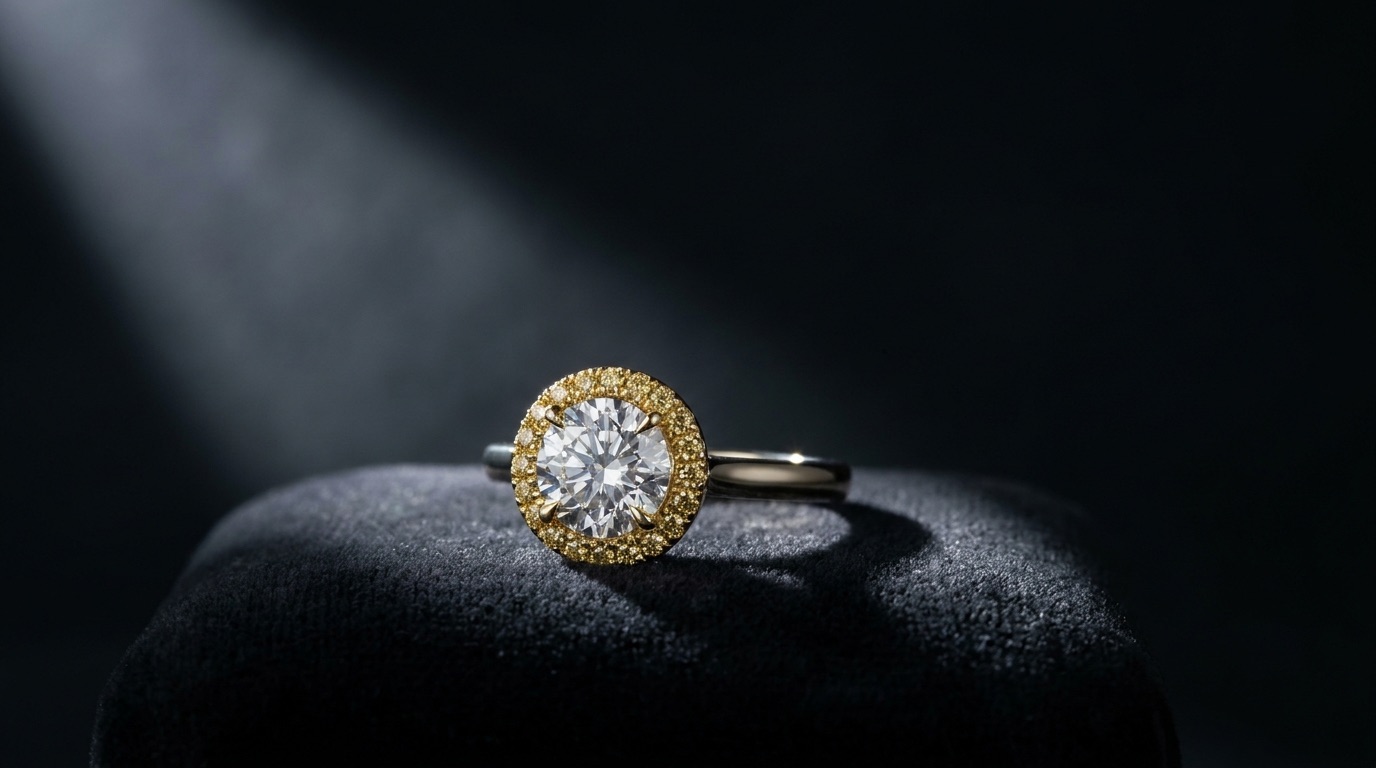
How is a fancy color melee parcel actually matched?
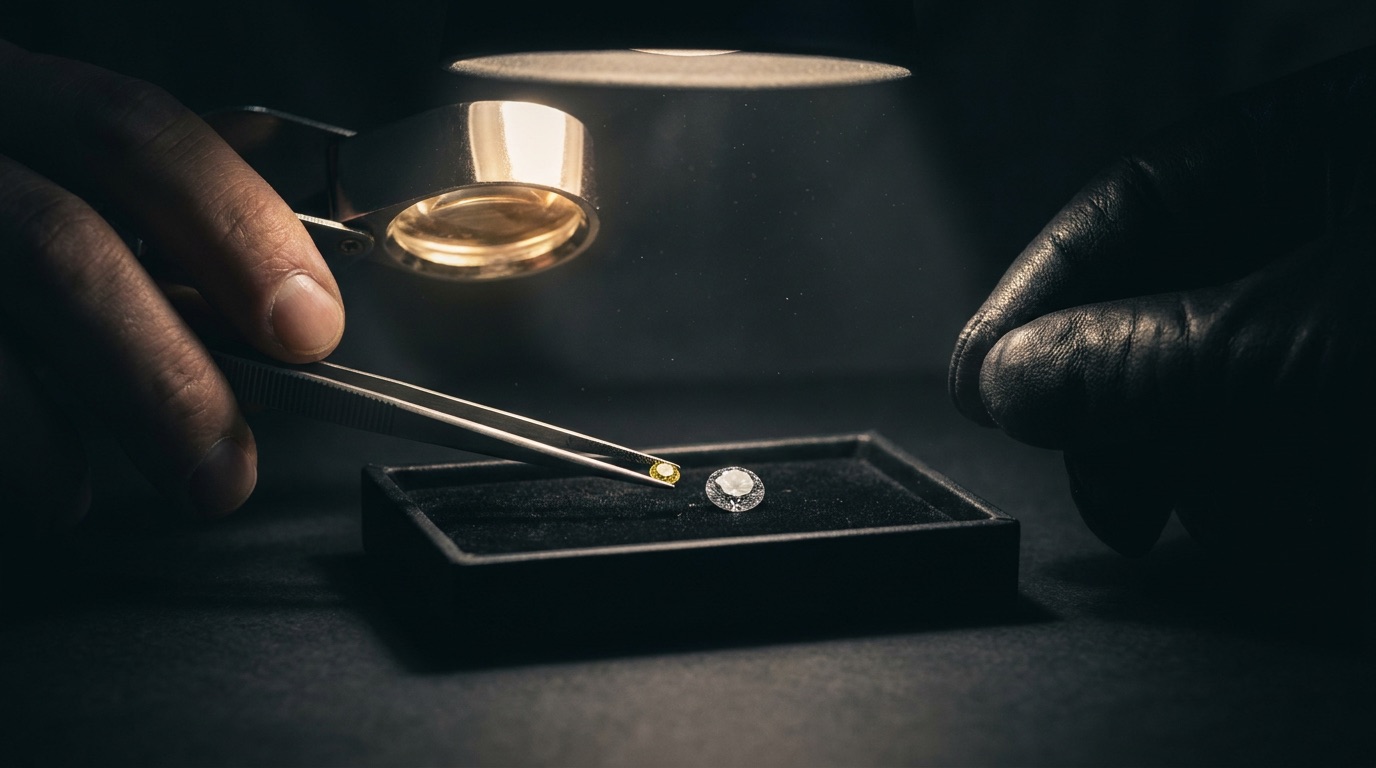
By comparing every stone against a set of reference master stones — physical stones that anchor the boundaries of the target color range — under consistent, controlled lighting, rather than by grading each stone individually the way a certified single is graded. A sorter holds each stone against the reference set and either accepts it into the parcel or routes it to a different color group.
That's a different discipline from single-stone certification, which assesses hue, tone, and saturation against a controlled reference system and documents it on a certificate. Melee stones are too small and numerous to run through that one at a time economically, so the question shifts from "grade this stone" to "does this stone belong in this parcel" — a faster, comparative judgment repeated at volume. Because the stones are CVD-grown and color-developed in-house, the sorter works with production output from a controlled process rather than assembling a match from scattered brokered lots, which is what makes holding a tight reference band realistic.
The reference master stones themselves are the anchor for the whole process — they get checked and re-verified periodically, and a sort is only as reliable as the reference set it's run against. A supplier working from a stable, maintained reference set can hold the same range consistently across separate sorting runs weeks apart; a supplier improvising a range from memory or a printed color chart can't.
The three variables a sorter actually controls: hue, tone, and saturation
Every fancy color diamond, single or melee, is described along three dimensions borrowed from the same color-grading vocabulary IGI and GIA use for certified stones: hue (is it yellow, pink, blue, green — and where it sits relative to adjacent hues), tone (how light or dark the color reads), and saturation (how strong or weak the color is at that tone). A certified single gets a documented position on all three axes. A melee sorter isn't documenting a position — they're making a fast accept-or-reject call against a physical reference stone that already sits at the edge of the target range, but the call is still being made on those same three variables.
Hue drift is the easiest failure to spot and the hardest to fix after the fact: a yellow stone that leans slightly green, or a pink stone that leans slightly purple, will read as "off" next to its neighbors even if every stone individually would pass as its named color in isolation. Tone and saturation drift are subtler — two stones can both legitimately be "Fancy Yellow" and still not match, because one sits at the pale edge of the range and the other sits at the deep edge. A parcel held to a tight range controls for all three at once; a parcel assembled by hue name alone usually only controls for the first.
Lighting matters more than most buyers assume, for the same reason. A pair of stones that agree under a jeweler's daylight-balanced loupe can visibly disagree under warm showroom halogen or a phone camera's white balance, because tone and saturation shift with color temperature more than hue does. Sorting under one controlled light source, and spot-checking the accepted range under at least one secondary light, is what keeps a matched parcel matched once it leaves the bench and lands on a customer's counter.
Color banding: why melee is graded in ranges, not single grades
A certified fancy color single gets one grade — say, Fancy Intense Yellow — because it's one stone and the cost of full grading is justified by the stone's value. Melee doesn't work that way, even before certification economics enter the picture: at roughly 0.9mm to 2.5mm, the color step between adjacent grade boundaries (Fancy Light to Fancy, or Fancy to Fancy Intense) is visible under a loupe but genuinely hard to call consistently, stone by stone, at volume. Grading in bands — accepting a defined span across one or two adjacent grade steps — is the practical answer, and it's the standard the whole trade actually sorts to, not a shortcut unique to any one supplier.
The width of the band is a direct tradeoff against yield. A single-grade band (all Fancy Yellow, no drift toward Fancy Intense at either edge) discards a larger share of any production run and costs more per finished carat sorted. A two-grade band (Fancy Yellow to Fancy Intense Yellow) is the default most quotes land on, because it holds a tight enough look for finished jewelry while keeping a usable share of the run in spec. A buyer who needs a single-grade band for a high-visibility piece can ask for it — it's a real option — but it should be priced and timed as the tighter, lower-yield sort it is, not assumed as the default.
Banding is set on the color axis independently from the size axis, covered below, which is why a complete spec for a matched parcel names both a color range and a size tolerance — not just a hue.
What does a "color range" spec actually mean?
A color range like "Fancy Yellow to Fancy Intense Yellow" defines the tolerance band a parcel is held to — every stone in the parcel falls somewhere between those two boundaries, rather than the parcel being one uniform grade. It's the melee equivalent of a size tolerance, applied to color instead of millimeters.
| Hue | Typical color range notation | What it controls |
|---|---|---|
| Yellow | Fancy Yellow to Fancy Intense Yellow | Saturation band — how deep the yellow reads |
| Pink | Fancy Light Pink to Fancy Pink | Tone and saturation — avoiding drift toward purple or orange |
| Blue | Fancy Light Blue to Fancy Blue | Saturation — how cool and deep the blue reads |
| Green | Fancy Light Green to Fancy Green | Saturation, given how limited green rough is generally |
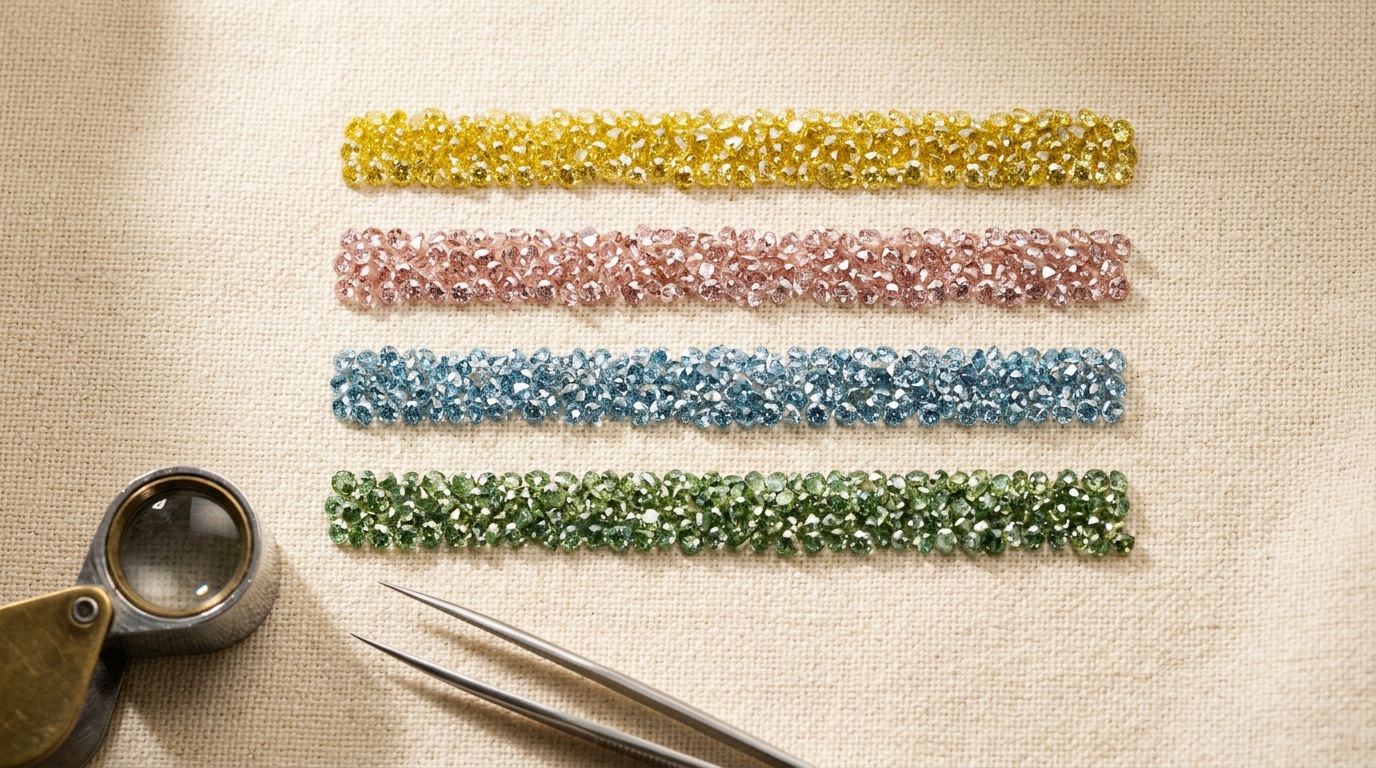
Guru Diam's fancy color melee line covers these four hues — Yellow, Pink, Blue, and Green — in round and fancy calibrated shapes. Champagne and cognac tones aren't part of the current fancy color melee line.
Ranges are set at the point of a quote based on what the design needs. A tighter range costs more sorting effort and yields a smaller usable parcel from the same production run, because fewer stones fall inside a narrow band; a wider range fills faster but carries more visible variation across the piece. Stating the range explicitly, rather than just naming a hue, is the single most useful thing a buyer can do when requesting a quote.
Batch sorting in practice: from color-developed run to boxed lot
A matched parcel doesn't come off the wheel already sorted — it's assembled in passes, each one narrowing the group further. The first pass is a hue split: color-developed and cut goods get separated into broad families (yellow, pink, blue, green) against a coarse reference set, mostly to route stones to the right specialist sorter and catch anything that isn't a clean read on any of the four hues Guru Diam carries in fancy color.
The second pass is the band sort — this is where the reference master stones for the specific quoted range come out, and each stone in a hue family gets held against them under the controlled light source and either accepted into the band or routed to an adjacent one. This is the slowest, most skill-dependent step, and it's where an experienced sorter's judgment on tone and saturation earns its cost.
The third pass is size and shape: stones that passed the color band get run against calibration gauges and grouped by millimeter diameter or, for fancy calibrated shapes, by length-to-width ratio. A stone can pass color and fail size, or the reverse — both passes have to clear independently before a stone counts toward the parcel weight a buyer quoted.
The final pass is a QC audit: a random sample pulled back out of the finished parcel and re-checked against the reference set by someone other than the primary sorter, catching drift that can creep in over a long sorting run as eyes fatigue or the reference stones themselves need re-cleaning. Only after that audit does a parcel get weighed, packaged, and released against a wholesale order.
None of this is visible from a product listing — it's the difference between a supplier who can describe a color range and one who's actually running the sort that holds it.
Calibration tolerance: matching size alongside color
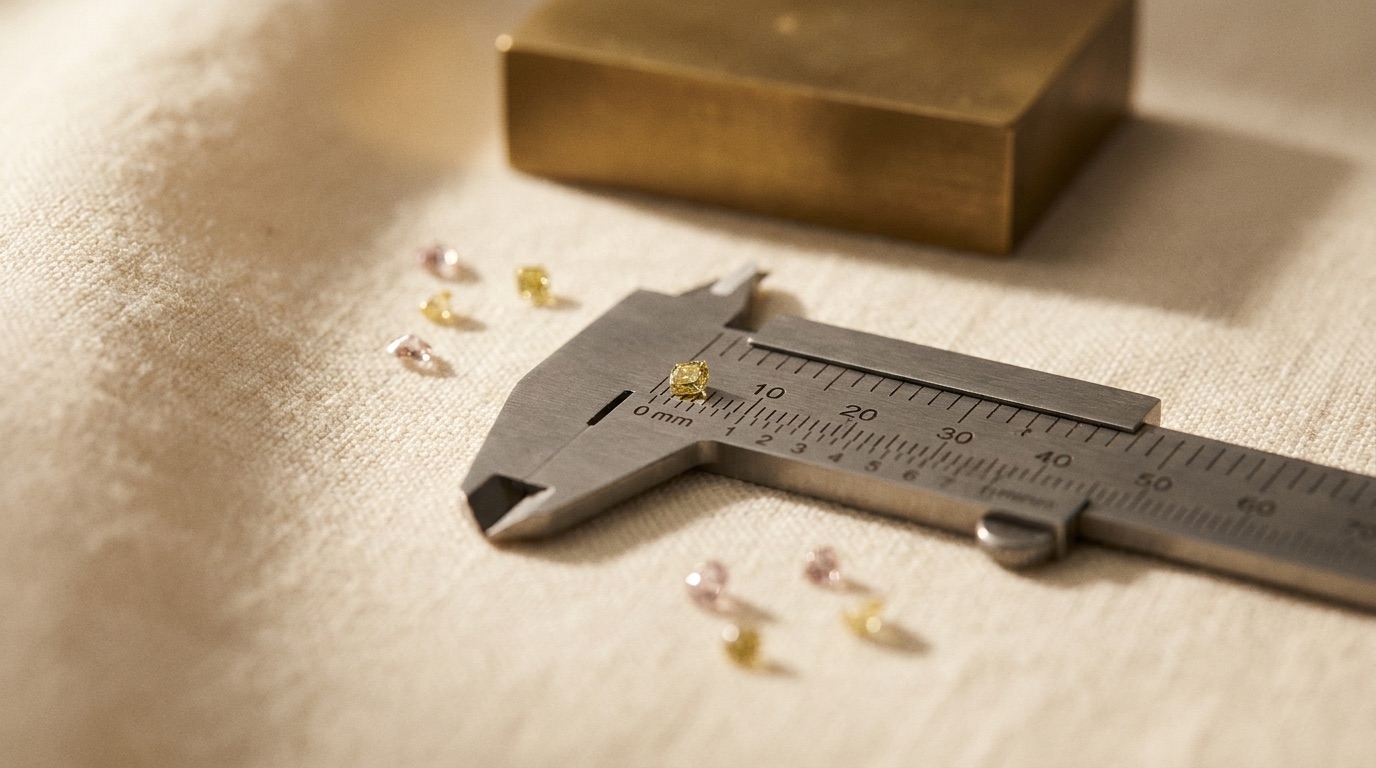
Size calibration works the same way it does for colorless melee — a target millimeter diameter, or length × width for fancy shapes, held to a tight tolerance and checked with precision gauges — but it has to hold at the same time as the color match, which is what trips up parcels assembled from mixed sources. A stone can be in-range on color and out-of-range on size, or vice versa, and either failure shows up on the bench as a stone that doesn't seat cleanly or doesn't blend. In-house production keeps both checks against the same standard on the same stones, rather than reconciling size specs from one supplier against color specs from another after the fact.
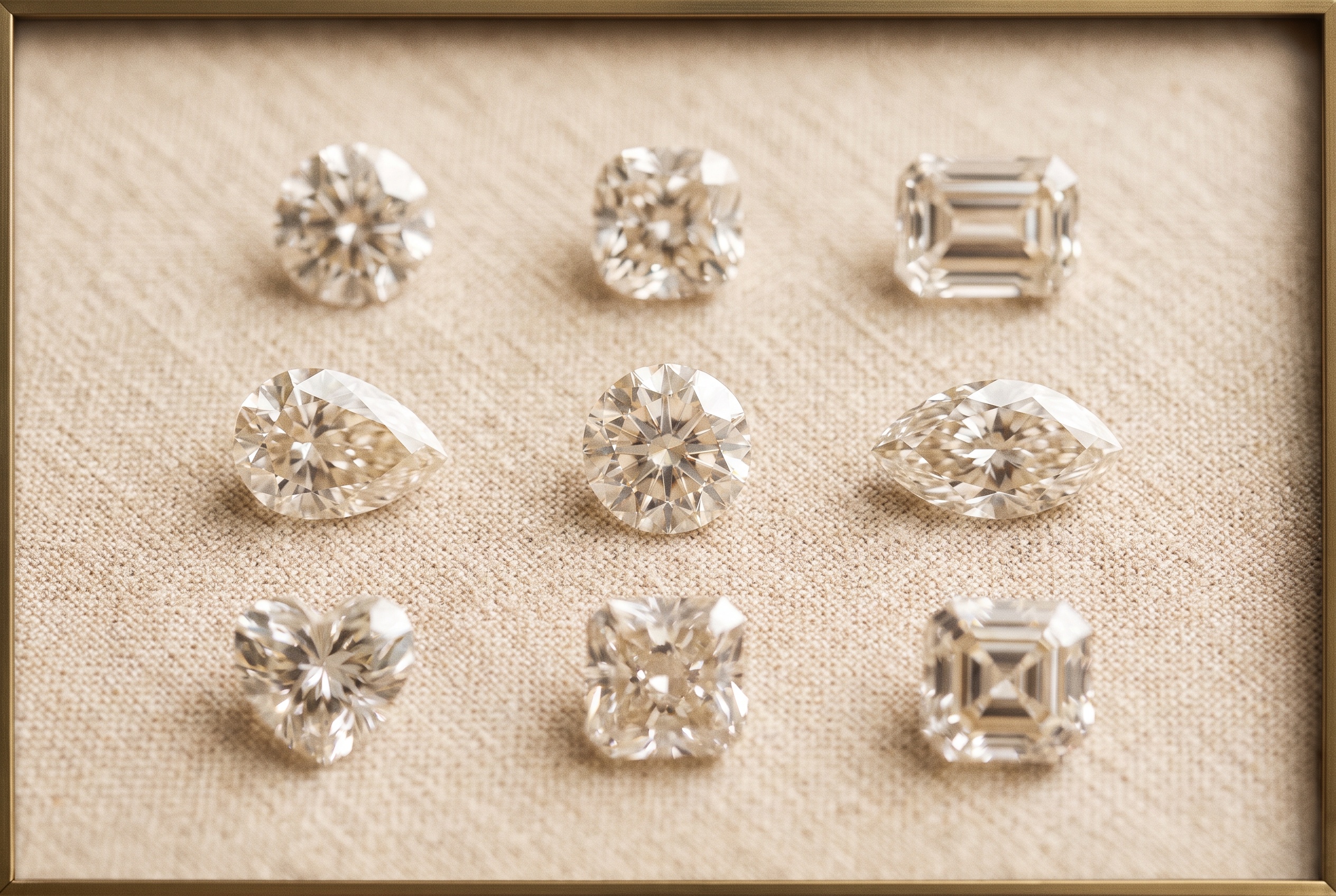
Fancy calibrated shapes — Emerald, Radiant, Pear, Marquise, and other calibrated shapes on request — add a second dimension to the tolerance: length-to-width ratio has to hold alongside overall size, since a batch of pear-shape melee that's correct on length but inconsistent on width will show visibly uneven outlines once set in a row. Round goods only need the single diameter tolerance, which is part of why round fancy color melee is generally the faster spec to fill against a tight range.
Quality standards: the clarity and consistency floor within a color-matched parcel
Color band and size tolerance get the most attention because they're what a mismatched stone announces first, but a matched parcel is also held to a clarity floor — eye-clean, VS+ range — applied consistently across every stone in the batch, not just the ones that happen to catch the light during a quick check. A parcel with even color and size but a few visibly included stones scattered through it will still show as inconsistent once set, just from a different axis than color.
Cut consistency matters too, in a way that's easy to overlook: two stones can be the same hue, same size, and same clarity tier and still catch light differently if their proportions vary, because a shallow stone and a well-proportioned stone of the same diameter don't return color the same way under the same light. Because Guru Diam's fancy color melee is cut and color-developed in-house rather than assembled from brokered lots of unknown cut quality, proportions are controlled at production rather than inherited as a variable the sorter has to work around after the fact.
Why matching is the real differentiator among wholesalers
Describing fancy color melee is easy; producing a parcel that seats and reads as one consistent field is not. That gap is why most wholesalers who list fancy color melee are actually reselling whatever loose color stones they can source, sorted loosely if at all, rather than running the reference-stone matching process a usable parcel requires.
The tell is in how a supplier answers a size-and-color-range request. One that can hand you a defined range — "Fancy Yellow to Fancy Intense Yellow, 1.3mm ± tolerance" — is running real production and sorting; one that can only offer "yellow melee, various sizes" is likely reselling an unsorted lot, and the parcel will show it on the bench: visible tone drift, seats that don't match. Ask for the range and the tolerance before you buy, and ask how the range was checked — against a reference set under controlled light, or by eye against whatever's on hand.
Why this matters for finished-jewelry consistency
A loose parcel that reads as matched on a sorting tray under a single light source has to keep reading as matched once it's set — in a halo, a three-stone accent run, a pavé shank — and viewed under every light a finished piece actually lives under: jewelry-case LED, daylight through a store window, a phone camera at the point of sale. Color and size variation that was borderline on the bench gets magnified once stones are prong-set close together, because the eye compares adjacent stones directly instead of judging each one in isolation.
This is the practical reason color banding and calibration tolerance matter more for fancy color melee than for a single center stone: a center stone is judged on its own merits, but a melee run is judged as a field, and a field is only as consistent as its worst outlier. One stone that drifted half a tone warm, or a size gauge that was off by a few hundredths of a millimeter, is invisible loose in a parcel bag and obvious the moment it's set next to nine identical neighbors.
For a jeweler or designer building a piece around a matched parcel, that translates directly into fewer remakes and fewer client-facing surprises after a piece is set and photographed — the kind of rework that costs bench time on a custom order, regardless of who absorbs it. Buying against a stated color range and tolerance, rather than a hue name, is what keeps that risk on the sorting bench instead of on the finished piece.
Sourcing a matched fancy color melee parcel
Guru Diam cuts, color-develops, and sorts fancy color melee in-house — the reference-stone matching process described above runs on our own production, not on brokered lots reconciled after the fact, which is what makes stating a real color-range spec and holding it possible. Quotes, account management, and in-stock orders run through our New York Diamond District desk (36 West 47th Street, Suite 601A, New York, NY) and our Los Angeles office (607 South Hill Street, Suite 241, Los Angeles, CA).
In-stock matched parcels ship same-day — before 6pm EST from New York, before 4pm PST from Los Angeles. Melee is QC'd against the color and size baseline described above rather than individually or parcel-certified, with IGI grading available on request. For a color range, size, or shape outside current stock, made-to-order sorting and cutting is a direct conversation with the production floor — turnaround depends on the range requested and what's already in the current run, so it's worth stating the full spec up front rather than just the hue.
See our fancy color melee overview, round melee guide, and fancy-shape melee guide for what's currently on hand by shape.
How to order a matched parcel: what to specify in a quote request
The fastest way to get an accurate quote — and the fastest way to tell whether a supplier can actually run the process above — is to specify the full spec instead of a hue name. A complete request covers:
- Hue and color range: not just "yellow," but the range — Fancy Yellow to Fancy Intense Yellow, for example — or a center stone to match against.
- Size and shape: millimeter diameter for round, or length × width for a fancy calibrated shape (Emerald, Radiant, Pear, Marquise, or another calibrated shape on request), plus the tolerance needed.
- Quantity in carats: total carat weight required, since melee is bought and sorted by weight, not piece count.
- Clarity floor: the default is an eye-clean, VS+ baseline — state it if a piece needs a tighter floor.
- Certification preference: melee ships as QC'd parcel goods by default; note if IGI grading on the parcel is needed for the order.
A supplier running real production can answer all five points specifically. One that can only offer "yellow melee, various sizes" is signaling a resold, loosely-sorted lot — the tell described earlier in this piece, and worth asking about even for a small order.
Ready to buy? Open a verified wholesale account at /signup and book time with a gemologist at /book-appointment to work through a spec before committing to a parcel.
FAQ
How is fancy color melee matched for color?
By comparing each stone against physical reference master stones under a single controlled light source, holding every stone in the parcel within a defined color range across hue, tone, and saturation — a comparative sorting process run in passes, not individual certification.
What does a color range like "Fancy Yellow to Fancy Intense Yellow" mean?
It defines the tolerance band a parcel is held to, the same way a millimeter tolerance defines a size range. Stating the range explicitly when requesting a quote is the most useful spec a buyer can give.
Is fancy color melee individually certified?
No. It's QC'd in-house against a color, size, and clarity baseline rather than certified stone by stone or at the parcel level. IGI grading is available on request.
How do I tell if a wholesaler can actually deliver a matched fancy color melee parcel?
Ask for a defined color range and size tolerance, not just a hue name. A supplier running real production and sorting can quote a specific range; one that can only offer "yellow melee, various sizes" is likely reselling an unsorted lot.
Can Guru Diam match a fancy color melee parcel to a specific center stone?
Yes. State the center stone's hue and tone when requesting a quote, and the parcel is sorted against that reference — the same in-house discipline used for fancy color matched pairs.
What hues and shapes does Guru Diam offer in fancy color melee?
Yellow, Pink, Blue, and Green, in round and fancy calibrated shapes (Emerald, Radiant, Pear, Marquise, and other calibrated shapes on request), from 0.8mm to 9.0mm. Champagne and cognac tones aren't part of the current fancy color melee line.