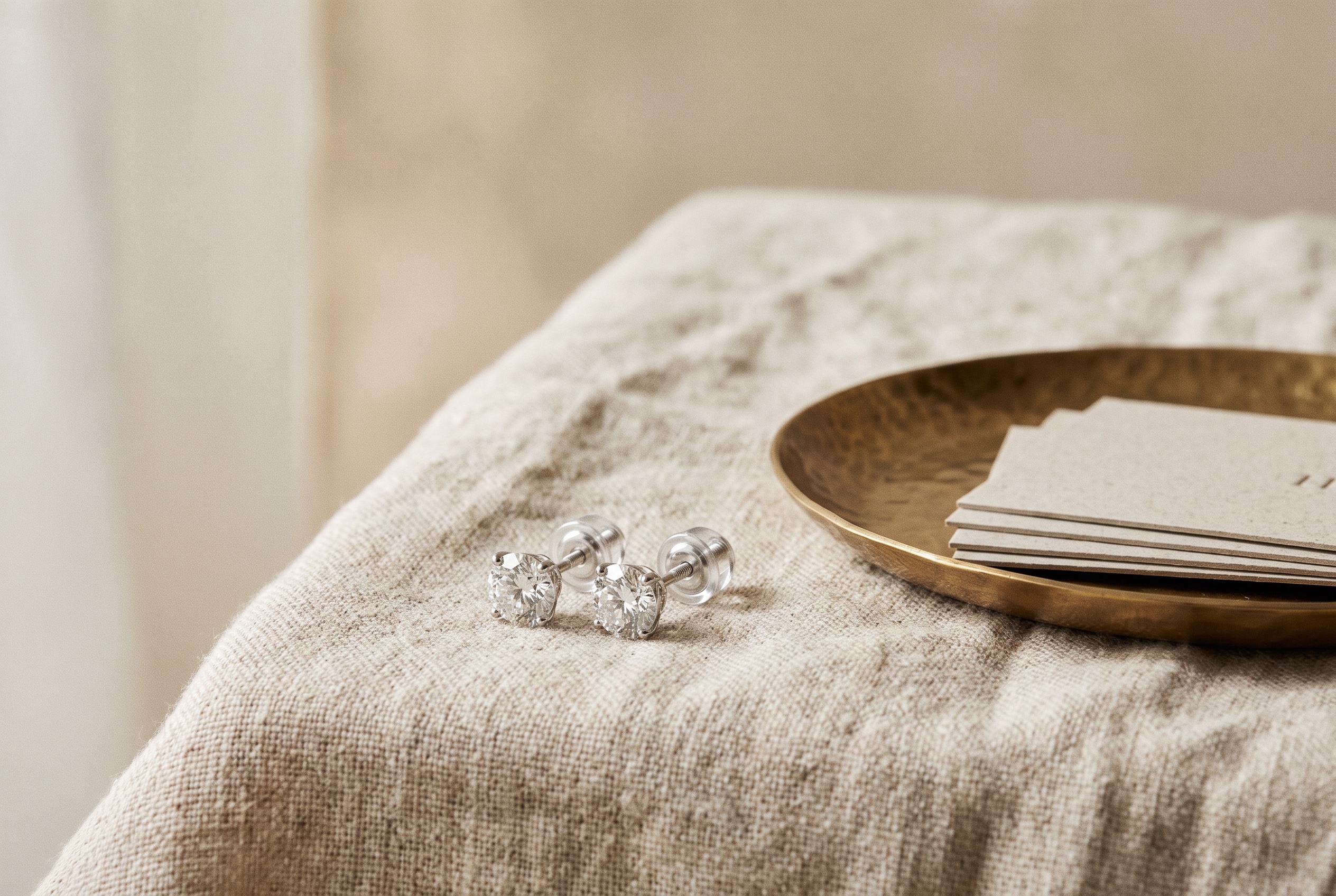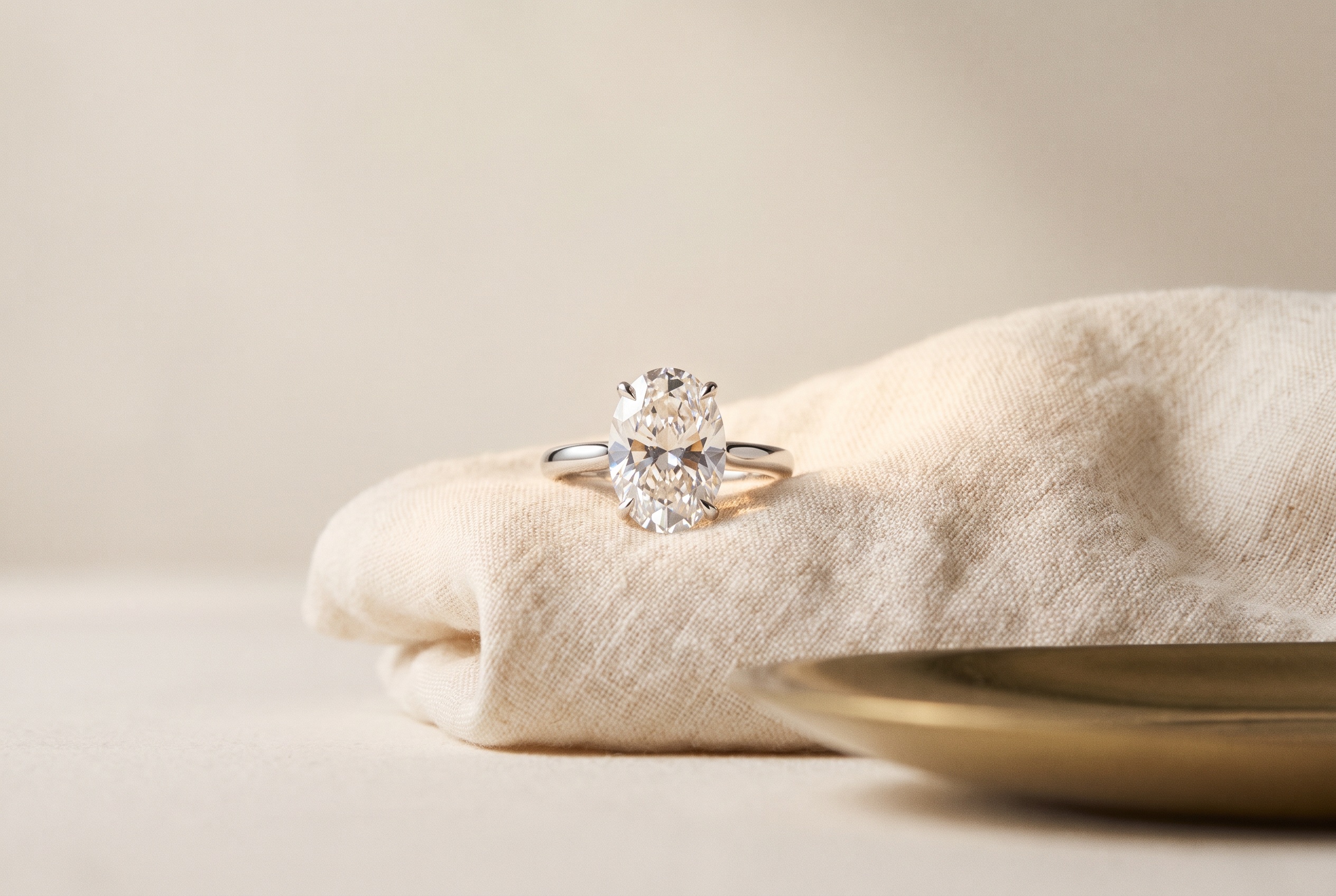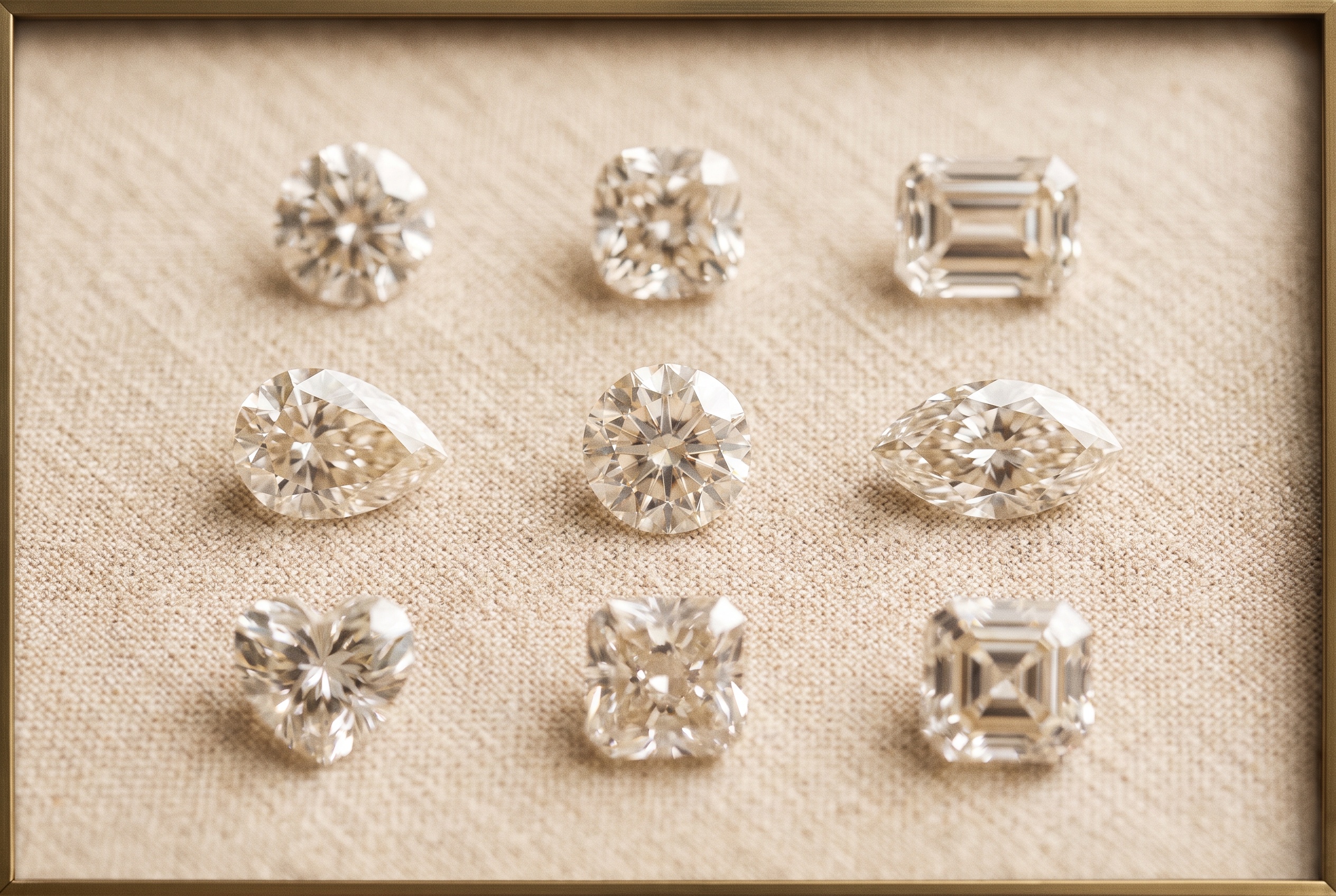

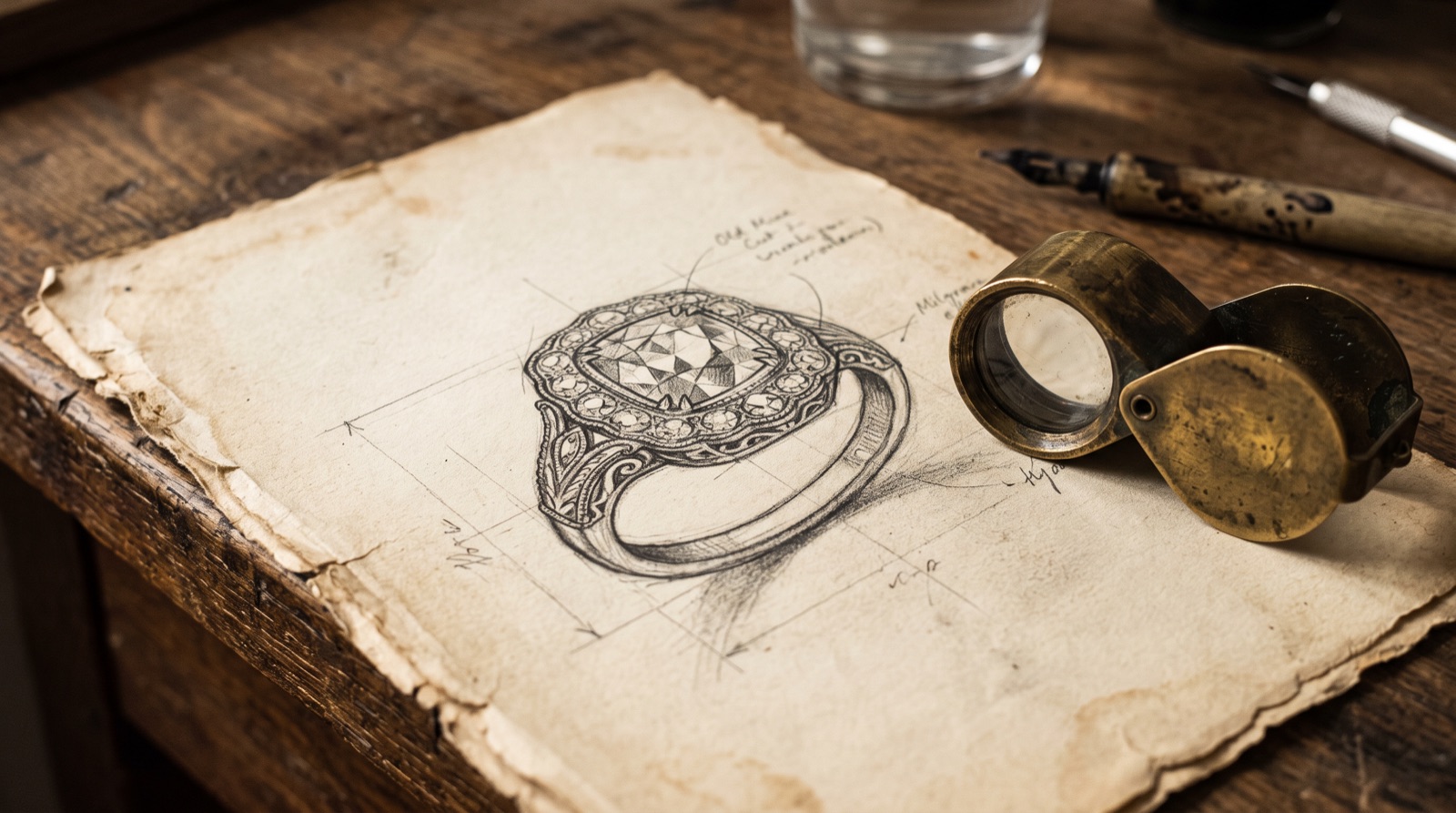
Antique and exotic diamond cuts — Old Mine, Old European, Kite, Lozenge, Moval, Hexagonal, Trillion, Criss-Cut, and Padparadscha-style stones — carry a real, structural per-carat premium over both round brilliants and modern fancy shapes like Emerald, Cushion, or Oval. That premium isn’t a markup pulled out of thin air. It tracks directly to the tooling, hand-finishing time, and cutting skill required to produce a true antique-style facet pattern, all of which are scarcer and slower than what round brilliant or standard fancy-shape cutting requires. For a jeweler quoting a custom piece, understanding that three-tier structure — and explaining it to the client before the estimate lands — is what keeps an antique-cut center stone from feeling like sticker shock.
The Three-Tier Cut Hierarchy
Every diamond cut on the market falls into one of three pricing tiers relative to the others. None of these tiers are set by fashion alone — each one reflects a different level of production complexity.
| Tier | Cuts in This Tier | Market Position | Why It’s Priced This Way |
|---|---|---|---|
| Antique / Exotic | Old Mine, Old European, Hexagonal, Moval, Lozenge, Kite, Trillion, Criss-Cut, Padparadscha-style | Highest per-carat cost | Bespoke faceting patterns, hand-finishing, limited pool of cutters trained in period-accurate work |
| Regular Fancy | Emerald, Asscher, Cushion, Oval, Pear, Marquise, Radiant, Princess, Heart | Mid-market | Modern, well-documented faceting recipes; moderate complexity; broader cutting capacity |
| Round Brilliant | Brilliant Round | Lowest per-carat cost | Fully standardized geometry, highest cutting throughput, most automation-friendly |
This is worth stating plainly, because it’s the single most common misconception jewelers run into with clients: Emerald, Asscher, and Cushion cuts are technically step cuts, and step-cut faceting is old in origin — but none of those three are antique cuts. They’re modern, standardized fancy shapes with well-established cutting recipes and wide production capacity. The antique tier is reserved for cuts like Old Mine and Old European that replicate a specific historical faceting style, hexagonal and moval shapes, and true novelty geometries like Kite, Lozenge, Trillion, and Criss-Cut. If a client asks for a “vintage-looking cushion,” that’s a regular fancy cut styled to look old — not an antique cut, and it shouldn’t be quoted like one.
Round Brilliants: The Commodity Baseline
Round brilliant is the reference point every other cut gets compared against. The geometry is fixed, the cutting process is the most repeatable in the industry, and cutting capacity for round goods is the deepest of any shape. That combination is what keeps round priced lowest per carat — it isn’t that round stones take less skill to appreciate, it’s that the cutting process scales more efficiently than any other shape.
Regular Fancy Cuts: Modern, Not Antique
Emerald, Asscher, Cushion, Oval, Pear, Marquise, Radiant, Princess, and Heart shapes sit in the middle of the market. They require more faceting judgment than round — matching proportions on an elongated Oval or a Pear, or keeping a Cushion’s corners symmetrical, takes real attention — but the recipes are standardized and widely known among cutters. That’s the mid-tier: more complexity than round, but nowhere near the scarcity of skill that antique and exotic cuts demand.
Antique and Exotic Cuts: The Craftsmanship Premium
Old Mine, Old European, Hexagonal, Moval, Lozenge, Kite, Trillion, Criss-Cut, and Padparadscha-style cuts sit at the top of the pricing ladder, and for structural reasons:
- Non-standard faceting patterns. Antique-style cuts don’t follow the same repeatable angle tables as round or regular fancy shapes. Each one requires a faceting approach suited to that specific geometry.
- Hand-finishing. These cuts lean more heavily on manual finishing passes rather than fully automated cutting, which adds time per stone.
- Fewer cutters trained in the style. Cutting an authentic Old Mine or Old European facet pattern — or a clean Kite or Lozenge — is a narrower skill set than standard round or fancy-shape cutting, which limits how much of this work can run in parallel.
- Lower yield from rough. Antique and exotic shapes are often less forgiving of the rough they’re cut from, which means more rough is consumed to reach a finished carat weight in some of these shapes.
None of this is proprietary to any one supplier — it’s the same production logic across the industry, and it’s why antique-cut center stones are quoted differently than round from the first conversation. For illustration only, a stone in the antique tier might carry something in the range of double the premium of a round brilliant at the same carat weight — that’s a hypothetical relative comparison, not a fixed rate, and the actual premium moves with the specific cut, carat weight, and stone quality.
A Closer Look at Each Antique and Exotic Cut
The antique and exotic tier isn't one style with nine names attached to it — each cut in that tier is a distinct faceting geometry with its own outline, proportions, and yield profile. Knowing the difference matters when a client asks for something specific, and it's the fastest way to catch a mismatched spec before a quote goes out.
- Old Mine Cut. A cushion-shaped antique cut with a high crown, small table, and rounded corners on a roughly square-to-rectangular outline. It predates the modern round brilliant, and its proportions vary more from stone to stone than a modern cut's — a byproduct of hand and early-bruting production rather than a flaw. Old Mine stones show broad, chunky flashes of light rather than the tightly engineered brilliance-and-fire balance of a modern round.
- Old European Cut. The direct precursor to the modern round brilliant, developed once cutting equipment allowed for a more consistently circular outline. It still carries a smaller table, higher crown, and larger culet than a modern round, which gives it a softer, more romantic light return — especially under warm lighting.
- Hexagonal Cut. A six-sided cut, usually step-faceted, that requires holding symmetry across six edges instead of four corners or one continuous curve. Slight asymmetry reads far more obviously on a hexagon than on a round stone, which narrows the margin for error during cutting.
- Moval Cut. A hybrid between marquise and oval — more rounded than a marquise, less full than an oval, and named for exactly that blend. Matching the pointed ends of a marquise to the continuous curve of an oval in one outline is a harder proportion problem than cutting either parent shape alone.
- Lozenge Cut. A rhombus-shaped step cut, historically popular as an accent stone in Art Deco jewelry. With only four straight edges and two sharp points, any deviation from true symmetry is immediately visible, which is part of why well-cut lozenge goods are scarce.
- Kite Cut. A four-sided cut with one pointed end, shaped like its namesake. Kites are used almost exclusively as side or accent stones — often flanking a center stone in a three-stone design — and require precise angle-matching between a pair so both wings read as mirror images of each other.
- Trillion Cut. A triangular cut, brilliant- or step-faceted, with three points that are especially prone to chipping if not properly beveled during cutting and later during setting. Triangular goods also don't yield out of rough the same way round or cushion goods do, which changes the math on usable carat weight per piece of rough.
- Criss-Cut. A square step cut with an X-shaped, crossing facet pattern across the pavilion, built to add more brilliance to the step-cut family than a standard emerald cut's parallel facet rows provide — a hybrid between an emerald cut's clean lines and a brilliant cut's sparkle.
- Padparadscha-Style Cut. A rounded, cushion-adjacent faceting silhouette historically associated with fancy-shape sapphire cutting, applied here to diamonds for jewelers who want an heirloom-adjacent outline without the more pronounced culet and crown geometry of a full Old Mine cut.
None of these are a round or cushion stone wearing a fancier name. Each is a distinct faceting geometry with its own yield profile, tooling setup, and finishing time — which is exactly why the antique and exotic tier carries the premium described above, and why "vintage-looking" and "antique" need to be treated as two different specs on a quote.
Facet Patterns and Light Performance: Why Antique Cuts Look Different Under Light
Part of what a client is paying for in the antique and exotic tier is a different look, not just a rarer name. That difference comes down to facet geometry:
- Round brilliant. Modern round brilliants are cut to 57 or 58 facets (57 without a culet facet, 58 with one), a geometry refined specifically to maximize brilliance and fire under a wide range of lighting conditions.
- Old European. Built around a similar facet count to the modern round, but with a smaller table, steeper crown, and larger culet — proportions that predate the mathematical "ideal cut" brilliance-and-fire optimization formalized by Marcel Tolkowsky in 1919. The result is a softer, broader flash pattern instead of a modern round's tight, high-contrast sparkle.
- Step cuts (Emerald, Asscher, Criss-Cut, Lozenge). These use parallel rows of rectangular or trapezoidal facets instead of triangular brilliant-style facets, which produces long, mirror-like flashes of light and shows off clarity more directly than it produces sparkle. It's part of why step-cut stones typically need a cleaner clarity grade to read well than a brilliant-cut stone of the same size.
- Mixed and novelty cuts (Kite, Trillion, Hexagonal, Moval). These blend brilliant-style faceting on the crown with step-style or modified faceting on the pavilion — one more reason they take longer to cut correctly, since the cutter is balancing two different faceting logics in a single stone instead of applying one repeatable formula.
The practical takeaway for a jeweler: don't judge an antique or exotic cut against a round brilliant's sparkle under a jeweler's loupe light. Evaluate it under the kind of ambient lighting a customer will actually wear it in, and set that expectation with the client before they see the stone in person.
What Changes on the Grading Report for Antique and Exotic Cuts
Certification for antique and exotic cuts follows the same labs and the same rigor as any other shape, but a few things on the report read differently, and it's worth knowing before a client — or a jeweler new to the category — misreads them:
- No single overall cut grade. GIA issues an overall cut grade (Excellent, Very Good, Good, and so on) only for standard round brilliant diamonds. Antique cuts, exotic shapes, and regular fancy shapes alike are still graded on polish and symmetry, but there's no single cut-grade number to compare stones against. Photos, video, and proportions — table percentage, depth percentage, culet size, girdle thickness — carry more of the evaluation weight for these shapes.
- Culet size reads differently. A larger, sometimes open culet is a normal, expected feature on an authentic Old Mine or Old European cut — not a grading defect the way it would be flagged on a modern round brilliant. A buyer applying modern-round expectations to an antique proportion report can mistake a correctly cut Old Mine for a poorly cut modern stone.
- Color, clarity, and fluorescence grading don't change. Those follow the same lab methodology regardless of cut. What changes is how the proportions section should be interpreted, and the absence of that single cut-grade field outside standard round brilliant.
- Certification tier still applies by carat, not by cut. IGI, GIA, and GCAL all issue reports on antique and exotic shapes at 0.30ct and above. Melee accents in any cut — antique or otherwise — remain uncertified parcel goods QC'd to a house color and clarity baseline rather than individually graded.
Sourcing Antique and Exotic Cuts: What to Ask Before You Commit
Because this tier is lower-volume and harder to standardize than round or regular fancy goods, the sourcing conversation carries more weight than it does for a commodity shape. A few questions are worth asking before a stone — or a supplier relationship — gets locked in:
- What's the exact cut name? "Vintage-inspired cushion" and "Old Mine cushion" are not interchangeable specs. The first is a regular fancy cut styled to look old; the second is the antique cut itself, with different proportions and a different price basis.
- Is it cut in-house or brokered through a third party? In-house cutting means proportions and custom requests can be coordinated directly; brokered stones add a layer of lead time and quality variability that's harder to control on a repeat order.
- Can I see more than one photo or a video? Antique cuts throw light differently than modern cuts, and a single static photo under one lighting setup can make an authentic Old Mine look flat, or a well-cut Kite look uneven when it isn't.
- What's the certification status? Loose center stones at 0.30ct and up should carry IGI or GIA paperwork; melee accents in any shape are uncertified parcel goods QC'd to a DEF+/VS+ baseline, not individually graded — confirm which one you're actually being quoted.
- What's the realistic timeline — separately for sourcing and for build? Antique and exotic cuts are lower-volume by nature and shouldn't be quoted against the same in-stock, ready-to-ship expectation that applies to round melee or common fancy shapes. The 4–6 day production window applies to finished jewelry once the center stone is already in hand and the design is locked — not to sourcing the antique stone itself.
What Actually Drives the Price Gap
When a client asks “why does this cost so much more than the round I looked at,” the honest answer has three parts, and none of them are about margin:
- Tooling. Round and regular fancy cuts run through established, repeatable setups. Antique and exotic cuts require setup and adjustment specific to that shape, every time.
- Time on the wheel. More manual passes per stone means fewer stones finished per hour of cutting time — that time gets reflected in the per-carat cost.
- Scarcity of the skill itself. There are simply fewer people who can execute a period-accurate Old Mine or a clean Kite than there are people who can cut round brilliants at volume.
This is the framing worth repeating to a retail client: the premium buys craftsmanship and rarity, not a fancier name. A round brilliant and an Old Mine of the same carat weight are not the same amount of cutting work, and the price reflects that difference directly.
Setting Customer Expectations Before You Quote an Antique-Cut Piece
The single most avoidable friction point on an antique-cut custom order is the client hearing the price for the first time at the estimate stage. Build the conversation earlier instead:
- Quote the stone before you quote the setting. Antique and exotic center stones should be priced and confirmed with the client before CAD work starts, so the stone cost isn’t buried inside a single bottom-line number later.
- Name the tier out loud. Telling a client “this is an antique-tier cut, which is priced differently than the round or cushion you were comparing it to” up front does more to prevent pushback than any amount of after-the-fact justification.
- Confirm certification status. Loose center stones at 0.30ct and above are individually certified — IGI or GIA — which is part of what the client is paying for at that tier. If the piece also uses melee accents, be clear that melee is uncertified parcel goods sourced against a color and clarity baseline, not individually graded stones. That distinction matters if a client starts comparing certificate paperwork across every stone in the piece.
- Separate stone sourcing time from build time. The 4-6 day production window some custom jewelry programs quote applies to the finished piece once the center stone is in hand and the design is locked — it isn’t a promise about how quickly an antique or exotic stone can be sourced. Antique-tier stones are lower-volume by nature, so build sourcing time into the client conversation separately from build time.
- Lock the stone before CAD renders. If the center stone changes after CAD has already been built around its exact measurements, you’re re-rendering — which costs time on both ends. Confirm the stone first.
Operational Checklist for Speccing an Antique-Cut Custom Order
Before an antique or exotic center stone goes into a formal quote, run through this sequence:
For sourcing the center stone itself, certified stones at 0.30ct and above — including exotic and antique-tier shapes — are organized in the cert diamonds and exotic fancy shapes categories, with fancy color stones broken out under fancy color certified diamonds. Melee for accent work is sourced separately through wholesale melee. Once the center stone is confirmed, the custom build itself runs through the same custom jewelry process regardless of which tier the center stone falls into — the pricing difference lives in the stone, not the build process.
Frequently Asked Questions
Why do antique cuts cost more than round brilliants of the same carat weight?
Antique cuts like Old Mine and Old European use non-standard faceting patterns that require more hand-finishing time and a narrower pool of cutters trained in that specific style. Round brilliants use a fully standardized, high-throughput cutting process. The price difference reflects that gap in tooling and cutting time, not a markup on the stone itself.
Are Old Mine and Old European cuts the same category as Emerald or Cushion cuts?
No. Emerald, Asscher, Cushion, Oval, Pear, Marquise, Radiant, Princess, and Heart are modern fancy shapes with standardized cutting recipes, even though some of them are technically step cuts. Old Mine, Old European, Hexagonal, Moval, Lozenge, Kite, Trillion, Criss-Cut, and Padparadscha-style cuts are the true antique and exotic tier, priced above regular fancy shapes for that reason.
Is melee available in antique or exotic cuts?
Melee is sourced as uncertified parcel goods against a color and clarity baseline, not individually graded per stone. If a custom piece pairs an antique-tier center stone with melee accents, treat those as two separate sourcing and certification conversations with the client rather than one combined stone spec.
How should I explain the antique-cut premium to a retail customer without it sounding like an upsell?
Frame it around production, not prestige: antique and exotic cuts take more manual cutting time from a smaller pool of skilled cutters than round or regular fancy shapes. Naming that tier and its production logic before the estimate — rather than defending the number after — is what keeps the conversation from feeling like a bait-and-switch.
Does the 4-6 day custom jewelry turnaround apply to sourcing an antique-cut diamond?
No. The 4-6 day window applies to finished custom jewelry production once the center stone is confirmed and the design is locked. Sourcing an antique or exotic center stone happens before that window starts and should be scoped separately in the client conversation.
Are Guru Diam’s antique and exotic cut diamonds lab-grown?
Yes. All center stones and melee, across every cut tier, are CVD-grown. Certification for loose stones 0.30ct and above is handled through IGI or GIA regardless of which pricing tier the cut falls into.
What's the practical difference between an Old Mine cut and an Old European cut?
Old Mine is cushion-shaped — a squarish outline with rounded corners and a high crown — and predates the Old European cut. Old European is round in outline and came later, once cutting equipment allowed for a more consistently circular shape, though it still carries a smaller table and larger culet than a modern round brilliant. Both show a softer, broader light pattern than a modern ideal-cut round.
Does GIA assign a cut grade to antique and exotic diamond cuts?
No. GIA issues an overall cut grade only for standard round brilliant diamonds. Antique cuts, exotic shapes, and regular fancy shapes are still graded on polish and symmetry, but there's no single cut-grade number to compare stones against — proportions, photos, and video matter more when evaluating these shapes.
Are antique and exotic cut diamonds cut in-house?
Yes. Antique and exotic cuts are made in-house, which allows proportions to be discussed and adjusted for a custom order rather than sourced as a fixed, pre-cut inventory item.