
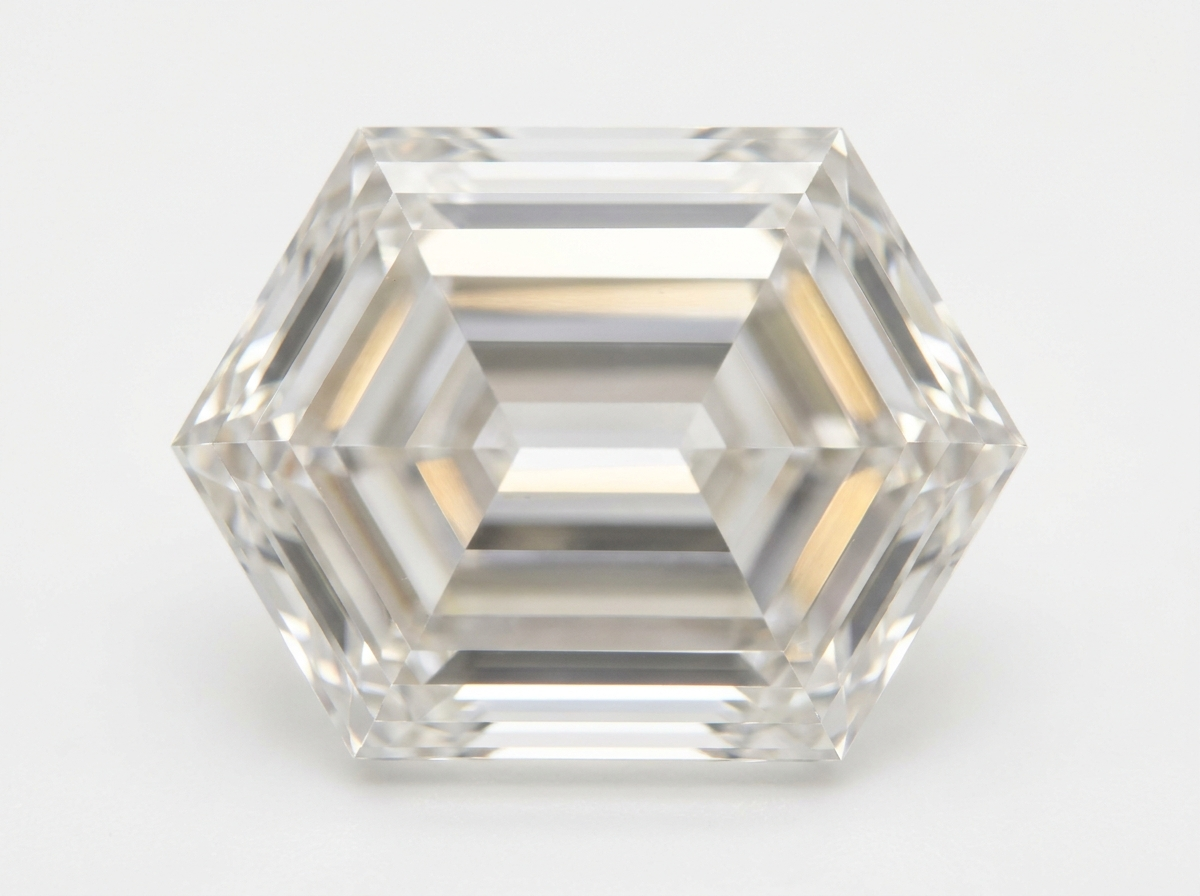
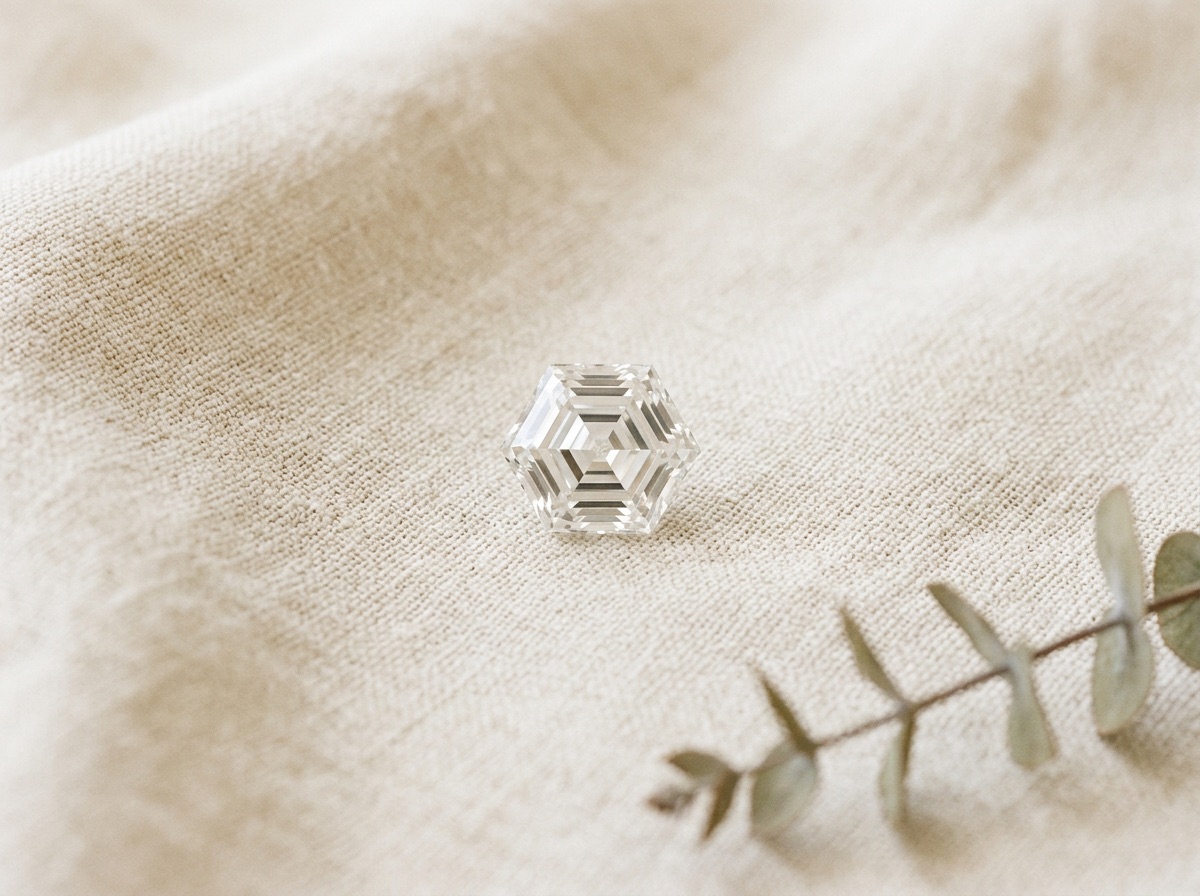
A hexagon cut diamond is a flat-sided, six-sided step-cut shape — no points, no curves, just six straight edges meeting at even angles — prized for its clean geometric outline and open, mirror-like table. Guru Diam stocks 473 hexagon diamonds on hand, CVD-grown and cut in-house, IGI-certified on request, with certified center stones and calibrated matched sets ready to ship from our New York Diamond District and Los Angeles trade desks.

What Is a Hexagon Cut Diamond? Facet Structure Explained
A true hexagon is a step-cut shape: six flat sides, no pointed ends, broad parallel facets running around a wide open table instead of the many small facets of a brilliant cut. That flat, faceted outline is what buyers mean when they search "hexagon cut" — and it's worth being precise about, because the name gets used loosely in the trade. A Dutch Marquise, also sold as a Brilliant Hexagon, is a related but different stone: elongated, pointed at both ends, and brilliant-faceted for maximum fire rather than the quiet, geometric flash of a true hexagon. See our Dutch Marquise / Brilliant Hexagon guide for that shape specifically — this guide covers the flat-sided, step-cut hexagon only.
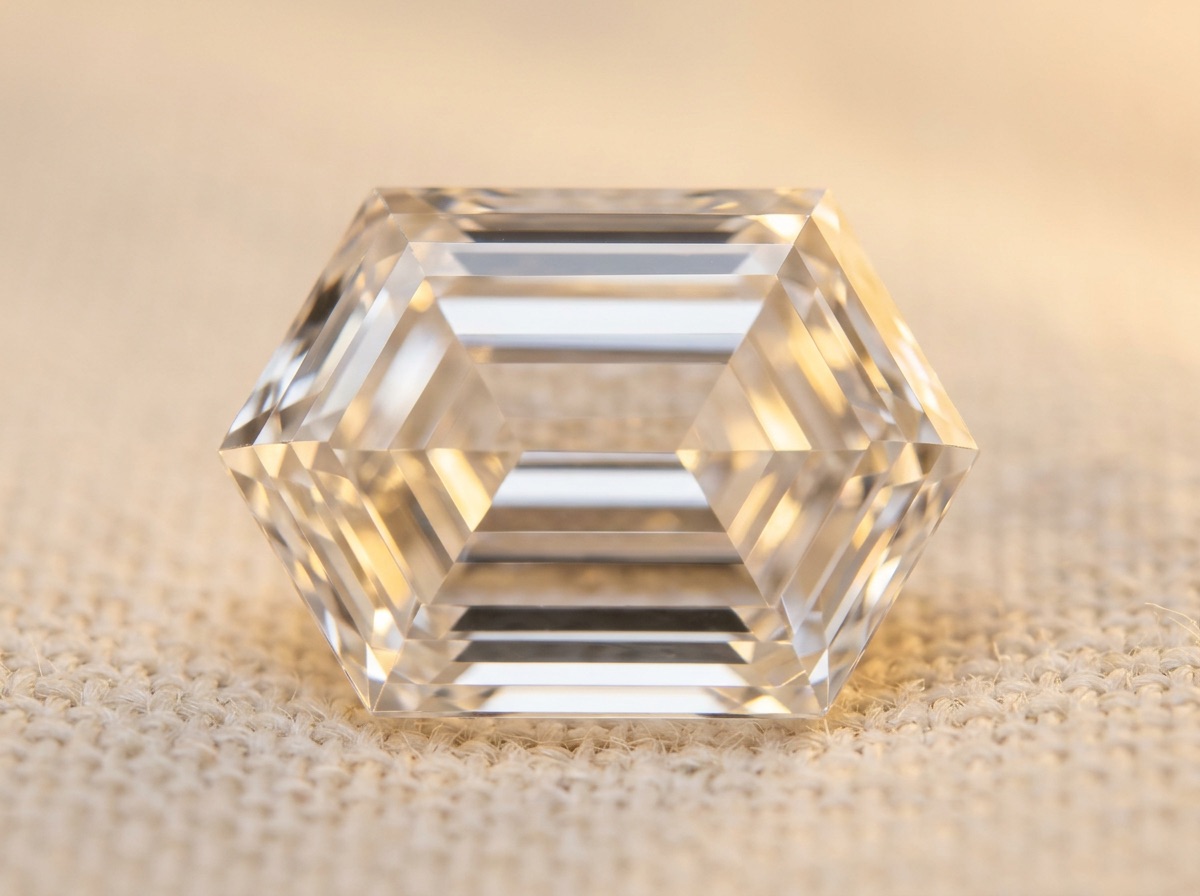
Mechanically, a step-cut hexagon is built the same way an emerald or Asscher cut is built, just wrapped around a six-sided outline instead of a rectangle or square. A large, open table sits at the center. Around it, one or two rows of long, rectangular "step" facets run parallel to each of the six girdle edges on both the crown (above the girdle) and the pavilion (below it), narrowing down to a small culet or shallow point at the base. There's no brilliant-style faceting to break up reflections into tiny sparkles — the light bounces off those broad, flat planes in wide, alternating flashes instead, which is why step-cuts read as calmer and more architectural than round or cushion stones of the same size.
Hexagon diamonds are cut in two general proportions: a near-equilateral hexagon, where all six sides run close to the same length for a compact, symmetrical outline (roughly a 1:1 to 1.1:1 length-to-width ratio — it reads almost like a rounded stop-sign shape), and an elongated hexagon, stretched along one axis to a 1.2–1.5:1 ratio or beyond for a more dramatic, finger-covering look. Both are step-faceted, which means the light performance reads as broad, alternating flashes — the "hall of mirrors" effect associated with emerald and Asscher cuts — rather than the scattered sparkle of a brilliant cut.
A Short History of the Hexagon Cut
Step-cut polygon shapes — hexagon included — trace their popularity to the Art Deco period of the 1920s and '30s, when jewelry design borrowed directly from the geometric vocabulary of the era's architecture and graphic art. Emerald cuts became the signature center stone of the period, and cutters extended the same step-faceting logic to other flat-sided outlines — hexagons, kites, lozenges, half-moons, and trapezoids — to use as side stones and accents flanking a rectangular center. The appeal was consistency: a hexagon's straight edges tile cleanly against an emerald cut's straight edges, so a three-stone or cluster piece could read as one continuous geometric composition instead of a round stone awkwardly bridging a rectangular one.
Hexagon has always sat at the rarer end of that Art Deco step-cut family. Because it's produced in far smaller volume than emerald or Asscher, it never became a mainstream retail shape the way those two did — it stayed a specialty cut, sourced by jewelers who wanted an antique-style outline their competitors weren't carrying. That scarcity is exactly why Guru Diam classifies hexagon in its antique cut tier, alongside old mine, old European, kite, moval, lozenge, trillion, and criss-cut — the category is our sourcing specialty, not an afterthought bolted onto a round-and-princess catalog.
The current wave of demand is a direct echo of that Art Deco original: geometric, minimalist engagement ring design has come back into fashion, and hexagon — along with kite and other antique polygon shapes — has moved from pure accent-stone duty into standalone center-stone use for buyers who want something their customers can't find at a mall jeweler.
Trade-Name Synonyms: Dutch Marquise, Hexagonal Marquise, and Rupee Cut
If you've heard a hexagon-adjacent stone called a Dutch Marquise, Hexagonal Marquise, or Rupee cut, it's worth pausing before you quote a price — none of those three names refer to the flat-sided step-cut hexagon covered in this guide. All three are trade names for the same related shape: an elongated, pointed-at-both-ends stone with brilliant faceting, more commonly sold under the name Brilliant Hexagon. The "hexagon" in each of those names refers to the six-sided facet arrangement on the crown, not to a flat, no-point outline — visually, the finished stone looks much closer to a marquise than to the hexagon this guide describes.
That naming overlap causes two different mix-ups worth flagging separately. First, don't confuse a Dutch Marquise / Hexagonal Marquise / Rupee cut with the step-cut hexagon on this page — one is brilliant-faceted with points, the other is step-faceted with none. Second, don't confuse either of those with a standard marquise (also called a navette) — the familiar elongated, pointed oval shape used constantly in solitaire and three-stone settings. A standard marquise has no hexagonal facet structure at all; it's a separate cut with its own sourcing guide. When a buyer asks for "hexagon," always confirm which of the three shapes — step-cut hexagon, Dutch Marquise / Brilliant Hexagon, or standard marquise — they actually mean before quoting.
Hexagon vs. Dutch Marquise (Brilliant Hexagon)
Because the names overlap so easily in casual trade conversation, it helps to see the two shapes side by side:
| Spec | Hexagon (step-cut) | Dutch Marquise / Brilliant Hexagon |
|---|---|---|
| Outline | Flat-sided, no points | Elongated, pointed at both ends |
| Faceting | Step-cut (broad, flat planes) | Brilliant-cut (high fire) |
| Light behavior | Broad flashes, hall-of-mirrors | High fire and scintillation |
| Typical use | Center stone or accent | Center stone, antique-style settings |
| Trade rarity | Uncommon, calibrated stock available | Very low, mostly made-to-order |
Hexagon Cut vs. Kite Cut: Two Antique Shapes Compared
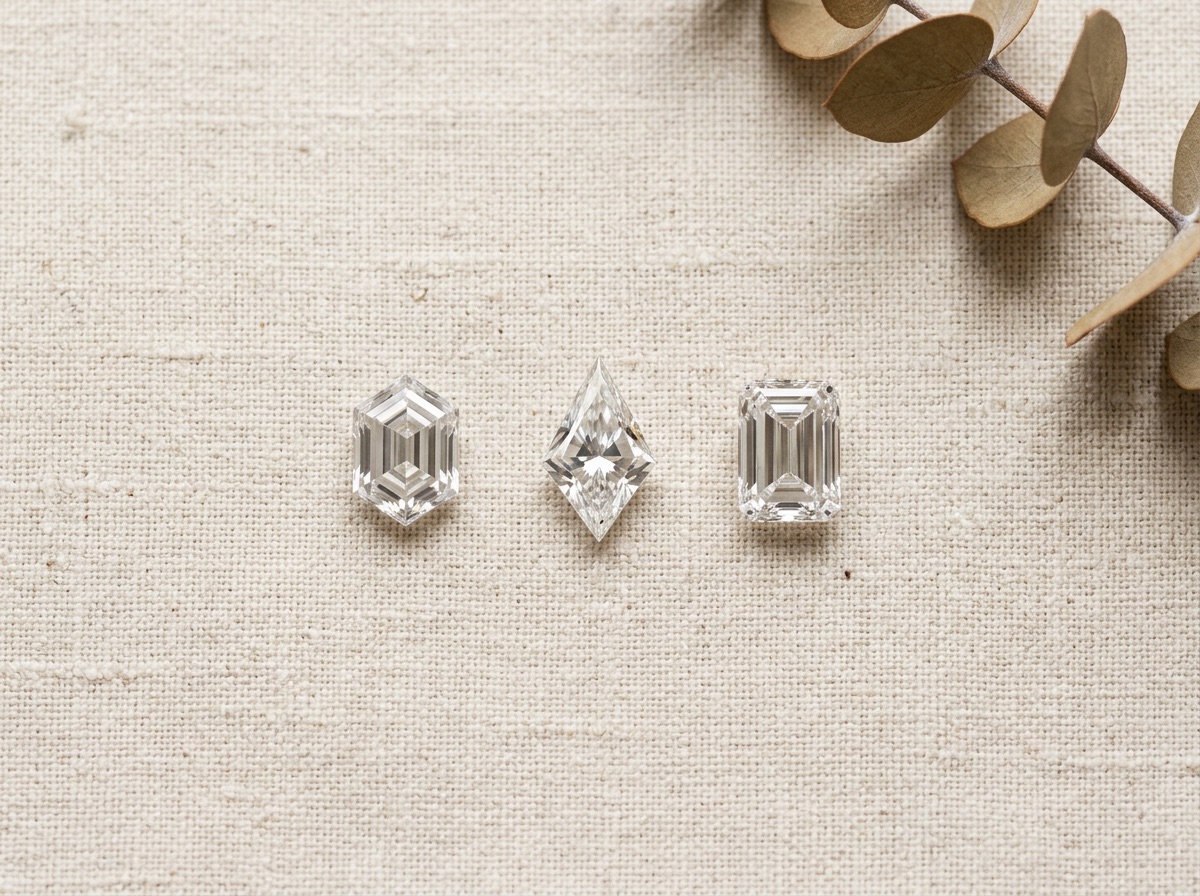
Hexagon and kite sit in the same antique-cut tier at Guru Diam, get requested by the same style of buyer, and are frequently confused by anyone who hasn't sourced either one before — so it's worth being explicit about how they differ. A kite is a four-sided shape: two shorter edges meeting at a point on top, two longer edges meeting at a point on the bottom, like the toy it's named for. A hexagon has six sides and no points at all. Set them side by side and the difference is immediate — kite reads sharp and directional, hexagon reads flat and grounded.
Their trade roles overlap more than their outlines suggest. Both are used constantly as side stones flanking a larger center stone in three-stone and cluster designs, both tile cleanly against emerald-cut and Asscher-cut centers, and both are sourced almost exclusively by jewelers deliberately chasing an antique, non-mainstream look. Where they split is orientation flexibility: a kite's points give it a natural "arrow" direction that designers use to draw the eye toward the center stone, while a hexagon's flat sides make it more of a neutral geometric block — useful when a designer wants a repeating tile motif (an eternity band, a cluster) rather than a directional accent.
Buyers building a three-stone or cluster piece around an emerald or Asscher center often ask which of the two reads more "antique" — the honest answer is that both do, and the choice comes down to whether the design calls for a pointed accent (kite) or a flat-tiled one (hexagon).
Hexagon Cut vs. Emerald Cut: Step-Cut Cousins
Hexagon and emerald share the same underlying faceting logic — broad, parallel step facets around an open table, producing the same calm "hall of mirrors" light behavior instead of scattered brilliant sparkle. That's where the similarity ends. Emerald cut is a rectangular outline with cut corners, sits in Guru Diam's regular fancy (mid-market) tier alongside cushion, oval, and radiant, and is one of the most widely recognized shapes in the retail market — most jewelers can source it from any supplier, and most consumers already know what it looks like. Hexagon is a genuine antique specialty shape: harder to source, produced in far lower volume, and immediately read by a customer as something they haven't seen at every other counter.
The practical trade difference is availability and positioning. Emerald cut is a safe, high-recognition sell that moves fast because buyers already understand it. Hexagon is a slower-moving, higher-margin specialty sell — the shape a jeweler stocks specifically to differentiate a case or a custom-build offering from a competitor running an all-round, all-emerald, all-oval inventory. Jewelers building an antique-cut program often pair the two deliberately: an emerald-cut center with hexagon or kite side stones is one of the most requested Art Deco-style combinations we quote.

How Guru Diam Sources and Cuts Hexagon Diamonds
Every hexagon diamond in Guru Diam's inventory is CVD lab-grown and cut in-house, start to finish — we don't outsource faceting to a third-party cutting house or resell someone else's parcel goods relabeled as our own. That matters more for an antique step-cut shape than it does for round brilliant: getting six angles even, a table centered, and a symmetrical outline out of rough that didn't start as a hexagon takes real cutting judgment, and a supplier who only handles volume commodity shapes typically won't have that skill in-house at all.
Because hexagon is a genuine specialty within our antique-cut category, we carry standing inventory rather than cutting purely to order — the 473 stones on hand span both near-equilateral and elongated proportions across a range of carat weights, so a buyer can pull a matched set or a single center stone without waiting on a fresh cutting run. When a request falls outside current stock — an unusual length-to-width ratio, a larger carat weight, or a specific angle spec for a signature piece — our gemologists take that as a sourcing brief and can quote a custom cutting timeline on request, rather than telling a buyer to substitute a different shape.
Matched pairs and sets for accent use are calibrated as a group, not assembled after the fact from loose singles — size, color, and facet angle are held to a tight tolerance across the whole set before it ships, which is the difference between an eternity band that reads as one continuous tile of hexagons and one where every third stone visibly breaks the pattern.
Grading and Quality: What to Check Before You Buy
Guru Diam's hexagon inventory is CVD-grown, IGI-certified on request for individual stones sold as a center stone, and calibrated/matched for accent use. For buyers who need a different lab on file, hexagon center stones can also be certified through GIA or GCAL on request — we don't lock buyers into a single lab.
Before committing to a stone, run through the same checklist every step-cut buyer should use, whether it's hexagon, emerald, or kite:
- Length-to-width ratio — near-equilateral hexagons run close to 1:1, elongated versions typically 1.2–1.5:1. Confirm which proportion the design calls for before quoting, since the two read as almost different shapes on the finger.
- Angle symmetry — the six angles need to be even. An uneven hexagon is visually obvious in a way an uneven round simply isn't; a buyer's eye catches a lopsided polygon instantly, even without a loupe.
- Table and depth percentage — for step-cut stones generally, these two numbers determine whether the stone reads bright and open or dark and "fisheye" (a cloudy, collapsed-looking center caused by a table cut too shallow or too deep relative to the pavilion).
- Clarity grade — because a step-cut's open table and broad facets don't scatter light the way a brilliant cut's small facets do, inclusions have nowhere to hide. VS or better is the safer floor for a clean, eye-clean hexagon, especially for larger center stones where the open table makes even minor inclusions easier to spot.
- Color grade at the open table — the same "nowhere to hide" logic applies to color; a warmer color grade reads more visibly in a hexagon's broad, flat table than it would scattered across a brilliant cut's many small facets.
None of this is unique to hexagon — it's the same discipline any experienced step-cut buyer already applies to emerald or Asscher stones — but it's worth restating because hexagon buyers are disproportionately first-time step-cut buyers drawn in by the geometric trend, and the "brilliant cut habits don't transfer" gap shows up most often on exactly these points.
What Drives Hexagon Diamond Pricing
Hexagon diamonds price on the same core inputs as any lab-grown stone — carat weight, color, clarity, and certification — plus several factors specific to step-cut polygon shapes that move price independently of the standard 4Cs:
- Length-to-width ratio. Both near-equilateral and elongated proportions carry standing inventory, but a request for an unusual ratio outside the common range narrows the pool of matching rough and can push a stone toward custom-cut pricing.
- Angle symmetry precision. A hexagon cut to tight, even angle tolerances costs more to produce than one cut loosely — the six-way symmetry requirement leaves less forgiving margin in the rough than a four-sided or round shape does.
- Carat weight and yield. Cutting a symmetrical hexagon from rough typically sacrifices more raw material than cutting a round or an emerald cut of comparable finished weight, since a six-sided outline is a less efficient fit against most rough shapes. Larger finished carat weights compound that yield cost.
- Certification. A certified individual stone (IGI, GIA, or GCAL, on request) prices differently than an uncertified stone quoted for calibrated accent use — the grading and paperwork are a real cost input, not a formality.
- Matched-set premium. Accent stones sold as a calibrated pair or set price above the sum of their individual parts, because holding size, color, and angle consistent across multiple stones is a tighter production standard than cutting singles to a general spec.
For buyers pricing out a full piece — say, an emerald-cut center flanked by hexagon side stones — it's worth requesting the center stone and the matched accent set as separate line items on the quote. The two price on different logic, and bundling them into one number makes it harder to see where the cost is actually coming from.

Styling and Use-Case Guidance: Center Stone vs. Accent
Hexagon is one of the few step-cut shapes that works comfortably as either a center stone or an accent stone, and the two uses call for different sourcing.
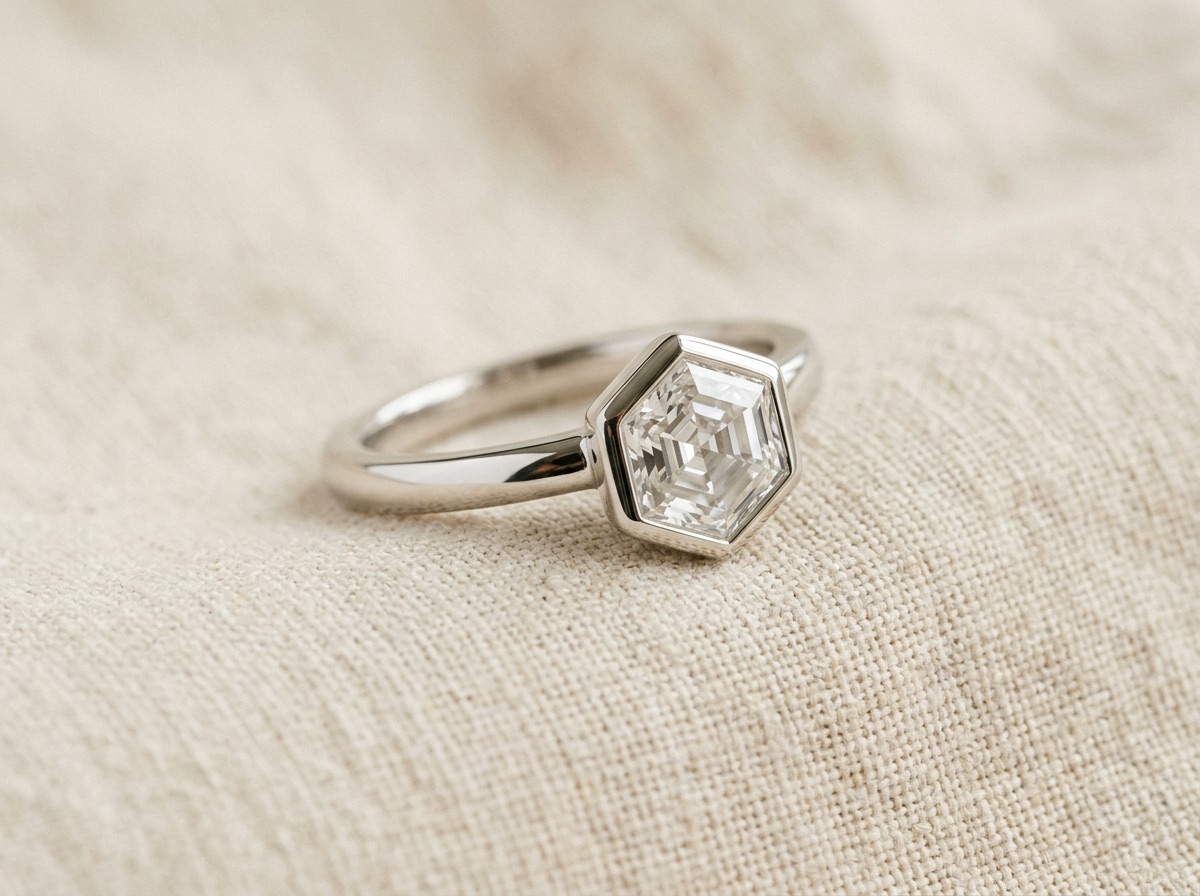
As a center stone, its flat sides and low, open profile suit minimalist and geometric engagement ring styles — bezel settings and low-profile solitaires in particular, where the hexagon's straight edges read as architectural rather than fussy. A bezel setting in particular suits a hexagon well because it wraps a continuous metal edge around all six sides evenly, which reinforces the geometric outline instead of interrupting it the way prong settings can on a shape with corners.
As an accent stone, hexagons are set in pairs or clusters flanking a round or oval center, or used as a repeating motif in eternity and stacking bands, where the flat sides tile cleanly against each other with almost no visible gap — a look that's difficult to achieve with any pointed or curved shape.
Elongated hexagons in particular have picked up in demand alongside the broader emerald-cut and geometric-jewelry trend, since the extra length reads as an elongated silhouette on the finger without the pointed ends of a marquise or Dutch Marquise. Buyers sourcing hexagon for a signature piece should specify both the L:W ratio and the faceting depth up front — small changes in either shift the stone from sharp and architectural to soft and rounded, even though the outline stays a hexagon.
For jewelers building a custom piece rather than pulling from loose inventory, Guru Diam's custom setting service finishes rings in 4–6 days once the stone and design are locked — that timeline applies to the finished jewelry build, not to sourcing the loose hexagon itself, which ships from on-hand inventory as soon as the stone is selected.
How to Order Hexagon Diamonds Wholesale
Ordering hexagon diamonds through Guru Diam follows the same account-based process as the rest of our loose-diamond catalog. Open a verified wholesale trade account at /signup — accounts are for independent jewelers, designers, and manufacturers buying at trade pricing, not individual consumers. Once verified, you can browse on-hand hexagon inventory by carat weight, L:W ratio, and certification status, and pull center stones or matched accent sets directly against current stock.
For anything outside standard inventory — a custom L:W ratio, a larger carat weight than what's currently on hand, a matched set sized beyond our standing calibration range, or certification through a specific lab for a client requirement — book time with a gemologist at /book-appointment. That conversation is where sourcing timelines, custom cutting specs, and multi-stone matching requirements get scoped properly rather than guessed at over email.
Buyers building a full piece around a hexagon — center stone plus matched side stones, or a hexagon-tiled eternity band — should request the full parts list on one quote rather than sourcing stones piecemeal. It's the fastest way to confirm the whole set is available in matching color and cut quality before a design gets locked with a client.

Source Hexagon Diamonds Trade-Priced, In Stock Now
Guru Diam carries 473 hexagon diamonds on hand as IGI-certified (on request) lab-grown loose inventory, plus matched pairs and sets cut to spec for accent use, from our New York Diamond District and Los Angeles offices. Open a verified wholesale account at /signup and book time with a gemologist at /book-appointment.
Frequently Asked Questions
What is a hexagon cut diamond?
A hexagon cut diamond is a flat-sided, six-sided step-cut shape with no pointed ends — six straight edges meeting at even angles, faceted with broad, flat planes rather than many small brilliant facets. It reads as a clean, geometric shape rather than the elongated, sparkly look of a Dutch Marquise.
Is a hexagon cut the same as a Dutch Marquise or Brilliant Hexagon?
No. A hexagon cut is flat-sided with no points and step-cut faceting for a quiet, broad-flash look. A Dutch Marquise (also called Brilliant Hexagon, or Hexagonal Marquise and Rupee cut in some trade circles) is elongated with pointed ends and brilliant faceting for maximum fire — a related but visually distinct shape covered in its own guide.
Can hexagon diamonds be used as a center stone?
Yes. Hexagon is one of the few step-cut accent shapes that also works as a standalone center stone, particularly in minimalist and geometric engagement ring designs with bezel or low-profile settings.
Are hexagon diamonds certified?
Individual hexagon diamonds sold as center stones are certified on request through IGI, GIA, or GCAL. Smaller hexagons used as matched accent stones are sold as calibrated, gradable goods, the same convention used for other side-stone shapes.
What's the difference between a hexagon cut and a kite cut?
A kite has four sides and comes to a point at the top and bottom, like the shape it's named for. A hexagon has six flat sides and no points at all. Both are antique-tier step-cut shapes used heavily as accent stones alongside emerald and Asscher centers, but a kite reads as a directional, pointed accent while a hexagon reads as a flat, tileable one.
How do I order hexagon diamonds wholesale from Guru Diam?
Open a verified wholesale trade account at /signup to browse and pull from current on-hand hexagon inventory. For custom L:W ratios, larger carat weights, matched sets outside standard calibration, or a specific certification lab, book time with a gemologist at /book-appointment to scope the request directly.