
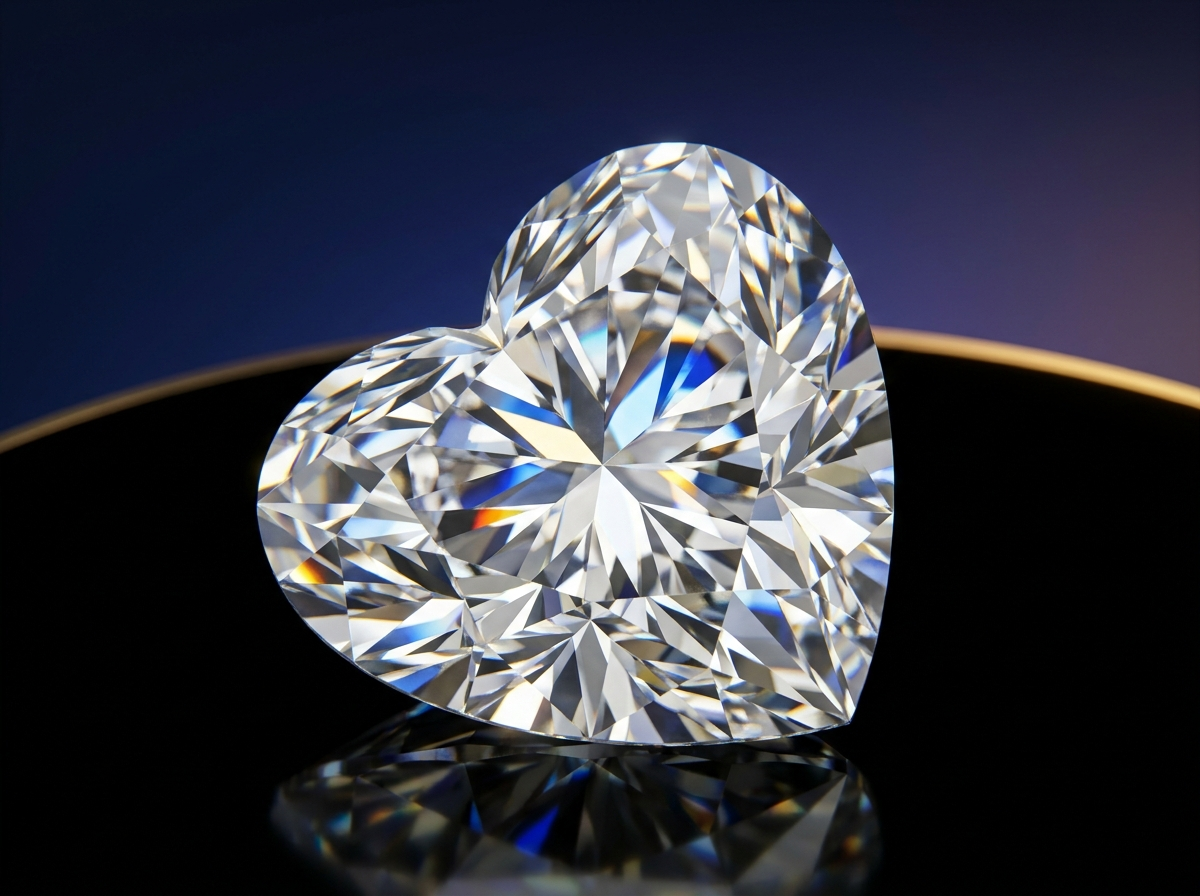
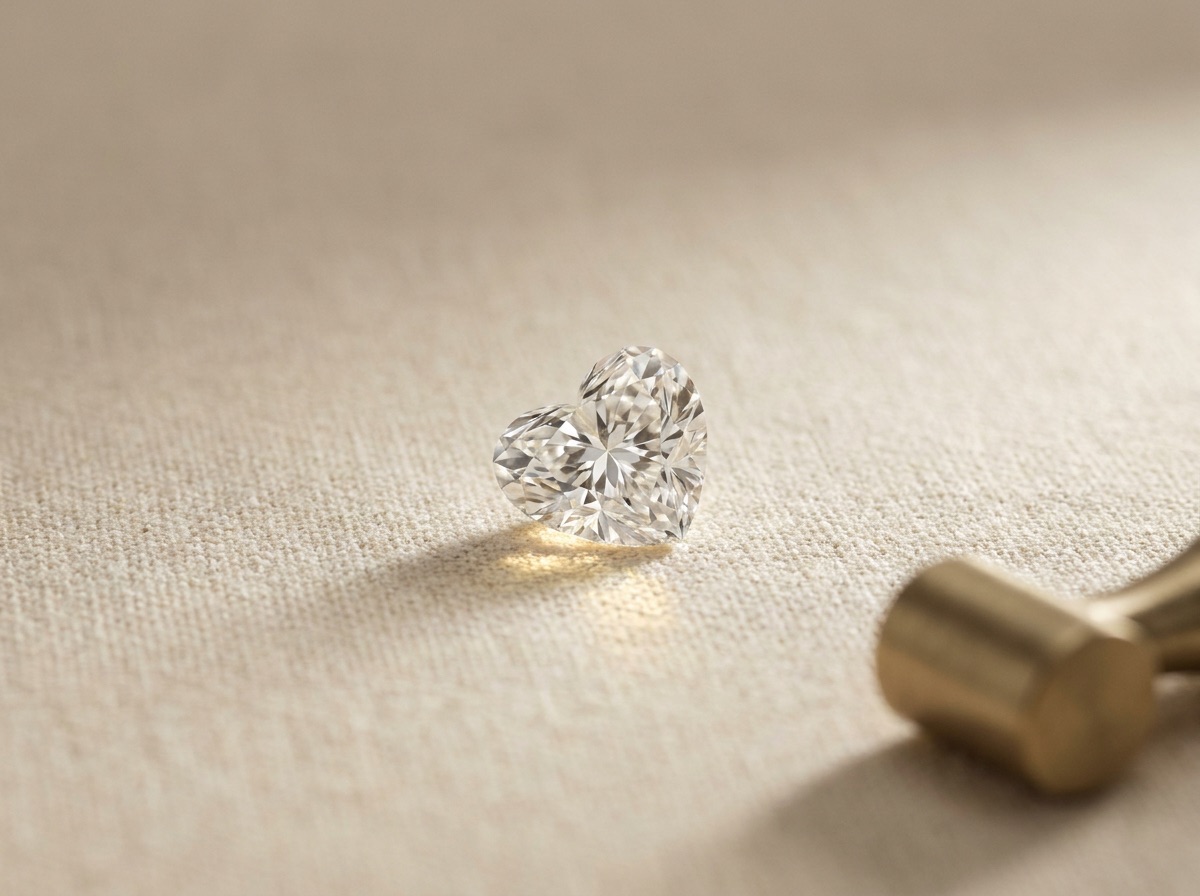
A heart shape diamond is a modified brilliant cut — two symmetrical lobes meeting at a defined cleft at the top, narrowing through the wings to a single point at the bottom — faceted for fire and immediately recognizable as the diamond trade's most literal romantic shape. Guru Diam stocks 169 IGI-certified, CVD-grown heart shape diamonds in colorless white, in stock now from our New York Diamond District desk.
Heart is a shape almost every client asks for by name, and yet most sourcing pages treat it as an afterthought — a single listing buried under round and princess with no real explanation of symmetry, grading, or what actually separates a heart cut that sells itself from one that sits in a case. This guide covers the shape properly: how it's cut, how to grade it, what drives price, how to style it, how it stacks up against pear, and how to get it into a customer's hands.
What is a heart shape diamond?
A heart cut is a modified brilliant: two rounded lobes at the top separated by a cleft, narrowing through two "wings" to a single point at the bottom, faceted for fire — typically around 59 facets — rather than the broad flat planes of a step cut. It's the most demanding symmetry problem in mainstream diamond cutting. The cleft depth, the two lobes, the two wings, and the point all have to mirror each other, or the stone reads as visibly lopsided face-up.
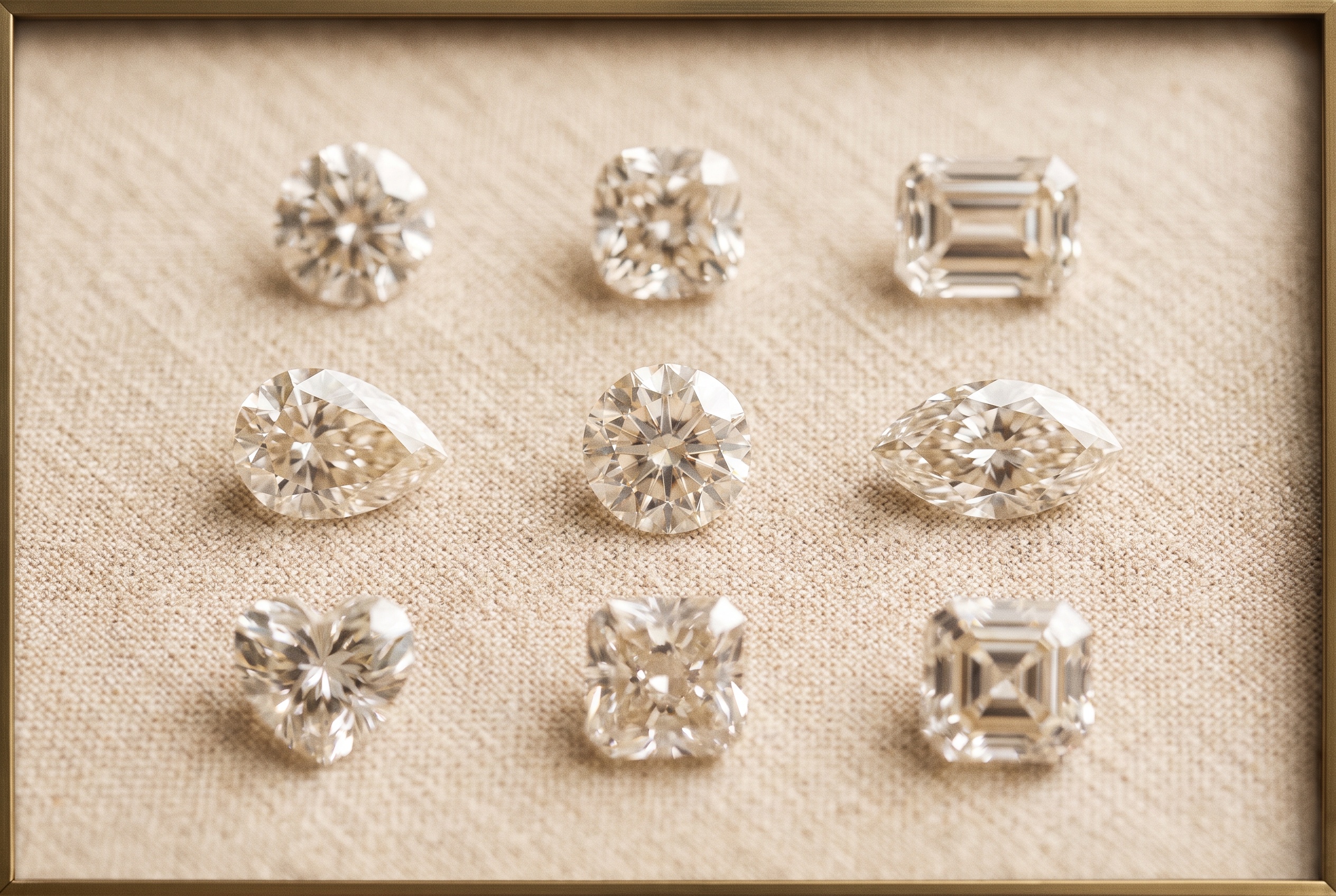
In the trade, heart sits in the regular fancy tier alongside emerald, asscher, cushion, oval, pear, marquise, radiant, and princess — modern cuts, not antique-style cuts, even though a few of that group borrow step-cut faceting. That distinction matters for sourcing conversations: buyers who ask for heart are usually shopping the same mid-market bracket as oval and pear, not the antique-cut collector bracket that goes toward Old Mine or Old European. Knowing which bracket a client is in tells you what else to show them alongside the heart itself.
Heart shape's appeal is almost entirely narrative — it's the one diamond outline a non-jeweler recognizes on sight, which makes it a strong anniversary, push-present, and statement-jewelry seller even outside bridal. That same recognizability is also why quality control matters more here than on most shapes: customers who don't know cut grades from clarity grades absolutely notice when a heart looks "off."
Anatomy of the cut: lobes, cleft, wings, and point
Four structural elements define whether a heart shape diamond reads correctly to the eye, and it's worth walking through each one because they're the vocabulary you'll need when a buyer asks what makes one heart better than another sitting next to it in the case:
The lobes. The two rounded humps at the top of the stone. They need to be the same height, the same width, and the same curvature — any deviation and the heart looks tilted even when it's sitting perfectly straight in a setting.
The cleft. The notch between the two lobes. Depth is the single most scrutinized measurement on a heart shape stone: too shallow and the outline reads as a rounded pear with a dent in it; too deep and it undercuts the crown, weakening the stone at a structurally sensitive point. A well-cut cleft is deep enough to read clearly from arm's length but shallow enough that it doesn't compromise the girdle.
The wings. The two curved sides running from each lobe down to the point. Wing shape controls how "plump" or "slim" a heart reads — fuller wings give a rounder, softer silhouette; straighter wings give a more elongated, angular one. Neither is objectively better; it's a matched-pair problem, since the left and right wing have to mirror each other exactly.
The point. Where both wings converge at the bottom. A point that's off-center relative to the cleft above it throws off the entire outline even if the lobes and wings are each individually well-formed on their own.
All four elements are graded together as outline symmetry, which is a separate consideration from the standard cut grade a certificate reports. A heart can carry an Excellent cut grade from a lab and still look meaningfully worse than a neighboring stone if its outline symmetry is a grade or two behind.
Why heart shape symmetry is harder to cut right
Heart tolerates almost no cutting error compared to a round, where minor deviations are hidden by the shape's circularity — every asymmetry in a heart is visible to the naked eye. A cleft cut too shallow reads like a rounded pear instead of a heart; a cleft that's too deep or off-center makes the whole stone look lopsided. Below roughly half a carat, the cleft can be hard to see clearly at all, which is why heart shape tends to perform best starting around 0.50ct and up, where the outline reads distinctly.
Because of this, request the outline symmetry grade specifically when sourcing a heart shape stone — not just the overall cut grade. Two stones with identical carat, color, and clarity can look meaningfully different face-up if one has better lobe and wing symmetry than the other. This is the single most common gap between what a spec sheet promises and what a customer sees when the ring box opens, and it's worth training sales staff to check for it before a heart shape order goes out, not after a client complains.
Grading a heart shape diamond: what actually matters
Standard 4Cs grading — carat, color, clarity, cut — still applies to heart shape diamonds, but it doesn't capture the shape-specific factors that determine whether a stone performs well face-up. When you're evaluating heart shape inventory, or coaching a buyer through a comparison, four additional checks matter more here than on almost any other shape.
Length-to-width ratio
Most heart shape diamonds fall in a 0.90–1.10 length-to-width range, which reads as a "classic" balanced heart. Ratios outside that band start to look either squat and wide or narrow and elongated — neither is wrong, but it's a style preference the client should choose deliberately, not something that happens by accident because it's the only stone in stock.
Cleft depth and definition
Covered above as a cutting concern, but it's also a grading concern at the point of sale: hold the stone table-up and confirm the cleft is visible without magnification. If it isn't, the shape isn't doing its job regardless of what the certificate says about cut quality.
Wing symmetry
Compare the left and right wing against each other, not against an abstract ideal. Lay a straightedge or loupe reference against the stone's long axis and check that both wings curve away from it identically. This is the fastest way to catch a heart that will look tilted once it's set, since setting can't correct for asymmetry that's baked into the cut.
Bow-tie effect
Like other fancy shapes with elongated pavilions (pear, oval, marquise), heart shape stones can show a dark "bow-tie" shadow across the center of the stone under certain lighting, caused by facets that don't return light evenly through the widest part of the cut. A faint bow-tie is normal and often invisible in typical lighting; a heavy, high-contrast bow-tie is a cutting quality issue worth flagging before a stone goes into inventory photography or a client viewing.
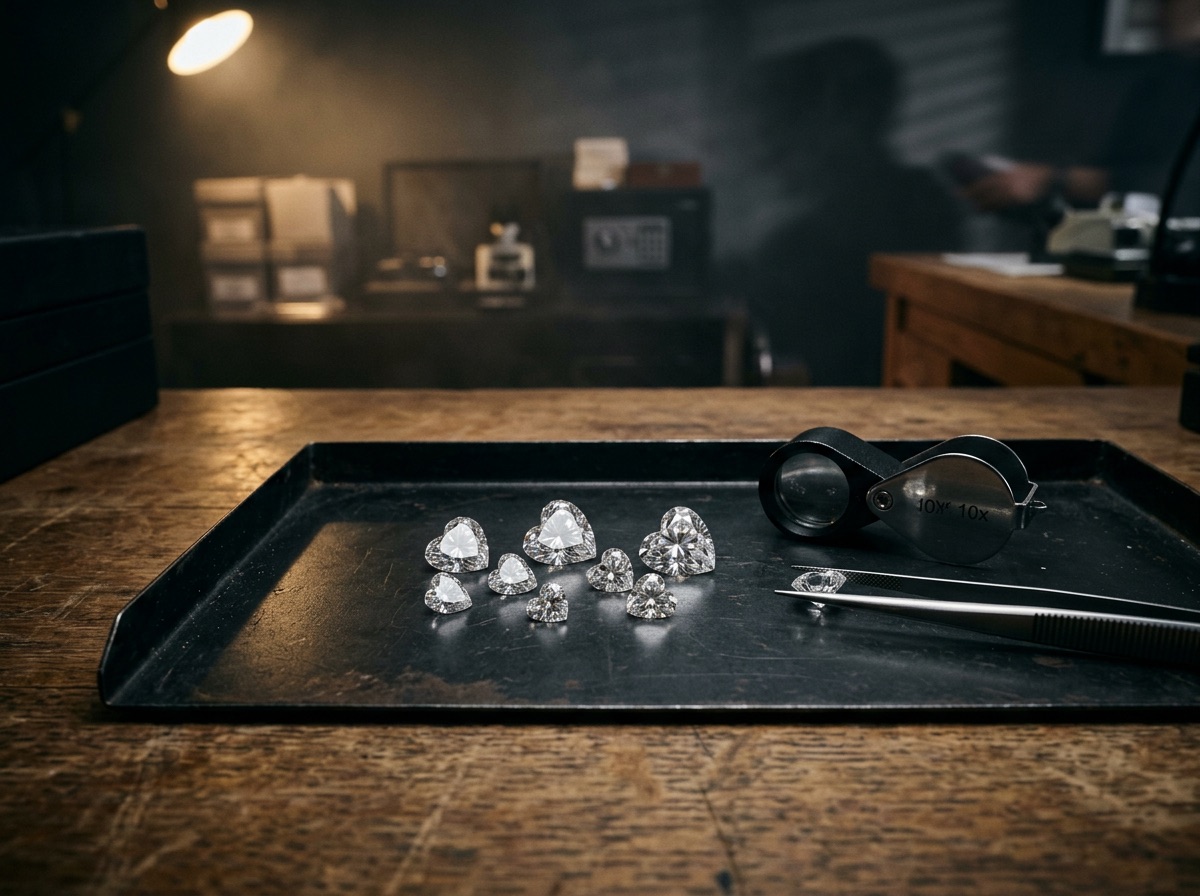
None of these four checks require lab equipment — they're a loupe, a straightedge, and a few seconds of comparison against the stone next to it in the tray. Building this into a standard intake or reorder checklist is the cheapest quality-control step available in wholesale heart shape sourcing.
Cutting heart shape diamonds in-house
Guru Diam cuts, polishes, and finishes its heart shape inventory in-house, which is what makes the symmetry-grading standard above enforceable in the first place — a supplier reselling parcel-sourced heart shape stones from multiple outside cutters can't guarantee consistent lobe, cleft, and wing proportions across a run, because every parcel comes from a different hand and a different rough decision. Cutting in-house means every heart shape stone in the 169-piece on-hand count was cut against the same outline symmetry standard, not assembled from whatever heart-shaped rough happened to be available on a given week.
That consistency also means made-to-order heart shape cutting is available for anything outside current stock — a specific carat weight, a tighter length-to-width ratio, or a fancy color heart that isn't sitting in the case. Because cutting is in-house, custom heart shape requests don't route through a third party or wait on an outside cutter's queue.
Heart shape: spec and availability
| Spec | Detail |
|---|---|
| Outline | Two symmetrical lobes, defined cleft, single bottom point |
| Facet style | Modified brilliant (~59 facets) |
| Recommended minimum size | ~0.50ct and up, where the cleft reads clearly |
| Length-to-width ratio | 0.90–1.10 for a classic balanced outline |
| Color | Colorless, D–J range (fancy color available separately) |
| Growth method | CVD-grown |
| Certification | IGI standard; GIA and GCAL available on request |
| Stone type | Certified single stones (not melee) |
| On-hand count | 169 pieces |
| Typical uses | Solitaire rings, pendants, statement earrings, anniversary pieces |
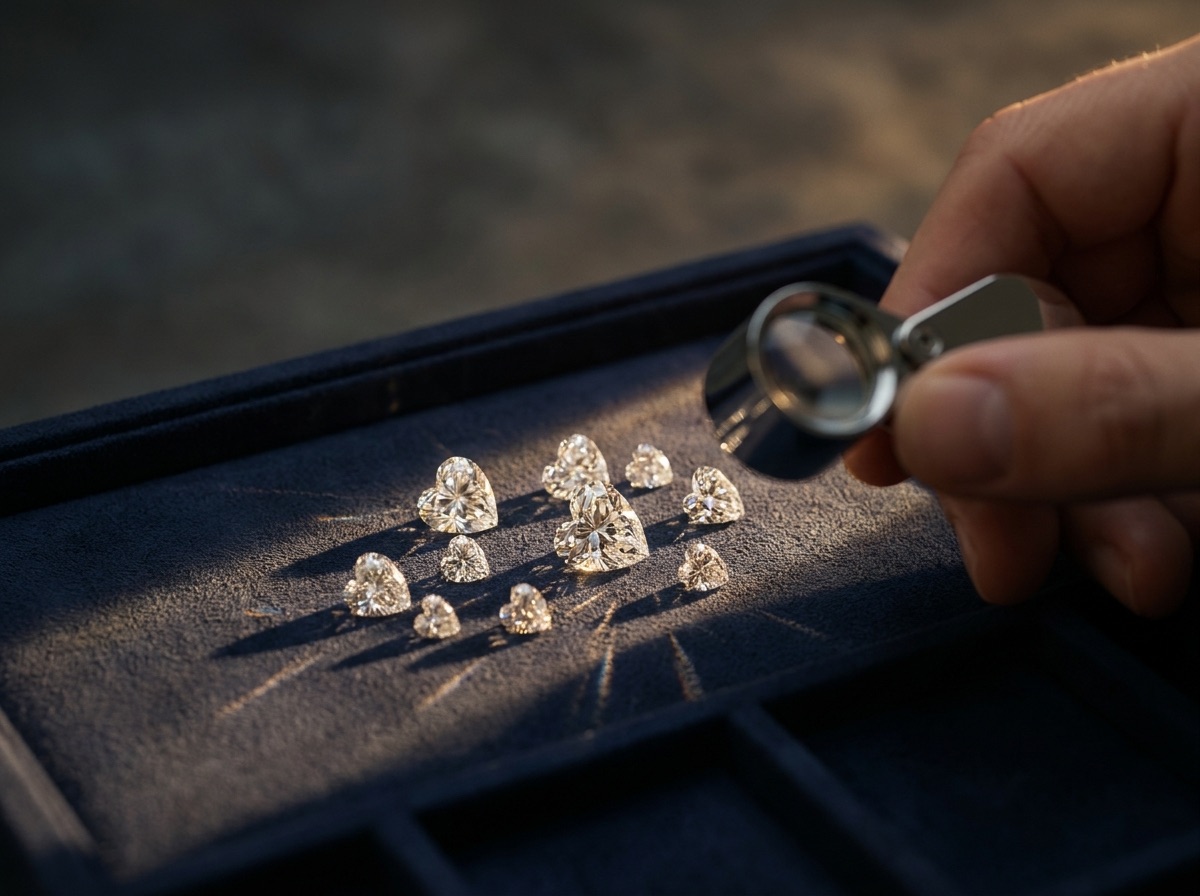
With 169 pieces on hand across the colorless range, heart offers real breadth across carat weight and symmetry grade rather than a handful of listings padded out with marginal stock — enough depth that a buyer sourcing for a specific client brief has actual choices to compare side by side, not one option to accept or decline.
What drives heart shape diamond pricing
Heart shape pricing follows the standard carat/color/clarity/cut framework with three shape-specific factors layered on top, and understanding the layering helps explain price spreads between two stones that look similar on a spec sheet.
Outline symmetry grade. A heart with excellent lobe, cleft, and wing symmetry commands a premium over a stone with the same carat, color, and clarity but a weaker outline grade — the labor and rough-yield cost of hitting tight symmetry tolerances on this shape is real, and it shows up in price before it shows up on a spec sheet.
Carat weight relative to the 0.50ct threshold. Because heart shape performs poorly below roughly half a carat, demand — and therefore price per carat — steps up meaningfully once a stone clears that line, more than the smooth carat-weight curve you'd see on round or princess.
Length-to-width ratio. Stones sitting in the 0.90–1.10 "classic" band are the most requested and typically price at a slight premium to stones with unusual ratios, simply on demand — not because an elongated or squat heart is lower quality.
Color, clarity, and certification lab choice layer on top of those three the same way they would for any other shape: D–F commands more than G–J at equal clarity, and higher clarity grades widen the spread further at larger carat weights where inclusions are easier to spot with the unaided eye. On certification, IGI-certified stones typically carry a lower certificate cost than GIA or GCAL at comparable grading rigor, which is why IGI is the default across Guru Diam's heart shape stock — buyers who need GIA or GCAL for a specific client or market can request it on the same stone.
Certification: IGI, GIA, and GCAL for heart shape stones
All three labs grade heart shape diamonds against the same 4Cs framework, with outline symmetry reported as part of the cut assessment. The practical difference between them for wholesale buyers is turnaround and market recognition rather than grading standard: IGI is the fastest-moving option and the one most lab-grown inventory ships against by default; GIA carries the strongest name recognition with end consumers, which matters for retailers selling in markets where clients specifically ask for a GIA certificate; GCAL adds a cut-precision report on top of the standard grading, which some retailers use as an additional selling point on higher-carat solitaire pieces.
Guru Diam's heart shape inventory ships IGI-certified as standard, with GIA or GCAL certification available on request for buyers who need a specific lab for their market or client base. Requesting a lab swap on an in-stock stone adds lead time versus a same-day IGI-certified shipment, so it's worth flagging at order time rather than after a piece has already shipped.
Styling heart shape diamonds: solitaires, pendants, and statement pieces
Heart shape carries three distinct use cases in a trade catalog, and each one puts different demands on the stone and the setting.
Solitaire engagement rings. This is where outline symmetry matters most, because a solitaire has nothing else in the piece to distract the eye — the stone is the entire design. A three-prong or five-prong setting that cradles the point without a visible prong crossing the cleft is standard; a bezel or halo can also work well on heart shape, since both add a clean outline around the stone that reinforces rather than competes with its silhouette. Recommend 0.75ct and up for a solitaire brief specifically — below that, the shape reads ambiguously even in a well-cut stone, which undercuts the whole point of choosing heart over round or oval for a center stone.
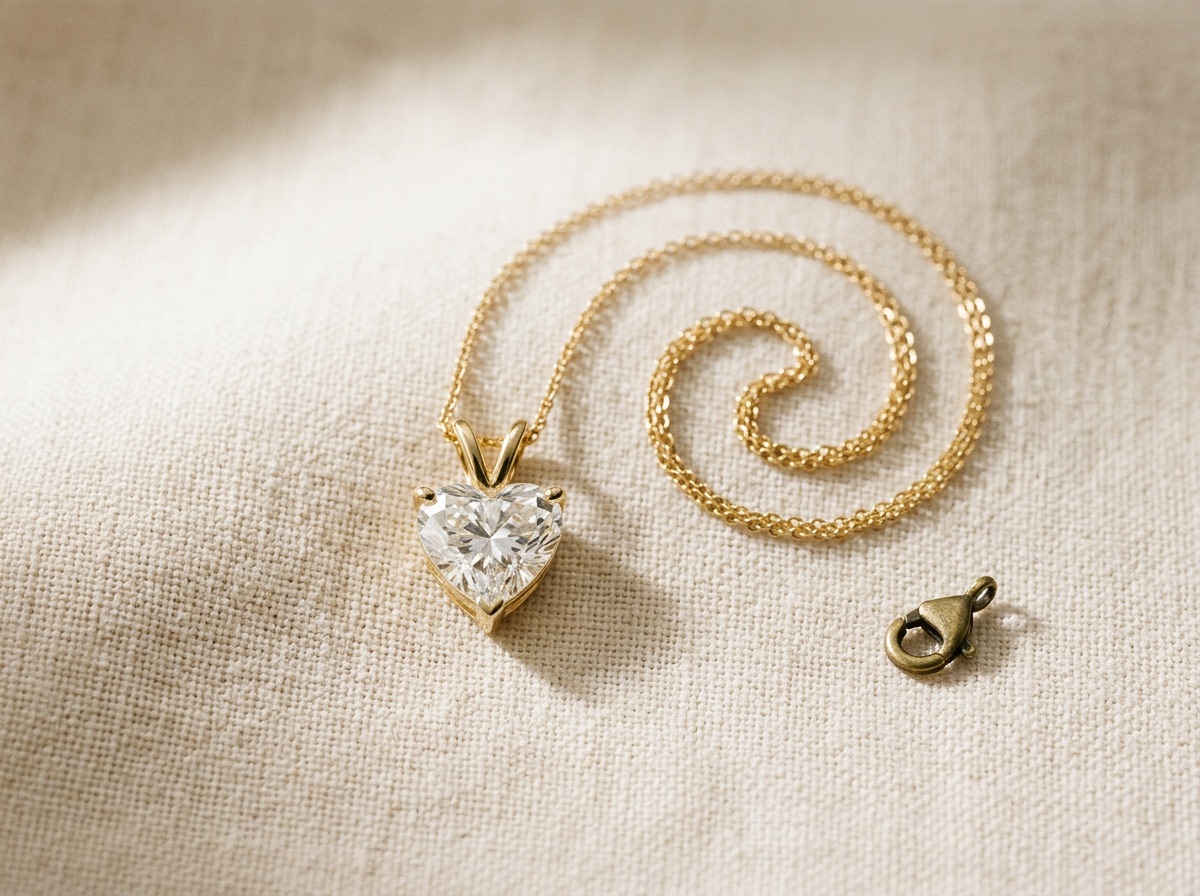
Pendants. Heart is arguably the strongest pendant shape in the catalog precisely because the silhouette does the work with no need for a large carat weight — a 0.30–0.50ct heart pendant reads clearly at typical wearing distance in a way a heart solitaire ring at that size wouldn't. Orientation matters here: point-down is the overwhelming default and what buyers expect without being told, but a point-up "inverted heart" setting is a distinctive request some fashion-forward retailers ask for specifically, and it's worth knowing that variant exists before a client's request gets waved off as unusual.
Statement earrings and anniversary pieces. Matched-pair sourcing is the operative concern for earrings — two heart shape stones need to match not just on carat, color, and clarity but on length-to-width ratio and wing shape, or the pair will read as mismatched even at a glance. This is a case where pulling both stones from the same on-hand inventory run, rather than sourcing two separately, meaningfully reduces the risk of a visible mismatch.
Heart shape vs. pear shape: helping clients choose
Heart and pear share a lineage — a pear is essentially a heart shape without the cleft, tapering to a single rounded point at the top instead of two lobes — which makes them a natural comparison for any buyer weighing the two against each other, and a common conversation for a sales team to need a fast, accurate answer for.
The practical differences that matter for a sourcing decision:
Symmetry risk. Pear has one axis of symmetry to get right (left side mirrors right side); heart has that same axis plus the added cleft-depth and dual-lobe problem. Pear is meaningfully more forgiving to cut and to grade, which shows up in a tighter, more predictable price curve across a comparable inventory run.
Minimum size for shape recognition. Pear reads clearly at smaller carat weights than heart does — a 0.30ct pear still shows its teardrop outline, where a 0.30ct heart's cleft is often too subtle to register. Heart needs that 0.50ct-and-up threshold to look intentional; pear doesn't.
Narrative vs. versatility. Heart sells on symbolism — it's the shape a client chooses specifically because it's a heart. Pear sells on versatility — the elongated silhouette flatters the finger, works equally well as a solitaire, a pendant point-up or point-down, or an earring drop, and doesn't carry heart's explicit romantic signaling, which some clients prefer for exactly that reason.
Setting flexibility. Pear's single point (versus heart's cleft-plus-point) makes prong placement simpler and gives designers more room to play with asymmetric or east-west settings. Heart setting design is more constrained by the need to protect the cleft and keep the outline legible.
The short version for a sales conversation: recommend heart when the client wants the shape itself to carry meaning, and recommend pear when they want an elongated, flattering silhouette without committing to the heart's explicit symbolism — or when budget favors a smaller stone that still reads clearly as an intentional fancy shape.
Fancy color heart shape diamonds
Heart shape is also available in fancy color — yellow, pink, blue, and green — for buyers looking to pair the shape's narrative strength with a colored stone for a statement piece or a client who's already passed on colorless heart shapes elsewhere. Fancy color heart shape carries the same symmetry considerations as colorless — the cleft, lobes, wings, and point all need to mirror each other regardless of body color — with the added factor of how the color distributes across the outline, since uneven color saturation is more visible on a shape with this many distinct facial regions than it is on a round or oval. See our fancy color heart shape guide for sourcing detail on that inventory specifically.
Sourcing heart shape diamonds wholesale — how to order
Guru Diam sources heart shape diamonds as wholesale, trade-only inventory — no retail markup — from our New York Diamond District desk (36 West 47th Street, Suite 601A) and our Los Angeles office (607 South Hill Street, Suite 241). In-stock pieces ship same-day from New York. For a custom setting, CAD-to-finished-piece turnaround runs 4–6 days.
Ordering follows the same process as any other shape in the catalog: open a verified wholesale trade account, browse live on-hand inventory filtered by carat, color, clarity, and certification lab, and either check out an in-stock stone directly or book time with a gemologist to walk through symmetry grades on a specific set of candidates before committing. For anything outside the 169-piece on-hand range — a specific length-to-width ratio, a larger carat weight, or a fancy color heart shape — in-house cutting means a custom order doesn't require waiting on outside supply.
Ready to buy? Open a verified wholesale account at /signup and book time with a gemologist at /book-appointment.
Frequently Asked Questions
What is a heart shape diamond?
A heart shape diamond is a modified brilliant cut with two symmetrical lobes meeting at a defined cleft, narrowing through the wings to a single point. It's faceted for fire rather than step-cut, and is one of the most recognizable diamond shapes in the trade.
Why is heart shape diamond symmetry so important?
Because a heart has zero tolerance for the kind of minor cutting deviation that a round shape hides easily. The cleft, both lobes, both wings, and the point all have to mirror each other, or the asymmetry is visible face-up. Request the outline symmetry grade, not just the overall cut grade, when sourcing a heart.
What's the minimum carat weight for a heart shape diamond to look good?
Heart shape generally performs best starting around 0.50ct and up, since the cleft — the defining feature of the shape — can be difficult to see clearly on smaller stones. For a solitaire engagement ring specifically, 0.75ct and up gives the clearest, most confident outline.
How does heart shape compare to pear shape for a client who can't decide?
Pear is more forgiving to cut, reads clearly at smaller carat weights, and offers more setting flexibility. Heart carries stronger symbolic weight but needs more carat weight and tighter symmetry to look intentional. Recommend heart when the shape's meaning matters to the client; recommend pear for a versatile, elongated silhouette at a lower size threshold.
Are Guru Diam's heart shape diamonds lab-grown, and are they certified?
Yes. Guru Diam's heart shape inventory is CVD-grown and cut in-house, IGI-certified as standard, with GIA or GCAL certification available on request. All pieces are certified single stones, not melee.
How fast can I get a heart shape stone or a finished custom piece?
In-stock pieces ship same-day from New York. For a custom setting, CAD-to-finished-piece turnaround runs 4–6 days from our New York and Los Angeles desks.