
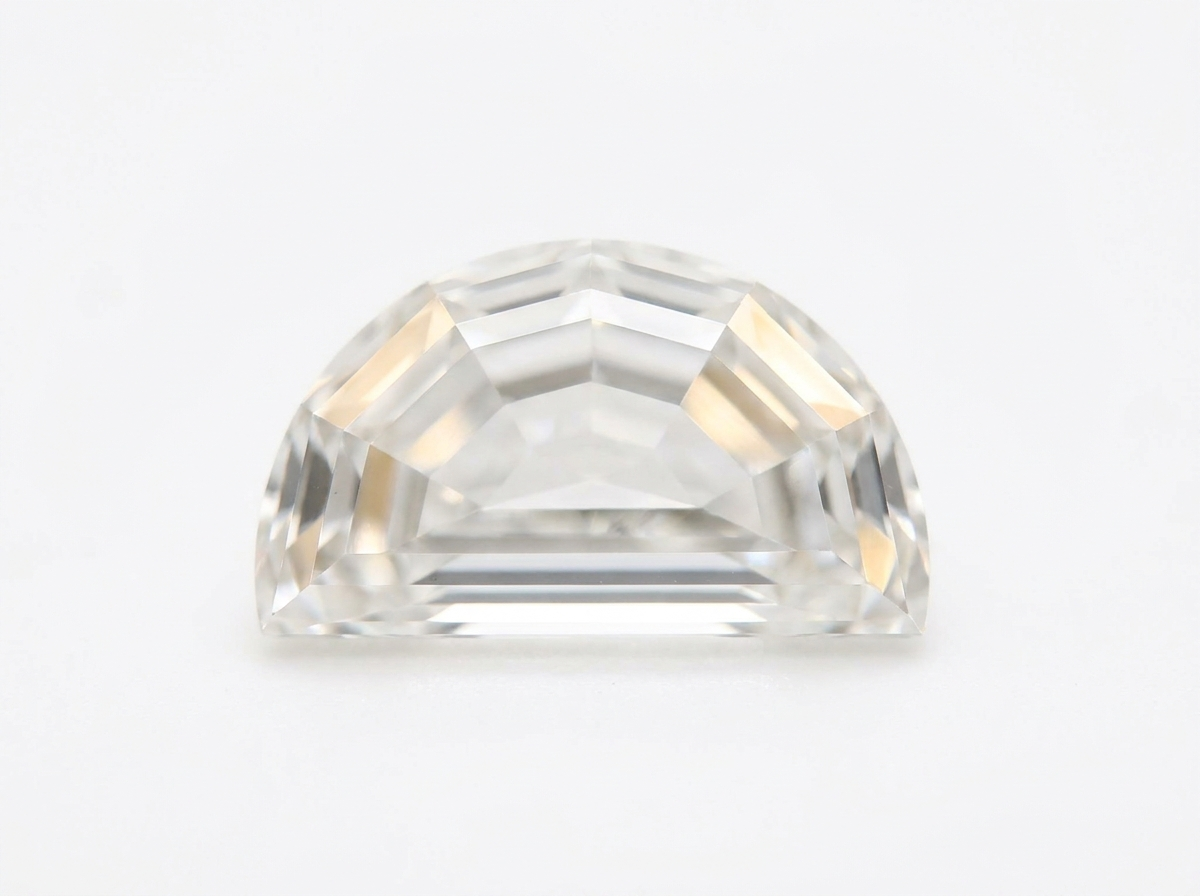
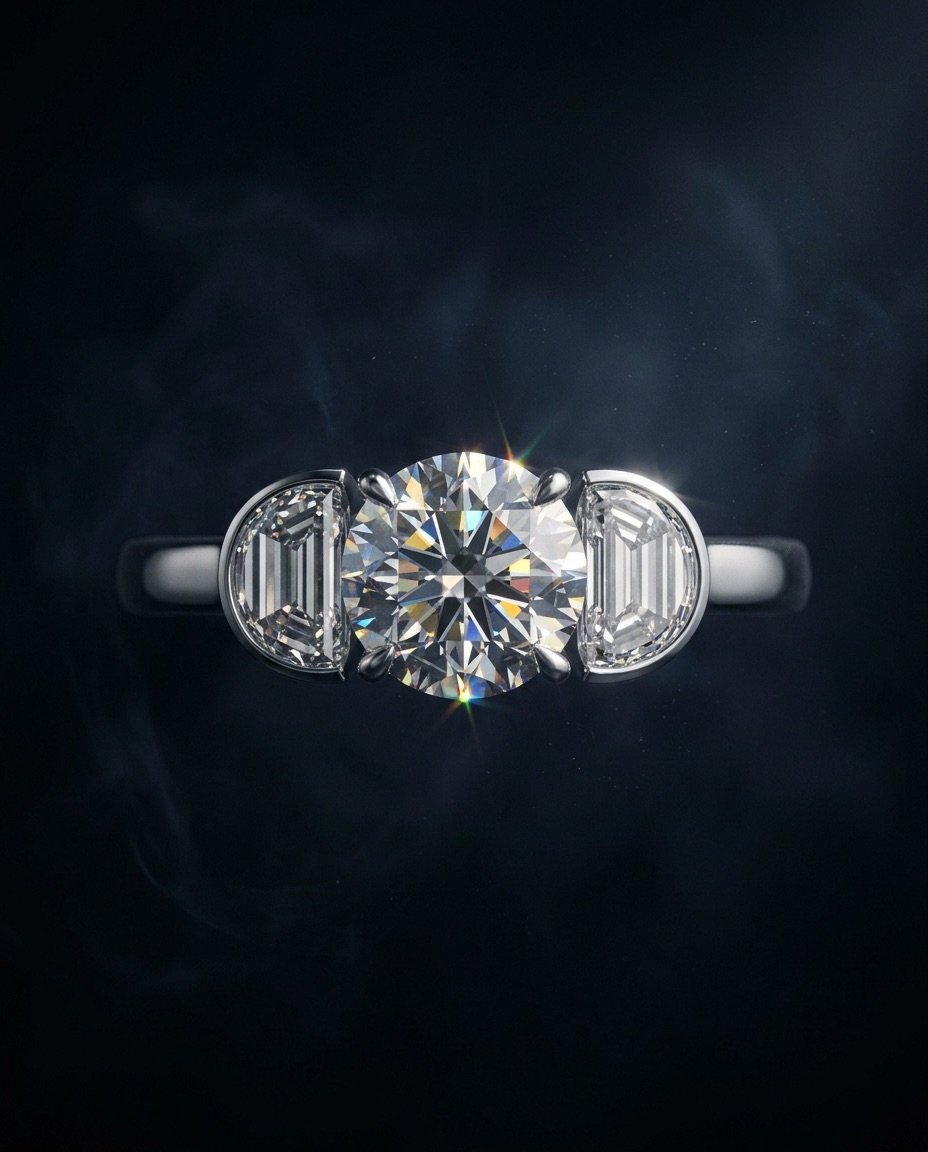
A Half Moon diamond is a crescent-shaped side stone — a semicircle with a flat straight edge (the chord) and a curved outer edge (the arc) — used almost exclusively in mirrored pairs to flank a center stone, most associated with Art Deco-era three-stone and cocktail rings. Guru Diam stocks 701+ Half Moon diamonds, calibrated and matched, CVD lab-grown, IGI-gradable on request.
What is a Half Moon diamond?
A Half Moon is exactly what the name describes: a diamond cut to a demilune outline, one straight edge running like a chord across the stone and one continuous curved edge forming the arc. That combination of one hard line and one soft curve is what makes the shape read instantly as a deliberate design choice rather than an off-cut — it's a geometric shape, but not a symmetrical one, which is part of why it's stayed a specialty item rather than a volume staple. In the trade, "demilune" is used interchangeably with Half Moon on older invoices and European stock sheets; both terms describe the same crescent outline.
Facet structure — step cut vs. brilliant
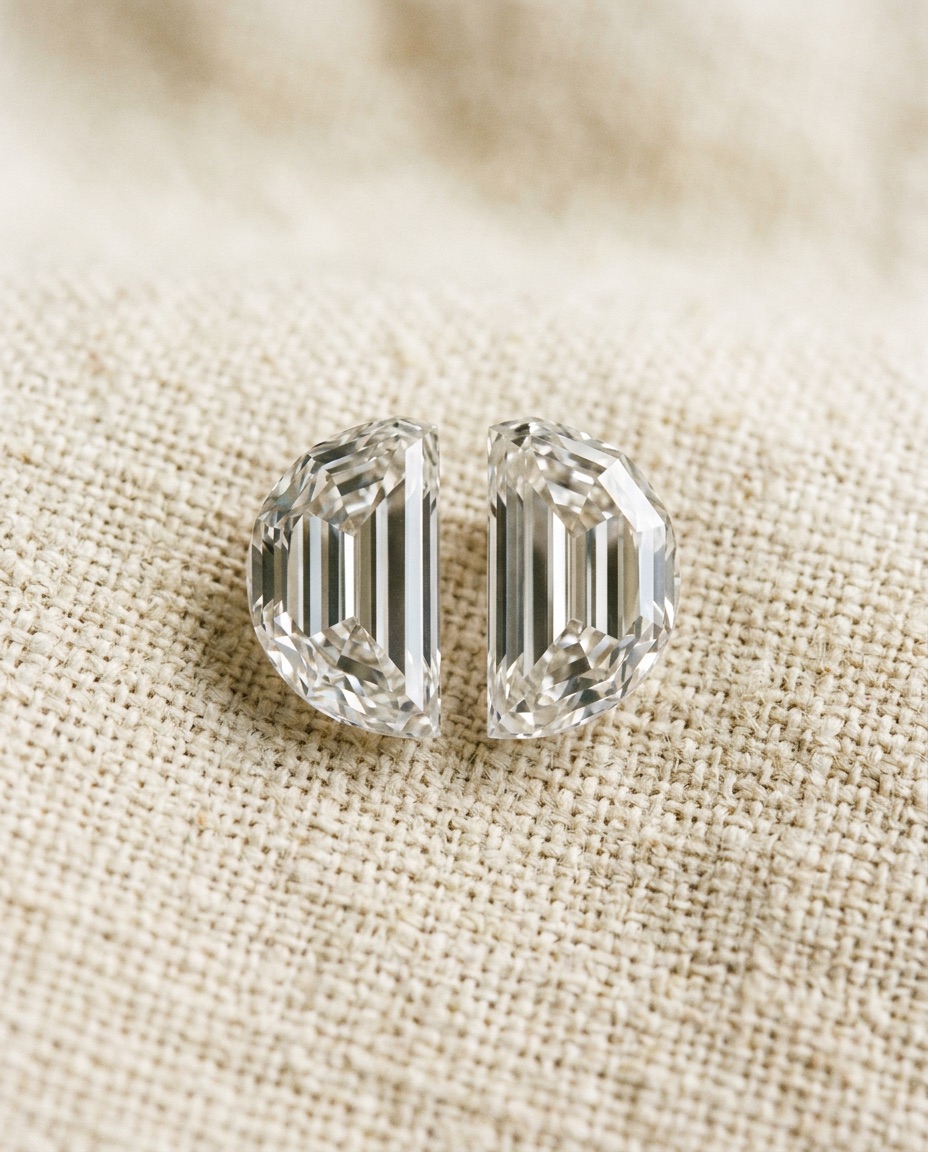
Most Half Moon diamonds in circulation are cut as step cuts: a flat table, a few concentric rows of long, narrow facets following the curve of the arc, and a straight, unadorned girdle edge along the chord. That faceting choice isn't arbitrary — step-cut facets are easier to keep symmetrical across a curved outline than a full brilliant facet arrangement, and the resulting flat, mirror-like flashes read as calm and architectural rather than sparkly, which suits the Art Deco pieces the shape is built for. A brilliant-faceted version exists — small kite and star facets adapted to the crescent outline for more fire — but it's the less common cut of the two and typically a special-order request rather than standard stock, since faceting a brilliant pattern onto a curved-and-straight outline is a harder proportions problem than step-cutting the same shape.
Where the shape comes from
Half Moon belongs to the same family of geometric side-stone shapes — alongside baguettes, trapezoids, kites, and bullets — that came out of the Art Deco design vocabulary of the 1920s and 1930s, when jewelers were moving away from the softer, floral Edwardian settings toward hard-edged, architectural lines. A crescent is an efficient way to introduce a curve into an otherwise angular Art Deco composition without breaking the geometric theme, which is exactly why it shows up so often flanking a round or old European cut center stone in three-stone rings from that period. The shape never disappeared from the antique and vintage-revival side of the trade, and it's had a steady second life over the past decade as antique-style engagement rings and Deco-inspired anniversary bands have come back into fashion — a Half Moon pair is one of the fastest ways to signal "vintage" on a ring without sourcing an actual period stone.
Anatomy of a Half Moon: chord, arc, and why pairs are the whole problem
Three measurements define a Half Moon and determine whether it will sit well against a center stone: the chord length (the straight edge), the height (the distance from the chord to the peak of the arc), and the curve profile of the arc itself. Unlike a round or square stone, where a single ratio describes the whole outline, a Half Moon's proportions have to be read as a shape, not a number — which is part of why sourcing them well takes more than pulling two stones off a parcel sheet with matching carat weights.
Chord-to-height ratio and "fullness"
The ratio between the chord and the height determines how full or how flat the crescent looks. A higher, fuller arc (closer to a true half-circle) reads as a rounder, softer accent; a lower, flatter arc reads as a slimmer, more architectural sliver that hugs closer to the center stone's girdle. Neither is objectively better — the right ratio depends on the setting and the center stone it's flanking — but it's a spec worth asking for explicitly, the same way a buyer would ask for length-to-width ratio on a marquise or oval. Two Half Moons at the same carat weight can look meaningfully different in a mounting if one is cut fuller and the other flatter.
Mirroring for pairs
This is the shape's defining sourcing problem. Half Moons are set in pairs on either side of a center stone, and for the pair to read as symmetrical, the two stones can't just be similarly sized crescents — they have to be true mirror images of each other, with matching chord length, matching height, and matching curve profile, oriented so the flat edges face the same direction relative to the center stone. Two Half Moons that are individually well-cut but not genuinely mirrored will still look off once they're mounted, because the eye catches asymmetry across a ring's centerline far more readily than it catches a size mismatch. This is the single reason Half Moon has stayed a low-volume specialty shape industry-wide: cutting a true mirrored pair takes more planning at the rough-selection stage than cutting two same-sized stones from whatever rough happens to be on the wheel that day.
Corner protection at the chord tips
The two points where the straight chord meets the curved arc are the shape's most exposed edges — sharper and thinner than any point on the arc itself, and the first place a Half Moon will chip if it's caught on fabric or knocked against a hard surface. It's a smaller-scale version of the same handling risk that applies to a marquise or kite's points, and it deserves the same setting-side attention: a prong or bezel edge positioned to shield the corners rather than leave them fully exposed extends the practical wear life of the stone meaningfully.
Half Moon vs. related shapes
| Spec | Half Moon | Trillion | Kite |
|---|---|---|---|
| Outline | Crescent — one straight edge, one curved edge | Triangular, rounded or pointed corners | Elongated diamond/rhombus, four points |
| Faceting | Step cut standard; brilliant on request | Brilliant, high fire | Brilliant or step cut |
| Set as | Mirrored pair, flanking a center stone | Single accent or pair, side or center | Pair, flanking a center stone |
| Sourcing difficulty | High — true mirroring required | Moderate | Moderate — also needs mirroring for pairs |
Kite is the closest cousin to Half Moon in the way it's sold and used: both are almost always bought as mirrored pairs to flank a center stone in an antique-style three-stone ring, and both carry the same pair-matching sourcing problem as their defining difficulty. The practical difference is silhouette — a Kite's four straight edges give a sharper, more angular Art Deco line, while a Half Moon's single curve softens the composition, which is why the two shapes get specified for slightly different design briefs even though they solve the same "elegant side stone with a story" problem. Trillion sits a step further away: it's a triangular brilliant, usually cut for more fire than a Half Moon's calmer step-cut flash, and it's just as often used as a standalone accent or even a small center stone as it is in a matched pair. A buyer choosing between the three is usually choosing on silhouette and light behavior first, sourcing difficulty second.
How Guru Diam sources and cuts Half Moon diamonds
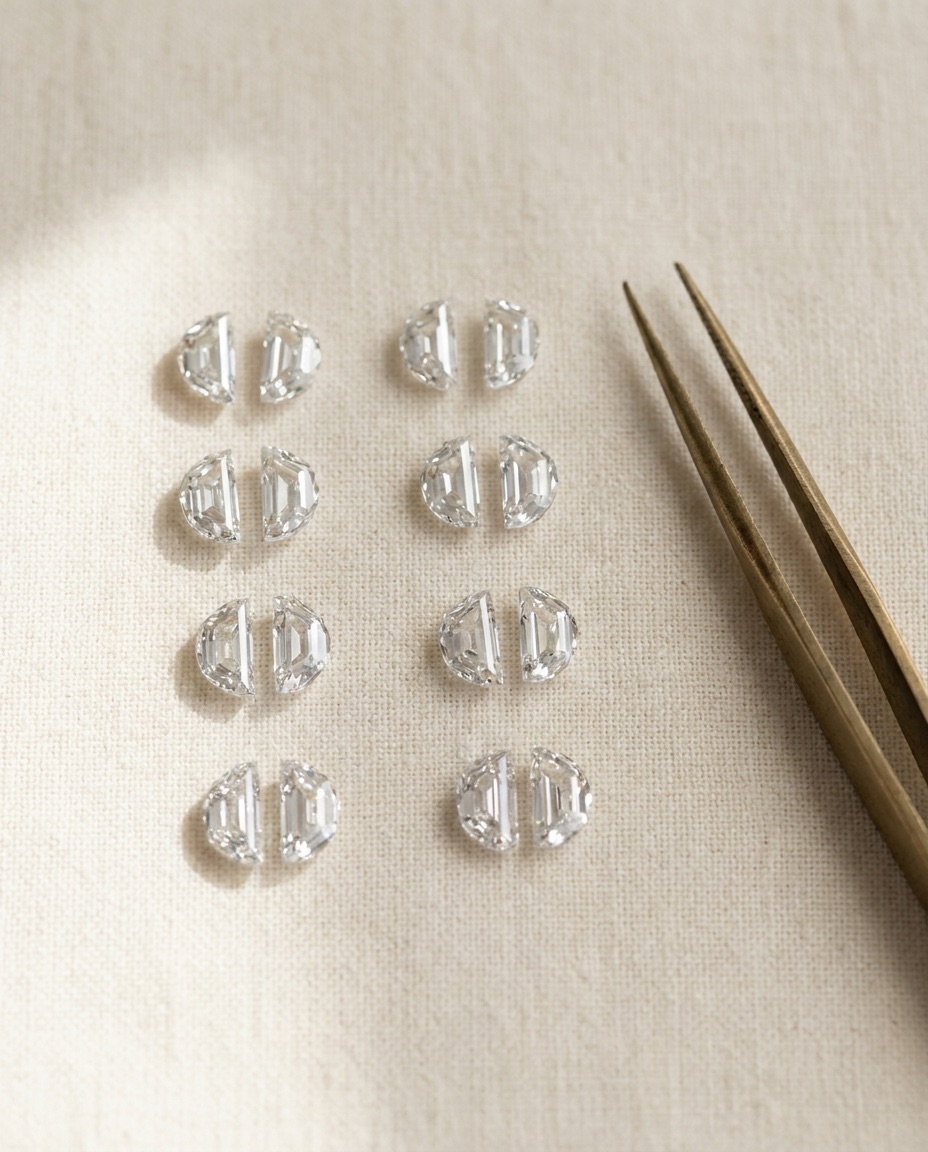
Guru Diam calibrates and mirrors Half Moon pairs in-house rather than pulling two similarly sized loose stones off a parcel and calling it a match. That distinction matters more for this shape than almost any other side stone in the catalog: because a true pair requires matching chord length, height, and curve profile in mirror orientation, cutting to a specific pair spec has to happen as a planned process from the rough stage, not as a post-hoc sorting exercise on finished stones. Rough selected for Half Moon production is chosen with the crescent outline — and the pair it will eventually become half of — in mind, rather than cut opportunistically from whatever's left over after cutting rounds and standard fancy shapes.
Every Half Moon pair leaving Guru Diam's cutting floor is checked for mirror symmetry before it's added to on-hand inventory — chord length, height, and curve profile compared stone-to-stone, in addition to whatever polish and symmetry grading the eventual certificate captures. That in-house control is what makes it possible to hold a live bench of 701+ Half Moon stones across a spread of sizes and proportions, rather than the handful of one-off pieces most wholesalers carry. All cutting, faceting, and polishing happens in-house; CVD lab-grown rough only, in line with the rest of Guru Diam's white diamond catalog.
Grading a Half Moon diamond
Fancy step-cut shapes grade on the same 4Cs framework as any other diamond, but a few things shift for a shape this small, this flat-faceted, and this pair-dependent.
Color
Step-cut facets — the standard faceting for a Half Moon — are more forgiving of light body color than a brilliant cut, because the broad, flat facet planes don't concentrate and refract color the way a brilliant's smaller facets do. That said, Half Moons are almost always set beside a whiter center stone, and any color difference between the side stones and the center reads immediately in a side-by-side comparison. Most wholesale buyers stay in the D–H range for Half Moon pairs meant to match a colorless or near-colorless center stone, and treat color matching between the two side stones — not just an acceptable grade on paper — as the real spec to hit.
Clarity placement
Because a Half Moon's step-cut facets are broad and flat, inclusions are more visible here than they would be under the same clarity grade on a brilliant-cut stone of similar size — step cuts are famously less forgiving of inclusions than brilliants, the same reason emerald and asscher buyers are advised to look at the actual stone rather than trust the grade alone. VS2 and above is the safer buying range for a Half Moon meant to sit clean and bright next to a center stone; buyers considering SI clarity should ask for a plot or a clear photo rather than sourcing on the number alone.
Symmetry and pair-matching as the de facto cut grade
Neither GIA nor IGI issues an overall cut grade for fancy shapes, Half Moon included — that grading only exists for round brilliants, where decades of light-performance modeling support a single rolled-up score. For a Half Moon, symmetry and polish grades on the individual stone's report do part of the job, but the spec that actually determines whether a pair is sellable is mirror-matching between the two stones, which doesn't appear on either stone's certificate at all. That's a visual and dimensional check a buyer has to do — or trust their supplier to have already done — rather than a line item to read off a grading report.
Carat weight, sizing, and matching to a center stone
Half Moon pairs are sized to the center stone they're flanking, which makes carat weight a secondary spec behind millimeter dimensions for most wholesale orders. A jeweler building a three-stone ring around, say, a 7mm round or a 7x5mm oval center needs a Half Moon pair cut to a specific chord length that will sit flush against that center stone's girdle — too short and there's a visible gap, too long and the side stones crowd or overlap the center. As a rough trade reference, Half Moon side stones for standard three-stone work typically run in the 3mm–7mm chord range, with height scaled to whatever fullness ratio the design calls for; larger pairs, and the occasional single Half Moon cut as a small statement or center stone in a Deco-style cocktail ring, run above that range on request.
Because sizing is driven by the center stone rather than a standalone carat target, wholesale buyers get faster, more accurate quotes by specifying chord length and desired fullness — or simply the dimensions of the center stone the pair needs to flank — rather than asking for "a matched pair of half moons" by carat weight alone. Carat weight still matters for pricing, but two pairs at the same total carat weight can differ meaningfully in chord length depending on how full or flat they're cut, the same way ratio changes the read on a marquise independent of carat weight.
Pricing factors for wholesale Half Moon diamonds
Beyond the standard 4Cs, pair-matching quality is the single biggest price lever on a Half Moon order. A pair with precisely mirrored chord length, height, and curve profile commands a real premium over two individually well-cut Half Moons that happen to be similar in size — and buyers sourcing from a supplier who cuts to a planned pair spec, rather than sorting after the fact, are paying for that planning, not just for two pieces of polished carbon. Corner condition at the chord-to-arc points factors in the same way it does for a marquise or kite's tips: soft, slightly rounded corners discount a stone regardless of its color and clarity grade, since a sharp, clean corner is both a visual and a durability marker.
Relative to round brilliants of comparable color, clarity, and total carat weight, Half Moon — like most fancy step-cut side stones — trades at a discount per carat. That discount narrows for genuinely matched pairs versus loose singles, because a buyer who needs a true pair for a specific project has fewer substitutable options than a buyer who just needs "a Half Moon" for a one-off accent. Buyers quoting a three-stone job sight-unseen should always confirm that a quoted pair is cut-to-match rather than sorted-to-match — the price difference between the two is real, and so is the visible difference once the ring is mounted.
Sourcing true matched pairs — how it actually works
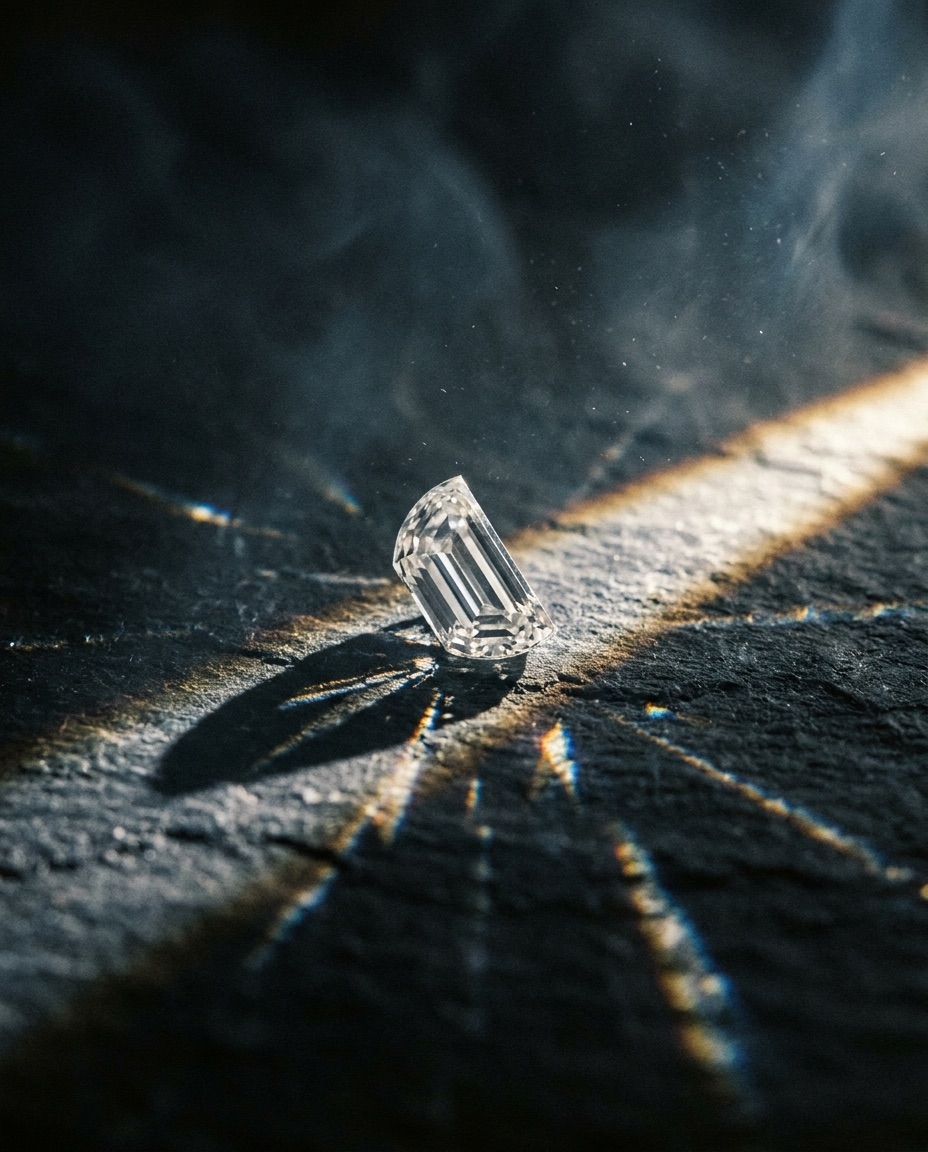
The practical difference between a supplier who can deliver a true Half Moon pair and one who can't comes down to whether pairs are cut together from planned rough or assembled after the fact from a mixed parcel of loose stones. Guru Diam's in-house cutting floor plans Half Moon production as pairs from the rough-selection stage, which is what makes it possible to fill a specific chord-length and fullness request rather than offering only whatever pairs happen to already exist in inventory. For buyers with a recurring need — a jeweler who regularly builds three-stone Deco-style rings, for example — that in-house cutting capacity also means a custom pair spec can be cut to order rather than waiting for the right match to surface in stock.
For one-off or rush orders, the 701+ on-hand Half Moon stones give buyers a live bench to pull an already-matched pair from without waiting on a cutting run, across a spread of chord lengths and fullness ratios. Either path — pulling from on-hand stock or cutting a custom pair spec — runs through the same in-house floor, so buyers aren't choosing between quality tiers, only between what's already cut and what needs to be.
Setting and styling guidance for jewelers
Half Moon is a design-forward, low-volume shape — jewelers stocking it are almost always selling a specific vintage or Deco-revival aesthetic, not a commodity side stone, and styling advice for retail customers should lean into that rather than treat it like a generic accent.
Three-stone Art Deco rings
This is the shape's core use case and has been since the 1920s: a center stone flanked by a mirrored Half Moon pair, the flat chord edges facing the center and the curved arcs sweeping outward toward the shoulders. It's a look that reads as period-correct even on a brand-new lab-grown build, which is exactly the appeal for customers chasing an antique aesthetic without sourcing an actual estate piece.
Which center shapes pair best
Round and oval centers are the most common Half Moon pairings, since the curved arc naturally echoes a round or oval girdle line. Cushion and old mine or old European cut centers — both already vintage-coded shapes — are a close second and lean even further into the Deco-revival styling. Emerald and asscher centers work too, but the pairing reads more contrast-driven — hard rectangular lines against a soft crescent — which some designs use deliberately and others avoid.
Cocktail rings and anniversary bands
Beyond the classic three-stone build, Half Moon pairs show up in cocktail rings as a wider architectural accent flanking a larger center stone, and in anniversary or eternity-adjacent bands where a run of alternating Half Moons and straight baguettes builds the same hard-line-meets-curve visual language across a full band rather than a single ring.
Half Moon beyond standard pair sizing
Guru Diam's standard calibrated melee lineup — round brilliant plus fancy calibrated shapes like emerald, radiant, pear, and marquise, cut in the 0.8mm–9.0mm range at a DEF+/VS+ baseline — doesn't carry Half Moon as a stocked melee shape, since the shape's whole value proposition is mirrored pair-matching rather than parcel-level calibration. Smaller Half Moon accents beyond standard three-stone side-stone sizing can be cut as a calibrated shape on request through the same in-house floor that produces the standard pair inventory; buyers with a project that needs Half Moon at melee-adjacent scale should flag that as a custom request rather than expect it off a standard melee parcel sheet.
How to order Half Moon diamonds wholesale from Guru Diam
Guru Diam sells trade-only — a verified wholesale account is required before pricing and live inventory are visible, keeping the platform limited to independent jewelers, designers, and manufacturers rather than retail shoppers. Once an account is active, Half Moon pairs are on-hand inventory, ready to ship same-day out of either coast: New York same-day before 6pm EST, Los Angeles same-day before 4pm PST. Certification is flexible across the three labs the trade actually works with — IGI standard, GIA and GCAL available on request — so a buyer supplying a retailer with a specific lab requirement isn't stuck reordering.
Because pair-matching quality is difficult to evaluate from a spec sheet alone, buyers sourcing Half Moon for a specific project are better served booking time with a gemologist to compare chord length, fullness, and mirror symmetry side by side rather than working from photos. Buyers building a full order across multiple shapes and colors get the same consolidation that applies across the rest of the catalog — one vendor, one shipment, one relationship — rather than sourcing an antique-style side stone from one supplier and everything else from another because no single vendor carries the full spread.
Frequently Asked Questions
What is a Half Moon diamond? A Half Moon is a crescent-shaped diamond — one straight chord edge and one curved arc edge — almost always sold and set as a mirrored pair flanking a center stone. It's also called a demilune cut in the trade.
Why is it hard to find a true matched pair of Half Moon diamonds? The two stones need to mirror each other precisely in chord length, height, and curve profile, oriented as opposites, to sit symmetrically on either side of a center stone. That's a harder matching problem than most side-stone shapes, and it's why most wholesalers carry only a handful of loose pieces rather than genuinely cut-to-match pairs.
Are Half Moon diamonds cut as step cuts or brilliants? Step cut is standard — flat, broad facets following the curve, which suits the shape's calm, architectural Art Deco look. A brilliant-faceted version with more fire exists but is typically a special-order request rather than standard stock.
How do I know what size Half Moon pair I need? Size to the center stone, not to a target carat weight. Provide the center stone's girdle dimensions and the chord length needed to sit flush against it; Guru Diam can match a pair to those specs or pull the closest fit from the 701+ on-hand bench.
Are Half Moon diamonds certified? They're sold as calibrated matched-pair goods, IGI-gradable on request with GIA and GCAL available, following the same convention as other antique-style side-stone shapes — pair-matching itself isn't a certificate line item, so it's checked visually alongside the grading report.
What center stone shapes pair best with Half Moon side stones? Round and oval centers are the most common pairing since the curve echoes the girdle line; cushion and old mine or old European centers lean further into a full Deco-revival look. Emerald and asscher centers work as a deliberate hard-line-meets-curve contrast.