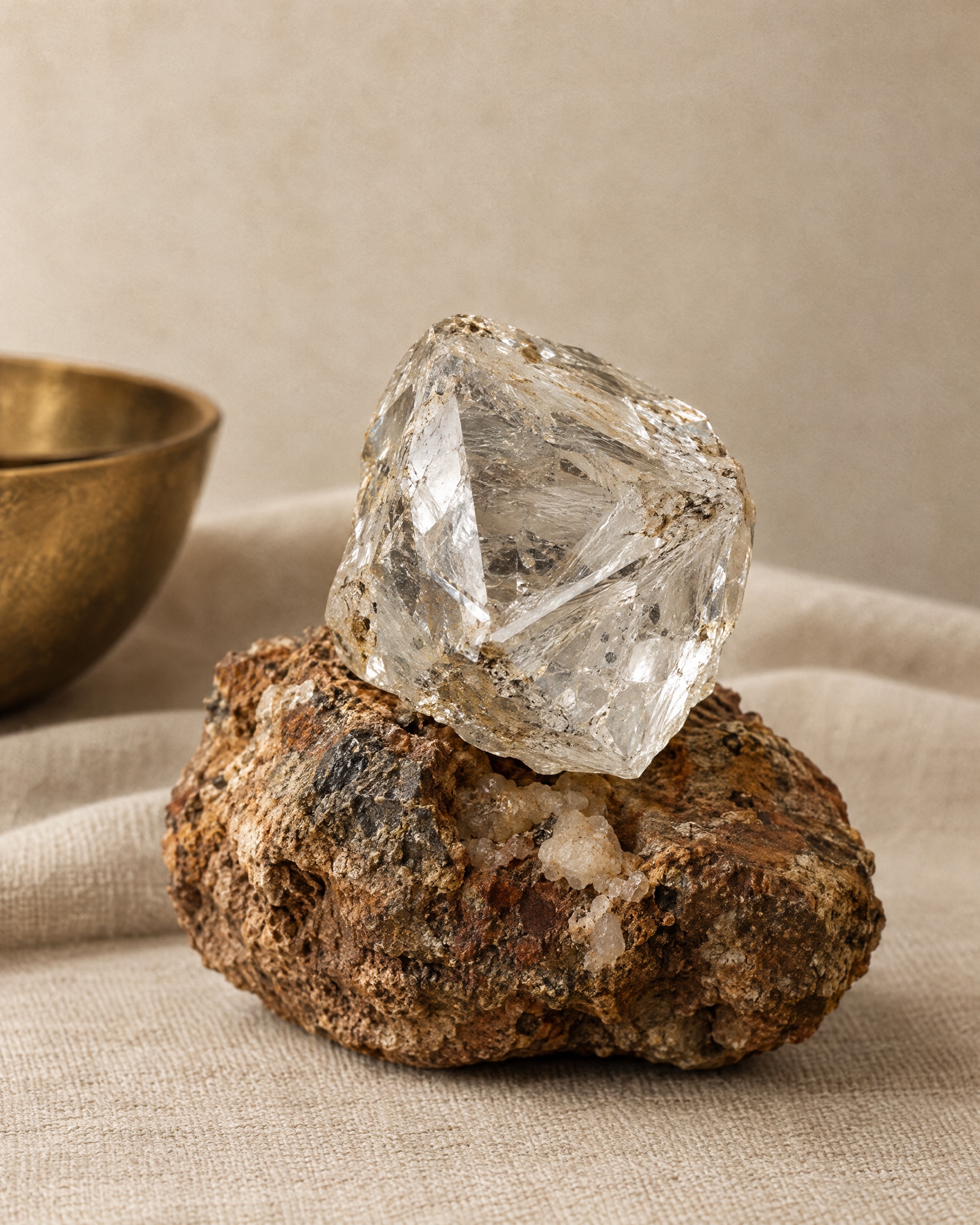
The Golconda diamond mines were a group of alluvial diamond deposits near the historic Golconda Sultanate in what is now Telangana, India, active from roughly the 1500s through the 1700s and responsible for some of the most famous diamonds in history, including the Koh-i-Noor, the Hope Diamond, and the Regent Diamond. Golconda itself was a trading and cutting center rather than a mine site — the actual diggings were spread across the Krishna River basin, with stones brought to Golconda's markets for sale and distribution to merchants arriving from across Asia, the Middle East, and, by the 1600s, Europe. Today, "Golconda diamond" is used less as a literal mine-of-origin claim and more as a trade term for a specific category of exceptionally pure, high-transparency Type IIa diamonds, since the historical mines themselves have long been exhausted.
This guide covers where the Golconda mines actually were, the diamonds that made the name famous, why "Golconda" survives as a trade and grading term centuries after the mines closed, how that historical legacy compares with modern natural and lab-grown sourcing, and where a wholesale buyer can source comparable Type IIa material today.
Where the Golconda Mines Actually Were
Despite the name, no diamonds were ever mined at Golconda Fort itself. The fort, near present-day Hyderabad, was the administrative and commercial capital of the Golconda Sultanate, and later a major cutting and trading hub. The actual alluvial deposits were scattered along the Krishna and Godavari river systems, in mining areas including Kollur, Paritala, and Wajra Karur, sometimes more than 150 miles from the fort itself. Merchants and cutters converged on Golconda's markets to buy rough material brought in from these outlying diggings, which is how the region's name became permanently attached to the diamonds themselves rather than the specific mine sites.
A Brief History of the Region's Diamond Trade
Diamond mining in the Golconda region predates written records by centuries, but it reached its commercial peak under the Qutb Shahi dynasty and later Mughal control between the 1500s and 1700s, when European traders — most notably the French gem merchant Jean-Baptiste Tavernier — documented visiting the mines and markets directly. For roughly two centuries, this region was effectively the only significant commercial source of diamonds known to European and Middle Eastern markets, since Brazilian deposits weren't discovered until 1725 and South African mining didn't begin until the 1870s. Production declined through the 1700s and 1800s as the most accessible alluvial deposits were worked out, and by the time large-scale kimberlite mining began in South Africa, Golconda's mines had effectively stopped being a meaningful commercial source.
Tavernier and the European Diamond Trade Boom
Jean-Baptiste Tavernier made six voyages to Asia between 1630 and 1668, several of which took him directly to the Golconda region's mines and markets, and his published travel accounts became one of the primary Western sources documenting how the trade actually worked — how rough stones were sorted, how local rulers taxed and controlled output, and how European buyers negotiated for material to bring home. Tavernier himself is closely associated with what later became known as the Tavernier Blue, a large blue diamond he acquired in India that was later cut down into what is now the Hope Diamond. His accounts helped fuel a surge of European interest in Indian diamonds through the late 1600s and 1700s, cementing Golconda's reputation in Western markets well beyond its actual productive lifespan.
Other Historic Indian Diamond-Producing Regions
Golconda dominates the popular narrative, but it wasn't India's only historic diamond-producing area. The Panna region in present-day Madhya Pradesh has a mining history stretching back centuries and, unlike the Golconda-area deposits, still sees small-scale diamond mining today, though at nowhere near historical Golconda-era volumes. Wajra Karur, in present-day Andhra Pradesh, is sometimes cited in historical sources as a distinct source region whose output was also funneled through Golconda's markets rather than sold under its own name — another reason the "Golconda" label ended up covering a wider geographic footprint than the fort's immediate surroundings.
Famous Diamonds Traced to the Golconda Mines
| Diamond | Approx. Current/Historic Weight | Notable History |
|---|---|---|
| Koh-i-Noor | 105.6 carats (cut) | Passed through Mughal, Persian, Afghan, and Sikh rulers before entering British Crown Jewels in 1849 |
| Hope Diamond | 45.52 carats | Famous deep-blue color; now on permanent display at the Smithsonian National Museum of Natural History |
| Regent Diamond | 140.64 carats (cut) | Once mounted in Napoleon's sword hilt; now displayed at the Louvre |
| Orlov Diamond | 189.62 carats | Set in the Imperial Sceptre of Russia, now held at the Kremlin Diamond Fund |
| Darya-i-Noor | Approx. 182 carats | Pale pink, part of the Iranian Crown Jewels |
These stones share more than geographic origin — most are notable for exceptional transparency and, in several cases, virtual freedom from nitrogen impurities, which is the underlying trait that later gave rise to the modern use of "Golconda" as a quality descriptor. These five are only the best-documented survivors; historical accounts describe many more large, exceptional stones passing through Golconda's markets that were later recut, lost, or absorbed into royal collections without a traceable modern identity. The Great Mogul Diamond, described by Tavernier as an enormous rough stone he personally examined in the 1660s, is one such example: it was never conclusively matched to any diamond known today, and some historians speculate it may have eventually been recut into the Orlov or another surviving stone, though this remains unproven.
Why "Golconda" Became a Grading Term, Not Just a Place Name
Nitrogen is the impurity responsible for most diamond color, and it's present in the overwhelming majority of natural diamonds mined worldwide. A small fraction, however, contain no measurable nitrogen at all — these are classified as Type IIa, and they tend toward exceptional transparency, sometimes described as having a distinctive "liquid" or glassy look under light. A disproportionate share of documented Golconda-region stones happen to fall into this category, so over time gemological literature and the trade press began using "Golconda" informally to describe any exceptionally transparent, high-clarity Type IIa diamond — regardless of where it was actually mined. Major labs including GIA have occasionally used "Type IIa, Golconda-type" language on grading reports for stones with the right optical characteristics, though this is a descriptive quality reference rather than a literal, verifiable claim of Indian origin.
Type IIa Diamonds: What Actually Defines the Category
Type IIa diamonds represent roughly 1-2% of all natural diamonds mined. They lack the nitrogen impurities present in Type Ia stones (the most common category, roughly 98% of natural production) and lack the boron responsible for Type IIb's blue coloration. The practical result is a diamond with exceptional transparency and, frequently, higher thermal conductivity than nitrogen-bearing stones — a property gemologists sometimes use as a diagnostic clue. Type IIa diamonds can occur in any modern mining region, not just historically Golconda-linked deposits; notable modern Type IIa production has come from Letšeng in Lesotho and parts of the Golconda-adjacent legacy in India's own more recent finds.
Can You Actually Buy a "Golconda Diamond" Today?
Not in the sense of a diamond freshly mined from the historical Golconda deposits — those mines are commercially exhausted and have been for well over a century. What the trade sells today under Golconda-adjacent language is either: a documented antique stone with a traceable ownership history back to the historical mines (extremely rare and typically auction-house territory, commanding significant premiums), or a modern Type IIa diamond marketed using "Golconda-type" as a descriptive quality shorthand for its exceptional transparency, without any claim of historical Indian origin. Buyers should treat any "Golconda diamond" listing skeptically unless it comes with documented provenance or is clearly using the term as a Type IIa quality descriptor rather than an origin claim.
Auction houses that do handle genuinely documented Golconda-provenance stones typically require a chain-of-custody history reaching back through prior sales records, royal or noble collection inventories, or prior auction catalog entries — the kind of paper trail that took a stone through identifiable owners across decades or centuries. A seller using "Golconda" language without any of that documentation is almost certainly describing optical quality rather than a verifiable historical claim, and buyers evaluating such a listing should ask directly which meaning is intended before paying any associated premium.
How Labs Actually Test for Type IIa Classification
Type classification isn't a visual judgment call — gemological labs including GIA determine it through infrared and ultraviolet-visible spectroscopy, which measures how a diamond absorbs specific wavelengths of light. Nitrogen and boron each produce distinctive absorption signatures, so a lab can determine within a controlled testing environment whether a stone falls into Type Ia, Ib, IIa, or IIb with a high degree of confidence, rather than relying on appearance alone. This is also why Type IIa status can be confirmed on both natural and CVD lab-grown stones through the same testing methods — the classification describes the crystal's chemical composition, not its origin story.
Legends and Superstitions Attached to Golconda-Era Diamonds
Several Golconda-linked stones carry famous curse legends — the Koh-i-Noor and the Hope Diamond are the two most commonly cited, with popular stories attributing misfortune to their various owners across centuries. Historians generally treat these as retrospective storytelling rather than documented fact: large, famous diamonds tend to pass through the hands of rulers and elites who, across enough centuries, statistically experience plenty of both good and bad fortune regardless of what jewelry they own, and dramatic curse narratives tend to get attached after the fact to particularly eventful ownership histories. The persistence of these stories says more about how compelling a truly exceptional diamond's provenance narrative can be than about any actual property of the stones themselves — but it's part of why "Golconda" retains such strong brand recognition well outside gemological circles.
How This Legacy Connects to India's Modern Diamond Industry
India's role in the global diamond trade didn't end when the Golconda mines were worked out — it shifted from mining to processing. Surat, in Gujarat, grew over the 20th century into the world's dominant diamond-cutting and polishing center, handling a large majority of the world's diamonds by volume (including both natural and, more recently, lab-grown CVD material) regardless of where they were originally mined or grown. Guru Diam's own lab-grown diamonds are cut and polished in India before final grading and shipment from our New York and Los Angeles locations — a continuation, in a very different commercial form, of India's centuries-long role at the center of diamond processing that Golconda's historical trade helped establish.
Golconda-Type Clarity vs. Modern Lab-Grown Type IIa Production
One of the more interesting modern parallels is that CVD lab-grown diamonds are frequently Type IIa by default, since the controlled growth process doesn't introduce the nitrogen impurities common in natural formation. This means the exceptional transparency historically prized in Golconda-linked stones is, in a CVD lab-grown diamond, closer to the baseline outcome than a rare exception — a buyer sourcing a CVD stone for its clean, high-transparency look isn't chasing the same rarity premium that applies to a documented antique Type IIa natural diamond, but can source comparable optical quality at a materially different price point and volume.
This matters commercially because it changes what "exceptional transparency" costs to acquire. A natural Type IIa stone with strong provenance can carry a substantial premium over an otherwise-comparable Type Ia stone of the same carat, cut, and clarity grade, purely because of its rarity within natural production. A CVD lab-grown Type IIa stone doesn't carry that same scarcity premium, since the growth process itself tends toward that chemical purity — pricing instead follows the standard 4Cs criteria (carat, cut, color, clarity) rather than a type-based rarity multiplier. For a jeweler building inventory around a "exceptionally clear" or "icy" marketing angle, that's a meaningfully different cost structure to work with.
Table: Golconda-Era History vs. Modern Type IIa Sourcing
| Historical Golconda Diamonds | Modern Type IIa (Natural) | Modern Type IIa (CVD Lab-Grown) | |
|---|---|---|---|
| Availability | None — mines exhausted | Rare, roughly 1-2% of natural production | Common outcome of the CVD growth process |
| Provenance | Documented ownership history required | Origin generally not traced to individual mine | Manufacturing facility, not a mine, is the origin |
| Price Positioning | Museum/auction-tier, effectively priceless for named stones | Significant premium over typical Type Ia stones | Priced on standard 4Cs criteria, no rarity premium for type |
| Certification Language | Historical documentation, not a modern grading report | May carry "Type IIa" note on GIA/IGI report | May carry "Type IIa" note on GIA/IGI report |
What Buyers and Jewelers Should Take Away From the Golconda Story
For a buyer without an interest in antique or estate stones, the practical lesson from Golconda's history isn't about sourcing a mythical mine — it's about understanding that "Golconda" as used in current listings is almost always a clarity and transparency descriptor, not a literal origin claim, and treating it accordingly. If exceptional transparency and Type IIa characteristics are the actual goal (for a signature piece, a high-visibility solitaire, or a buyer specifically requesting that look), both natural and CVD lab-grown options exist, and IGI, GIA, and GCAL certification are all available to confirm type classification on the stone actually being purchased, rather than relying on a seller's historical framing.
It's also worth separating the marketing story from the buying decision. A retail jeweler telling a customer about the Koh-i-Noor or the Hope Diamond as part of a sales narrative around an exceptionally clear stone is using legitimate, well-documented history to add context to a purchase — that's different from implying the specific stone being sold has any actual connection to those historical diamonds or mines. Keeping that distinction clear in customer-facing copy avoids overstating a stone's story while still benefiting from genuinely interesting, verifiable history.
Golconda vs. the Next Great Historic Diamond Source: Brazil
When Golconda-region production finally declined past commercial relevance in the early 1700s, Brazil's Diamantina region (discovered 1725, in the state of Minas Gerais) became the next dominant global source, holding that position for roughly 150 years until South African kimberlite mining began in the 1870s. The transition illustrates a pattern that has repeated throughout diamond-industry history: a dominant source region eventually depletes or gets outpaced by a newly discovered one, and the trade's center of gravity shifts accordingly. Brazil's alluvial deposits, like Golconda's, eventually gave way to larger-scale industrial mining elsewhere — first South Africa, later Russia, Botswana, and Canada. Understanding this pattern helps explain why no single country has ever held a truly permanent monopoly on natural diamond production, and why sourcing diversification has always been a practical, historically grounded strategy rather than a purely modern risk-management idea.
Why This History Still Comes Up in Trade Conversations
Golconda's diamonds remain a reference point in the trade for a reason beyond nostalgia: they represent the first large-scale, sustained commercial diamond market in recorded history, predating South African, Russian, Canadian, and Australian production by centuries. Grading terminology, trade routes, and even some of the cutting techniques that shaped the modern diamond industry trace back through this period. Understanding that history gives buyers useful context for why certain quality descriptors exist at all, and why exceptional clarity carries the cultural weight it does in diamond marketing, well beyond its purely technical definition.
Sourcing Type IIa and High-Transparency Diamonds Through Guru Diam
Guru Diam supplies both natural and CVD lab-grown diamonds, including exceptional-clarity stones suited to buyers chasing the same visual quality historically associated with Golconda-linked diamonds, with full IGI, GIA, or GCAL certification available on request. Certified loose stones can be browsed through the certified diamonds category, and buyers building matched sets can review the matching pairs category. Trade accounts can review wholesale terms at the wholesale hub or apply directly through trade partner, and jewelers wanting a finished piece built around an exceptional stone can work through custom jewelry, with rings finished in 4-6 days. In-stock certified inventory ships same-day from New York (before 6pm EST) and Los Angeles (before 4pm PST).
Frequently Asked Questions
Where were the Golconda diamond mines actually located?
Not at Golconda Fort itself, but in alluvial deposits scattered along the Krishna and Godavari river basins in present-day Telangana, India, including areas like Kollur and Paritala. Golconda was the trading and cutting hub where rough stones from these outlying sites were bought and sold.
Can you still mine diamonds at Golconda today?
No. The historical alluvial deposits were worked out by the 1700s-1800s and are not a commercial diamond source today. Modern Indian diamond activity centers on cutting and polishing, primarily in Surat, rather than mining.
What does "Golconda diamond" mean when it appears in a listing today?
In almost all modern contexts it's a quality descriptor referring to exceptional transparency and Type IIa characteristics, not a literal claim that the stone was mined from the historical Golconda deposits. Genuine documented Golconda-origin antique stones are extremely rare and typically sell at auction with full provenance records.
What is a Type IIa diamond?
A diamond with no measurable nitrogen impurities, representing roughly 1-2% of natural production. Type IIa stones are prized for exceptional transparency and are the classification most associated with historic Golconda diamonds.
Are CVD lab-grown diamonds Type IIa?
Many are, since the controlled CVD growth process doesn't introduce the nitrogen impurities common in natural formation. This makes high-transparency, Type IIa-characteristic stones considerably more accessible through lab-grown sourcing than through natural Type IIa material.
Does Guru Diam sell diamonds mined from the historical Golconda deposits?
No — those deposits are exhausted and not a commercial source. Guru Diam supplies certified natural and CVD lab-grown diamonds, including exceptional-clarity Type IIa material, with IGI, GIA, or GCAL certification confirming the actual grading characteristics of the stone purchased.
Is a "Golconda-type" diamond more valuable than a regular diamond of the same 4Cs grade?
For a documented antique natural stone, yes — genuine Golconda-provenance stones carry a substantial rarity premium at auction. For a modern diamond simply described as "Golconda-type" based on its Type IIa transparency, value still follows standard 4Cs pricing (carat, cut, color, clarity); the descriptor communicates optical quality rather than adding an automatic premium on its own.