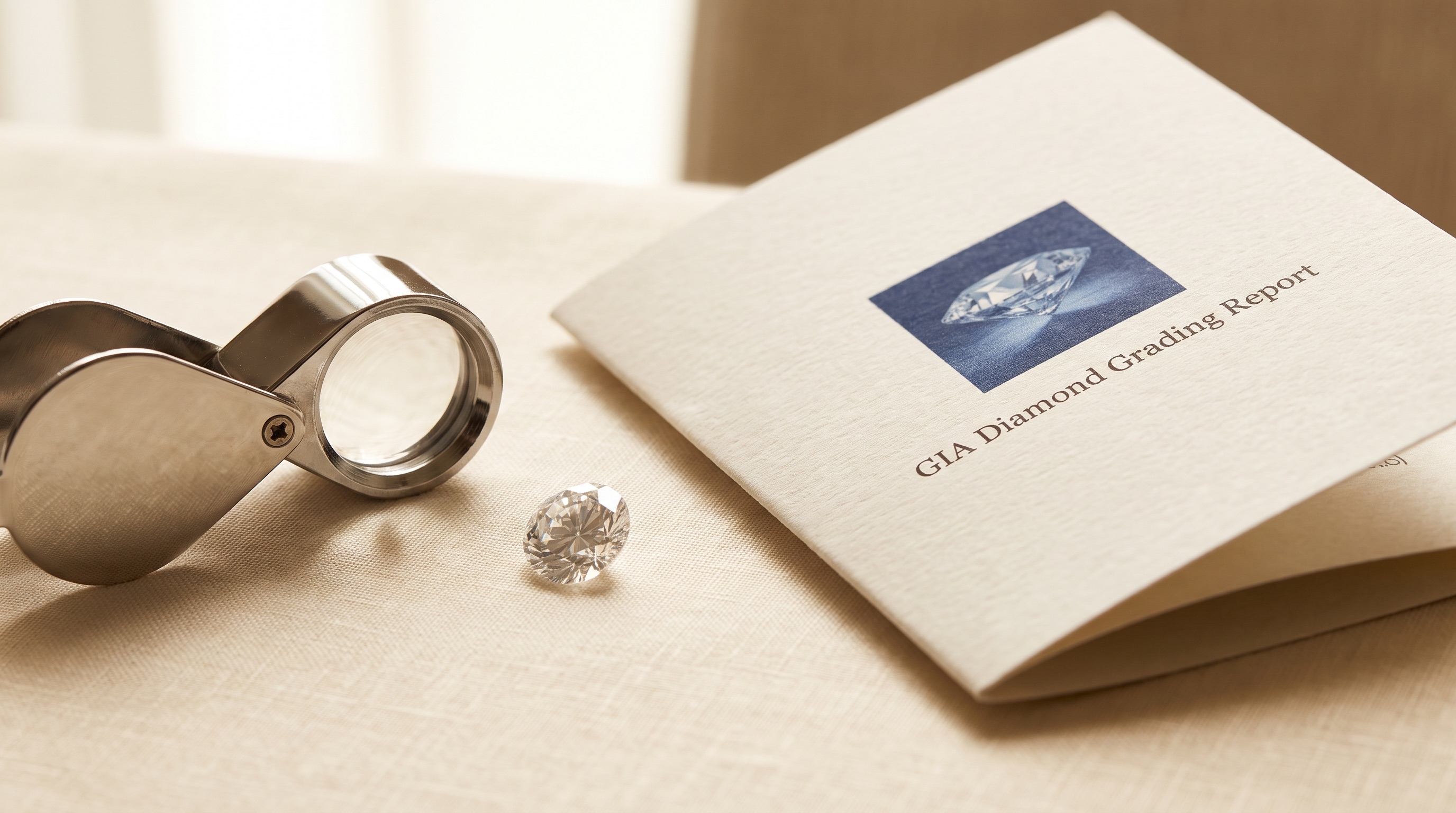
A GIA diamond report — formally a GIA Diamond Grading Report — is a document issued by the Gemological Institute of America that records a specific diamond's measured characteristics: carat weight, color grade, clarity grade, cut grade (for round brilliants), proportions, and a unique report number laser-inscribed on the stone's girdle. It is not an appraisal, an insurance valuation, or a guarantee of price — it is a factual, standardized description of the stone as GIA's lab measured it on a specific date.
For a wholesale buyer, the GIA report is the single document a purchase decision, a resale price, and a customer disclosure all hang on, which makes understanding exactly what it does and doesn't say more than a formality. This guide breaks down what's actually printed on a GIA report, how the grading process behind it works, what it deliberately leaves out, and how to read one correctly before a stone changes hands.
What GIA Actually Is
The Gemological Institute of America is a nonprofit research and educational institute founded in 1931, widely regarded in the trade as the strictest and most consistent of the major grading labs. GIA doesn't buy, sell, or broker diamonds — its grading operation is structured to be independent of any commercial stake in the stones it examines, which is part of why a GIA report carries more weight in resale and cross-border trade than reports from labs with looser grading standards or closer ties to sellers. GIA grades both natural and laboratory-grown diamonds, issuing a visually distinct report for each category so a buyer can immediately tell which type of stone they're looking at.
What's Printed on a GIA Diamond Report
A standard GIA Diamond Grading Report includes a defined set of fields, each representing a specific measured or assessed characteristic:
- Report number — a unique identifier, also laser-inscribed on the stone's girdle, used to verify the report against GIA's own database
- Shape and cutting style — e.g., round brilliant, emerald cut, cushion modified brilliant
- Measurements — precise millimeter dimensions (length, width, depth)
- Carat weight — measured to the thousandth of a carat, reported to the hundredth
- Color grade — D (colorless) through Z (light yellow or brown) for standard grading; a separate Fancy Color grading system applies to colored diamonds
- Clarity grade — Flawless through Included, based on inclusions and blemishes visible under 10x magnification
- Cut grade — Excellent through Poor, issued only for standard round brilliant cuts within GIA's grading parameters
- Polish and symmetry — separate Excellent-through-Poor grades for surface finish and facet alignment
- Fluorescence — None, Faint, Medium, Strong, or Very Strong reaction under long-wave ultraviolet light
- Proportions diagram — a scaled illustration of the stone's crown angle, pavilion depth, table size, and girdle thickness
- Clarity plot (on full reports) — a diagram mapping the approximate location of inclusions as observed by the grader
- Comments — notable characteristics not captured elsewhere, such as laser drilling or clarity enhancement, when present
GIA Report Types: Full Report vs. Diamond Dossier
GIA issues more than one report format depending on stone size and requested service level. The full GIA Diamond Grading Report includes the clarity plot and is typically issued for stones 0.15ct and above, or on request. The GIA Diamond Dossier, a more compact report format historically used for smaller stones, omits the clarity plot but includes all the same grading fields and carries a laser inscription on the girdle rather than a full plotted diagram — useful for smaller melee-adjacent center stones where a full plot adds cost without meaningfully changing the buying decision. Buyers comparing two similarly graded stones should check which report type they're looking at, since the Dossier format is not a lesser grade, just a more compact document for smaller stones.
Natural vs. Laboratory-Grown GIA Reports
GIA issues a separate, visually distinct report for laboratory-grown diamonds — historically titled the GIA Laboratory-Grown Diamond Report — that uses the same grading scales and terminology as the natural diamond report but is printed with different background coloring and header language specifically so the two document types can't be confused at a glance. As of GIA's 2020 policy update, lab-grown diamond reports state color and clarity grades using the same terminology as natural diamond reports rather than a broader banded scale, which brought lab-grown grading language into closer alignment with the natural-diamond system used for decades. A wholesale buyer sourcing across both categories should always confirm which report type accompanies a given stone before comparing grades side by side, since a report header, not the grade language alone, is the definitive way to tell the two apart at a glance.
| Feature | Natural Diamond Report | Laboratory-Grown Diamond Report |
|---|---|---|
| Report title | GIA Diamond Grading Report | GIA Laboratory-Grown Diamond Report |
| Background/border design | Standard GIA layout | Distinct coloring, clearly labeled "Laboratory-Grown" |
| Grading scales used | Standard D-Z color, FL-I3 clarity | Same D-Z color, FL-I3 clarity scales (post-2020 policy) |
| Girdle inscription | Report number only (standard) | Report number plus "Laboratory-Grown" and growth method (e.g., CVD) |
| Cut grade | Issued for standard round brilliants | Issued for standard round brilliants |
What a GIA Report Does Not Tell You
A GIA report is not an appraisal and includes no monetary value — GIA's grading operation is deliberately separated from pricing to avoid any appearance of conflict of interest, and any document claiming to be a "GIA appraisal" is not a genuine GIA product. The report also doesn't guarantee the stone's current market price, doesn't account for how a diamond will look once mounted in a specific setting, and doesn't certify the seller's business practices or return policy — those remain the buyer's own due diligence, separate from anything printed on the report itself. Buyers occasionally assume a high grade guarantees strong resale value; grade is one major input into value, but market conditions, certification currency, and buyer demand for a specific shape or size at the time of resale all move independently of the grade printed years earlier.
How the GIA Grading Process Works
A diamond submitted to GIA is examined by multiple independent graders working without knowledge of each other's assessments, and their findings are cross-checked before a final grade is issued — a deliberate structure designed to reduce the influence of any single grader's judgment on a subjective characteristic like clarity or color. Color and clarity are graded using controlled lighting and calibrated master stone sets rather than a grader's unaided visual impression, and cut grade for round brilliants is calculated from precise proportion measurements against GIA's own cut-grading research rather than assessed subjectively. This multi-grader, calibrated-reference approach is the primary reason GIA reports are treated in the trade as the most consistent baseline for cross-supplier comparison, even when a specific stone's grade sits at the boundary between two tiers.
Report Currency and Why It Matters for Wholesale Buying
A GIA report describes a diamond as it existed on its grading date — it does not automatically account for any damage, re-cutting, or clarity treatment applied to the stone afterward. A stone that's been chipped, re-polished, or laser-drilled after its original grading date may no longer match its report, even though the physical document itself remains unchanged. Wholesale buyers purchasing pre-owned, resale, or older-inventory stones should treat report currency as a real diligence item — checking whether a stone shows any visible sign of post-grading alteration and, where there's doubt, having a stone re-examined rather than assuming an older report still fully describes the stone in hand today.
Verifying a GIA Report Before Purchase
GIA maintains a free online report-lookup tool where any report number can be checked against GIA's own records to confirm a report is genuine, unaltered, and actually associated with the stone it's presented alongside. This is a standard, non-negotiable step in wholesale purchasing — report fraud, including altered photocopies and reports paired with a different, lower-grade stone than the one originally graded, is a known risk in the trade, and a report number that doesn't match GIA's database, or a report for a shape or carat weight that doesn't match the physical stone, is an immediate red flag that should stop a transaction before it closes.
Reading the Proportions Diagram and Clarity Plot
The proportions diagram on a full GIA report gives a scaled cross-section of the stone showing table percentage, crown angle, pavilion depth, and girdle thickness — the measurements that drive light performance independent of color and clarity grade. A buyer evaluating light performance alongside the printed cut grade can use this diagram to spot proportion combinations, like an unusually deep pavilion or thick girdle, that eat into carat weight without contributing visible size or brilliance. The clarity plot, included on full reports, maps the approximate size, type, and location of a stone's inclusions as observed by the grader — useful for confirming a specific stone's inclusion pattern matches what a seller has described, and occasionally useful for buyers who want to know whether an inclusion sits under the table (more visible) or near the girdle (typically less visible once set).
GIA Reports and Fancy Color Diamonds
Fancy color diamonds — yellow, pink, blue, green, and other hues outside the standard D-Z near-colorless range — receive a separate GIA Colored Diamond Grading Report using its own color intensity scale (Faint, Very Light, Light, Fancy Light, Fancy, Fancy Intense, Fancy Dark, Fancy Deep, and Fancy Vivid) rather than the D-Z letter scale used for near-colorless stones. This report format also documents hue, tone, and saturation more specifically than the standard report, since color itself, not clarity or cut, is the primary value driver for fancy color stones. Buyers sourcing fancy color inventory should confirm they're looking at a Colored Diamond Grading Report rather than a standard report misapplied to a colored stone, since the two use meaningfully different terminology.
GIA vs. Other Grading Labs
IGI and GCAL are the other two certification labs most commonly seen alongside GIA in the lab-grown and natural wholesale trade, and all three use broadly comparable grading scales and terminology. GIA is generally regarded as applying the strictest, most conservative grading standard of the three, which is part of why GIA-graded stones sometimes carry a modest price premium over an identically graded IGI or GCAL stone at the same nominal grade — the market treats GIA's grade as slightly more reliably conservative. This doesn't mean IGI or GCAL certification is unreliable; it means a buyer comparing stones certified by different labs should factor in each lab's typical grading tendency rather than treating a G-VS1 from any lab as strictly interchangeable with a G-VS1 from another.
Common Misconceptions About GIA Reports
A frequent misconception is that a GIA report guarantees a diamond is "GIA certified" in a legally binding sense — GIA itself avoids the word "certified" in its own materials, preferring "graded," specifically because grading involves professional judgment on characteristics like clarity and color that carry some inherent, if narrow, margin of assessment. Another common misconception is that all lab-grown diamonds are automatically lower-graded or ineligible for top grades — a well-made CVD stone can and does receive the same top color, clarity, and cut grades as a comparable natural stone, since GIA grades the physical characteristics of the stone in front of it, not its growth method. A third misconception is that an older report is somehow less valid than a recent one — a report's grades don't expire, though as noted above, a stone's physical condition can change after grading in ways the original report won't reflect.
The Girdle Inscription: A Physical Link to the Report
Most diamonds accompanied by a GIA report carry a laser inscription on the girdle — the thin band around the stone's widest point — recording the report number in microscopic text, typically visible only under 10x magnification with a loupe or microscope. This inscription is the physical link between a specific stone and its paperwork, and it's what a buyer checks first when confirming that a report presented alongside a stone actually belongs to that stone rather than a different one entirely. Girdle inscription is optional on natural diamond reports (requested at submission) but standard on laboratory-grown diamond reports, where GIA also inscribes the growth method — CVD or HPHT — directly alongside the report number, a deliberate disclosure measure specific to lab-grown material. A wholesale buyer receiving a stone with no visible inscription matching its accompanying report should treat that as a reason to slow down and verify further, not assume the paperwork is simply for a different, similar stone in the same shipment.
Report Fees, Turnaround, and Why Larger Stones Cost More to Grade
GIA charges submission fees scaled primarily to carat weight and service speed, with larger stones costing more to grade than smaller ones — a structure that reflects the additional time a grader spends examining a bigger stone's proportions and inclusions, plus the higher insured value GIA carries while the stone is in the lab's possession. Standard service typically takes one to two weeks depending on submission volume and stone complexity, with expedited service available at a premium for buyers who need a report faster, such as ahead of a trade show or a time-sensitive sale. Wholesale buyers submitting their own rough or unset stones for grading should factor turnaround time into inventory planning, particularly around peak submission periods when major trade shows drive a temporary spike in lab volume across the industry.
When a Stone Should Be Re-Submitted for Grading
A diamond that has been re-cut, re-polished after chipping, or had a clarity-enhancing treatment applied after its original grading date no longer accurately matches its existing report, and should be re-submitted to GIA for a new report reflecting its current state. This is a genuine trade consideration when buying older or previously owned inventory: a stone that was chipped and repaired doesn't automatically ship with an updated report unless someone in the chain specifically requested one, meaning a buyer relying solely on an original, older report could unknowingly purchase a stone that no longer meets the clarity or cut grade printed on the paperwork in hand. Reputable wholesale sellers disclose known post-grading alterations up front rather than leaving a buyer to discover a discrepancy after purchase, and buyers sourcing resale or estate-adjacent inventory should ask directly whether any stone has been worked on since its report date.
How Wholesale Buyers Use GIA Reports in Pricing Decisions
In wholesale trading, the GIA report is the common reference point two parties use to agree on price without both needing to independently re-examine a stone from scratch — a practice that only works because GIA's grading is trusted to be consistent enough that a buyer across the country, or across the world, can price a stone off its report with reasonable confidence sight-unseen for an initial quote. Rapaport and other trade pricing guides publish price-per-carat benchmarks organized specifically around GIA's grading categories, which is part of why GIA remains the most widely referenced lab in cross-border wholesale trading even in markets where IGI or GCAL certification is also common and accepted. A buyer who understands exactly what's driving a report's grade — proportions, inclusion location and type, color undertone — is better positioned to negotiate price against those published benchmarks than one treating the letter-and-number grade as the entire picture.
Sourcing GIA-Graded Diamonds Wholesale
Guru Diam supplies loose CVD lab-grown and natural diamonds with IGI, GIA, and GCAL certification available at 0.30ct and above, sold individually or as pre-matched pairs. Trade buyers can browse current certified inventory through certified diamonds and matching pairs, and review fancy color GIA-graded stock through fancy color loose diamonds. In-stock inventory ships same-day from Guru Diam's New York and Los Angeles locations, and new trade accounts can apply through trade partner, with current terms available at the wholesale hub. For related certification topics, see our GIA report verification guide, GIA-certified lab-grown diamonds guide, and GIA-certified natural diamonds guide.
GIA Reports and Insurance Documentation
Insurance companies commonly request a GIA report number as part of scheduling a diamond piece on a jewelry policy, since it provides an objective, third-party description of the stone independent of the retailer who sold it. A GIA report on its own isn't sufficient for insurance purposes, though — insurers generally also require a separate appraisal document stating current replacement value, since the GIA report deliberately excludes any price information. Retailers selling certified stones to end customers should be prepared to explain this distinction clearly: the GIA report proves what the stone is, while a separate appraisal establishes what it would cost to replace, and customers occasionally assume one document does the job of both.
Regional Trade Preferences and GIA's Global Reach
While IGI and GCAL both maintain strong reputations and see extensive use in the lab-grown wholesale trade specifically, GIA remains the most globally recognized name across natural diamond markets in the US, Europe, and much of Asia, giving GIA-graded stones somewhat broader immediate acceptance when a stone moves across borders or between trading centers with different regional certification preferences. This matters most for wholesale buyers who anticipate reselling into markets or through channels where buyers may be less familiar with, or less trusting of, a certification body outside GIA — a consideration worth weighing alongside cost and turnaround time when deciding which lab to use for a given stone, particularly higher-value natural stones intended for cross-border resale.
Frequently Asked Questions
Is a GIA diamond report the same as an appraisal?
No. A GIA report is a factual description of a diamond's measured characteristics — carat weight, color, clarity, cut, and proportions. It includes no monetary value and is not an appraisal, which is a separate document typically prepared by an independent appraiser for insurance or valuation purposes.
How can I verify a GIA report is genuine?
Enter the report number into GIA's free online report-check tool, which confirms whether the report exists in GIA's records and shows the grades originally issued. Always verify before completing a wholesale purchase, since altered or mismatched reports are a known fraud risk in the trade.
Does a GIA report expire?
The grades themselves don't expire, but they describe the stone as it existed on the grading date. A stone that's been damaged, re-cut, or treated after grading may no longer match its original report even though the document is unchanged.
What's the difference between a GIA Diamond Grading Report and a Diamond Dossier?
Both use the same grading fields and scales. The Dossier is a more compact format historically used for smaller stones, omitting the full clarity plot diagram in favor of a laser inscription and a condensed layout.
Do lab-grown diamonds get the same GIA grades as natural diamonds?
Yes. Since 2020, GIA grades laboratory-grown diamonds using the same color and clarity terminology as natural diamonds, issued on a visually distinct report clearly labeled as laboratory-grown. The stone's growth method doesn't limit the grade it can receive.
Why do GIA-graded stones sometimes cost more than IGI or GCAL-graded stones at the same grade?
GIA is generally regarded as applying the most conservative grading standard of the major labs, so the market sometimes prices in a modest premium for a GIA grade versus a nominally identical grade from another lab. All three labs remain widely accepted in the wholesale trade.