GIA certified diamond jewelry is a finished piece — a ring, pendant, or pair of earrings — set with a center diamond that was graded by the Gemological Institute of America before it was mounted, with the original report number and grading details preserved and typically referenced on the piece's accompanying paperwork. The certification describes the stone, not the finished piece as a whole, which is a distinction that trips up a surprising number of buyers and even some retail sales staff.
This guide covers what "GIA certified" actually means once a stone is set, how that differs from a loose-stone certificate, what changes for a jeweler sourcing or reselling certified finished pieces, and what to check before buying or building a piece around a GIA-certified center stone.
What "GIA Certified" Means for a Finished Piece
GIA grades loose diamonds, not mounted jewelry. When a piece of jewelry is described as "GIA certified," what's actually being represented is that the center stone (and sometimes select side stones) carries a GIA grading report issued before the stone was set — documenting its carat weight, cut, color, clarity, and measurements at the time it was graded. Once a stone is mounted, GIA's own report no longer directly examines the stone in its set state; the certification is a historical record of the stone's characteristics as graded loose, matched to the finished piece by report number.
This matters because a diamond's cut and clarity grade in particular can be harder to fully re-verify once it's prong-set or bezel-set, since some facets and inclusions become partially obscured by the mounting. A trustworthy GIA-certified piece keeps the original report number traceable and verifiable, so a buyer can look up the stone's graded characteristics independently of the setting.
Loose Stone Certificate vs. Certified Finished Jewelry
| Aspect | Loose Certified Stone | Certified Finished Jewelry |
|---|---|---|
| What's examined | The stone alone, fully accessible under magnification | The stone as graded before setting; not re-examined once mounted |
| Report matching | Report number matches the stone directly, often laser-inscribed on the girdle | Report number should be referenced on the piece's paperwork and, ideally, laser-inscribed and visible via loupe |
| What can be re-verified after purchase | Full 4Cs re-examination is straightforward | Full re-verification of clarity and some cut aspects is harder once set; carat weight and color remain checkable |
| Typical buyer | Jewelers and designers building a custom piece around a chosen stone | Retail buyers purchasing a finished ring, pendant, or earrings |
Why Buyers Look for GIA Specifically on Finished Pieces
GIA carries the strongest overall trade and consumer name recognition among certification labs, and that recognition matters more, not less, once a stone is set — a retail buyer evaluating a finished engagement ring generally can't independently inspect the stone the way a trade buyer inspecting loose goods can, so the certifying lab's reputation becomes a larger share of the buyer's confidence in the purchase. GIA's founding mission as a nonprofit research and educational institute, and its consistently strict grading standards relative to some other labs, are the reasons "GIA certified" functions as a meaningful trust signal on a finished piece specifically, where the buyer has less direct ability to verify quality themselves.
How to Verify a GIA Report on a Set Stone
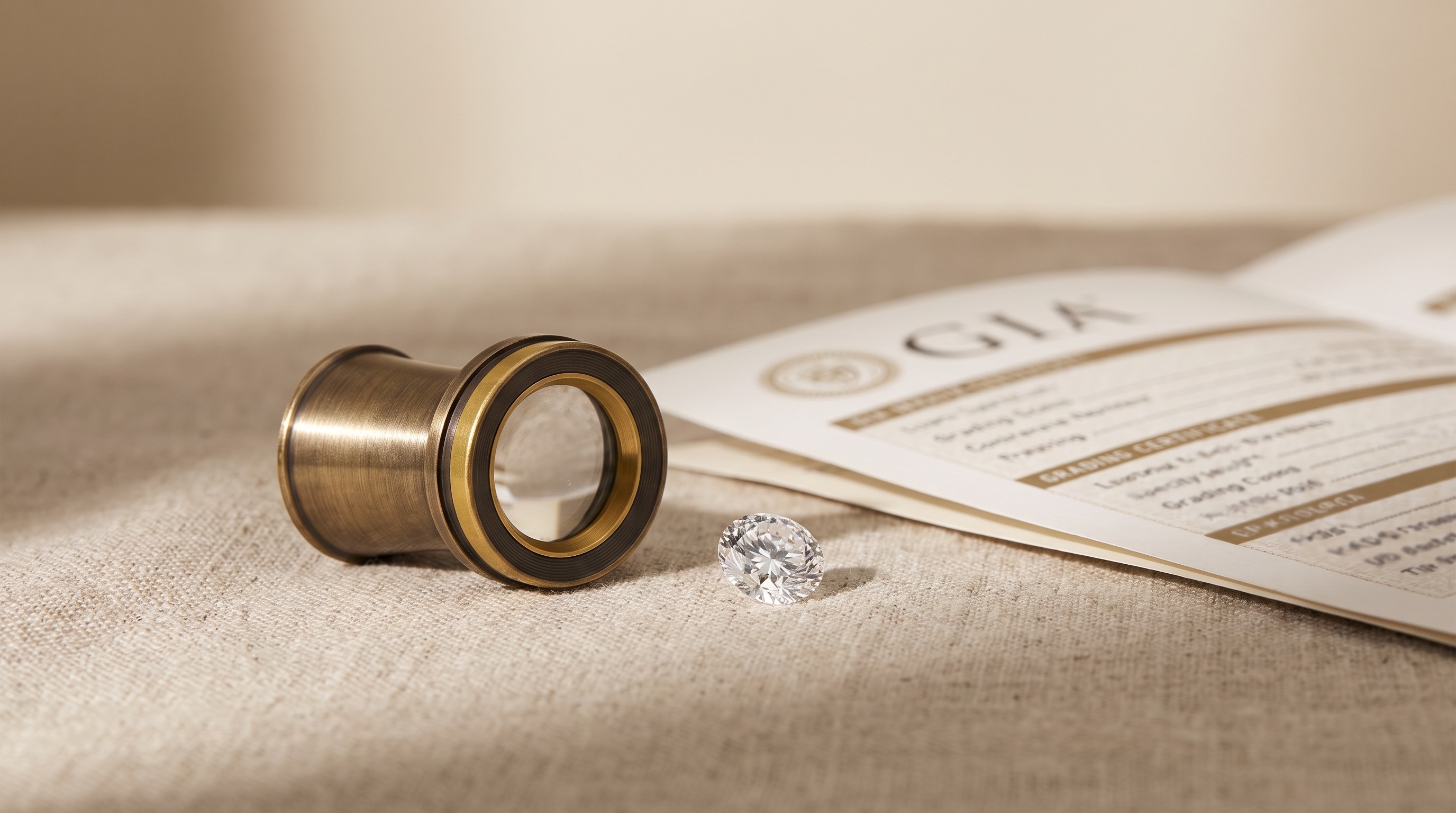
- Check for a laser inscription. Many GIA-graded stones carry a microscopic laser inscription of the report number on the girdle, visible under a jeweler's loupe even once set — this is the single most reliable way to confirm a set stone matches its claimed report without unsetting it.
- Look up the report number directly. GIA's own report-check tool lets anyone enter a report number and confirm it's genuine and see the stone's graded characteristics, independent of what a seller's paperwork claims.
- Confirm measurements are consistent with the report. A jeweler can measure a set stone's visible diameter and rough depth and compare it against the report's stated dimensions as a sanity check, even without full unmounting.
- Ask whether the stone has been unset and reset since grading. A stone that's changed settings since its original GIA report is still the same graded stone, but it's worth confirming the report number still matches, particularly on resale or estate pieces.
What GIA Certification Does Not Cover on a Finished Piece
A GIA diamond grading report says nothing about the metal, the setting's craftsmanship, or any side stones unless those side stones were separately graded and referenced. A "GIA certified" ring can still have a poorly executed setting, low-purity or misrepresented metal, or uncertified melee accent stones — certification applies specifically to the graded center stone, not to the piece as a whole. Buyers and jewelers should treat "GIA certified" as a claim about the center diamond only, and evaluate metal purity, setting quality, and any accent stones separately on their own merits.
This is worth spelling out explicitly to retail customers, since the marketing shorthand "GIA certified ring" can easily be misread as a blanket quality guarantee covering the whole piece. A well-trained sales team draws that distinction clearly at the point of sale — confirming what the certification does cover (the center stone's grading), and being upfront about what it doesn't (setting craftsmanship, metal purity, and any uncertified accent stones) — rather than letting the phrase do more persuasive work than it's actually entitled to.
GIA vs. IGI vs. GCAL for Finished Jewelry
| Lab | Common Use Case | Notable Strength |
|---|---|---|
| GIA | Natural and lab-grown center stones, especially retail-facing pieces | Strongest overall trade and consumer name recognition |
| IGI | Most common lab for lab-grown center stones specifically | Strong international trade recognition, especially for lab-grown |
| GCAL | Buyers prioritizing light-performance and cut-grade rigor | Detailed cut-grade and light-performance analysis |
All three labs grade against comparable 4Cs frameworks, and a well-graded stone from any of the three is a reasonable basis for a finished piece. The choice often comes down to what the intended retail buyer is most likely to recognize, and GIA's broad name recognition is a common reason jewelers specifically request it for a piece's center stone when sourcing or building to order.
Lab-Grown vs. Natural: GIA Certifies Both
GIA grades both natural and lab-grown diamonds, using the same 4Cs framework for each, with the growth method clearly disclosed on the report. A GIA-certified lab-grown center stone is graded to the identical color and clarity standards as a GIA-certified natural stone of the same specifications — the report's growth-method field is the only place the two categories are distinguished. Jewelers building finished pieces around either category should confirm the growth method is clearly stated on the accompanying report, since natural and lab-grown pricing diverge substantially at the same grade and carat weight, and a buyer deserves to know which they're paying for.
Sourcing Certified Center Stones for a Custom Piece
Jewelers and designers building a custom piece around a GIA-certified center stone typically source the loose stone first, confirm its report independently, and then move to setting. This sequencing matters: a stone should be verified against its GIA report while still loose and fully accessible, before it's mounted and full re-examination becomes harder. A jeweler who skips independent verification at the loose-stone stage and only checks paperwork after setting is trusting the seller's representation rather than confirming it directly — a meaningfully weaker position, especially on a higher-value center stone.
Disclosure Requirements for Certified Jewelry
In the United States, FTC guidelines govern how a jeweler must represent a diamond's certification, origin (natural vs. lab-grown), and any treatments in customer-facing materials and receipts. A piece marketed as "GIA certified" should have paperwork on hand that a customer can verify matches the report number, and any treatment disclosed on the original GIA report (clarity enhancement, for example) needs to carry through to the retail disclosure as well, not get lost between the loose-stone purchase and the finished piece's point of sale. Jewelers should treat this as a standing compliance practice across their inventory rather than something checked only when a customer specifically asks.
What Happens to Certification During Resizing or Repair
A GIA report describes the stone, not the setting, so resizing a ring band or performing prong repair doesn't itself affect the certification's validity — the stone's graded characteristics haven't changed. That said, any repair work that involves removing and resetting the stone is a good opportunity to re-verify the laser inscription and report number match, particularly on older or estate pieces where paperwork may have been separated from the piece at some point over its ownership history. A jeweler performing significant repair work on a certified piece should build this quick re-verification into standard workflow rather than assuming continuity by default.
Insurance and Appraisal Considerations
A GIA grading report is not the same document as an insurance appraisal, though the two are often confused at the point of sale. The GIA report establishes the stone's objective grading characteristics; an insurance appraisal, typically prepared by an independent appraiser, assigns a replacement value based on current market pricing for a stone of that grade, and is the document an insurer will actually want on file for a policy or claim. Jewelers selling GIA-certified finished pieces should be clear with customers that the GIA report and an insurance appraisal serve different purposes, and that most insurers will want the appraisal specifically, not just the grading report, before writing a policy. Some jewelers offer appraisal services alongside the sale as a value-add; others refer customers to an independent appraiser, which has the advantage of avoiding any appearance of a conflict of interest between the seller's price and the appraised value.
For estate or resale pieces, a fresh appraisal is generally worth obtaining even when an original GIA report exists, since market pricing for a given grade combination shifts over time and an appraisal prepared years earlier may no longer reflect current replacement cost, particularly for lab-grown center stones where per-carat pricing has moved substantially as production has scaled.
Common Mistakes Jewelers Make with Certified Center Stones
- Treating "certified" as synonymous with "high quality." A GIA report can just as easily document a heavily included, low-color stone as a top-tier one — certification confirms accuracy, not that the grade itself is impressive.
- Losing track of the report-to-stone chain during a build. When a loose stone moves from sourcing through setting to final inventory, it's easy for the physical report to get separated from the piece if there isn't a consistent tracking process — every step should keep the report number attached to the piece's internal record.
- Assuming a laser inscription alone is sufficient proof. Inscriptions can wear or become difficult to read over time, especially on older pieces; independently looking up the report number remains the more reliable verification step.
- Not disclosing growth method clearly on finished-piece listings. A GIA report discloses natural vs. lab-grown clearly, and that distinction needs to carry through to the retail listing and receipt, not just live on paperwork a customer may never see.
- Mixing certified and uncertified stones in the same product line without clear labeling. A jewelry line that carries both certified center stones and uncertified accent or secondary stones should make that distinction unambiguous in product descriptions, since a customer reasonably assumes "certified" language applies to the whole piece unless told otherwise.
International Buyers and Cross-Border Certification Recognition
GIA's grading reports are recognized broadly across international markets, which is one practical reason jewelers building pieces intended for export or a multinational customer base often specifically request GIA over a more regionally-concentrated lab. That said, buyers sourcing or reselling into a specific international market should confirm which certifying labs carry the strongest local trade recognition and consumer trust in that particular market — recognition can vary meaningfully by region even though GIA generally ranks among the most broadly accepted labs worldwide. A jeweler building a certified jewelry line intended for cross-border resale benefits from checking this upfront rather than assuming uniform recognition everywhere a piece might eventually be sold.
Why Some Finished Jewelry Skips Center-Stone Certification Entirely
Not every diamond in a finished piece needs its own individual grading report — melee and small accent stones are typically sold and set as uncertified parcel goods against a quality baseline (color and clarity range) rather than individually certified, since individual certification cost isn't proportionate to a small stone's value. This is standard, accepted practice across the trade and isn't a quality shortcut; it simply reflects that certification economics only make sense above a certain per-stone value threshold. A "GIA certified" claim on a finished piece should be understood as applying specifically to the center stone (and any individually notable side stones large enough to carry their own report), not to every diamond visible on the piece, including any pavé or small accent stones set along a band or halo.
Comparing GIA-Certified Jewelry Pricing Across Sellers
Comparing two "GIA certified" pieces on price alone is close to meaningless unless the underlying stone specifications are held constant. A ring listed at a lower price than a comparable-looking competitor's may simply carry a lower color or clarity grade, a smaller actual carat weight than it visually suggests, or a lower-karat or plated metal in the band — none of which shows up in a casual side-by-side comparison of two product photos. The reliable way to compare is to pull the actual report numbers (or, before purchase, the full stated grading specs) for both pieces and compare like-for-like: same shape, same color grade, same clarity grade, same cut grade, same metal purity, before drawing any conclusion about which is the better value. A retailer or wholesale buyer building out a competitive certified-jewelry line should expect informed customers to make exactly this kind of comparison and should be prepared to state grading specifics clearly and consistently across listings, rather than leaning on vague marketing language like "premium quality" in place of the actual GIA-graded numbers.
Common Buyer Questions at the Point of Sale
- "Can I see the actual certificate, not just a printout?" A legitimate seller should be able to provide the original GIA report or a verifiable copy, and the report number should be independently checkable on GIA's own site.
- "Does the setting affect the certification?" No — the GIA report describes the stone as graded loose; the setting is a separate consideration evaluated on its own craftsmanship and metal quality.
- "Is a GIA-certified ring automatically a good deal?" Certification confirms the stone's grading is accurate, not that the price is competitive — buyers should still compare pricing across the specific grade combination represented on the report.
- "What if the report number doesn't match the loupe inscription?" That's a serious red flag warranting further investigation before purchase — it can indicate a stone swap, an error, or a report that doesn't actually belong to the stone being sold.
Building a Certified Jewelry Line as a Retailer
Retailers building out a certified finished-jewelry line benefit from working with a wholesale supplier that can provide both loose GIA-certified center stones and finished settings, since sourcing the two separately introduces more points where paperwork can get separated from the physical stone. A supplier that can document the chain from loose certified stone through to finished piece — including confirming the report number carries through consistently on receipts and product listings — makes it meaningfully easier for a retailer to maintain accurate disclosure across their own customer-facing sales process.
Sourcing GIA-Certified Diamond Jewelry Wholesale
Guru Diam is a trade-only wholesale supplier carrying certified loose diamonds — natural and CVD lab-grown, with IGI, GIA, and GCAL certification all available — alongside custom finished jewelry built around those same certified center stones. Cutting, setting, and polishing are handled in-house, with polishing on lab-grown material completed in India ahead of final grading and shipment from Guru Diam's New York and Los Angeles locations, before certified stones ship out or move into a custom build. Custom pieces are finished in 4-6 days once a center stone is selected, giving jewelers a fast turnaround for building certified finished inventory to order rather than holding it speculatively.
Buyers can browse certified loose stones through the certified diamonds category, source calibrated accent stones through matching pairs, and build a full piece around a chosen center stone through custom jewelry. For fancy-color certified center stones, see the fancy color loose diamonds category. Trade accounts can review terms at the wholesale hub or apply through trade partner.
Frequently Asked Questions
What does GIA certified mean on a piece of jewelry?
It means the center diamond carries a GIA grading report issued before it was set, documenting its carat weight, cut, color, and clarity. The certification describes the stone, not the finished piece's setting or metal.
How do I verify a GIA certificate on a ring I already own?
Check for a laser inscription of the report number on the stone's girdle, visible under a jeweler's loupe, and look up that report number directly on GIA's own report-check tool to confirm it's genuine and matches the stated grading.
Does setting a diamond affect its GIA grade?
No — the GIA report reflects the stone's grading at the time it was examined loose. Setting doesn't change the underlying grade, though some aspects like clarity can become harder to independently re-verify once a stone is mounted.
Is GIA-certified jewelry more expensive than uncertified jewelry?
Typically yes, at a comparable stone quality, since certification removes ambiguity about the stone's actual grade and adds buyer confidence, particularly valuable on a finished piece where the buyer can't easily inspect the stone independently themselves.
Can lab-grown diamond jewelry be GIA certified?
Yes — GIA certifies both natural and lab-grown diamonds using the same 4Cs framework, with the growth method clearly disclosed on the report. A GIA-certified lab-grown center stone is graded to identical standards as a GIA-certified natural stone of the same specifications.
What should I check before buying a "GIA certified" piece from a reseller?
Ask for the original report or a verifiable copy, confirm the report number independently through GIA's own lookup tool, and check for a laser inscription on the stone matching that number before relying on the seller's paperwork alone.