GCAL (Gem Certification & Assurance Lab) and GIA (Gemological Institute of America) are both third-party diamond grading laboratories, but they occupy different positions in the trade: GIA is the most widely recognized grading lab in the global diamond market, while GCAL is known for unusually strict, technology-driven cut and light-performance grading paired with a permanent laser inscription on every stone. Neither report is "better" in every scenario — the right choice depends on what a buyer or jeweler actually needs a certificate to do.
What GIA Actually Is
The Gemological Institute of America is a nonprofit research and grading institute founded in 1931, and it developed the 4Cs framework (cut, color, clarity, carat) that the entire diamond trade now uses as a common language. A GIA report grades a diamond's color and clarity on GIA's own reference scales, assigns a cut grade for standard round brilliants, records proportions and finish, and discloses fluorescence and any observed treatments. GIA does not sell diamonds, appraise diamonds for insurance purposes, or offer grading services tied to a specific retailer, which is part of why its reports carry the trust they do across such a wide range of markets and buyer types.
What GCAL Actually Is
GCAL is a private, for-profit grading laboratory built specifically around precision cut and light-performance analysis. Every diamond GCAL grades receives a permanent laser inscription linking the physical stone to its report, and GCAL's cut grading leans heavily on proprietary optical technology that measures light return, contrast, and scintillation rather than relying primarily on proportion tables and human visual assessment. GCAL markets itself directly on grading consistency and anti-fraud protection, positioning strict, repeatable cut analysis as its core differentiator rather than competing on brand name recognition the way GIA does.
Grading Philosophy: Where the Two Labs Genuinely Diverge
The clearest, most defensible distinction between the two labs is in how each approaches cut grading specifically. GIA's cut grade for round brilliants is derived from a combination of measured proportions, optical symmetry, and finish, validated against a large research dataset built over decades — a methodology designed for consistency across an enormous volume of stones graded worldwide every year. GCAL's approach is narrower in scope but more technologically intensive per stone, using computer-based light-performance imaging to assess how a specific stone actually handles light, which supporters argue captures real-world sparkle performance more precisely than proportion-based grading alone. Both approaches are legitimate; they simply weight different inputs, and buyers who care most about verified light performance in a specific stone are the ones most likely to notice the difference between the two.
| Factor | GIA | GCAL |
|---|---|---|
| Founded | 1931, nonprofit research institute | Private grading lab, technology-focused |
| Cut grading basis | Proportions, symmetry, finish, validated against a large research dataset | Proprietary optical light-performance imaging plus proportion analysis |
| Laser inscription | Available as an add-on for most reports | Standard on every report |
| Global recognition | Broadest name recognition in the trade worldwide | Recognized and respected, narrower footprint than GIA |
| Fluorescence, clarity, color grading | Full 4Cs reporting, industry-standard scales | Full 4Cs reporting, industry-standard scales |
| Primary reputation | Consistency at scale, deepest resale-market trust | Strict, technology-verified cut precision |
Report Format Differences
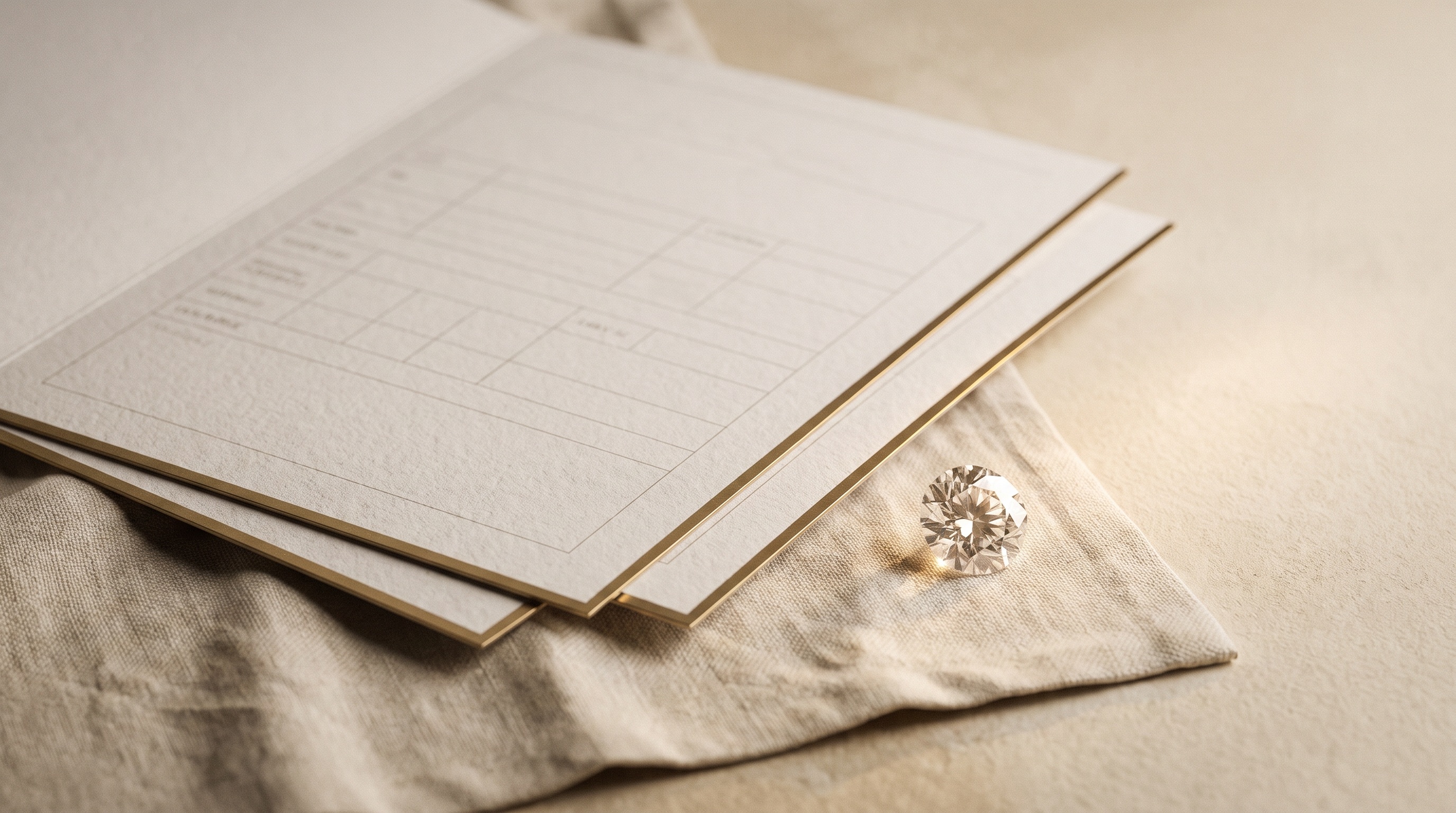
A GIA report presents the 4Cs alongside a proportions diagram, a clarity plot showing the approximate location of inclusions, fluorescence, and finish grades (polish and symmetry), formatted in GIA's long-standing, widely recognized layout that most jewelers and buyers can read at a glance. A GCAL report covers the same core 4Cs data but places heavier visual emphasis on light-performance analysis, often including additional imaging or a light-performance score that isn't part of a standard GIA report. Neither format is more "complete" than the other in terms of the core grading data disclosed — the difference is in which additional layer of analysis each lab chooses to foreground.
Cut Grading and Light Performance in Practice
For a standard round brilliant, both labs will generally land on a similar overall cut assessment for a well-cut stone — genuinely poorly proportioned stones don't slip through either lab's process. Where GCAL's approach tends to matter most is at the margins: a stone with proportions that fall within an acceptable range on paper but that GCAL's light-performance imaging flags as underperforming (or, conversely, a stone whose proportions look unremarkable but that tests unusually well for actual sparkle) is where the two labs' methodologies can produce a meaningfully different practical read on the same physical diamond. Buyers specifically prioritizing verified light performance above all else are the ones most likely to find GCAL's approach worth seeking out.
Laser Inscription and Anti-Fraud Protection
GCAL inscribes a report number directly on every stone's girdle as a standard part of its process, making it straightforward to confirm that a specific physical diamond matches its certificate. GIA also offers laser inscription, but it's typically an add-on selected at the time of submission rather than a universal default across every report. For buyers or jewelers specifically concerned with stone-swap risk in a supply chain with multiple handoffs, a standard, non-optional inscription is a genuine practical advantage of a GCAL report — though a GIA report with inscription requested provides the same underlying protection.
Global Recognition and Resale-Market Liquidity
This is where GIA's advantage is most significant and least disputable: GIA is the most widely recognized grading lab in the global diamond trade, accepted without question by jewelers, appraisers, insurers, and resale platforms across essentially every major market. A GIA report requires no explanation to a buyer, an insurer, or a secondary-market platform anywhere in the world. GCAL reports are recognized and respected within the trade, particularly among buyers familiar with GCAL's cut-grading reputation, but the pool of jewelers, appraisers, and resale channels that treat a GCAL report with the same immediate, no-questions-asked familiarity as a GIA report is narrower. For a buyer who expects to resell or who wants maximum liquidity and universal recognizability down the line, that gap in market familiarity is a real, practical consideration.
Pricing and Market Perception
Two stones with identical 4C specifications can carry a modest price difference depending on which lab graded them, largely tracking the recognition gap described above rather than any difference in the physical stone itself. A GIA report generally commands a small premium in resale and trade-listing contexts specifically because of its universal recognizability — dealers and platforms price in the certainty that any buyer, anywhere, will accept the grading at face value without further verification. A GCAL report, particularly on a stone bought specifically for its verified cut performance, can represent strong relative value for a buyer who's confident in their own resale channel or who isn't prioritizing maximum universal liquidity.
| Buyer priority | Better-suited lab | Why |
|---|---|---|
| Maximum resale liquidity, unfamiliar future buyers | GIA | Broadest global recognition; no explanation needed anywhere in the trade |
| Verified cut and light-performance precision | GCAL | Technology-driven light-performance grading is GCAL's core specialty |
| Built-in anti-fraud stone verification | GCAL | Laser inscription is standard, not an add-on |
| Insurance and appraisal familiarity | GIA | Appraisers and insurers across markets default to GIA without question |
| Value relative to specifications, confident resale channel | GCAL | Often modestly better priced for identical specs given the recognition gap |
When GCAL Is the Better Choice
GCAL is a strong fit for a buyer or jeweler who wants documented, technology-verified cut and light-performance data on a specific stone, values the built-in anti-fraud protection of standard laser inscription, and isn't primarily optimizing for maximum universal resale recognizability. Jewelers marketing a stone specifically on its light performance — "engineered for maximum brilliance," for instance — often find a GCAL report's additional light-performance documentation genuinely useful as supporting evidence for that specific sales pitch, in a way a standard GIA proportions table doesn't directly provide.
When GIA Is the Better Choice
GIA is the better choice whenever universal recognizability, insurance and appraisal familiarity, and maximum resale liquidity matter most — which, for most buyers purchasing a significant stone, is most of the time. A GIA report requires zero explanation to virtually any jeweler, appraiser, or secondary buyer anywhere, and that universal trust is difficult to replicate through any other single credential. For engagement rings, investment-grade stones, and any purchase where future resale or insurance interactions are a realistic possibility, GIA's broader recognition carries real practical weight beyond the grading data itself.
GCAL vs GIA for CVD Lab-Grown Diamonds
Both labs grade CVD lab-grown diamonds, and both clearly label a lab-grown report as such, stating the growth method on the certificate. The same core distinction applies in the lab-grown market as in natural: GIA reports carry broader recognizability across trade and resale channels, while GCAL's light-performance grading and standard laser inscription appeal to buyers specifically focused on verified cut quality and stone-identity assurance. Because lab-grown diamonds are priced more heavily on the 4Cs and less on brand-name provenance than natural stones sometimes are, the practical gap between the two labs' reports is, if anything, somewhat narrower in the lab-grown segment than in high-value natural stones.
GCAL vs GIA for Natural Diamonds
For natural diamonds, particularly higher-value and higher-color stones, GIA's report carries additional weight because of how deeply embedded it is in natural-diamond resale, insurance, and appraisal infrastructure built up over decades. A GCAL-graded natural diamond is a legitimately, rigorously graded stone, but a buyer purchasing a significant natural diamond as a long-term or heirloom-intended piece should weigh GIA's broader resale-market familiarity accordingly, particularly if reselling or insuring the stone down the line is a realistic future scenario.
Common Misconceptions About GCAL and GIA
- "GCAL grades more leniently than GIA to make stones look better." GCAL's cut grading is, if anything, stricter and more technically demanding than proportion-based grading alone — its reputation in the trade is built specifically on rigor, not leniency.
- "A GCAL report is worth less than a GIA report on an identical stone." Value differences track market recognition and liquidity, not any difference in the accuracy or legitimacy of the underlying grading.
- "GIA doesn't grade cut quality precisely." GIA's cut grade is a rigorously validated, industry-standard assessment; GCAL's light-performance imaging is an additional, more granular layer of analysis, not a correction of a weaker GIA process.
- "You can't get a laser inscription from GIA." GIA offers laser inscription as an add-on service; it simply isn't the default the way it is with GCAL.
- "One lab is universally 'the best' regardless of what the buyer needs." The right lab depends on the buyer's priorities — resale liquidity, verified light performance, insurance familiarity, or cost relative to specs — not a single universal ranking.
How to Decide Between a GCAL and GIA Stone
The most practical approach is to work backward from what the certificate needs to accomplish for that specific buyer. A jeweler stocking inventory for a broad customer base, where any given piece might later be appraised, insured, or resold through an unfamiliar channel, is generally better served defaulting to GIA-certified stock for maximum flexibility. A buyer or jeweler specifically building a program around verified cut and light performance, or one who wants standard laser-inscription protection on every stone without requesting it individually, has a genuine, defensible reason to prioritize GCAL. Many trade buyers reasonably carry both, matching the certificate to the specific stone and customer rather than treating the choice as all-or-nothing.
Comparing a GCAL Report to a GIA Report Side by Side
| Report element | GIA | GCAL |
|---|---|---|
| 4Cs (color, clarity, carat, cut) | Yes, industry-standard scales | Yes, industry-standard scales |
| Proportions diagram | Yes | Yes |
| Clarity plot | Yes | Yes |
| Fluorescence | Yes | Yes |
| Light-performance imaging | Not a standard element | Core, proprietary element of the report |
| Laser inscription | Available as an add-on | Standard on every stone |
| Growth method disclosure (lab-grown) | Yes, explicitly stated | Yes, explicitly stated |
Verifying a Report Online
Both labs offer a way to confirm that a report number corresponds to a real, issued certificate, which is a useful extra step whenever a stone changes hands outside a direct, trusted relationship. GIA's report-check tool is widely used across the trade and consumer market alike, reflecting the sheer volume of GIA reports in circulation globally. GCAL similarly allows verification of its reports, tied closely to the standard laser inscription on every stone it grades, so a buyer can confirm the physical stone in hand matches a specific report number rather than relying on a printed document alone. Either verification path is a meaningful layer of protection, and a buyer or jeweler handling a stone from an unfamiliar source should use it regardless of which lab issued the report.
How Grading Turnaround and Submission Differ
GIA's scale — processing an enormous volume of stones across multiple global labs — generally means broad availability and established submission channels for any dealer or jeweler working with GIA regularly. GCAL, as a smaller, more specialized operation, often markets faster turnaround on individual submissions as part of its value proposition, given its narrower focus and lower overall volume relative to GIA. For a jeweler weighing which lab to submit a specific stone to, expected turnaround time is a genuinely practical factor alongside the grading-philosophy and recognition considerations covered earlier in this guide, and it's worth confirming current turnaround directly with either lab for a specific submission rather than assuming a fixed timeline.
GCAL vs GIA for Jewelers Building Trade Inventory
A jeweler stocking inventory for resale has to think about lab choice slightly differently than an individual buyer purchasing a single stone. Inventory that needs to move quickly across a broad customer base, potentially through wholesale channels, auction, or resale platforms with buyers unfamiliar with the specific jeweler, benefits from GIA's universal recognizability — it removes a layer of friction from every transaction downstream. A jeweler running a program specifically built around verified cut performance as a sales differentiator, on the other hand, has a genuine reason to stock GCAL-certified stones as part of that specific pitch, using the report's light-performance data as supporting evidence in the sales conversation itself. Many trade buyers reasonably stock both, using GIA as the default for broad inventory and GCAL selectively for stones marketed specifically on cut and light performance.
What Hasn't Changed Regardless of Lab
It's worth restating plainly: choosing between a GCAL and a GIA report has no bearing on a diamond's actual physical quality. A well-cut, high-clarity stone is well-cut and high-clarity regardless of which lab's letterhead documents it, and a poorly cut or heavily included stone doesn't improve by virtue of carrying either lab's name. The choice between the two labs is about which report format, verification method, and market-recognition profile best fits a specific buyer's or jeweler's actual priorities — not a signal about the underlying stone's inherent quality.
Frequently Asked Questions
Is a GCAL diamond worth less than a GIA diamond?
Not in terms of the physical stone's quality. Price differences between otherwise identical GCAL- and GIA-graded stones typically reflect GIA's broader global recognition and resale liquidity, not any gap in grading accuracy or legitimacy between the two labs.
Which lab is stricter on cut grading, GCAL or GIA?
GCAL is generally considered the stricter, more technically granular grader on cut and light performance specifically, using proprietary optical imaging in addition to proportion analysis. GIA's cut grading is rigorously standardized but relies more heavily on proportions, symmetry, and finish.
Does every GCAL diamond come with a laser inscription?
Yes — laser inscription linking the physical stone to its report is a standard part of every GCAL report, unlike GIA, where it's typically an optional add-on requested at submission.
Can I resell a GCAL-certified diamond as easily as a GIA-certified one?
Generally yes within the trade, but GIA's broader global recognition means a GIA report is accepted without question by a wider range of jewelers, appraisers, and resale platforms. A GCAL report is respected and legitimate but has a somewhat narrower footprint of instant recognizability.
Do GCAL and GIA grade lab-grown and natural diamonds the same way?
Both labs use the same core grading standards for the 4Cs across natural and lab-grown stones, and both clearly disclose a diamond's growth method when it's lab-grown. The lab-to-lab differences described in this guide — cut-grading approach and recognition — apply similarly across both origins.
Is GIA always the better choice for an engagement ring?
For most buyers, yes, primarily because of GIA's universal recognizability for future insurance, appraisal, or resale needs. That said, a GCAL report is a fully legitimate, rigorously graded option, particularly for a buyer prioritizing verified cut and light performance.
Are GIA and GCAL the only labs worth trusting?
They're both reputable, established labs with real grading standards, alongside IGI, which is also widely used in the trade. The key is choosing a recognized, standardized lab rather than an unaccredited or in-house grading source with no independent verification.
A Brief Note on IGI as a Third Option
While this guide focuses on GCAL and GIA specifically, IGI (International Gemological Institute) is the other major lab active across the global trade, and it's worth mentioning briefly for context. IGI is widely used, particularly prevalent in lab-grown diamond grading and in international markets, and offers its own combination of recognition and grading standards distinct from both GIA and GCAL. A buyer or jeweler weighing lab options isn't limited to a binary GCAL-or-GIA choice — IGI is frequently a third legitimate consideration, especially for lab-grown stones, though the core tradeoffs described throughout this guide (recognition breadth versus specialized grading emphasis) are useful lenses for evaluating any lab, IGI included.
Putting It All Together
The GCAL-versus-GIA decision ultimately comes down to matching a report to its purpose. A stone destined for a broad resale market, insurance appraisal, or an unfamiliar future buyer benefits most from GIA's universal recognition. A stone being marketed specifically on verified cut precision and light performance, or one where built-in laser-inscription protection against stone substitution matters most, is a genuinely strong fit for GCAL. Both labs apply real, rigorous, independently verified grading standards — the choice between them is a strategic one about audience and purpose, not a judgment about which lab is more trustworthy in the abstract.
Sourcing GCAL and GIA Certified Diamonds from Guru Diam
Guru Diam carries loose diamonds certified by IGI, GIA, and GCAL, so trade buyers and jewelers can match the certificate to the specific stone, customer, or program rather than defaulting to a single lab across the board. Our certified diamond catalog spans standard, antique, and fancy shapes across natural and CVD lab-grown stock, with each stone's grading lab clearly listed alongside its full 4C specifications. In-stock inventory ships same-day from New York before 6pm EST or Los Angeles before 4pm PST, and our custom jewelry program finishes commissioned pieces in 4-6 days once a stone is selected.
Trade accounts building a program around a specific lab preference, whether that's GIA for maximum resale liquidity or GCAL for verified light performance, can work directly with our team through the wholesale hub or a trade partner account to source consistently against that preference. We also carry a dedicated range of fancy color loose diamonds and matching pairs, both available across our certified lab options, for jewelers sourcing beyond standard white diamond inventory.