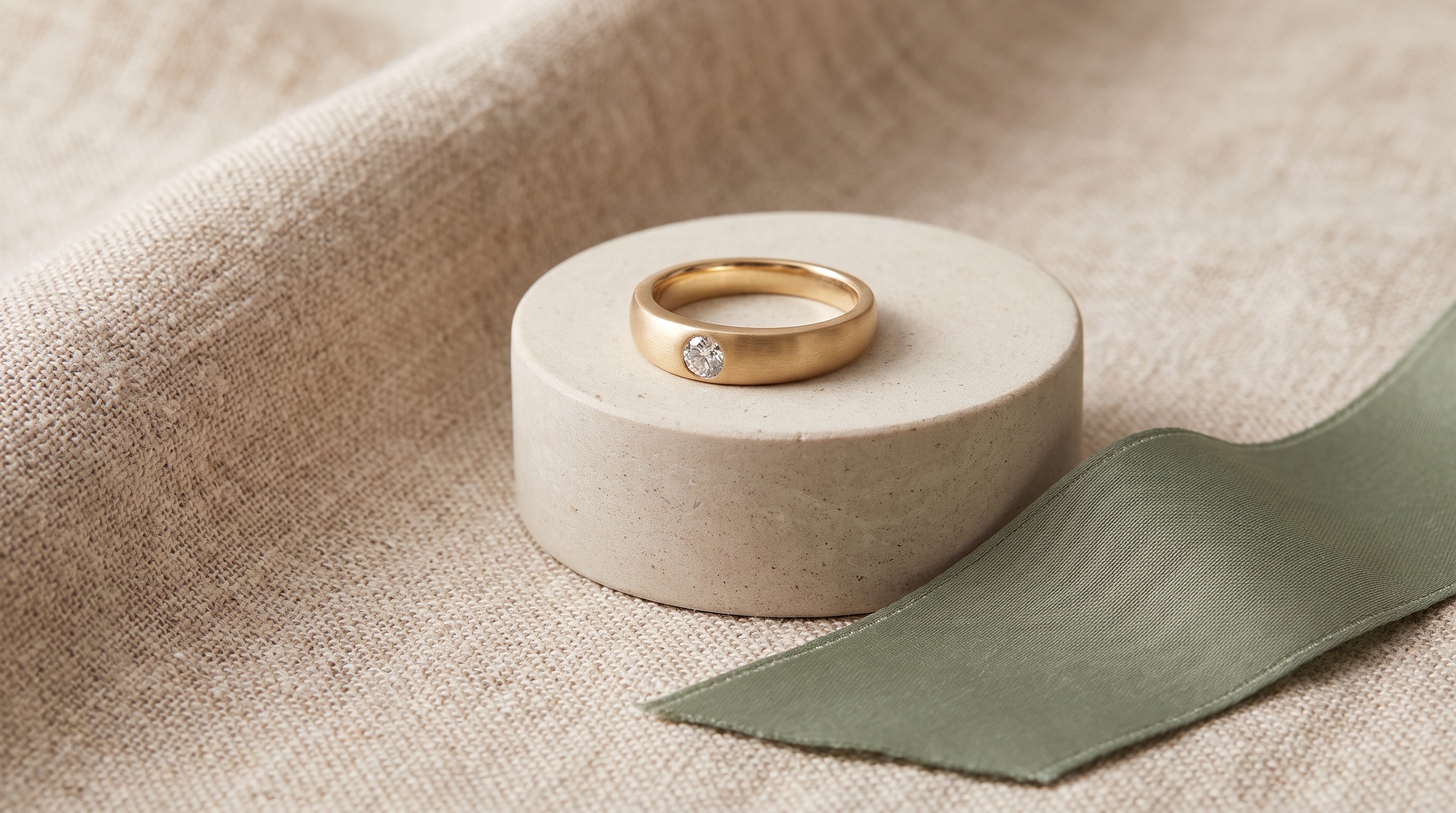
A flush setting ring sets each diamond directly into a hole drilled into the metal, so the stone sits perfectly level with the surrounding surface rather than raised within prongs or a bezel rim — also called a gypsy setting, a name drawn from its long history in men's signet and pinky rings. Because there's no raised metal or protruding prongs above the ring's surface, flush-set stones are among the most snag-resistant and durable setting styles available, which has made the technique popular well beyond its traditional use for both men's and women's everyday and stacking rings.
This guide is written for the trade — jewelers, manufacturers, and designers sourcing diamonds and evaluating setting partners for flush-set ring designs. It covers how the technique is constructed, what it requires from stone selection and setting execution, durability and light-performance tradeoffs versus raised settings, and what to ask a manufacturing partner before committing to a flush-set production run.
How a Flush Setting Is Constructed
A flush (gypsy) setting starts with a hole drilled into the metal slightly smaller than the diamond's girdle diameter. The stone is set into the hole from the top, and the setter uses a graver or bead-pushing tool to work a thin ring of metal from around the hole's edge up and over the stone's girdle, securing it in place — a technique closely related to bead setting, but applied to a single recessed hole rather than a cluster of raised beads. Once complete, the stone sits with its table perfectly level with, or very slightly below, the surrounding metal surface, with no raised rim, prong, or bezel wall visible above the setting at all. This is what distinguishes flush setting from bezel setting: a bezel uses a raised metal rim standing above the surface to hold the stone, while a flush setting has no raised element whatsoever — the metal that secures the stone is worked flush with the surface itself.
Because the technique relies on precisely drilling a hole matched to each individual stone's exact girdle diameter, flush setting requires more individualized craftsmanship per stone than a setting style built around a standardized prong or bezel template — a factor that affects both production time and the tolerance required in stone sizing, covered in more detail below.
Flush vs. Bezel vs. Prong: Setting Comparison
| Setting Style | Profile Height | Snag Resistance | Relative Brilliance | Typical Use |
|---|---|---|---|---|
| Flush (gypsy) | Level with or below the surface — lowest profile of any setting | Highest — no raised element to catch on anything | Lowest — light enters only from directly above | Men's and women's daily-wear rings, stacking bands, industrial and active-lifestyle wear |
| Bezel | Low — a thin raised rim around the stone | High — no protruding prongs, but a rim can still catch slightly | Moderate — light enters from above and, on an open bezel, partly from the side | Daily-wear rings, pendants, stones needing extra protection |
| Prong | Elevated — the stone sits raised above the band | Lower — prongs can snag on fabric, hair, and gloves | Highest — maximum light entry from all angles | Engagement rings and pieces where brilliance is the priority |
Stone Selection for Flush Setting
Round brilliant diamonds are by far the most common choice for flush setting, since the technique depends on drilling a precisely round hole to match the stone's girdle, and a round stone's consistent circular outline makes that fit far more straightforward to execute accurately than an angular fancy shape would. Small to moderate sizes — commonly 2mm to 4mm, occasionally up to 5-6mm for a bolder statement piece — are typical, since flush setting is most often used for multiple stones arranged in a pattern (a row, a scattered cluster, or stones set around a band's full circumference) rather than for a single large center stone. Fancy shapes can be flush-set, but the technique is considerably more demanding on non-round outlines, since the drilled recess has to precisely match an angular or curved girdle shape rather than a simple circle — buyers requesting flush-set fancy shapes should expect longer setting time and should confirm the specific setter has direct experience with fancy-shape flush work before committing a production run to it.
Girdle Diameter Tolerance and Sourcing Precision
Because each stone is set into a hole drilled to its specific diameter, flush setting requires tighter size-matching precision at the sourcing stage than prong or bezel setting typically does — a stone that's even slightly under- or over-sized relative to its stated millimeter measurement can either sit loose in a hole drilled to spec, or fail to seat properly in a hole drilled slightly too small. Buyers sourcing melee or small accent stones specifically for flush-set production should request tighter-than-standard sizing tolerance from their supplier, and should confirm the supplier's stated millimeter measurements are independently verified rather than estimated from carat weight alone, since carat-weight-to-diameter conversion varies slightly by cut proportions and isn't a reliable substitute for actual measured diameter when precision matters this much.
Durability Advantages of Flush Setting
Flush setting's core commercial advantage is durability under regular wear. Because no metal or stone element protrudes above the ring's surface, there's nothing to catch on clothing, hair, gloves, or tools during normal daily activity — a meaningful advantage for buyers with active jobs, hobbies involving frequent hand use, or a general preference for low-maintenance jewelry that doesn't require the same vigilance a raised prong setting does. This durability profile is a large part of why flush setting has historically been associated with men's rings specifically, since men's daily-wear jewelry — signet rings, wedding bands, pinky rings — has traditionally prioritized resilience under manual work and daily wear over maximum light performance, though the style has broadened well beyond that traditional association in recent years.
Light Performance Tradeoffs
The same recessed construction that gives flush setting its durability advantage also limits how much light reaches the stone, since light can only enter from directly above rather than from the sides the way a raised prong or open bezel setting allows. A flush-set diamond will read visibly less bright and less lively than the same stone in a prong setting, an important expectation to set with a customer choosing this style, since the visual tradeoff is inherent to the construction rather than a flaw in stone quality or setting execution. Retailers should frame flush setting's appeal around its clean, minimalist look and exceptional durability rather than positioning it as delivering the same brilliance as a raised setting, since customers who prioritize maximum sparkle are better served by a different setting style entirely.
Common Flush Setting Ring Styles
- Single flush-set stone. One diamond flush-set into a signet-style or simple band, the most traditional application of the technique.
- Scattered flush-set cluster. Multiple stones flush-set at varying points around the band or across a wider ring face, a popular contemporary fashion-ring approach that reads as understated and modern.
- Flush-set eternity or half-eternity band. A continuous or partial row of flush-set stones around the band, offering a lower-profile, more durable alternative to a channel or shared-prong eternity design.
- Men's signet or pinky ring with a flush-set center. The technique's traditional home, often paired with a flat or slightly domed ring face and a single diamond or small cluster.
Certification and Melee Grading for Flush-Set Stones
Larger flush-set stones (0.30ct and above) are individually certified — IGI, GIA, or GCAL — the same standard applied across Guru Diam's loose-stone catalog generally. The small melee commonly used in scattered or clustered flush-set designs typically ships as graded but uncertified parcel goods against a stated commercial standard (commonly DEF+/VS+), consistent with standard melee sourcing practice, since individual certification isn't cost-effective at the sizes most flush-set melee falls into.
Natural vs. Lab-Grown Diamonds for Flush Setting
CVD lab-grown diamonds are common in flush-set designs, particularly for scattered or multi-stone patterns where total carat weight adds up across several stones — lab-grown material's lower per-carat cost lets a jeweler offer a more elaborate flush-set pattern at an accessible price point. Natural stones remain a solid choice as well, particularly for a single-stone signet or men's ring where the piece is meant to be a long-term, heirloom-quality item rather than a fashion-forward multi-stone design. Both origins set and wear identically once flush-set; the choice comes down to positioning and price point rather than any technical difference in how the setting performs.
Manufacturing Considerations and Setter Skill
Flush setting is more labor-intensive per stone than prong or channel setting, since each hole is individually drilled and each stone individually secured by hand-working the surrounding metal — there's no templated, repeatable mechanism the way a standard four-prong head or a machined channel offers. This makes setter skill and experience a more significant quality variable for flush work than for some other setting styles, and buyers evaluating a manufacturing partner for a flush-set production run should ask specifically about the setter's experience with the technique, request a physical sample under magnification before committing to a full run, and confirm the shop's rework or replacement policy if a stone is damaged during the drilling or setting process — a real risk given how precisely the hole has to match the stone.
What to Ask a Manufacturing Partner About Flush Setting
- How experienced is the setter with flush work specifically, as opposed to general prong or bezel setting experience?
- What sizing tolerance does the shop require from sourced stones to guarantee a proper fit, and can they work from the buyer's own sourced melee or do they require stones sourced through their own channel?
- What's the shop's policy if a stone is damaged during drilling or setting, given the more delicate, individualized nature of this technique compared with templated prong work?
- Can the shop execute flush setting on fancy shapes, or only round stones, if a specific design calls for it?
Metal Considerations for Flush Setting
Flush setting works across the standard range of ring metals — 14k and 18k white, yellow, and rose gold, and platinum — though metal hardness affects how the technique executes in practice. Platinum's malleability makes it especially well suited to flush setting, since the metal moves cleanly when worked over the stone's girdle without the risk of cracking that a harder, more brittle alloy can present; some higher-karat gold alloys can be more prone to hairline cracking around the drilled hole if the setter isn't sufficiently experienced with the metal's specific working properties. Buyers sourcing flush-set pieces in platinum or higher-karat gold specifically should confirm their setting partner has direct experience with that metal for this technique, not just general setting competency.
Resizing Flush-Set Rings
Resizing a flush-set ring generally works the same as resizing a plain band when the flush-set stones sit away from the resizing point at the back of the shank, but resizing becomes more complicated on designs where flush-set stones extend around a larger portion of the band's circumference, since cutting and rejoining the shank near a flush-set stone risks disturbing that stone's setting. Retailers should confirm and communicate resizing limitations at the point of sale for any flush-set design with stones extending significantly around the band, similar to the guidance that applies to eternity and other full-circumference set designs, so a customer isn't surprised later by a limitation that wasn't disclosed up front.
Merchandising Flush Setting as a Category
Flush setting's positioning as a durable, low-maintenance, minimalist style resonates particularly well with customers who've had a prior negative experience with a snagged or damaged prong on another ring, or who work with their hands regularly and have specifically avoided fine jewelry for that reason. Framing the style around "wear it without worrying about it" messaging, paired with honest expectation-setting about the reduced brilliance tradeoff, tends to convert better than positioning flush setting as a brilliance-competitive alternative to prong setting, since customers drawn to this style are generally prioritizing durability and a clean aesthetic over maximum sparkle from the outset.
History and Origin of the Gypsy Setting Name
The "gypsy setting" name has a long history in the trade, referring to the technique's traditional association with rugged, protective jewelry meant to withstand hard daily wear — historically popular for men's signet and pinky rings precisely because the recessed, protruding-free construction held up to manual labor and daily activity better than a raised prong setting would. The style has been in continuous use for well over a century, predating most of the setting techniques covered elsewhere on this site, and its enduring popularity in men's jewelry specifically reflects how well the underlying durability logic still holds up against modern daily-wear demands. In recent years the style has broadened considerably beyond its traditional men's-jewelry association, appearing in minimalist women's stacking bands, scattered-stone fashion rings, and understated everyday pieces where the low, unobtrusive profile itself has become the primary appeal rather than durability alone.
Quality Control Checks for Finished Flush-Set Pieces
Because flush setting depends on precisely matching a drilled hole to an individual stone's exact girdle diameter, the most common manufacturing defects in this category involve a stone sitting slightly proud of the surrounding metal surface (undermining the entire point of the technique), a visibly uneven metal edge around the stone where the setter's work wasn't finished cleanly, or a stone that sits slightly crooked relative to the ring's face because the drilled hole wasn't perfectly perpendicular to the surface. A physical inspection under magnification, checking that each stone sits genuinely flush and level with no visible gap or unevenness at the edge, is the most efficient quality-control step before accepting a finished piece from a setting partner, and it takes only a few minutes per piece once a buyer knows what to look for. Buyers running a recurring flush-set production line should track defect rates specifically for this technique separately from general setting defect tracking, since flush setting's higher skill requirement per stone means defect rates can vary more by individual setter than they would for a more templated setting style, and an isolated increase in this one category usually points to a specific setter or tooling issue rather than a broader quality problem.
Scaling a Flush-Set Product Line Across Price Tiers
A flush-set ring line can span a wide price range depending on stone count and size — a single small flush-set accent stone in a simple band sits at an accessible entry price point, while a design with a dozen or more scattered stones across a wider ring face, or a full flush-set eternity band, commands a meaningfully higher price reflecting both the added stone cost and the substantially greater setting labor involved. Retailers building a flush-set program benefit from offering options across this range, since the style's durability appeal draws customers across a wide range of budgets, and a single-stone entry option gives price-conscious buyers a way into the category without requiring the higher labor cost of a multi-stone piece, while a full multi-stone or eternity-style piece anchors the top of the line for buyers wanting a bolder statement.
Sourcing Diamonds for Flush Setting Wholesale
Guru Diam supplies certified loose diamonds and calibrated melee suited to flush-set production, across natural and CVD lab-grown material in round and select fancy shapes, with IGI, GIA, and GCAL certification available on stones 0.30ct and above. In-stock inventory ships same-day (before 6pm EST from New York, before 4pm PST from Los Angeles), and cutting, setting, and polishing are all handled in-house. Trade buyers can browse certified stones through certified diamonds or melee lots through matching pairs, and custom flush-set designs can be started through custom jewelry. New trade accounts can review terms at the wholesale hub or apply through trade partner. For a comparison of related low-profile settings, see our bezel setting guide and engagement ring settings guide.
Frequently Asked Questions
What is a flush setting ring?
A flush setting (also called a gypsy setting) sets each diamond directly into a hole drilled into the metal, so the stone sits level with the surrounding surface rather than raised within prongs or a bezel rim, with no protruding element above the setting at all.
What's the difference between a flush setting and a bezel setting?
A bezel uses a raised metal rim standing above the surface to hold the stone. A flush setting has no raised element at all — the stone sits directly in a drilled hole, level with the metal, giving an even lower profile than a bezel but reducing brilliance further.
Are flush-set diamond rings durable for daily wear?
Yes — flush setting is one of the most durable and snag-resistant setting styles available, since there's no raised prong or rim above the surface to catch on clothing, hair, or tools during normal activity, which is why it's historically been popular for men's daily-wear rings.
Do flush-set diamonds sparkle as much as prong-set diamonds?
No — because light can only enter a flush-set stone from directly above rather than from the sides, flush-set diamonds read visibly less bright than the same stone in a raised prong setting. The tradeoff is durability and a clean, minimalist profile in exchange for reduced light performance.
What diamond shapes work best for flush setting?
Round brilliant diamonds are by far the most common choice, since the technique requires drilling a precisely round hole matched to the stone's girdle. Fancy shapes can be flush-set but require significantly more setting skill and time to execute accurately.
Can a flush-set ring be resized?
Generally yes when the flush-set stones sit away from the resizing point at the back of the shank, though resizing is more complicated on designs where stones extend around a larger portion of the band, similar to other full-circumference set designs.
Why is flush setting historically associated with men's rings?
Because the recessed, protruding-free construction holds up to manual labor and daily activity better than a raised prong setting, flush (gypsy) setting has been a traditional choice for men's signet and pinky rings for well over a century, though the style has since broadened into women's stacking and fashion rings as well.