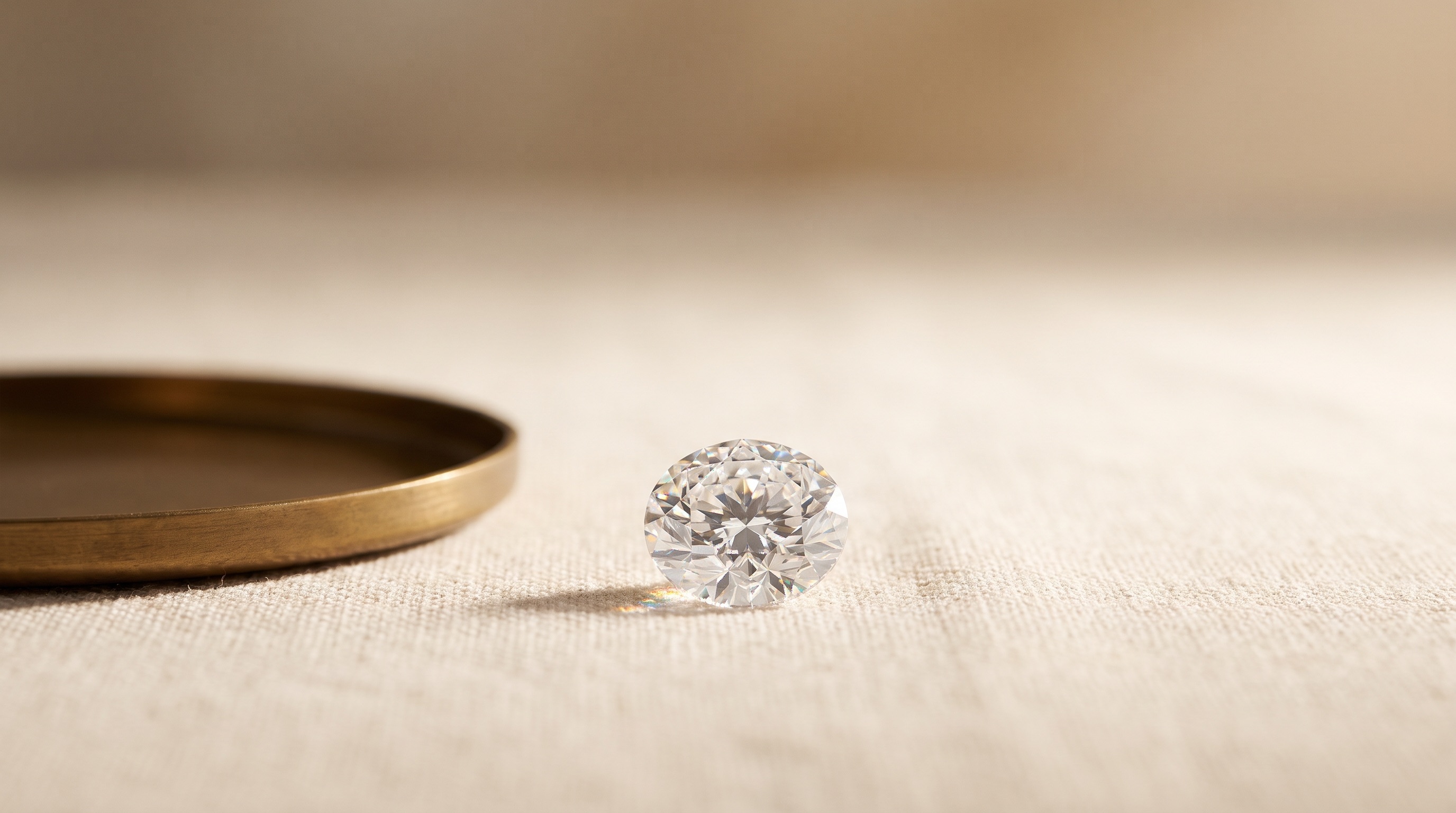
A flawless diamond is a stone graded FL (Flawless) or IF (Internally Flawless) — the two highest tiers on the GIA and IGI clarity scale, meaning no inclusions (FL) or no internal inclusions (IF) are visible to a trained grader under 10x magnification. Both grades sit above VVS1 and VVS2, and both are genuinely rare in certified inventory, whether natural or CVD lab-grown.
For wholesale buyers, "flawless" is one of the most misunderstood terms on a diamond certificate — not because the definition is complicated, but because the gap between what it means on paper and what it means on a retail counter is easy to overstate. This guide breaks down exactly what FL and IF grading involves, how the major labs assess it, how rare these grades actually are across both natural and lab-grown production, and — the part that matters most for a sourcing decision — when a client genuinely benefits from paying for that top tier versus when a VVS stone is the smarter recommendation.
What "Flawless" and "Internally Flawless" Actually Mean
Clarity grading measures the presence, size, position, and visibility of inclusions (internal characteristics) and blemishes (surface characteristics) when a diamond is examined by a trained grader using 10x magnification under controlled lighting. FL and IF are the two grades at the very top of that scale, and while they're often used interchangeably in casual conversation, they describe two distinct standards.
Flawless (FL)
A Flawless grade means the grader can find no inclusions and no blemishes at all under 10x magnification — nothing internal, and nothing on the surface. This includes the girdle, the culet, and every facet junction. FL is the strictest grade on the scale; a stone can have a technically perfect interior and still miss FL if a grader spots a trivial surface scratch or a naturally occurring extra facet from the polishing process.
Internally Flawless (IF)
An Internally Flawless grade means no inclusions are visible under 10x magnification, but minor surface blemishes are permitted — as long as they're the kind that could plausibly be polished away without affecting the stone's weight in a meaningful way. Common allowances at IF include a faint extra facet, a minor naturally occurring surface graining line, or a very light polish mark near the girdle. The interior standard for IF is identical to FL; the difference lives entirely on the surface.
In practice, this means IF diamonds are meaningfully more common in certified supply than true FL stones, because the surface-perfection bar for FL is difficult to hit even on an internally pristine stone. A polisher can control the interior of a diamond only to a point — surface finish depends on execution during the final cutting and polishing stages, and a single visible facet-junction imperfection is enough to drop a stone from FL to IF.
How FL/IF Differ From VVS1 and VVS2
One step below FL/IF on the GIA and IGI scales sits VVS (Very, Very Slightly Included), split into VVS1 and VVS2. The distinction between "no inclusions visible" and "VVS" comes down entirely to whether a grader can find anything internal under magnification — not how large or visually disruptive that inclusion is.
- VVS1: Inclusions are present but extremely difficult to locate under 10x magnification, typically visible only from the pavilion (the stone's underside) and often requiring the grader to know roughly where to look.
- VVS2: Inclusions are still very difficult to find under 10x magnification, but marginally easier to locate than VVS1 — sometimes visible from the crown (top-down) as well as the pavilion.
The functional gap between IF and VVS1 is narrower than most buyers assume. A VVS1 diamond can be internally pristine to the naked eye and nearly indistinguishable from an IF stone in a jewelry setting — the difference is a grader's ability to locate a pinpoint inclusion under strong magnification, not a visible flaw. This is the core tension this guide comes back to repeatedly: clarity grading above VS2 measures grader-detectable perfection, not eye-visible beauty, and the two stop tracking each other closely once you're above VS clarity.
The Full Clarity Scale, From FL to Included
To put FL and IF in context, it helps to see where they sit relative to the rest of the GIA/IGI clarity scale, which runs from Flawless down through Included:
- FL — Flawless
- IF — Internally Flawless
- VVS1, VVS2 — Very, Very Slightly Included
- VS1, VS2 — Very Slightly Included
- SI1, SI2 — Slightly Included
- I1, I2, I3 — Included
FL and IF sit within the top two of eleven possible grades. For context, the vast majority of diamonds sold at retail — natural and lab-grown alike — fall in the VS to SI range, which is where the best balance of eye-clean appearance and value typically lives. FL/IF is a specialty tier, not a default recommendation, and understanding that positioning is central to using it correctly with a client.
Clarity Grade Comparison Table
The table below summarizes what each grade actually means under magnification, how it typically reads to the naked eye at normal viewing distance, and its relative position in certified supply — useful as a quick reference when explaining the top of the scale to a retail client.
| Grade | Under 10x Magnification | Naked-Eye Appearance | Relative Rarity | Typical Positioning |
|---|---|---|---|---|
| FL | No inclusions, no blemishes anywhere on the stone | Eye-clean, indistinguishable from IF/VVS without a loupe | Rarest certified tier; a small fraction of graded output | Collector-grade, investment, or top-tier bridal |
| IF | No inclusions; minor surface characteristics only | Eye-clean, indistinguishable from FL/VVS without a loupe | Very rare; more available than FL but still a small share of supply | Premium bridal, high-end custom pieces |
| VVS1 | Extremely minor inclusions, hard to locate even for a trained grader | Eye-clean at any normal viewing distance | Uncommon; a meaningful step up in scarcity from VVS2 | Premium bridal where "top of the scale" matters to the buyer |
| VVS2 | Extremely minor inclusions, difficult to locate | Eye-clean at any normal viewing distance | Uncommon but more available than VVS1 | Strong value-to-clarity ratio for discerning buyers |
| VS1 | Minor inclusions, visible with effort under magnification | Eye-clean in nearly all cases | Moderately available | The most common recommendation for engagement center stones |
| VS2 | Minor inclusions, somewhat easier to locate than VS1 | Eye-clean in the large majority of cases; shape-dependent | Readily available | Strong value tier, especially in brilliant-cut shapes |
| SI1 | Noticeable inclusions under magnification | Usually eye-clean; inclusion visibility depends on shape and inclusion type | Widely available | Value-focused buyers; requires case-by-case inspection |
The pattern worth noting in that table: naked-eye appearance stops changing meaningfully once you cross into VS1 and above, even though the magnified grade keeps climbing all the way to FL. That's the single most important thing to communicate to a retail client weighing this decision, and we come back to it in detail below.
How Grading Labs Assess Clarity at the Top of the Scale
FL and IF determinations aren't made casually — at the top of the clarity scale, the margin for grader disagreement narrows, which is exactly why lab reputation and grading rigor matter more here than at any other tier.
GIA (Gemological Institute of America)
GIA is widely regarded as the strictest and most consistent clarity grader in the trade, particularly at the FL/IF tier. GIA graders work under standardized 10x binocular microscopes and cross-check findings against a second grader before a clarity call is finalized on any stone submitted for a full grading report. GIA reports for FL/IF stones are the most commonly requested by collectors and high-end retail buyers specifically because of this reputation for consistency at the extreme top of the scale.
IGI (International Gemological Institute)
IGI is the dominant lab for lab-grown diamond certification globally and grades using methodology consistent with GIA's standards, including 10x magnification review for clarity. IGI reports are widely accepted in the wholesale trade and are the standard choice for CVD lab-grown FL/IF stones, where IGI's throughput and lab-grown-specific expertise make it the most practical certification path for that segment of supply.
GCAL (Gem Certification & Assurance Lab)
GCAL is known in the trade for tighter cut-grade parameters and additional proprietary assessments (including a light-performance evaluation) alongside standard 4Cs grading. For FL/IF stones being positioned as top-of-market pieces, a GCAL report alongside — or in place of — a GIA report can add a layer of cut-quality documentation that resonates with buyers focused on light performance as much as clarity.
All three labs use the same 10x-magnification, unaided-eye-excluded methodology for clarity determination — the difference between labs at this tier is less about the grading standard itself and more about consistency, turnaround, and how a given report is perceived by the end buyer.
How Rare Are FL and IF Diamonds — Natural and CVD Lab-Grown
Natural FL/IF Rarity
In natural diamond production, FL and IF stones represent a very small share of gem-quality rough that ultimately reaches polished, certified form. Most natural rough carries some combination of internal inclusions from the geological conditions under which it formed, and achieving a completely inclusion-free (or near-inclusion-free) result after cutting is uncommon enough that natural FL/IF stones command a significant price premium over VVS and VS grades of comparable size, color, and cut.
CVD Lab-Grown FL/IF Rarity
CVD (chemical vapor deposition) production allows for tighter control over growth conditions than natural formation, which has increased the proportion of high-clarity output reaching VVS and above compared to natural mining. That said, FL and IF remain a distinctly smaller share of CVD output than VS and SI grades — growth-chamber conditions, gas purity, and substrate quality all influence whether a given crystal develops the internal characteristics that would prevent an FL or IF result. CVD's advantage is a somewhat higher yield rate at the top of the clarity scale relative to natural mining, not an elimination of clarity variation altogether. A buyer sourcing CVD FL/IF inventory should still expect it to represent premium, lower-volume stock relative to the VS/SI grades that make up the bulk of standard lab-grown wholesale supply.
One important scope note: FL/IF grading applies to certified loose diamonds at 0.30 carat and above — the tier where individual stones receive a full grading report from GIA, IGI, or GCAL. It does not apply to melee, which ships as uncertified parcel goods against a color/clarity quality baseline rather than individual grading. A buyer asking about "flawless melee" is really asking about a DEF+/VS+ parcel spec, not an FL/IF certificate — the two are different product categories entirely.
Price and Rarity Implications for Wholesale Buyers
Because FL and IF represent a small fraction of certified supply at any given carat weight, cut, and color combination, price per carat rises meaningfully — and often non-linearly — as clarity climbs from VS through VVS into FL/IF, particularly above one carat where FL/IF availability tightens further. A few sourcing realities worth building into a wholesale buying strategy:
- Availability narrows fast above 1 carat. FL/IF stones under half a carat are considerably easier to source consistently than FL/IF stones above 2 carats, where both natural and CVD supply thins out.
- Shape matters. Step cuts (emerald, Asscher) show inclusions more readily than brilliant cuts because of their open facet structure and lower light scatter, so a step-cut client chasing a truly eye-clean result may need to move up the clarity scale further than a round or cushion buyer would to achieve the same visual outcome.
- FL/IF pricing premiums compound with color and cut. A D-color, Excellent-cut FL stone commands a materially different price than an FL stone with a lower color grade or a Good cut grade — the top of the clarity scale is where every other 4C variable starts to matter more, not less, to final price.
- CVD FL/IF still trades at a meaningful discount to natural FL/IF at equivalent specifications, which is the main lever wholesale buyers use to bring top-clarity inventory within reach for retail clients who want the grade but not the natural-diamond price point.
Can You Actually See the Difference Between FL/IF and VVS?
This is the most useful — and most commonly skipped — piece of information in any FL/IF conversation: at normal viewing distance, with the naked eye, a trained observer generally cannot distinguish an FL diamond from an IF diamond, or either from a well-cut VVS1 or VVS2 stone. All of these grades describe characteristics that are, by definition, difficult or impossible to locate even under 10x magnification — which means none of them are visible without magnification in the first place.
The practical implication: a retail client paying a substantial premium for FL over VVS1 is very rarely paying for a visible difference in the finished piece. They're paying for the certificate — the documented rarity, the grading pedigree, and in some cases the resale or collector context that a top-of-scale grade carries. That's a completely legitimate reason to buy FL/IF; it's just a different reason than "it will look better," and a wholesale buyer serving retail clients is better positioned to make that recommendation honestly when the distinction is clear upfront.
Where clarity differences between grades do start to become naked-eye relevant is much lower on the scale — around SI2 and below, where inclusions can be large or positioned in a way that affects brilliance or is visible without magnification. FL through VS2 is, for nearly all practical purposes, a range where every grade looks equally clean to an unaided eye.
When a Retail Client Actually Needs FL/IF vs. When VVS Is the Better Recommendation
Given that visual difference is rarely the deciding factor, the right recommendation depends on what the client actually values:
FL/IF makes sense when:
- The client explicitly wants "the best available" and understands they're paying for grading rarity, not a visible upgrade — common in high-net-worth bridal and statement-piece purchases.
- The piece is being positioned as an investment or collector item, where certificate-documented rarity has resale and provenance value.
- The stone is a larger step cut (emerald, Asscher) where inclusions are more likely to be visible at lower clarity grades, and the client wants maximum assurance against any visible flaw.
- A matched pair or suite (earrings, a three-stone ring) requires the tightest possible consistency across stones, and sourcing from the top of the clarity scale simplifies matching.
VVS or VS is the better recommendation when:
- The client's priority is maximizing carat weight, color, or cut quality within a fixed budget — clarity above VS2 delivers the smallest visible return per dollar of any of the 4Cs.
- The stone is a round brilliant or another cut with high facet-driven light scatter, where VS-grade inclusions are already well-concealed by the cut's optical performance.
- The client is buying for everyday wear rather than a collector or resale context, where the practical value of a certificate-only distinction is lower.
The honest, balanced answer for most engagement and everyday bridal purchases is that VS1–VVS2 delivers essentially all of the visual benefit of FL/IF at a fraction of the cost, and a good wholesale partner should be comfortable saying so rather than defaulting every client toward the top of the scale. FL/IF earns its place for clients who specifically want the rarity and the paperwork — not as a universal upsell.
Sourcing FL/IF Diamonds for Wholesale
Guru Diam is a B2B wholesale supplier working exclusively with independent jewelers, designers, and manufacturers — not a direct-to-consumer retailer. Both natural and CVD lab-grown certified loose diamonds are carried, with IGI, GIA, and GCAL certification available depending on the stone and the client's preference, which makes it possible to source FL/IF inventory with the specific grading pedigree a given retail client is asking for rather than being limited to a single lab's output.
Because FL/IF availability at any given carat, shape, and color combination can shift quickly given how thin that tier of supply runs, in-stock certified inventory ships same-day from Guru Diam's New York location (orders before 6pm EST) or Los Angeles location (orders before 4pm PST) — useful when a client has a firm deadline and a specific FL/IF spec needs to move fast. For clients building a matched suite around a top-clarity center stone, matching pairs are sourced as a dedicated category rather than assembled ad hoc, which matters when clarity, color, and cut consistency across multiple stones is the whole point of the purchase. When an FL/IF center stone is heading into a finished piece rather than staying loose, custom engagement rings and other finished jewelry are turned around in 4–6 days — a timeline that applies to finished pieces only, not to loose-stone sourcing itself.
For jewelers evaluating a new certified-diamond source more broadly, the certified diamonds category and wholesale hub are the starting points for browsing current inventory across clarity tiers, and the trade partner page covers account setup for new wholesale buyers.
Frequently Asked Questions
What is the difference between a flawless (FL) and internally flawless (IF) diamond?
Both grades mean no inclusions are visible under 10x magnification. The difference is on the surface: FL allows no blemishes at all, anywhere on the stone, while IF permits very minor surface characteristics — like a faint extra facet or light polish mark — that don't affect the interior. FL is the stricter and rarer of the two grades.
Can you see the difference between FL/IF and VVS clarity with the naked eye?
Generally, no. FL, IF, VVS1, and VVS2 all describe characteristics that are difficult or impossible to locate even under 10x magnification, which means none of them are visible without magnification at normal viewing distance. The practical difference between these grades shows up on the certificate and in price, not in how the finished stone looks in a setting.
Are FL and IF diamonds more common in lab-grown or natural diamonds?
CVD lab-grown production allows tighter control over growth conditions, which produces a somewhat higher proportion of VVS-and-above output compared to natural mining. Even so, FL and IF remain a small, premium share of CVD supply — not the default outcome of lab growth — so both natural and lab-grown FL/IF stones should be treated as a specialty sourcing tier rather than standard inventory.
Is it worth paying extra for a flawless diamond over VVS or VS clarity?
It depends on what the buyer values. If the goal is a visibly better-looking stone, VS1 through VVS2 typically delivers the same eye-clean appearance as FL/IF at a significantly lower price. FL/IF is worth the premium for buyers who specifically want top-of-scale rarity, certificate pedigree, or a collector/investment angle — not primarily for a visual upgrade.
Does FL/IF clarity apply to melee diamonds?
No. FL and IF are individual grading tiers on certificates issued for loose diamonds at 0.30 carat and above. Melee ships as uncertified parcel goods against a quality baseline (such as DEF+/VS+) rather than receiving individual clarity grades, so "flawless melee" isn't a real certified category — it's a different product entirely from an FL/IF loose stone.
Which grading lab is best for a flawless or internally flawless diamond?
GIA is widely regarded as the most consistent and strictest grader at the FL/IF tier for natural diamonds, and its reports are the most commonly requested for collector and high-end pieces. IGI is the standard choice for CVD lab-grown FL/IF stones given its scale and lab-grown-specific expertise. GCAL is a strong option when a buyer wants additional cut and light-performance documentation alongside the clarity grade.