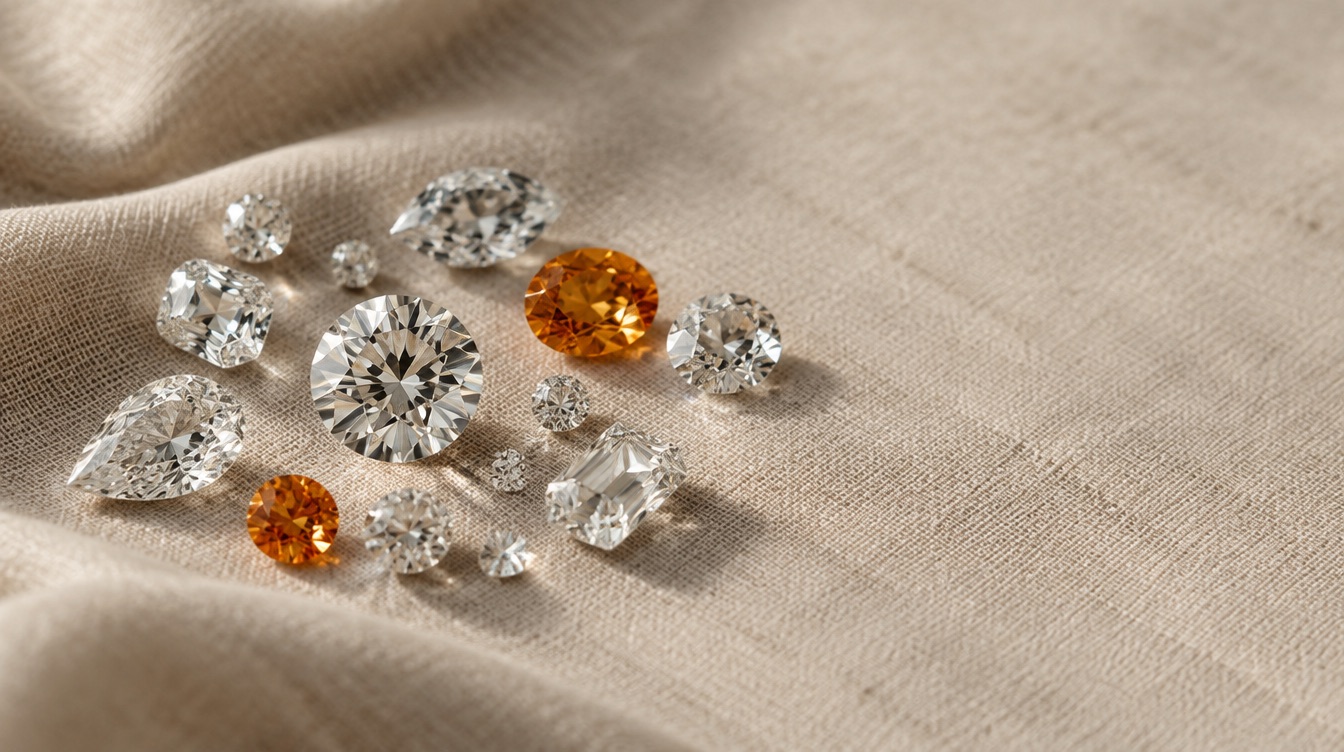
A fancy orange diamond is a diamond whose body color reads as a genuine, saturated orange strong enough to be graded on the fancy color scale — Faint through Fancy Vivid — rather than treated as an unwanted tint on the standard white diamond scale. True fancy orange stones, with little to no secondary yellow or brown modifier, are among the rarest categories in the entire fancy color diamond market, in both natural and lab-grown material.
This guide covers what actually causes orange color in a diamond, how natural fancy orange differs from lab-grown orange material in the broader market, how GIA and IGI apply their color grading criteria specifically to orange stones, why orange is so easily confused with yellow and brown on paper and in person, the secondary hue modifiers that describe most orange diamonds in practice, what drives price within the category, and what a trade buyer should check before sourcing a fancy orange stone.
What Makes a Diamond "Fancy Orange"
Color in a natural fancy color diamond comes from trace elements or structural irregularities in the crystal lattice that formed while the diamond crystallized deep in the earth. Nitrogen is the trace element behind most yellow diamonds, and it is also implicated in most natural orange diamonds — but the specific way nitrogen-related features are arranged and combined in an orange stone differs from the arrangement typical of a straightforward yellow diamond, which is part of why a true, well-saturated orange body color is so much less common than yellow at any given saturation level. Boron produces natural blue, and different structural defects account for pink, green, and other fancy colors — orange sits closer to yellow on the causation side than it does to something like blue or pink.
Because the underlying causes of yellow and orange color overlap, a stone's position between the two is often a matter of exactly how much of each influence is present, which is one reason orange diamonds are graded with unusual care against calibrated reference stones rather than by eye alone.
Natural Fancy Orange vs. Lab-Grown Fancy Orange in the Broader Market
Fancy orange diamonds exist in both natural and lab-grown form across the wider diamond market, and the two should never be conflated on a report or in a listing. Natural fancy orange diamonds get their color from the nitrogen-related causes described above, formed under natural geological conditions over an extremely long period. Lab-grown orange diamonds, grown by CVD (chemical vapor deposition) or other laboratory methods, can also develop orange or orange-related color, sometimes as-grown and sometimes refined afterward through post-growth treatment processes that other producers in the category use to develop or intensify color. Whether a stone is natural or lab-grown has no bearing on how its color is graded — hue, tone, and saturation are assessed the same way either way — but growth origin and any treatment must be disclosed separately and clearly on the certificate, and a buyer should never assume one from the color grade alone.
Worth noting directly: not every fancy color supplier carries fancy orange in either form. Orange sits at the rarer, more specialized end of the fancy color category, and plenty of established fancy color programs are built around the more commercially available hues — yellow, pink, blue, and green — without orange in the current lineup at all. That is a genuine sourcing consideration for a trade buyer, not a minor detail, and it is worth confirming directly with any supplier before assuming orange is part of what they stock.
How Rare Is a Fancy Orange Diamond?
Within the fancy color category, rarity varies enormously by hue. Yellow and brown diamonds are relatively abundant and are found across the full grading range up to Fancy Vivid at genuine commercial scale. Blue, pink, and green are meaningfully rarer, particularly once saturation climbs toward Fancy Intense or Fancy Vivid. Orange sits further out on the rare end of that spectrum, generally grouped alongside purple and red as among the scarcest fancy color categories overall — a well-saturated, low-secondary-hue orange diamond of any real size is a genuinely uncommon find in the natural market, and even in lab-grown production, clean orange color is harder to produce consistently than yellow, pink, blue, or green.
Most diamonds that show orange influence at all carry a strong secondary hue — brownish orange or yellowish orange are far more commonly encountered than a clean, dominant orange with little modifier. That secondary-hue reality is a big part of why "fancy orange" as a precise, pure grading description is rarer in practice than the word "orange" is in casual trade conversation.
The GIA and IGI Grading Scale Applied to Orange Stones
Fancy color grading — used by GIA, IGI, and GCAL alike — evaluates three variables together rather than a single number or letter: hue (the color family, including any secondary hue), tone (how light or dark the color appears), and saturation (how strong or intense the color reads). The named grades run from Faint, through Very Light, Light, Fancy Light, Fancy, Fancy Dark or Fancy Deep, Fancy Intense, and up to Fancy Vivid, the most saturated and generally the most valuable grade at any given hue and size.
Applied to orange specifically, that scale means a diamond can carry the word "orange" on its report at almost any point from a very faint hint of orange influence up through a bold, fully saturated Fancy Vivid Orange — and the difference in appearance, rarity, and price between those two ends of the same named hue is dramatic. A report that simply says "orange" without stating tone and saturation, or without noting a secondary hue if one is present, is not giving a buyer enough information to actually evaluate the stone.
Orange, Yellow, and Brown: A Grading Comparison
Orange, yellow, and brown are grouped together here deliberately, because they sit close to one another both on the color wheel and in the underlying causes of color in a diamond, and confusing the three is one of the most common mistakes newer buyers make when they first encounter fancy color stock.
| Criteria | Fancy Orange | Fancy Yellow | Fancy Brown |
|---|---|---|---|
| Typical color cause (natural) | Nitrogen-related, distinct arrangement from typical yellow | Nitrogen-related | Structural lattice irregularities (plastic deformation) |
| Common secondary hues | Brownish orange, yellowish orange | Brownish yellow, orangy yellow | Orangy brown, yellowish brown, pinkish brown |
| Position on the color wheel | Between yellow and red | Adjacent to green and orange | A darker-toned, desaturated neighbor of both yellow and orange |
| Relative market rarity | Rare — grouped with purple and red | Common — most available fancy color | Common — widely available across grades |
| Availability at Fancy Vivid | Very limited, in both natural and lab-grown supply | Routine at commercial wholesale scale | Uncommon; brown more often reaches Fancy Dark/Fancy Deep than Fancy Vivid |
| Typical price behavior | Strong premium once hue is clean with minimal secondary modifier | Moderate, predictable step-up by saturation grade | Generally the most accessible fancy color price point |
The table above is a general framework, not a fixed price list — actual pricing on any individual stone depends on its specific hue purity, tone, saturation, clarity, cut, carat weight, and growth origin together, not on the color name alone.
Secondary Hues: Reading an Orange Diamond's Full Description
A fancy color report almost always lists a secondary hue ahead of the primary color when one is present, and orange diamonds are described this way constantly because a clean, unmodified orange is so uncommon. The terms a buyer will most often encounter include:
- Fancy Vivid Orange / Fancy Intense Orange — the rarest description, a bold, highly saturated orange with little to no secondary hue pulling it toward yellow or brown.
- Orangy Yellow — a yellow-dominant stone with a noticeable orange influence; more common and more affordable than a primary-orange stone of comparable saturation.
- Yellowish Orange — orange-dominant with a visible yellow secondary influence; sits closer to true orange than orangy yellow does, and is priced accordingly higher within the orange-adjacent group.
- Brownish Orange — orange with a muted, warmer brown influence; a common real-world description for orange-toned stones, since brown-related causation often accompanies orange color.
- Orangy Brown — brown-dominant with orange influence; typically the most accessible price point among all orange-adjacent descriptions.
These distinctions are not academic. Two diamonds can both be described casually as "orange" in a trade conversation while sitting at meaningfully different points on an actual report, with correspondingly different rarity and price. A buyer evaluating orange stock should always ask for the full hue description exactly as it appears on the certificate, not a shorthand color name.
Why Orange Grading Gets Confused With Yellow and Brown
On a standard color wheel, orange sits directly between yellow and red, immediately adjacent to both — and brown, in gemological terms, generally behaves as a darker, more desaturated relative of the yellow-to-orange range rather than as a fully separate hue family. That physical closeness on the color wheel is exactly why grading orange diamonds is harder in practice than grading a hue like blue or pink, which sit further away from their neighbors and are less easily mistaken for something else.
A few practical reasons the confusion shows up so often:
Lighting shifts perceived hue
Warm incandescent or candle-style lighting can push a yellow or brownish-yellow stone toward looking more orange to the eye than its certified grade states, while cooler daylight-balanced lighting can pull a genuinely orange stone back toward looking more yellow. This is exactly why lab grading is performed under standardized, controlled lighting conditions rather than ambient light.
Tone and saturation interact with hue perception
A darker-toned yellow can visually read as closer to orange or brown than a lighter-toned yellow of the exact same hue family, simply because darkening a color shifts how the eye perceives it. This is part of why fancy color grading evaluates hue, tone, and saturation together rather than hue in isolation.
Trade and marketing language isn't standardized
Casual descriptive terms used in retail and trade conversation — "cognac," "champagne," "chocolate," and similar marketing names for brown-toned stones, along with looser uses of "orange" for stones that are formally graded as orangy yellow or yellowish brown — are not official grading terminology. A buyer should always confirm the actual lab-stated hue, tone, and saturation on the certificate rather than relying on a marketing name to know exactly where a stone sits.
What Drives Price in Fancy Orange Diamonds
Several factors interact to set price within the fancy orange category, and they don't weigh equally:
- Hue purity. A clean, dominant orange with minimal secondary hue commands a meaningfully stronger premium than a brownish orange or orangy yellow stone of comparable saturation and size, precisely because a pure orange hue is so much rarer.
- Saturation. As with every fancy color, moving up the scale from Fancy to Fancy Intense to Fancy Vivid typically produces the largest jumps in per-carat value, and this effect is especially pronounced in orange given how scarce genuinely vivid, clean orange material is at any size.
- Carat weight. Larger fancy orange stones become disproportionately rarer and more expensive per carat than smaller ones, following the same non-linear scaling seen across rare fancy colors generally.
- Growth origin and certification. Natural fancy orange diamonds and lab-grown fancy orange diamonds are priced on entirely different bases and should never be compared as if they were the same market — a report should always state origin clearly, and any color treatment must be disclosed as well.
- Clarity and cut. These still matter, but as with most well-saturated fancy color stones, a strong, clean body color tends to dominate visual appeal in a way that can make minor clarity characteristics or a less textbook cut less noticeable than they would be on a comparable white diamond.
Treated Color and Disclosure in Orange-Toned Diamonds
Because orange and brown causation in diamonds are closely related, the market includes diamonds that started out with a brown or brownish-yellow body color and were subsequently processed to develop or intensify an orange appearance. Reputable labs disclose any such treatment clearly on the certificate — a treated stone should never be represented or priced as if it were untreated natural or as-grown lab-grown color. A trade buyer sourcing fancy orange material at any real volume should make a habit of confirming treatment status explicitly on every certificate rather than assuming a strong orange color is necessarily as-formed.
Notable Context: Orange in the Wider Fancy Color Market
Fancy orange diamonds occupy a small, specialized niche of the broader colored diamond market, and large, high-saturation examples are uncommon enough that they occasionally attract outsized attention when they surface at major auction houses or in significant private collections — the kind of publicity that helps keep the category on trade buyers' radar even though day-to-day supply is thin. That visibility doesn't translate into deep liquidity, though: unlike yellow or brown, where a buyer can generally source meaningful volume at a chosen grade and size on request, fancy orange inventory tends to move opportunistically, stone by stone, as individual pieces become available rather than as a standing, reliably restockable category.
Buying Considerations for Trade Buyers Encountering Fancy Orange Stones
A few practical checks are worth making before committing to any fancy orange purchase or quote:
- Read the full hue description, not just the color name. "Orange" on its own tells a buyer almost nothing useful — confirm whether the report states a primary orange hue or an orange-adjacent secondary hue such as orangy yellow or brownish orange.
- Confirm tone and saturation explicitly. Two stones both labeled "orange" can sit at dramatically different points on the Faint-to-Fancy-Vivid scale, with correspondingly different pricing.
- Verify natural vs. lab-grown origin on the certificate. Never assume growth origin from the color description alone, and never accept a listing that blends the two.
- Ask directly about treatment. Given how closely orange and brown causation overlap, confirm whether any color treatment has been applied and that it is disclosed on the report.
- Expect thinner, less consistent supply than yellow, pink, blue, or green. Plan sourcing timelines accordingly, and be prepared to consider a closely related, more available hue — a well-chosen orangy yellow or yellowish orange, for example — if a specific size or budget target can't be met in a strictly pure orange stone.
- Confirm certification lab and criteria. GIA, IGI, and GCAL all grade fancy color diamonds using comparable hue, tone, and saturation frameworks, but buyers comparing stones across labs should confirm each report states all three variables explicitly rather than relying on a shared color name alone.
Sourcing Fancy Color Diamonds: Where Orange Fits Today
Guru Diam is a trade-only wholesale diamond supplier, and its current fancy color catalog — both certified loose stones at 0.30ct and above and calibrated fancy color melee in round and fancy shapes — covers yellow, pink, blue, and green. Fancy orange is not currently part of that lineup, and buyers specifically hunting for orange stock should factor that into sourcing plans rather than assume it against the broader fancy color range. That said, the underlying grading expertise carries across every fancy color, including orange: IGI, GIA, and GCAL certification are all available on the fancy color stones Guru Diam does carry, and the same hue, tone, and saturation literacy that applies to reading a yellow or pink diamond's report applies equally to evaluating orange material sourced elsewhere in the trade.
Guru Diam's broader positioning as one supplier for antique cuts, natural diamonds, fancy color stones, fancy color melee, and custom finished jewelry means a buyer building a program around fancy color more generally — yellow, pink, blue, or green center stones with matched accent melee, for example — can consolidate that sourcing in one place even while looking elsewhere in the trade specifically for orange. Trade buyers can review current fancy color inventory at the fancy color loose diamonds category, browse certified stock generally at certified diamonds, and apply for a wholesale account through trade partner. Current terms are posted at the wholesale hub, and buyers designing a custom piece around a fancy color center stone can start at custom jewelry.
Frequently Asked Questions
What causes the color in a fancy orange diamond?
In natural stones, orange color is generally associated with nitrogen-related features in the crystal lattice, in a different arrangement than the nitrogen-related causes typical of most yellow diamonds. Lab-grown orange diamonds develop their color during or after CVD growth, and any post-growth treatment must be disclosed separately on the certificate.
Are fancy orange diamonds rarer than yellow diamonds?
Yes. Yellow is the most commercially available fancy color at essentially every saturation level, while a clean, well-saturated fancy orange with minimal secondary hue is grouped among the rarer fancy colors, alongside purple and red.
What is the difference between "fancy orange" and "orangy yellow" on a diamond certificate?
Fancy orange means orange is the dominant hue on the report. Orangy yellow means yellow is dominant with a secondary orange influence. The two look different in person and are priced differently, even though both involve orange coloring.
Why do orange diamonds get confused with yellow or brown diamonds?
Orange sits directly between yellow and red on the color wheel, and brown behaves gemologically as a darker, more desaturated relative of the yellow-to-orange range. Lighting conditions, tone, and non-standardized trade marketing terms all add to the confusion, which is why lab certificates state hue, tone, and saturation explicitly rather than relying on a single color name.
Does Guru Diam carry fancy orange diamonds?
Not currently. Guru Diam's fancy color catalog, in both certified loose stones and calibrated melee, covers yellow, pink, blue, and green. Buyers specifically sourcing fancy orange should plan for that elsewhere in the trade while still consolidating other fancy color sourcing with a single supplier where useful.
Are lab-grown fancy orange diamonds graded differently from natural fancy orange diamonds?
No. Both are graded using the same hue, tone, and saturation criteria on the same Faint-to-Fancy-Vivid scale. The certificate states growth origin separately from the color grade, so a buyer should always confirm origin rather than assume it from the color description alone.
Guru Diam is a trade-only wholesale diamond supplier with locations in New York and Los Angeles, carrying CVD lab-grown fancy color diamonds in yellow, pink, blue, and green alongside natural diamonds, antique and standard cuts, and finished jewelry, with IGI, GIA, and GCAL certification available. Browse current fancy color inventory in the fancy color loose diamonds category or apply for a trade account through trade partner.