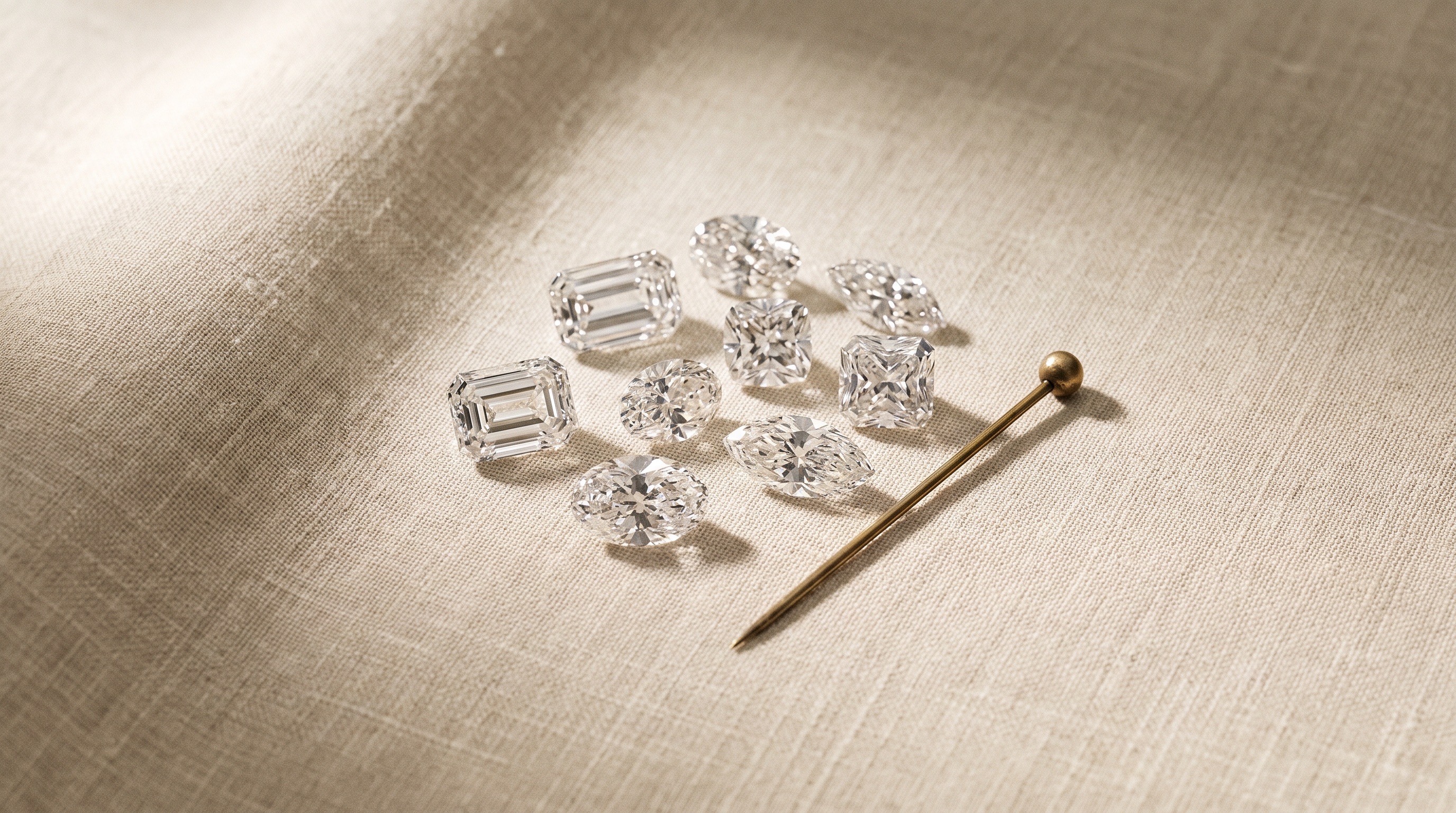
A fancy cut diamond is any diamond cut into a shape other than the round brilliant — emerald, oval, cushion, marquise, radiant, pear, princess, heart, and the antique styles like old mine and old European cut all fall under this umbrella term. In the trade, "fancy cut" is a catch-all that separates non-round shapes from the round brilliant, which is treated as its own category because of how standardized and dominant its faceting pattern is.
This guide covers what "fancy cut" actually means as trade terminology, how fancy cuts differ from round brilliants in faceting, light performance, and pricing, the two distinct tiers fancy cuts fall into (regular fancy vs. antique), a shape-by-shape comparison of the most common fancy cuts, and what a wholesale buyer should know before adding fancy cut inventory to a program.
What "Fancy Cut" Actually Means
"Fancy cut" is trade shorthand, not a technical grading term — it doesn't appear on a GIA or IGI certificate the way color, clarity, or carat weight does. Instead, it's a working category the trade uses to group every diamond shape other than the round brilliant under one label, because the round brilliant is cut and graded on its own standardized 57/58-facet pattern, with its own dedicated cut-grade scale (Excellent through Poor). Every other shape — sometimes called a "fancy shape" instead of "fancy cut," the two terms are used interchangeably — has its own facet arrangement, proportions, and set of trade conventions for evaluating quality, since there's no single universal cut-grade scale that applies across all of them the way there is for round brilliants.
This distinction matters practically for buyers: sourcing, evaluating, and pricing a fancy cut diamond requires shape-specific knowledge that doesn't transfer directly from round brilliant sourcing experience. A buyer comfortable evaluating round brilliant cut grade, for instance, needs a different framework entirely to evaluate whether an emerald cut's step facets are well-proportioned, or whether a marquise cut's points are symmetrical.
Fancy Cut vs. Round Brilliant: Key Differences
| Factor | Round Brilliant | Fancy Cut (general) |
|---|---|---|
| Facet pattern | Standardized 57/58-facet brilliant pattern | Varies by shape — brilliant-faceted (oval, marquise, pear) or step-faceted (emerald, asscher) |
| Cut-grade scale | Formal Excellent-to-Poor scale (GIA), Ideal (AGS) | No universal formal scale; evaluated on shape-specific proportion and symmetry conventions |
| Rough utilization | Lower yield from octahedral rough (more waste) | Often higher yield, especially step cuts and cuts derived from flatter rough |
| Clarity forgiveness | More forgiving — brilliant facets scatter light, masking small inclusions | Varies widely — step cuts like emerald and asscher are least forgiving; brilliant-faceted fancy cuts (oval, cushion, marquise) are more forgiving |
| Market share | Largest single category by volume | Smaller individually, but combined represent a meaningful share of overall trade demand |
The Two Tiers of Fancy Cuts
Guru Diam's own production and pricing taxonomy splits fancy cuts into two distinct tiers, and understanding the split helps explain why two fancy cut diamonds of similar size and quality can carry very different price positioning:
Regular Fancy (Mid-Market)
Emerald, Asscher, Cushion, Oval, Pear, Marquise, Radiant, Princess, and Heart make up the regular fancy tier — modern cuts developed and standardized largely across the 20th century, widely available, and priced in the mid-market range relative to round brilliant and antique cuts. Despite Emerald, Asscher, and Cushion sometimes being step-cuts by faceting style, they're grouped with this modern mid-market tier rather than with true antique cuts, since the distinction is about production era and market positioning, not faceting technique alone.
Antique (Premium Tier)
Old Mine, Old European, Hexagonal, Moval, Lozenge, Kite, Trillion, Criss-Cut, Padparadscha, and other true antique-style cuts occupy Guru Diam's premium tier — historical faceting styles, cut by hand or with older-style equipment conventions, that carry a scarcity and craftsmanship premium over both round brilliant and regular fancy cuts. These are the shapes buyers building an antique-cut or vintage-inspired jewelry line typically source specifically, rather than substituting a modern fancy cut for the look.
Common Fancy Cut Shapes at a Glance
| Shape | Tier | Facet Style | Character |
|---|---|---|---|
| Emerald | Regular fancy | Step-cut | "Hall of mirrors" clarity, flashes of light rather than sparkle, elongated silhouette |
| Oval | Regular fancy | Brilliant-faceted | Elongates the finger, high brilliance, can show a bow-tie shadow effect |
| Cushion | Regular fancy | Brilliant-faceted, rounded corners | Soft, romantic outline, strong fire, available in modified brilliant variants |
| Marquise | Regular fancy | Brilliant-faceted | Elongated with pointed ends, maximizes visual size per carat |
| Radiant | Regular fancy | Brilliant-faceted, cropped corners | Combines emerald outline with brilliant-cut sparkle, forgiving of inclusions |
| Princess | Regular fancy | Brilliant-faceted, sharp corners | High brilliance, efficient rough yield, corners need protective settings |
| Pear | Regular fancy | Brilliant-faceted | Teardrop silhouette combining round and marquise characteristics |
| Asscher | Regular fancy | Step-cut, square | Square emerald-style faceting, vintage Art Deco association |
| Old Mine | Antique | Cushion-shaped brilliant, high crown | Warm, candlelight sparkle, historical faceting proportions |
| Old European | Antique | Round brilliant precursor | Small table, high crown, chunky facets, forerunner to the modern round brilliant |
| Kite | Antique | Four-sided, elongated | Used mainly as a side/accent stone in antique-style settings |
| Trillion | Antique | Triangular, brilliant or step | Bold geometric silhouette, used as both center and accent stone |
Light Performance: How Fancy Cuts Differ From Each Other
Fancy cuts split broadly into two light-performance families. Brilliant-faceted fancy cuts — oval, cushion, marquise, radiant, pear, princess — use triangular and kite-shaped facets similar in principle to the round brilliant, producing scattered sparkle (scintillation) that helps mask minor inclusions and slightly off-color grades, which is why these shapes are generally considered more forgiving for buyers stocking a value-conscious tier of inventory. Step-cut fancy cuts — emerald, asscher — use long, rectangular, parallel facets that act more like a hall of mirrors, producing broad flashes of light rather than scattered sparkle. This faceting style shows inclusions and color far more readily, since there's no scattered light to camouflage them, which is why step-cut buyers typically need to source higher clarity and color grades than they would for an equivalent brilliant-faceted fancy cut or round brilliant to get a comparably clean face-up appearance.
How Fancy Cuts Are Priced Relative to Round Brilliant
Rough utilization is one of the biggest drivers of fancy cut pricing dynamics. A round brilliant, cut from octahedral rough, typically retains a smaller percentage of the original rough's weight than many fancy cuts do, since the round shape requires cutting away more material to achieve its faceting pattern. Fancy cuts — particularly cuts like cushion, radiant, and princess that can be cut more efficiently from a wider range of rough shapes — often achieve better rough utilization, which factors into wholesale pricing on the production side. On the demand side, round brilliant remains the highest-volume, most standardized shape in the market, giving it deep, liquid pricing benchmarks; fancy cuts trade in a less standardized market where price per carat can vary more by shape popularity, current styling trends, and how readily available well-cut examples of a given shape are at a given moment.
Setting Considerations for Fancy Cut Diamonds
- Corner protection. Shapes with sharp corners — princess, radiant, emerald, asscher — are more vulnerable to chipping at the corners than a round brilliant's continuous girdle edge, so settings for these shapes typically use protective prongs or a bezel specifically positioned over each corner.
- Bow-tie management. Elongated brilliant-faceted shapes — oval, marquise, pear, cushion in its elongated form — can show a dark "bow-tie" shadow across the center of the stone depending on cut proportions; buyers evaluating these shapes for inventory should check bow-tie visibility as part of quality assessment.
- Length-to-width ratio. For elongated shapes, the ratio between length and width significantly affects the stone's visual character, and buyer or end-customer preference on this ratio varies by shape and market — worth confirming against a buyer's specific design intent before sourcing.
- Culet and depth. Step cuts in particular are sensitive to depth — too deep and light leaks out the pavilion (dark center); too shallow and the stone can look glassy or washed out through the large open table.
CVD Lab-Grown and Natural Fancy Cuts
Fancy cut shapes are available across both Guru Diam's CVD lab-grown catalog and its natural diamond catalog — the cut itself doesn't determine origin, and cutting, grading, and setting considerations for a given fancy cut shape apply identically whether the rough started as lab-grown or natural material. CVD lab-grown rough is faceted using the same equipment and shape-specific conventions as natural rough, and both are gradable by GIA, IGI, and GCAL on the same shape-appropriate criteria. Buyers building a fancy cut program should source shape and quality specifications independent of origin, then choose lab-grown or natural based on the buyer's own positioning and price point rather than any difference in how the cut itself is executed.
Choosing Fancy Cut Inventory for a Wholesale Program
A buyer building out fancy cut inventory for the first time typically starts with the shapes carrying the broadest, steadiest demand — oval, cushion, and emerald consistently rank among the most requested fancy shapes across engagement and fashion jewelry — before expanding into lower-volume, more specialized shapes like marquise, pear, or antique styles like old mine and old European cut. Matching inventory mix to actual sell-through data, rather than stocking every available shape evenly, tends to produce better working capital efficiency, since fancy cut demand skews meaningfully toward a handful of popular shapes with a long tail of lower-volume specialty requests behind them.
Matched Pairs and Side Stones in Fancy Cuts
Fancy cuts play a particularly important role in matched-pair and side-stone sourcing, since many fancy shapes — trillion, kite, baguette, half-moon — are used specifically as accent or side stones flanking a center stone rather than as center stones themselves. Sourcing a well-matched pair in a fancy cut shape requires attention to more than just weight matching: the two stones also need to match in outline proportion, facet symmetry, and color/clarity appearance, since visible mismatches between paired fancy cut side stones are more noticeable to the eye than a similar mismatch would be between two round brilliant side stones.
Evaluating Fancy Cut Diamond Quality: What to Check
Because there's no single universal cut-grade scale spanning every fancy shape the way there is for round brilliant, evaluating fancy cut quality means checking a slightly different set of factors depending on the specific shape, though several considerations apply broadly across most fancy cuts. Outline symmetry matters across every fancy shape — an oval, pear, or marquise with an uneven or lopsided silhouette is immediately noticeable to the eye in a way a round brilliant's inherent symmetry doesn't require checking for. Facet alignment and polish quality matter more for step cuts like emerald and asscher, where a poorly aligned or poorly polished facet is far more visible against the shape's large, flat mirror-like surfaces than it would be scattered among a brilliant cut's many small facets. Proportions specific to each shape — length-to-width ratio for elongated cuts, crown height and pavilion depth for cuts prone to windowing or excessive light leakage — round out the checklist, and buyers sourcing fancy cuts at any real volume benefit from having shape-specific proportion guidelines on hand rather than applying round brilliant proportion expectations across the board.
Certificate Details Worth Double-Checking for Fancy Cuts
A grading certificate for a fancy cut diamond typically includes the same core information as a round brilliant certificate — carat weight, color, clarity, and measurements — but the cut-grade field is handled differently depending on the shape and the certifying lab. GIA, for instance, doesn't issue a formal overall cut grade for most fancy shapes the way it does for round brilliant, though it does report detailed measurements and proportions a buyer or gemologist can use to evaluate cut quality independently. IGI has extended formal cut grading to some popular fancy shapes in recent years. Buyers should confirm exactly what cut-quality information a given certificate actually includes for the specific shape in question, rather than assuming every fancy cut certificate carries the same overall cut grade a round brilliant certificate does.
Fancy Cut Diamonds as Melee and Accent Stones
Beyond center-stone use, fancy cut shapes play a significant role as calibrated melee and accent stones in finished jewelry — baguette, trillion, kite, half-moon, and other fancy shapes are commonly used as side stones flanking a center diamond, or set in a pavé, channel, or cluster pattern across a band or halo. Calibrated fancy-shape melee is cut to standardized size specifications so multiple stones match precisely for a uniform look across a piece, which is a different sourcing discipline than sourcing a single fancy cut center stone — calibrated melee is typically sold as uncertified parcel goods against a quality baseline (DEF+/VS+ is a common trade standard) rather than individually certified, since certifying each small accent stone individually isn't practical at that scale or price point.
Fancy Cut Diamonds in Engagement Ring and Fashion Jewelry Design
Fancy cut shapes drive a meaningful share of engagement ring and fashion jewelry design variety, since the shape of the center stone is often the single most defining visual choice in a piece's overall design. Oval and cushion have both seen sustained strong demand in recent bridal jewelry cycles, prized for their combination of brilliance and a softer, less traditional silhouette than round brilliant. Emerald cut carries a strong Art Deco and old-Hollywood glamour association that keeps steady demand among buyers seeking a more vintage-inspired aesthetic. Marquise and pear have each cycled through periods of renewed popularity, often tied to visible use in high-profile engagements or red-carpet jewelry, which is a dynamic wholesale buyers tracking fashion-adjacent demand should watch, since fancy cut shape popularity shifts more with styling trends than round brilliant demand does.
Fancy Cut Diamonds and Metal Pairing
The metal a fancy cut diamond is set in interacts noticeably with how the stone reads visually, more so for some shapes than others. Step cuts like emerald and asscher, with their broad flat facets and open table, tend to pick up more visible reflected color from the surrounding metal than brilliant-faceted shapes do — a yellow gold setting can warm a step cut's face-up color appearance more noticeably than it would a round brilliant or oval, which is worth factoring in when matching a specific color grade to a specific metal choice. Antique-tier cuts like old mine and old European are frequently set in yellow or rose gold specifically because their warmer, less icy-white light performance (a byproduct of their higher crown and different faceting proportions relative to modern cuts) pairs naturally with warmer metal tones, while modern brilliant-faceted fancy cuts are commonly set in white metals (platinum or white gold) to maximize the cool, bright sparkle those cuts are chosen for in the first place.
Sourcing Fancy Cut Diamonds Wholesale
Guru Diam carries the full range of fancy cut shapes across all three production tiers — round, regular fancy, and antique — alongside natural diamonds, certified loose stones, and finished jewelry, so buyers aren't limited to a narrow slice of the fancy cut market. The diamonds are cut and polished in India before final grading and shipment from Guru Diam's New York and Los Angeles locations, with IGI, GIA, and GCAL certification all available across the catalog. In-stock fancy cut inventory ships same-day (before 6pm EST from New York, before 4pm PST from Los Angeles), and matched pairs for side-stone programs are sourced and verified as sets rather than assembled ad hoc. Trade buyers can browse certified fancy cut inventory through certified diamonds and matched side-stone sets through matching pairs, review sourcing terms at the wholesale hub, or apply for a trade account through trade partner.
Antique Fancy Cuts and Estate Sourcing
A notable share of antique-tier fancy cuts entering the wholesale market come from estate and recut sourcing rather than fresh production, since old mine, old European, and similar historical cuts were largely produced before modern cutting equipment and faceting conventions existed, and demand for them today is met partly by recutting rough to historical proportions and partly by sourcing genuinely antique stones through estate channels. Buyers building an antique-cut program should understand which sourcing path a given supplier uses, since a newly cut stone faceted to antique proportions and a genuinely century-old stone carry different provenance stories that matter to some end customers, even when both are cut to the same historical faceting style and deliver a similar visual result.
Frequently Asked Questions
What does "fancy cut" mean for a diamond?
Fancy cut is trade terminology for any diamond shape other than the round brilliant — emerald, oval, cushion, marquise, radiant, pear, princess, heart, and antique styles like old mine and old European cut are all fancy cuts.
Is a fancy cut diamond cheaper than a round brilliant?
Often, per carat, though it depends on the specific shape, current demand, and rough utilization — fancy cuts frequently achieve better yield from rough than round brilliants, which can translate into more competitive per-carat pricing, but popular or antique fancy cuts can also command a premium over round brilliant of comparable quality.
Which fancy cut diamond shapes are most forgiving of inclusions?
Brilliant-faceted fancy cuts like oval, cushion, marquise, radiant, and pear scatter light in a way that helps mask minor inclusions, similar to a round brilliant. Step-cut shapes like emerald and asscher show inclusions much more readily due to their broad, flat facets.
What's the difference between "fancy cut" and "fancy shape"?
The two terms are used interchangeably in the trade — both refer to any diamond cut other than the round brilliant.
Are antique cuts considered fancy cuts?
Yes — antique cuts like old mine, old European, kite, and trillion fall under the broader fancy cut umbrella, but they occupy a distinct premium tier separate from modern regular fancy cuts like emerald, oval, or cushion.
Which fancy cut shapes are best for a first-time wholesale buyer to stock?
Oval, cushion, and emerald typically carry the broadest, steadiest demand among fancy cuts and are a reasonable starting point for a buyer new to stocking non-round shapes, before expanding into lower-volume specialty shapes like marquise, pear, or antique styles.
Can fancy cut diamonds be used in matched pairs for earrings or side stones?
Yes — matched pairs in fancy cut shapes are common for earrings and side-stone settings, though matching goes beyond weight alone: outline proportion, facet symmetry, and color/clarity appearance all need to align closely for a pair to read as intentionally matched rather than mismatched.
Do fancy cut diamonds need special settings?
Many do — shapes with sharp corners (princess, radiant, emerald, asscher) generally need corner-protective prongs or bezels, since those corners are more vulnerable to chipping than a round brilliant's continuous girdle edge.