
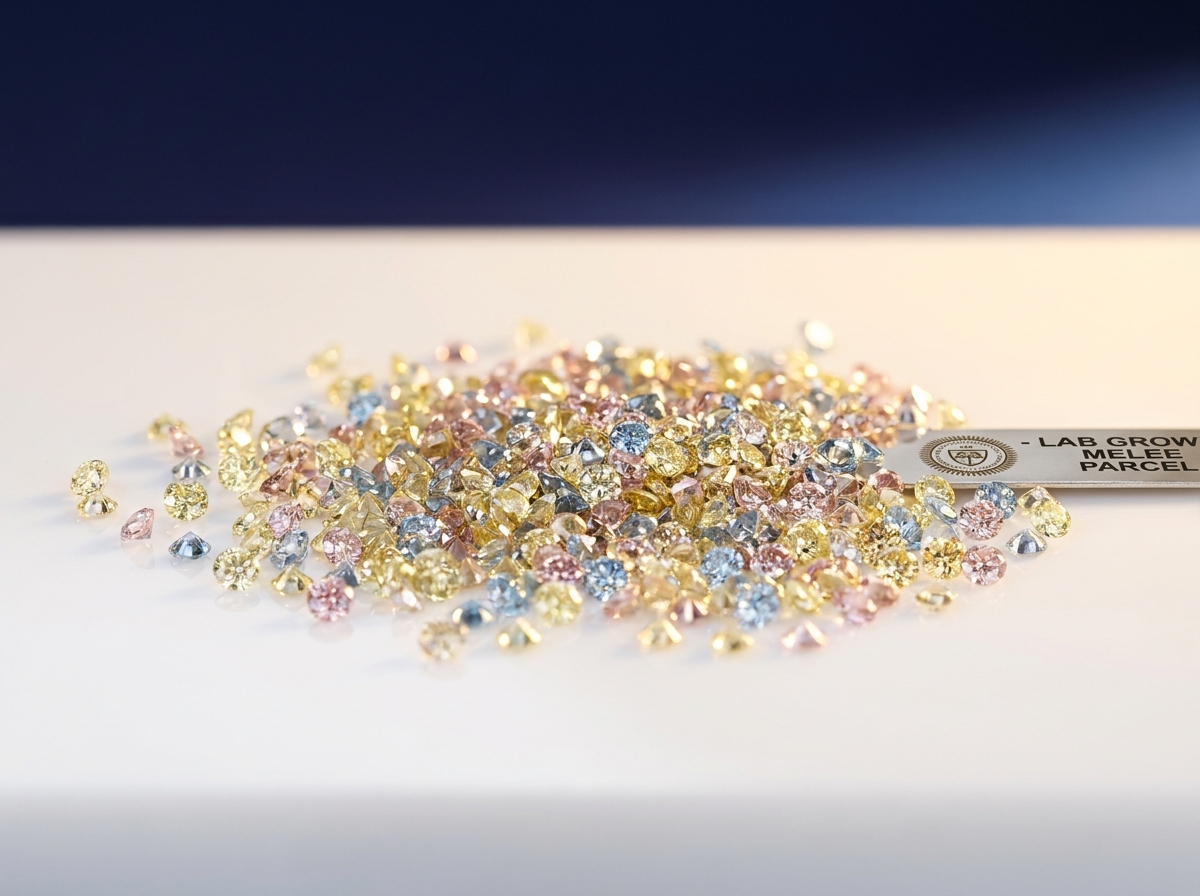
Fancy color round melee is calibrated round lab-grown diamond accent stones cut in an intentional hue — Yellow, Pink, Blue, or Green — sold by millimeter size group and color range for pavé, halo, and accent work, rather than as individually graded singles. It's the highest-volume shape in Guru Diam's fancy color melee category, with roughly 2,010 carats on hand across Yellow, Pink, and Blue, calibrated from 0.80mm micro-pavé up through 6.30mm.
What is fancy color round melee?
Fancy color round melee is the round-cut branch of Guru Diam's calibrated fancy color parcel program: round brilliant lab-grown diamonds grown and cut with an intentional hue, then sorted and sold by millimeter diameter and color range rather than certified and priced as one-off stones. That sorting logic is what separates melee from every other tier in the catalog. A certified fancy color loose stone — the 0.30ct-and-up tier — is graded, papered, and priced as an individual gem with its own report number. Fancy color round melee is priced and shipped as a group: a jeweler orders "1.4mm Pink" the same way they'd order a length of chain by the foot, specifying a size and a color range rather than picking a single stone off a tray.
Round holds that logic together better than any other shape because millimeter diameter maps to carat weight in a way that's predictable and repeatable. A cutter or setter can specify "1.3mm rounds" and know almost exactly what drops into the parcel, without measuring each stone individually the way a fancy-shape parcel sometimes requires. Fancy color doesn't change that math — it just adds a color-range spec on top of the size spec, which is why round is the shape most fancy color melee programs, Guru Diam's included, are built around first.
Melee vs. pavé: is it the same thing?
The terms get used almost interchangeably in casual trade conversation, but they describe two different layers of the same supply chain. Melee is the product — small calibrated diamonds, typically under about 0.20ct per stone, sold as parcel goods rather than certified singles. Pavé is a setting technique — small stones set close together with minimal visible metal between them, so the surface reads as a continuous field of light rather than individual prongs. Melee is what you buy; pavé is one of several things you can do with it once you've bought it.
The confusion is understandable because melee and pavé show up together so often that they've become shorthand for each other on a sales floor. But melee also goes into halos, channel settings, bridge/cathedral shoulders, and eternity bands — none of which are pavé in the strict sense — and pavé fields are occasionally built from stones slightly larger than what most wholesalers classify as melee. Knowing the distinction matters at the ordering stage: a buyer asking for "pavé diamonds" without specifying millimeter size and color range is really asking for melee, and a wholesaler who understands that shorthand can turn a vague request into an accurate parcel order faster.
Why round carries the deepest bench in fancy color melee
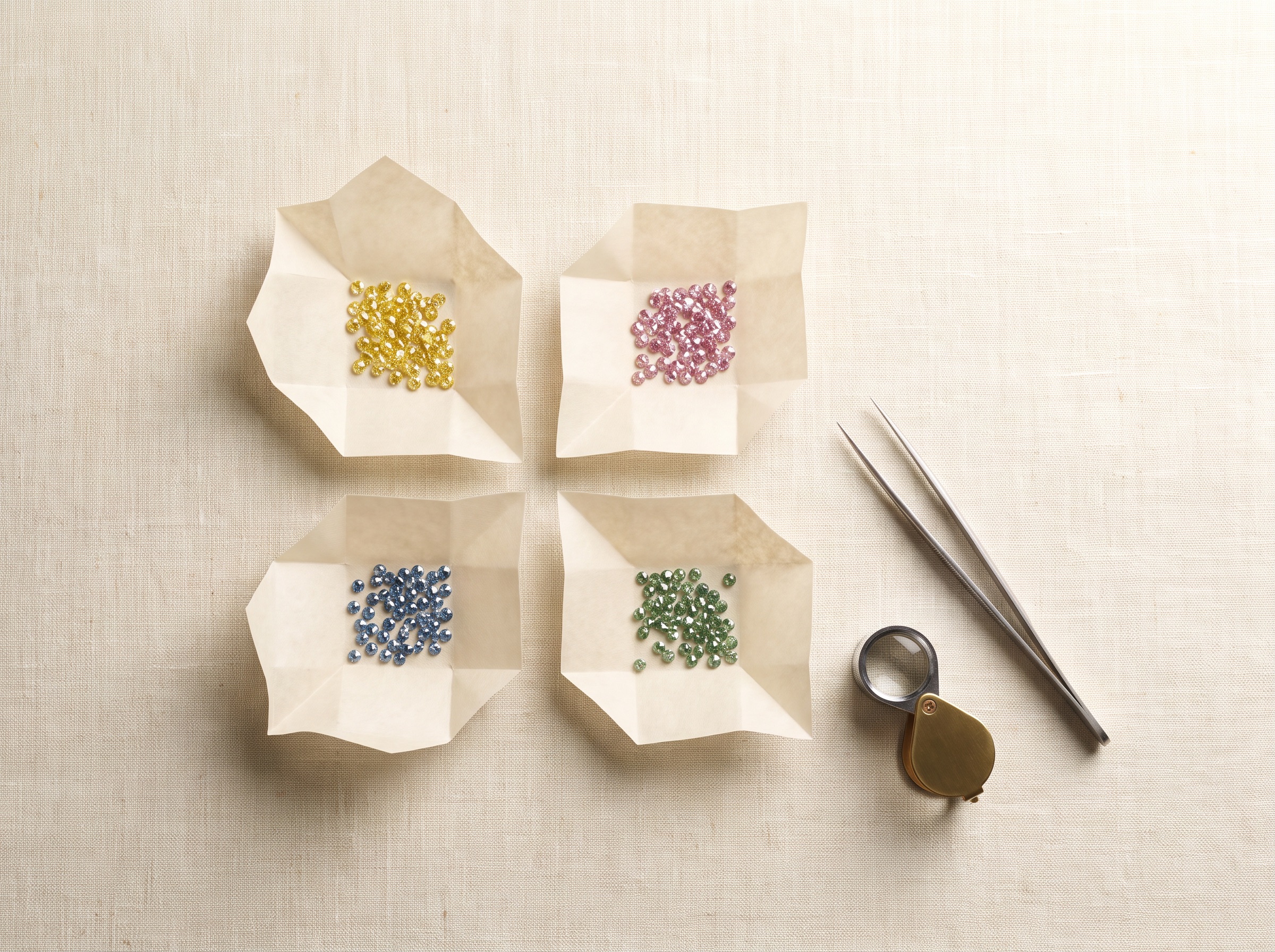
Round is the highest-volume shape across both colorless and fancy color melee work — pavé fields and halos are built almost entirely from round accents — which is also why it's the shape Guru Diam holds the deepest standing inventory in: roughly 2,010 carats across Yellow, Pink, and Blue as of this writing.
That depth matters specifically for fancy color, in a way it doesn't quite matter the same way for white melee. A pavé field or halo needs a large enough pool of matched stones in one hue to fill a run without drifting in tone from one end of the piece to the other — the eye catches a shade shift in a color pavé field far faster than it catches a slight clarity variance in a white one. A shallow bench forces a buyer to either accept a visible tone shift partway through a piece or wait on a fresh cutting run to fill out the parcel. Round is the shape where that risk is lowest at Guru Diam, because the standing parcel is deep enough to pull a full, tone-matched run for most jobs directly from stock, without routing the order to made-to-order cutting.
Guru Diam's broader melee program isn't limited to round — the same Yellow, Pink, Blue, and Green color range is also cut in fancy calibrated shapes (Emerald, Oval, Pear, Marquise, and other calibrated shapes on request) for buyers building a piece where round accents alone won't carry the design. Round simply carries the deepest and most consistently available bench of the group, which is why it's usually the first call for a pavé or halo job and the shape most buyers default to unless the design specifically calls for something else.
How Guru Diam sources and matches fancy color round melee
Fancy color melee starts as a different production problem than white melee. A colorless CVD run is graded on how close it comes to neutral — the goal is the absence of color. A fancy color run is graded on how consistently it hits and holds a target hue, tone, and saturation across every stone in the batch. That's a harder target to hit at volume, which is part of why fancy color melee commands a premium over equivalent-size white melee even before certification or clarity enter the conversation.
Color and hue sorting
Once a batch is cut, stones are sorted into color-range groups rather than individual grades. A "Pink" parcel isn't one uniform shade — it's a band of acceptable variation, tight enough that a full pavé run reads as a single consistent color to the eye, but wide enough that sorting stays efficient at parcel volume. Guru Diam's in-house sorting runs this by visual comparison against reference masters under controlled lighting, grouping stones into the size and color-range buckets that become sellable parcels. Yellow, Pink, and Blue are cut and sorted in the highest volume, which is why those three colors carry the deepest standing stock; Green runs thinner because fancy-saturated green CVD rough is more limited, so Green parcels are more often built to order than pulled complete from a shelf.
Matching to a center stone vs. a self-consistent field
Guru Diam sorts fancy color round melee orders two ways, and it's worth specifying which one a job needs before the parcel is pulled. A self-consistent field — the more common request — just needs every stone in the parcel to read as one uniform color against every other stone in that same parcel; it doesn't need to match anything outside the order. A center-stone match is a tighter ask: the melee needs to read as the same hue family as a specific fancy color center stone, which sometimes means pulling from a narrower band within the color-range group, or in some cases pairing melee with a fancy color center that's a shade off rather than forcing an exact match that isn't available in current stock. Buyers matching melee to a specific center stone should say so at the order stage — it changes which stones in the parcel are eligible and can affect both lead time and price.
Quality and consistency: how fancy color round melee is graded
This is the point where fancy color melee diverges most from white melee, and it's worth being explicit about the difference because the two get lumped together in casual trade conversation more than they should be.
Color first, not the DEF+/VS+ grid
Guru Diam's standard round and fancy-shape white melee is QC'd against a DEF+/VS+ baseline — near-colorless and eye-clean, judged on the same color-then-clarity grid used for certified stones, just applied at parcel scale instead of stone-by-stone. Fancy color melee doesn't run on that grid, because color isn't a defect to minimize — it's the entire point of the product. Fancy color round melee is graded and grouped primarily by hue accuracy, tone depth, and saturation consistency across the parcel: does the stone hit the target color, and does it match the rest of the batch closely enough that a finished pavé field or halo reads as one continuous shade. A stone that would fail a colorless-grid inspection for having "too much color" is exactly the stone the fancy color program is built around.
Clarity still has a floor
Color leads the grading, but clarity isn't ignored — it just isn't held to the same DEF+/VS+ standard used for white melee. Fancy color round melee is checked for eye-clean performance face-up: no inclusions dark or large enough to break the color field or catch the eye at normal viewing distance once the stone is set. That's a functional clarity floor rather than a formal clarity grade, and it's set that way deliberately — pinning fancy color melee to the same clarity floor as white melee would shrink the usable rough pool without improving how the finished piece actually looks, since a fancy color stone's saturation does more to hide minor inclusions than a colorless stone's transparency does.
What this means for a buyer comparing quotes
A wholesaler quoting fancy color melee against a DEF+/VS+-style spec sheet is either quoting white melee by mistake or overstating what the parcel was actually graded against. The right question to ask a supplier isn't "what clarity grade is this melee" — it's "how tight is the color-range band, and how was the parcel matched." That's the spec that actually determines whether a pavé field or halo will look uniform once it's set.
Fancy color round melee size and availability
| Diameter (mm) | Approx. weight per stone (ct) | Typical use | On-hand color depth |
|---|---|---|---|
| 0.80–1.20 | 0.0025–0.010 | Micro-pavé | Yellow, Pink, Blue deepest |
| 1.30–1.80 | 0.010–0.025 | Pavé, halo | Yellow, Pink, Blue deepest |
| 1.90–2.50 | 0.030–0.060 | Halo, eternity band | Yellow, Pink, Blue deepest |
| 2.60–3.50 | 0.060–0.115 | Eternity band, side accents | Yellow, Pink deepest; Blue/Green thinner |
| 4.00–6.30 | 0.20+ | Larger calibrated goods, channel work | Made-to-order more common above 4.00mm |
Weights are approximate and vary slightly with cut proportions; confirm exact calibration against your seats before cutting a mounting to fit. Color availability on hand runs Yellow, Pink, and Blue; Green round melee is thinner on the shelf given how limited fancy-saturated green rough is, and it's typically sourced through made-to-order cutting. Guru Diam's broader melee program spans 0.8mm to 9.0mm across the full catalog, but for round fancy color specifically, standing stock currently tops out around 6.30mm — larger calibrated sizes and anything at parcel depth above that range moves into made-to-order territory or, more often, into the certified 0.30ct+ loose-stone tier instead of melee.
One practical note for buyers new to ordering by millimeter rather than carat: always order a small overage against the exact carat total a piece requires. Setting loss — stones dropped, damaged, or set aside during the mounting process — typically runs a few percent on a pavé or halo job, and a parcel ordered to the exact gram-for-gram total often comes up short once the setter is midway through the piece.
Pricing factors that move fancy color round melee wholesale cost
- Color rarity — Yellow, Pink, and Blue are the deepest-stocked colors and price accordingly closer to standing-inventory rates; Green commands a premium tied to rough scarcity and the higher share of made-to-order cutting it requires.
- Saturation and tone depth — a deeper, more saturated hue within any of the four colors generally costs more than a lighter tone in the same size, mirroring how saturation drives price on certified fancy color stones at any carat weight.
- Millimeter size — larger calibrated sizes cost more per carat than micro-pavé sizes, both because larger fancy-color rough is scarcer and because sorting a tight color-range band gets harder to fill as stone size increases.
- Matching depth required — a self-consistent field parcel prices differently than a tight center-stone match, since a narrow-band match pulls from a smaller share of available stock and can add lead time.
- Parcel size (total carats or piece count) — larger orders sometimes see better per-carat pricing when they can be filled from standing stock, but very large color-matched orders that require made-to-order cutting price closer to a custom run than a stock pull.
- Stock vs. made-to-order — in-stock parcels price and ship faster; made-to-order calibration cutting for sizes or color depths outside current stock adds production time and is quoted as its own line, not blended into the standing-stock rate.
None of this makes fancy color melee inherently unpredictable to price — it means the quote is more sensitive to color and matching specs than a white melee quote is to clarity specs, so two "Pink 1.4mm" quotes from different sources aren't necessarily comparable unless both suppliers are matching against the same tone-depth expectation.
Styling and use-case guidance: pavé, halo, and accent work
Pavé fields
Pavé is where fancy color round melee does its heaviest lifting — a continuous field of color reads as a single design statement rather than a scatter of individual stones, which is exactly why tone consistency across the parcel matters more here than in almost any other setting. A shade shift that would be invisible on a single accent stone becomes obvious across a pavé band, which is the core argument for buying deep-bench colors (Yellow, Pink, Blue) for large-format pavé work and reserving thinner-stocked Green for smaller accent placements where a shift is less visually consequential.
Halo settings
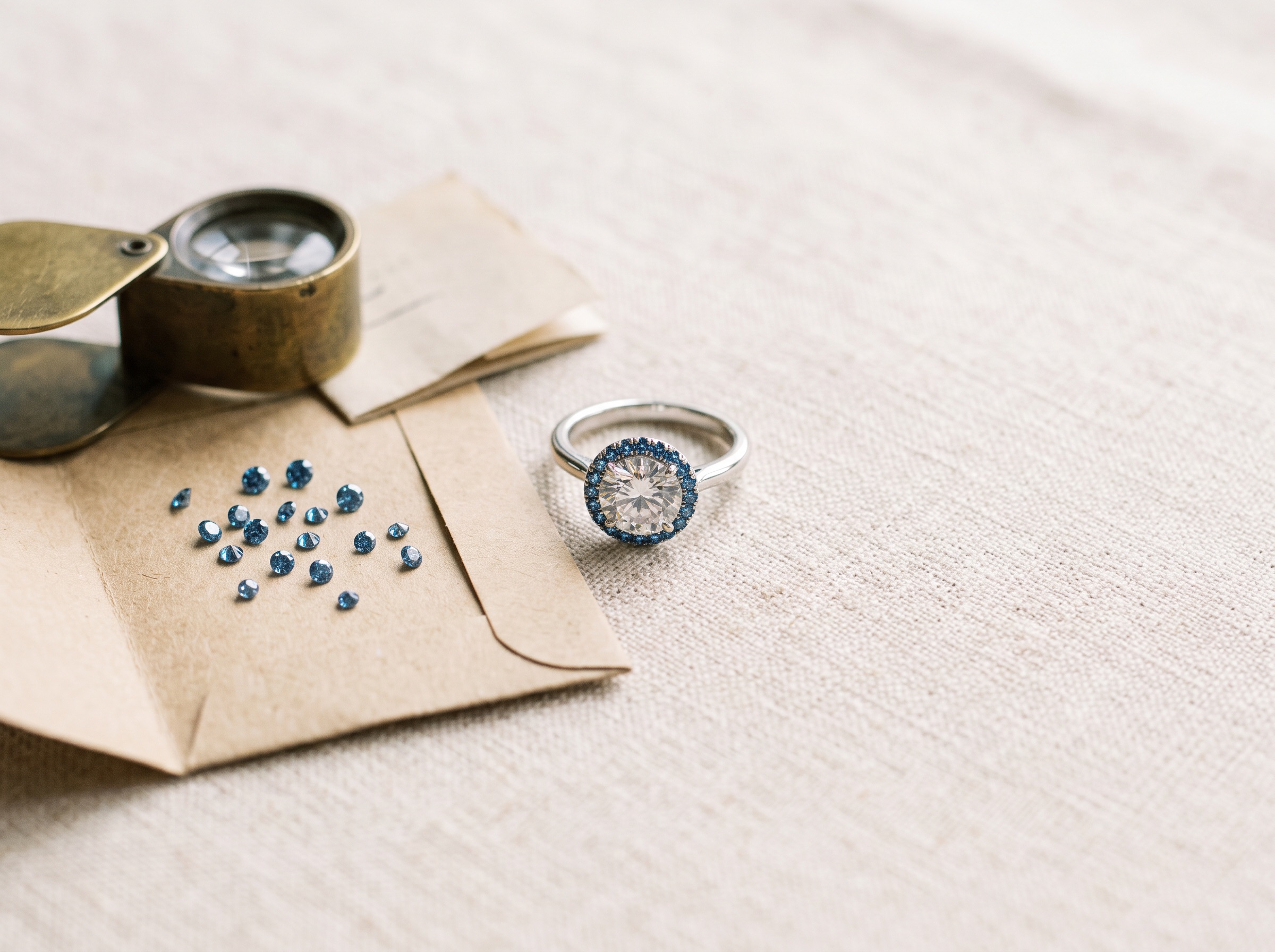
A fancy color halo puts melee in direct visual conversation with a center stone, whether that center is a certified fancy color diamond in the same hue family or a contrasting white center meant to make the color halo pop. Halo work generally needs a tighter color-range band than a pavé field spread across a wider surface, because the eye compares halo stones against each other in a tight circular arrangement where inconsistency is easy to spot.
Channel and accent work
Channel settings and smaller accent placements — shoulders, bridges, side stones flanking a center — are more forgiving on exact color-range width than pavé or halo, since fewer stones sit in direct visual comparison with each other at once. This is often where Green and other thinner-stocked colors get used most efficiently: a shoulder accent needs a handful of matched stones, not the deep parcel a full pavé field requires.
Mixing colors in one piece
Multi-color fancy melee pieces — a rainbow pavé band or a piece mixing Yellow and Pink accents by design — are increasingly common on custom builds. These orders benefit from specifying each color's millimeter size and quantity separately up front, since a mixed-color parcel is really several single-color parcels pulled and matched in parallel, not one blended order.
Fancy color round melee vs. certified fancy color loose stones
| Spec | Fancy color round melee | Certified fancy color loose (0.30ct+) |
|---|---|---|
| Size range | 0.80mm–6.30mm (approx. 0.0025–0.20ct+) | 0.30ct and up |
| Sold as | Calibrated parcel by MM size and color range | Individually graded single stone |
| Certification | Uncertified — QC'd in-house against color/tone consistency | IGI, GIA, or GCAL certified |
| Primary grading criteria | Hue accuracy, tone depth, saturation match across parcel | Color, clarity, cut, carat — full 4Cs on the report |
| Typical use | Pavé, halo, channel, accent work | Center stones, statement pieces, standalone sales |
| Colors available | Yellow, Pink, Blue, Green | Yellow, Pink, Blue, Green |
The two tiers aren't competing products — they're built for different jobs in the same piece. A jeweler building a fancy color halo ring typically needs both: a certified fancy color center stone with its own report, and a parcel of fancy color round melee to fill the halo or shoulders around it. Ordering both from the same source removes a step, since the melee can be pulled and color-matched against the actual center stone rather than matched blind against a written color description.
Sourcing fancy color round melee wholesale
Guru Diam sources fancy color round melee as wholesale, trade-only inventory — no retail markup — from the New York Diamond District desk (36 West 47th Street, Suite 601A, New York, NY 10036) and the Los Angeles office (607 South Hill Street, Suite 241, Los Angeles, CA 90014). In-stock parcels ship same-day from New York before the 6pm EST cutoff, or from Los Angeles before the 4pm PST cutoff.
Round melee is not individually or parcel-certified — it's CVD-grown and cut in-house, then QC'd against the color-consistency and clarity standard described above rather than issued a certificate. For buyers who need a certified fancy color stone, Guru Diam's 0.30ct+ loose fancy color inventory carries individual IGI, GIA, or GCAL certification instead of the parcel QC melee uses — that's a separate tier of the catalog, not an upgrade path on the melee itself. For a size or color depth outside current stock, made-to-order calibration cutting is a direct conversation with the cutting floor rather than a separate outside order.
How to order fancy color round melee wholesale from Guru Diam
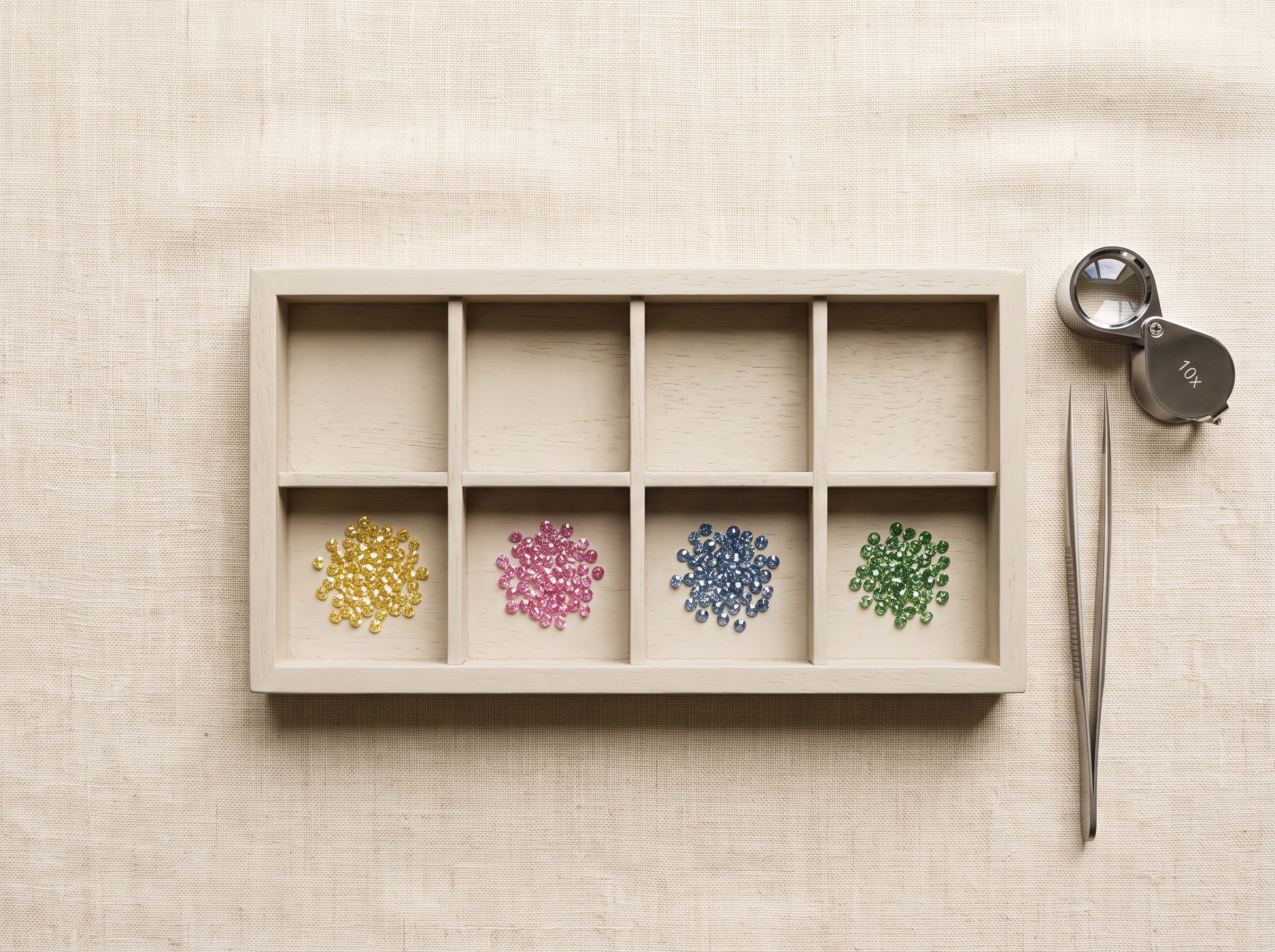
A complete fancy color round melee order specifies four things: the millimeter size group, the color (Yellow, Pink, Blue, or Green), the matching intent (self-consistent field vs. matched to a specific center stone), and the total carat weight or piece count needed — ideally with a small overage built in to cover setting loss. Buyers who send those four specs get an accurate quote and lead time on the first pass, rather than a round of back-and-forth to pin down what's actually needed.
Guru Diam supports 2,000+ active trade accounts across antique cuts, fancy shapes, fancy color melee, and custom jewelry — fancy color round melee is quoted and fulfilled through the same account, catalog, and gemologist support as the rest of the inventory, not a separate request process. For a job that pairs melee with a finished piece — a fancy color pavé band or halo ring built to order — the melee itself ships as on-hand inventory, while the finished custom piece (CAD to completed ring) typically turns in 4–6 days once the design is approved.
Ready to buy? Open a verified wholesale account at /signup and book time with a gemologist at /book-appointment.
Frequently Asked Questions
What is fancy color round melee? Round-cut lab-grown diamond accent stones cut in an intentional hue — Yellow, Pink, Blue, or Green — sold as a calibrated parcel specified by millimeter diameter and color range, used for pavé, halo, and accent work. It is not individually certified.
Is fancy color round melee the same as pavé diamonds? Not exactly. Melee is the product — small calibrated diamonds sold as parcel goods; pavé is a setting technique that uses melee, along with halos, channel settings, and eternity bands. Melee is what you buy, pavé is one of several things you can build with it.
Why is round the highest-volume fancy color melee shape? Millimeter diameter maps predictably to weight, making round the easiest shape to calibrate and set consistently, and pavé fields and halos are built almost entirely from round accents. It's also the shape with the deepest standing bench — about 2,010 carats on hand at Guru Diam across Yellow, Pink, and Blue.
What colors are available in fancy color round melee? Yellow, Pink, Blue, and Green. Yellow, Pink, and Blue carry the deepest on-hand stock; Green is available but thinner on the shelf and typically sourced through made-to-order calibration cutting.
Is fancy color round melee certified? No. It's CVD-grown and cut in-house, then QC'd in-house against a color-consistency and clarity baseline rather than certified individually or at the parcel level. Certified fancy color diamonds start at 0.30ct as individually graded loose stones through IGI, GIA, or GCAL.
How do I order fancy color round melee wholesale? Specify the millimeter size group, the color, the matching intent (self-consistent field vs. matched to a specific center stone), and the total carat or piece count needed to cover the piece plus a small overage for setting loss.