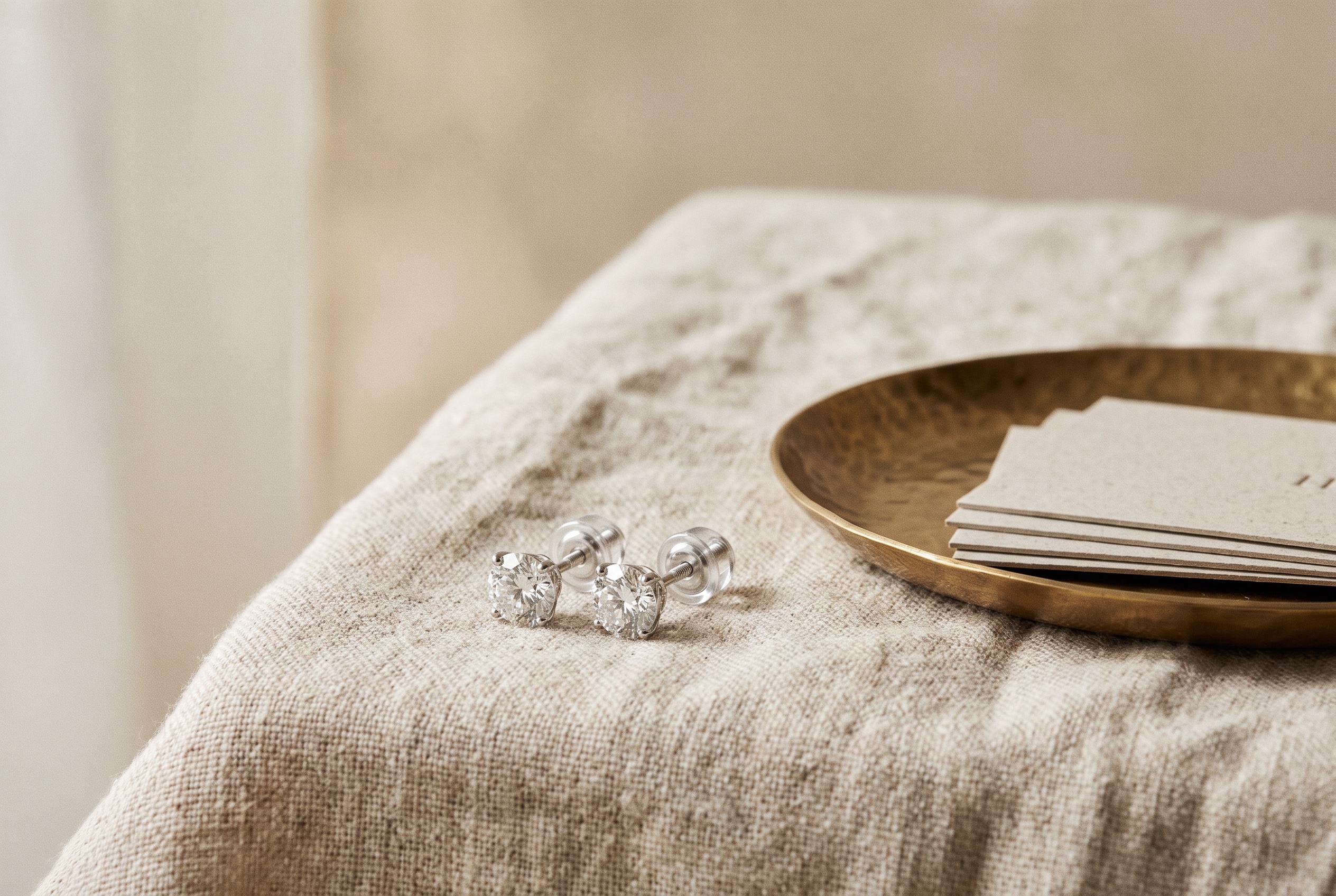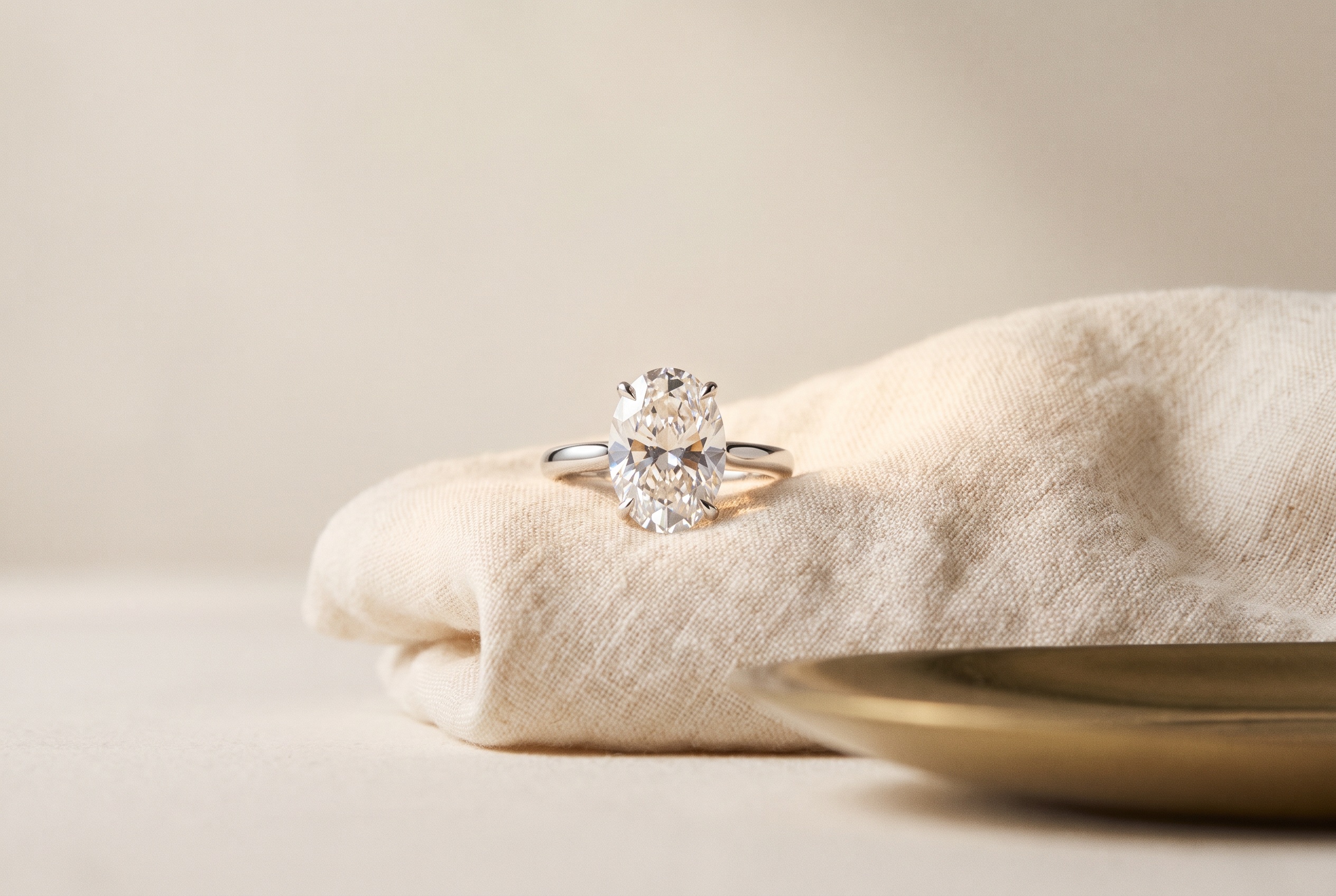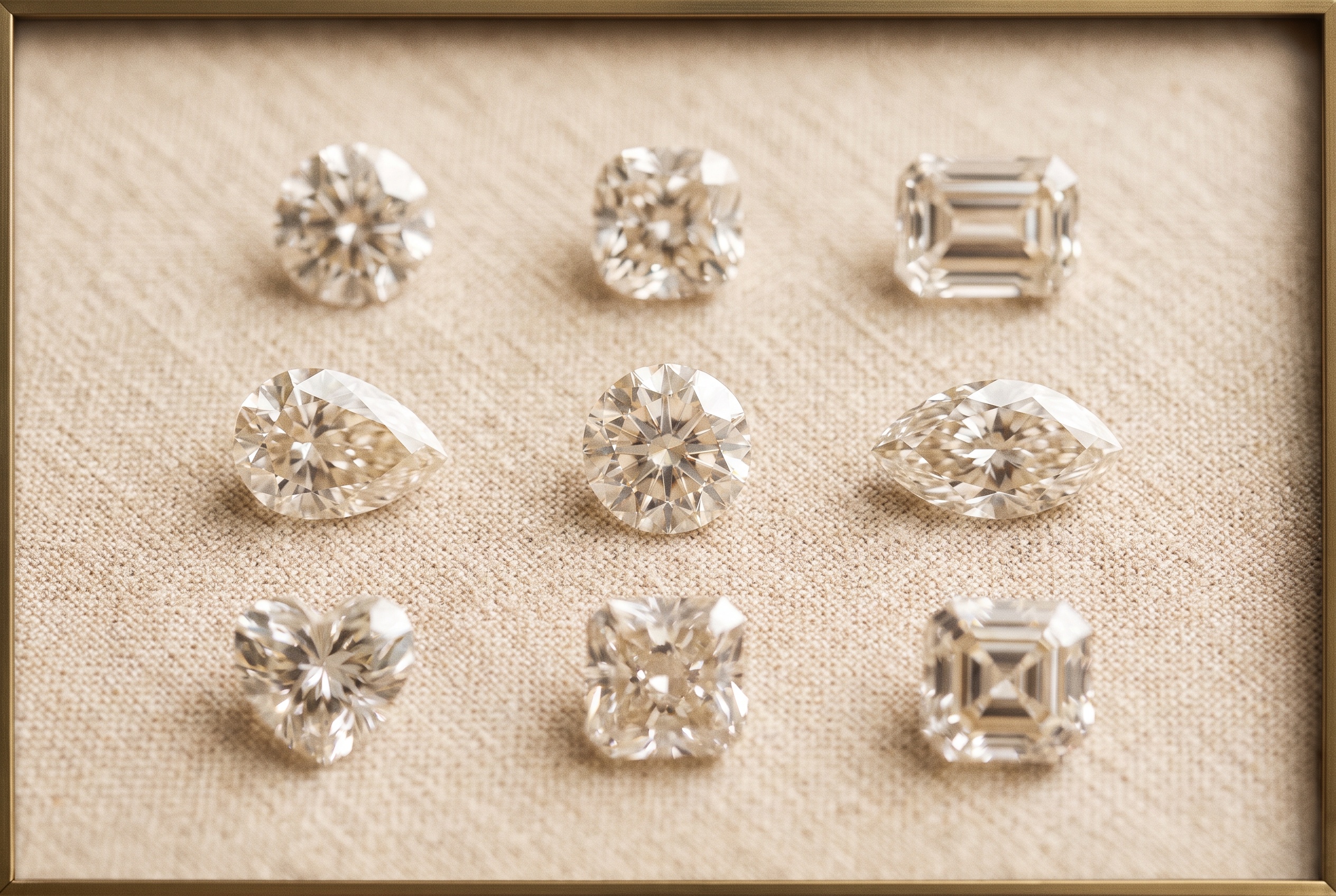

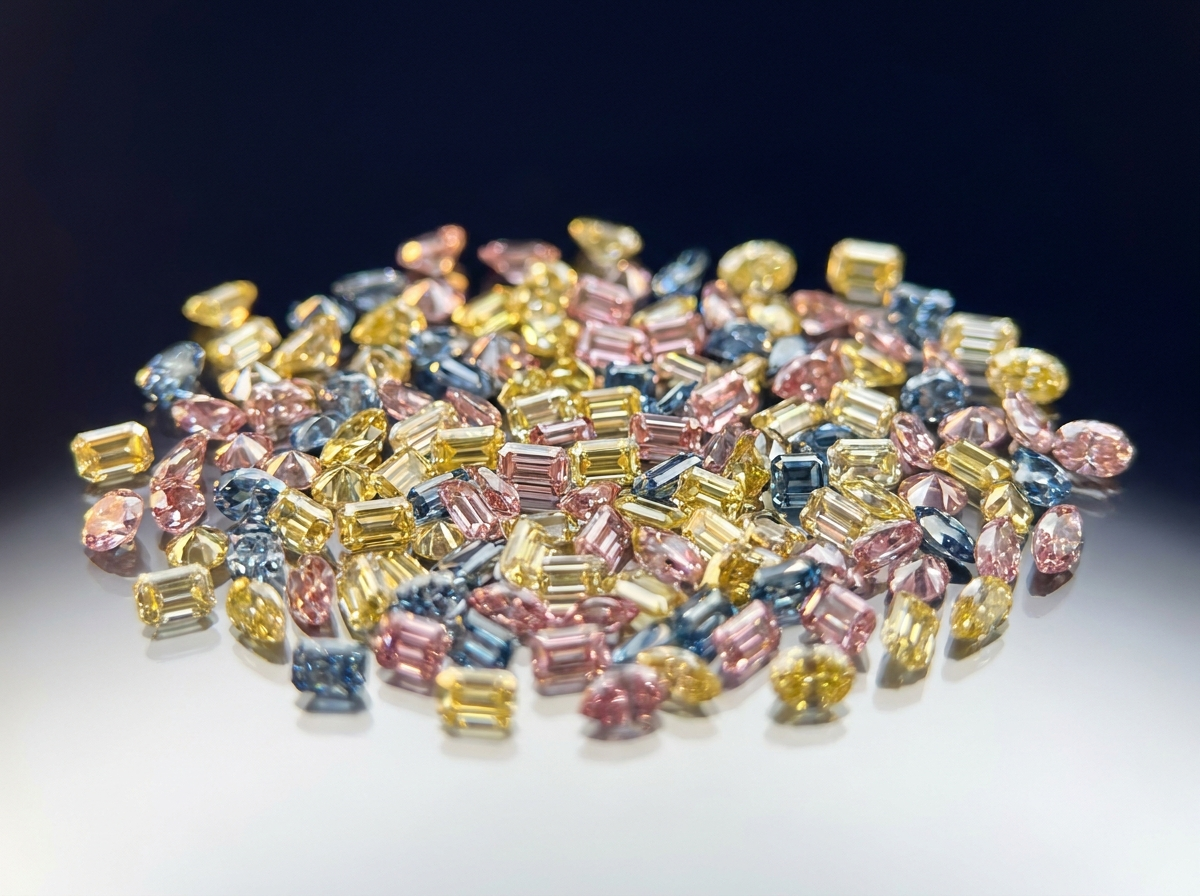
Fancy color fancy-shape melee is calibrated lab-grown diamond accent stones cut in Emerald, Oval, Pear, or Marquise outlines and an intentional hue, sold by length-×-width size range and color range — distinct from round pavé work, used for statement eternity bands and color-blocked designs. Guru Diam holds roughly 3,300 carats on hand across these four shapes, concentrated in Yellow, Pink, and Blue.
Round carries the volume in fancy color melee (see our fancy color round melee guide), but round isn't the right call for every design. A tapered eternity band that needs to read as a continuous line of color, or a piece that blocks two hues against each other in clean geometric sections, needs a shape with a real footprint — Emerald, Oval, Pear, or Marquise — not a field of small round dots. This page covers those four fancy-shape melee options in color: what they are, how Guru Diam sources and grades them as parcel goods, what drives price, how to style them, and how they compare to round melee and to certified fancy color loose stones.
What is fancy color fancy-shape melee?
It's calibrated parcel goods in Emerald, Oval, Pear, or Marquise outlines, cut in an intentional hue and specified by length × width — not a single MM diameter, since a fancy shape's footprint, not one dimension, determines the seat — plus a color range. Like all melee, it's sold as sorted parcel goods, not individually certified stones. That's the line between this category and Guru Diam's certified fancy color singles guides for these same shapes.
Every stone in the category is lab-grown via CVD, cut and finished in-house, and held to the same working baseline Guru Diam applies across its melee program: a defined color range per parcel and a clarity floor that keeps the run eye-clean once set close together. Sizes span the full melee window, roughly 0.8mm to 9.0mm on the longest dimension depending on shape, though most eternity-band and halo work draws from a narrower slice. Jewelers buying for a specific ring size or halo count should expect to work within a length × width band rather than a single stated size.
Why fancy-shape color melee is a different buying motion than round pavé
Fancy-shape melee is chosen when the design needs the stone's outline to do visible work — a continuous emerald-cut line down an eternity band, a graduated run of pear or marquise accents, a color-blocked section built from a shape with real geometry — rather than the uniform sparkle field a round pavé produces.
Each shape reads differently set in a run. Emerald's step-cut faceting shows fancy color as a broad, even wash across each stone — the same effect that makes emerald-cut fancy color singles a deliberate choice over brilliant cuts — and set in a line, that translates to a band reading as a continuous ribbon of color. Marquise and Pear, with their pointed ends, are the classic shapes for a graduated or tapered eternity line. Oval splits the difference: brilliant faceting like round, but an elongated footprint that covers more visible surface per stone, useful when a design wants color coverage without the stone count a round pavé would need.
The buying motion follows from that difference. Round pavé is typically bought by total carat weight against a single MM size, because every stone in a size is interchangeable. Fancy-shape melee is bought by shape, length × width, and color range, because the outline and proportion of each stone matter to how the finished piece reads — a setter needs a run where the stones graduate consistently or hold a stated length end to end, not just a bag of loose carat weight in the right hue.
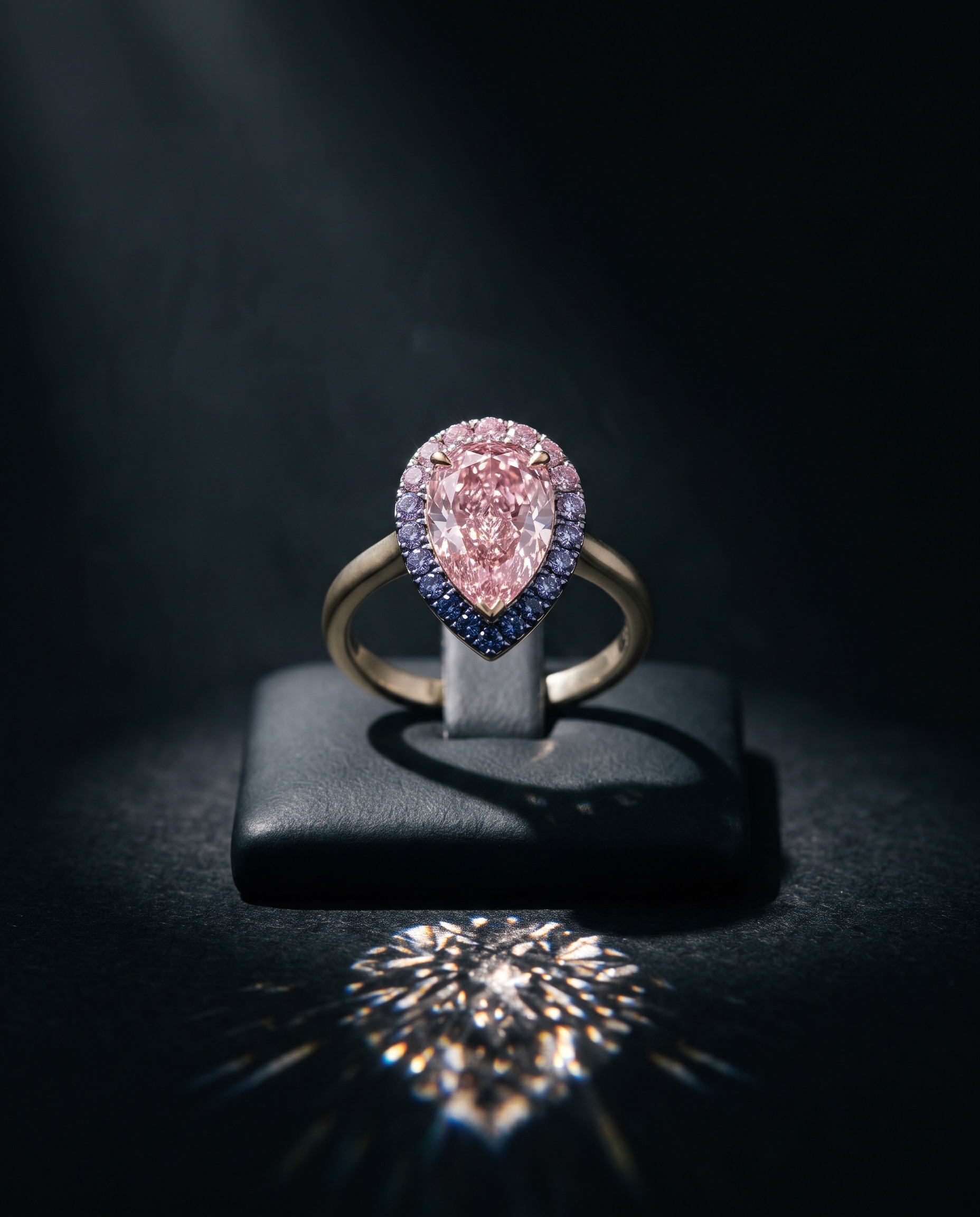
How Guru Diam sources and cuts fancy color fancy-shape melee
Fancy color fancy-shape melee starts as rough selected specifically for color potential, then gets cut and polished in-house to the target shape and hue. Because fancy-shape outlines carry less weight-retention margin than round brilliant — a marquise or pear point is unforgiving of a miscut angle — the cutting sequence is planned around the finished outline first, color intensity second, and yield third. That ordering is part of why fancy-shape parcels run thinner than round pavé in the same color: more of the rough gets rejected or redirected to a different shape before it reaches finished melee.
Guru Diam cuts and finishes this category in-house rather than buying pre-cut parcels from a jobber, which is what makes made-to-order calibration cutting possible for shapes, colors, or size runs outside standing stock — a large custom run gets planned and cut against the specific length × width and color range a project needs, rather than pulled from whatever happens to be on the shelf. Standing stock covers the combinations with reliable repeat demand (see the on-hand table below); everything else quotes against a cutting run planned with the order.
Sorting happens after cutting, not before: shape, then length × width band, then color range — so a parcel quoted at a stated size and hue holds that specification across every stone in it, not an average across a wider spread. That's what separates a usable wholesale parcel from a mixed lot a jeweler would otherwise have to re-sort on arrival.
Color, clarity, and matching: how parcel goods get graded in-house
Fancy color fancy-shape melee is not individually or parcel-certified — it ships as uncertified parcel goods, graded and matched in-house against a working color and clarity baseline rather than a third-party lab report. That's the structural difference from Guru Diam's certified fancy color loose stones at 0.30ct and up, which carry individual IGI, GIA, or GCAL paperwork. Melee, across the trade generally, doesn't get graded that way — the stones are too small and too numerous for per-stone certification to make economic sense, and the category is built around consistency across a parcel rather than a report on any single stone.
In practice, that means the in-house grading step does the job a lab report would do on a single stone: holding a defined color range and a clarity floor consistently across every stone in a lot. Fancy-shape grading also has to account for how faceting affects apparent color — an emerald cut shows color as a flat, even field, while a pear or marquise's pointed brilliance can concentrate or wash out color unevenly near the tip if the cutting angle runs off. Sorting by shape before sorting by color controls for that.
Matching intent is specified at order time, and it changes how a parcel gets pulled. A parcel can be sorted as a self-consistent field — every stone reading the same hue against every other, which is what a continuous eternity line needs — or matched in tone to a specific center stone, the more common ask when fancy-shape melee frames a fancy color center. State which one the project needs when requesting a quote; the two are pulled from different parts of the sorted inventory even within the same shape and color category.
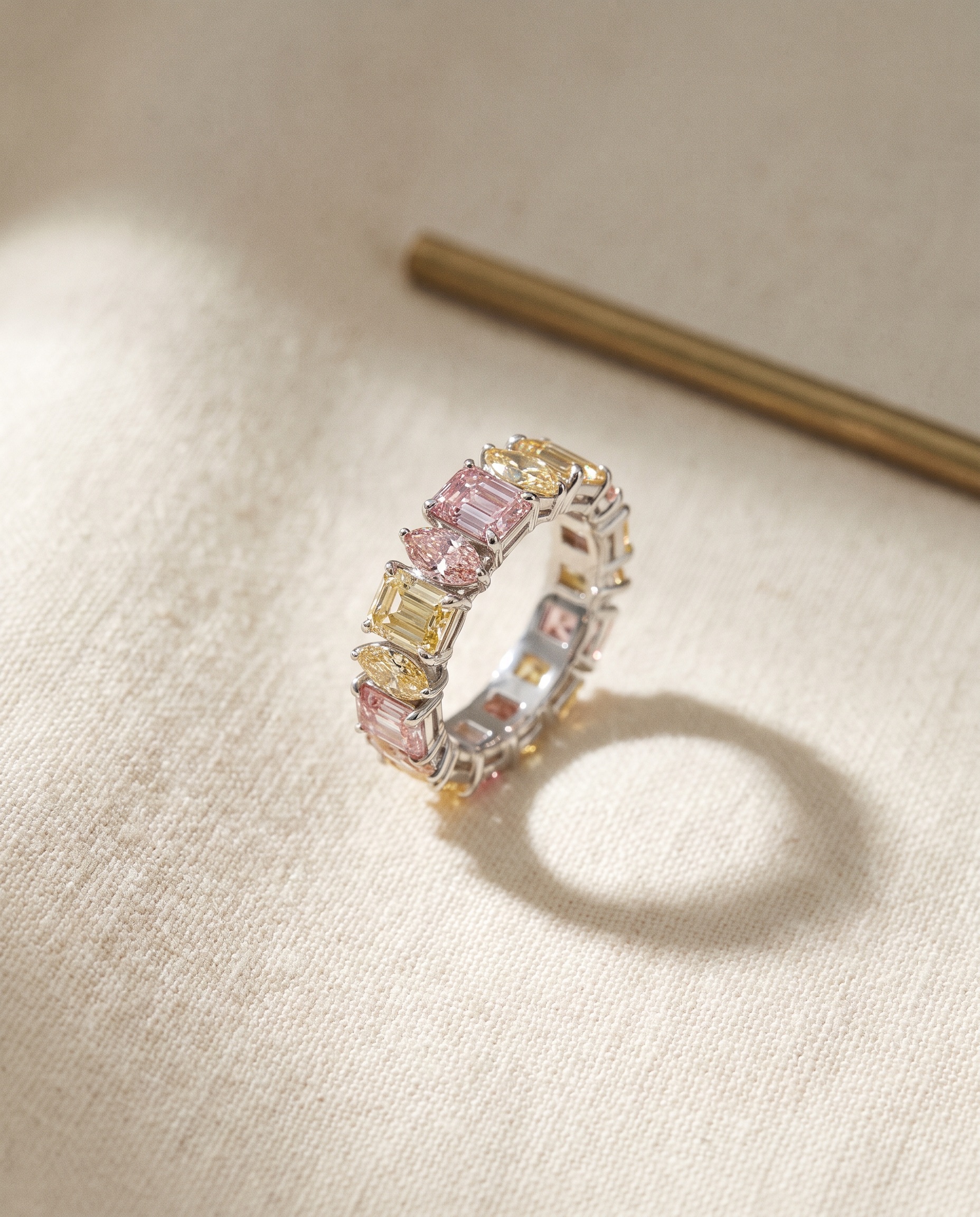
Quality and consistency: what to check before committing to a parcel
Parcel goods live or die on consistency, and fancy-shape color melee has more variables to hold steady than round: outline, length-to-width ratio, color depth, and clarity all have to track together across every stone in a run. A few things are worth confirming before committing to a large parcel.
Outline consistency. A stone that runs a fraction wider or narrower than its stated length × width sits visibly out of line in a channel or eternity setting, in a way a round stone's diameter tolerance doesn't expose. Ask what length-to-width ratio a parcel is held to, especially for marquise and pear, where the point angle is as visually load-bearing as the overall size.
Color depth across the run, not just the average. A parcel described as "Pink" can still carry real variation between its lightest and deepest stones. For a continuous line — an eternity band, a channel — that variation shows up as banding once set. For a scattered accent or halo, more variation is often invisible, and sometimes even preferred for a natural-feeling spread. Specify which effect the project actually needs.
Clarity under close setting. Melee gets set tight, often prong-to-prong or channel-set with minimal metal between stones, so inclusions invisible in a loose stone can show once the piece is finished and worn at typical viewing distance. The color-and-clarity baseline Guru Diam holds for CVD melee is built around that standard — eye-clean at the distance the finished piece is actually seen, not just under a loupe.
Depth of the specific shape and color combination. Not every shape carries equal stock in every color. Pear and Oval currently run deeper than Marquise and Emerald, and a less common combination — a large Marquise run in Blue, say — can be thinner even when the shape and color both show as on hand individually. Check current stock before locking a large custom run's cutting schedule, particularly for a pairing outside the deepest categories.
Fancy color fancy-shape melee: what's on hand
| Shape | On-hand (approx. ct) | Colors on hand | Typical use |
|---|---|---|---|
| Pear | 1,355 | Yellow, Pink, Blue | Graduated eternity lines, halos |
| Oval | 1,255 | Yellow, Pink, Blue | Eternity bands, halo accents |
| Marquise | 515 | Yellow, Pink, Blue | Tapered eternity, channel work |
| Emerald | 175 | Yellow, Pink, Blue | Step-cut eternity lines, channel work |
Pear and Oval carry the deepest bench of the four, with real depth across multiple length-×-width size groups in each color; Marquise and Emerald are real but thinner categories, worth checking current stock early for a large run. Green is available across all four shapes through made-to-order calibration cutting rather than standing stock — quote it against a planned cutting run rather than expecting it on the shelf alongside Yellow, Pink, and Blue.
What drives price in fancy color fancy-shape melee
Price in this category is set by the same core levers as any calibrated fancy color melee, with fancy-shape cutting adding one more variable on top.
Color and saturation. Deeper, more saturated hues cost more per carat than lighter tones in the same color family, largely because they require rough with stronger color potential and carry a lower yield of finished stones that hit the target depth consistently. Blue and Pink generally run at a premium over lighter Yellow at comparable depth, and Green — made-to-order across all four shapes — prices against its own cutting run rather than standing-stock economics.
Shape and cutting yield. Fancy-shape melee costs more per carat than round in the same color and size range, because fancy outlines retain less rough weight and demand more precise cutting to avoid a visible outline flaw. Within the fancy shapes, Marquise and Pear — with a pointed end that's unforgiving of a miscut angle — typically run a step above Emerald and Oval, whose outlines carry more tolerance for minor variation before it reads as a flaw.
Size band. Larger length × width stones within the melee range cost more per carat than smaller ones in the same shape and color, following the same accelerating curve that governs melee pricing generally.
Standing stock vs. made-to-order. A combination held in standing stock prices against current inventory and ships against that stock. A combination that requires made-to-order calibration cutting — Green in any shape, or a size/color pairing outside current depth — prices against a cutting run planned for that order, a different cost structure than pulling from a shelf.
Matching requirement. A parcel matched in tone to a specific center stone, or held to a tighter length-to-width tolerance than the standard sort, costs more to assemble than a self-consistent field, since more of the cut inventory has to be set aside during sorting to find stones that clear the tighter bar.
Request a quote against the specific shape, length × width, color, and matching intent a project needs — pricing on fancy-shape color melee varies enough by combination that a general per-carat figure isn't a useful starting point without those specifics.
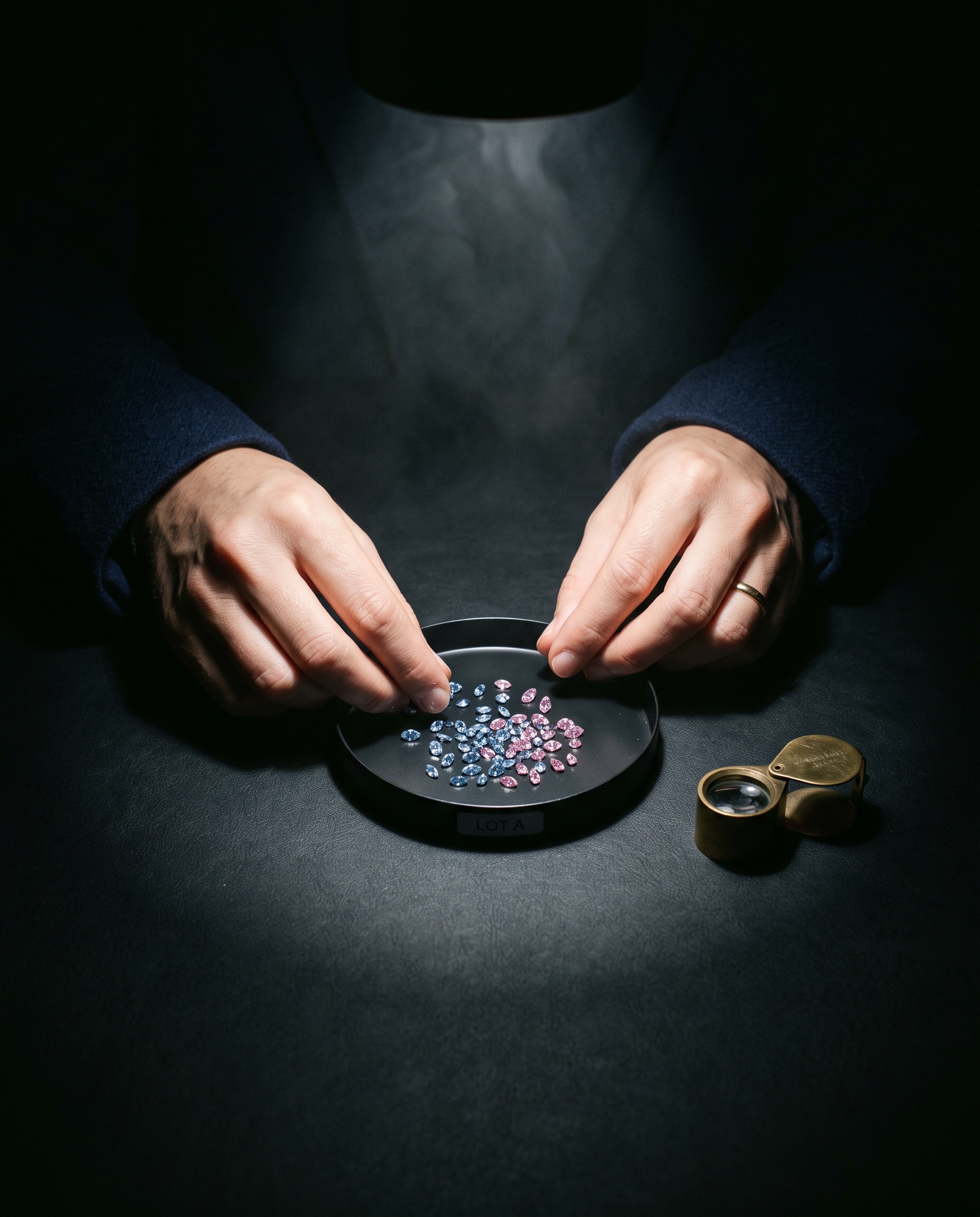
Styling and use cases: pavé lines, halos, and color-blocked accents in fancy shapes
Fancy-shape color melee shows up in a narrower set of applications than round, but it does work round can't do as cleanly.
Continuous eternity lines. Emerald and Marquise are the two shapes best suited to a band that needs to read as an unbroken ribbon of color rather than a row of individual sparkle points. Emerald's flat table shows color as a steady field stone to stone; Marquise's elongated point, set end to end, creates a visual line a round pavé of the same total width can't replicate.
Graduated and tapered work. Pear and Marquise are the standard choices for a graduated eternity line or a tapered shoulder — largest stone at center, stepping down toward the shank — because both shapes hold their proportions cleanly across a size range, which keeps the graduation looking deliberate rather than uneven.
Halo work. Pear and Oval both perform well as halo accents around a fancy color or white center stone, particularly when the halo needs to echo the center's outline rather than default to the round-brilliant halo that's become the standard. An oval center with an oval-melee halo, or a pear center with a pear-melee halo, reads as a single cohesive shape rather than a round frame wrapped around a fancy-shape stone.
Color-blocked and two-tone designs. Because fancy-shape melee is bought and sorted by a defined color range, it's the more reliable choice for a design that blocks two hues against each other in clean geometric sections — a Yellow field transitioning to a Pink field down a band, for example. Round melee can do this too, but the flat, even color face of an Emerald or the elongated field of an Oval reads the transition more deliberately than a scatter of round points would.
Accent and side-stone work. Outside eternity and halo applications, fancy-shape color melee also works as scattered accent stones or as side stones flanking a center — smaller applications where the shape's outline still contributes to the piece's geometry without a continuous line or full halo.
Across all of these, the shape choice should follow the design's line rather than the reverse — decide whether the piece needs a continuous ribbon, a graduated taper, a shape-echoing halo, or a color block, and the shape follows from that decision more than from color or price alone.
Fancy-shape melee vs. fancy color round melee
Round carries the volume in Guru Diam's fancy color melee program, and for good reason — it's the more flexible, deeper-stocked, and generally lower-cost-per-carat option for pavé and halo work where a uniform sparkle field is the goal. Fancy-shape melee isn't a replacement for round; it's a different tool for a different job.
The practical differences: round is specified and bought by MM diameter, since every stone in a size is interchangeable. Fancy-shape melee is specified by length × width, since outline and proportion matter to the finished look in a way a diameter number can't capture. Round generally holds deeper standing stock across more color and size combinations, given its higher cutting yield and broader demand. Fancy-shape stock is more concentrated — Pear and Oval run deep, Marquise and Emerald thinner — and uncommon combinations lean on made-to-order cutting more often than round does.
For a design brief, the decision is usually straightforward: if the piece calls for a uniform field of sparkle — full pavé coverage, a standard round halo — round is the faster, typically more cost-efficient choice. If the piece needs the stone's outline to do visible work — a continuous line, a graduated taper, a shape-matched halo, a color block with a clean edge — fancy-shape melee is the right call even at a premium over round. See the fancy color round melee guide for the round-specific version of this same buying process.
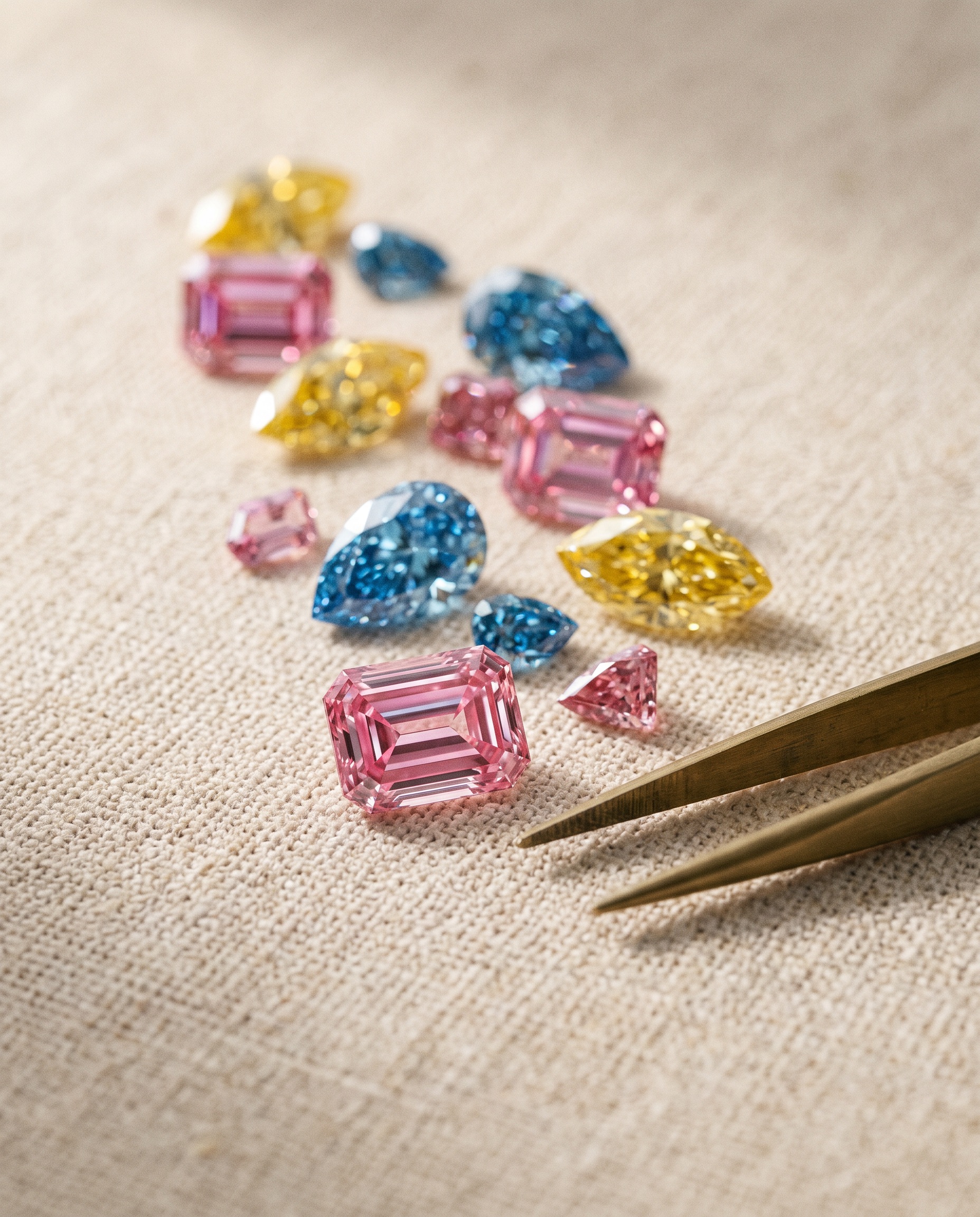
Fancy-shape melee vs. certified fancy color loose stones
The line between fancy color fancy-shape melee and Guru Diam's certified fancy color loose stones isn't shape or color — both categories cover Emerald, Oval, Pear, and Marquise in Yellow, Pink, Blue, and Green. The line is size, certification, and how the stone is bought.
Certified fancy color loose stones start at 0.30ct and carry individual IGI, GIA, or GCAL paperwork — a graded report on that specific stone's color, clarity, and cut. They're bought and sold as individual stones, each with its own documentation, typically as a center stone or featured accent where a single stone's credentials matter to the sale. Fancy color fancy-shape melee sits below that threshold: calibrated parcel goods, uncertified individually or as a parcel, graded and matched in-house against a working baseline, bought by the parcel against a stated shape, length × width, and color range rather than stone by stone.
The practical trigger for which category a project needs: if the sale or the design requires a documented report on a specific stone — a center stone a retail customer will want paperwork on, for instance — that's certified loose-stone territory. If the stones are accent or pavé work where consistency across a run matters more than individual documentation — an eternity line, a halo, a color-blocked section — that's melee territory, and buying it as certified singles would add cost without adding anything the finished piece needs. Projects that use both — a certified center stone with a fancy-shape melee halo or line matched to it — are common, and matching intent should be specified at quote time either way.
How to order fancy color fancy-shape melee wholesale
Guru Diam sources fancy color fancy-shape melee as wholesale, trade-only inventory — no retail markup — from its New York Diamond District desk (36 West 47th Street, Suite 601A, New York, NY 10036) and its Los Angeles office (607 South Hill Street, Suite 241, Los Angeles, CA 90014). In-stock parcels ship same-day from New York before the daily cutoff; the Los Angeles desk covers same-day West Coast requests the same way.
To request a quote, specify: shape (Emerald, Oval, Pear, or Marquise), length × width or a target size range, color (Yellow, Pink, Blue, or Green), and matching intent — self-consistent field or matched to a specific center stone. Standing-stock combinations quote and ship against current inventory; anything outside stock quotes against a made-to-order calibration cutting run planned with the order. For round pavé and halo work, see the fancy color round melee guide; for how a parcel gets color-matched across a run, see the matching and grading guide; for the full category overview, see the fancy color melee guide.
Ready to buy? Open a verified wholesale account, message the trade desk on WhatsApp, or book time with a gemologist to review current stock and plan a custom run before placing a parcel order.
FAQ
What is fancy color fancy-shape melee?
Calibrated lab-grown diamond accent stones cut in Emerald, Oval, Pear, or Marquise outlines and an intentional hue, sold as parcel goods specified by length × width and color range — used for statement eternity bands and color-blocked designs rather than the uniform field a round pavé produces.
How is this different from fancy color round melee?
Round melee fills a uniform sparkle field — pavé and halo work built from many small, identical accents, bought by MM diameter. Fancy-shape melee is chosen when the outline itself needs to do visible work, which is why it's specified by length × width rather than a single MM diameter, and priced at a premium over round for the same reason.
Which fancy-shape colors and shapes are on hand?
Pear, Oval, Marquise, and Emerald are on hand, concentrated in Yellow, Pink, and Blue, with Pear and Oval carrying the deepest bench. Green is available across all four shapes through made-to-order calibration cutting rather than standing stock.
Is fancy color fancy-shape melee certified?
No — not individually and not at the parcel level. It's CVD-grown, cut and finished in-house, and QC'd against a defined color and clarity baseline for every parcel. Certification lives with a different tier of Guru Diam's catalog: fancy color loose stones at 0.30ct and up, each carrying individual IGI, GIA, or GCAL documentation. If a sale needs a graded report on a specific stone, buy from that category instead of melee.
Can I get a fancy-shape color melee parcel matched to a specific center stone?
Yes. State the matching intent when requesting a quote — a self-consistent field for the run itself, or a parcel matched in tone to a specific center stone. See the matching and grading guide for how that color-range spec is set and held across a parcel.
Is there a minimum order for a fancy-shape color melee parcel or a made-to-order cutting run?
Standing-stock parcels ship same-day from New York against current inventory, with no meaningful minimum beyond what a project actually needs. Made-to-order calibration cutting runs are scheduled individually against the shape, size, and color a project requires — check current timeline and any run minimum with your account rep when requesting a quote for a custom color or size outside standing stock.