An engagement ring style refers to the overall design category a ring falls into — solitaire, halo, three-stone, vintage, modern minimalist, and antique are the most common — defined primarily by setting structure and stone arrangement rather than by the center diamond itself. For a jeweler advising customers or a manufacturer building a stocking range, understanding how these styles differ, and which combinations of style and setting show up together most often, matters more than treating each ring as a one-off custom build.
This guide compares the major engagement ring styles side by side, covers how each pairs with different diamond shapes and settings, and links out to more detailed guides on specific styles Guru Diam already covers in depth.
Engagement Ring Styles at a Glance
| Style | Defining Feature | Best Suited For | Relative Cost |
|---|---|---|---|
| Solitaire | Single center stone, minimal or no accent diamonds | Classic, timeless buyers; lets the center stone be the focus | Lower to moderate (cost concentrated in center stone) |
| Halo | Ring of smaller diamonds surrounding the center stone | Buyers wanting more visible sparkle/perceived size at a given carat | Moderate |
| Three-stone | Center stone flanked by two side stones | Symbolic framing (past/present/future); more total carat weight | Moderate to high |
| Vintage | Milgrain, filigree, or period-inspired detailing | Buyers wanting heirloom character over a modern minimal look | Moderate (detail work adds labor cost) |
| Modern minimalist | Clean lines, thin bands, low-profile settings | Buyers prioritizing everyday wearability and understated design | Lower to moderate |
| Antique-cut centered | Built around an Old Mine, Old European, or similar antique-cut stone | Buyers specifically seeking pre-modern cut character | Moderate to high (specialized cut, lower yield) |
Solitaire: The Baseline Style
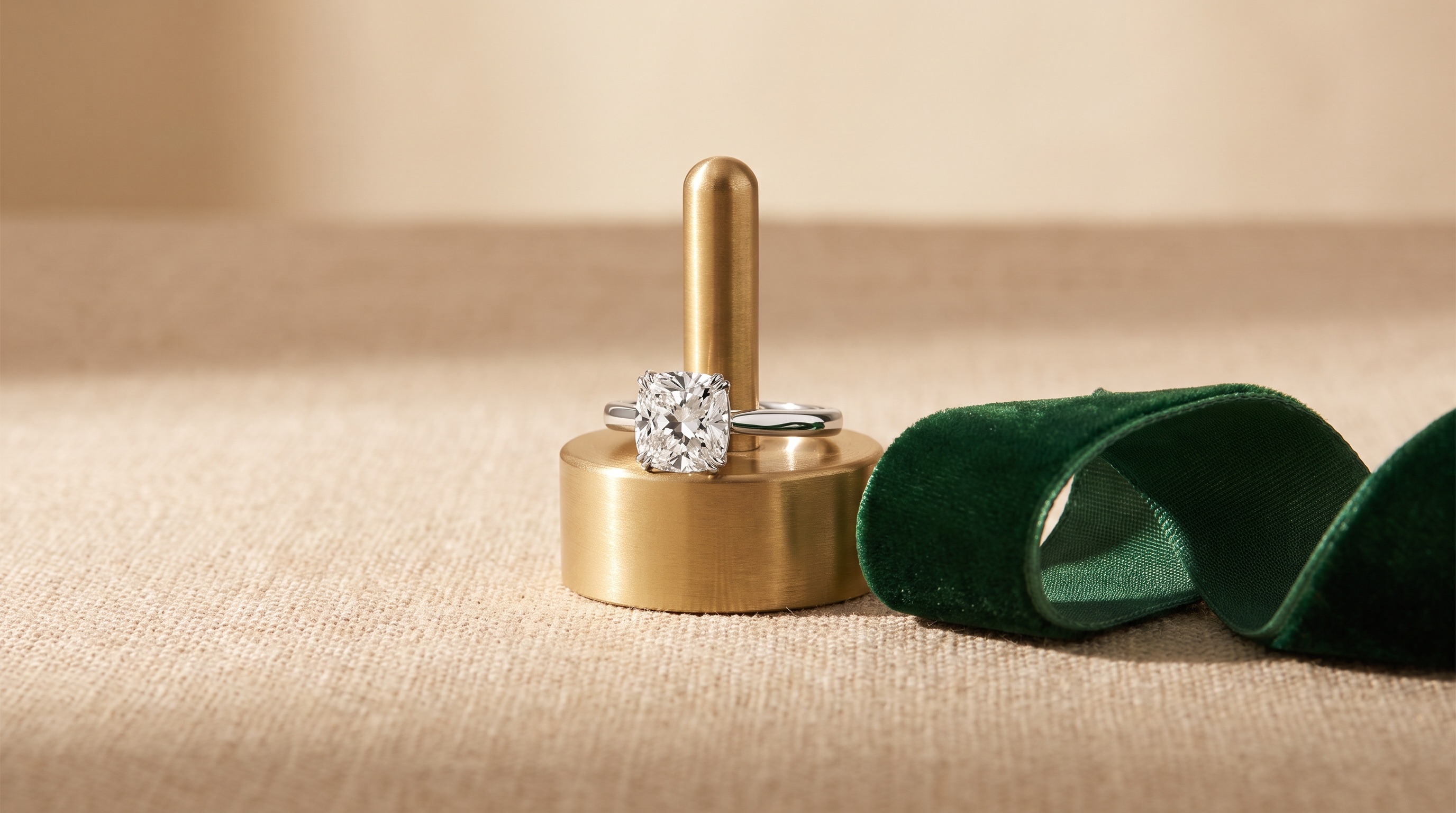
The solitaire is the reference point every other style is compared against — a single center diamond, usually in a four- or six-prong setting, with no accent diamonds competing for attention. Its appeal is largely about letting the center stone carry the entire visual weight of the ring, which means a solitaire buyer typically wants to prioritize center-stone size and quality over setting complexity. Guru Diam's solitaire setting guide covers prong count, metal choice, and center-stone shape pairing for this style in more depth.
Halo: Maximizing Perceived Size and Sparkle
A halo setting surrounds the center stone with a ring of smaller diamonds, which increases the ring's total visible diamond surface and can make a given center-stone carat weight read as visually larger than the same stone in a solitaire setting. This makes halo settings a popular choice for buyers working within a defined budget who want to maximize apparent size and sparkle without necessarily increasing center-stone carat weight. A hidden halo variant, where the halo sits beneath the girdle of the center stone rather than fully visible from the top, is a further sub-style worth stocking separately given its distinct look and separate demand pattern.
Three-Stone: Symbolic Framing and Added Carat Weight
A three-stone ring places two side stones — often smaller round or trapezoid-cut diamonds — flanking a larger center stone, traditionally read as representing a couple's past, present, and future. Beyond its symbolism, the practical effect of a three-stone setting is meaningfully more total carat weight on the hand than a solitaire at the same center-stone size, which appeals to buyers wanting a fuller look across the whole ring rather than concentrating all the carat weight and cost into one stone.
Vintage Styles: Milgrain, Filigree, and Period Detail
Vintage-style engagement rings borrow design language from specific historical periods — Edwardian filigree, Art Deco geometric patterning, Retro-era scale and boldness — expressed through milgrain edging, hand-engraved metalwork, and openwork gallery details rather than a smooth, minimal band. This detail work adds labor cost relative to a plain band, but appeals strongly to buyers specifically seeking heirloom character over a contemporary look. Guru Diam's vintage-style ring guide covers this broader multi-era category, while the Art Deco guide covers that specific period's geometric aesthetic in more depth.
Modern Minimalist: Clean Lines and Everyday Wearability
Modern minimalist engagement rings prioritize a thin band, low-profile setting, and the absence of ornamental detail, appealing to buyers who want a ring that reads as understated and wearable in professional or active settings rather than as a statement piece. This style has grown as a share of overall engagement ring demand over the past several years, driven partly by broader minimalist design trends and partly by buyers wanting a ring that pairs cleanly with a stacked wedding band later rather than competing visually with it.
Antique-Cut Centered Rings: A Specialized Sub-Category
Rings built specifically around an antique-cut center stone — Old Mine, Old European, Kite, or similar historically-styled cuts — represent a further specialization beyond a generically "vintage-styled" ring, since the antique character comes from the stone's own cut geometry (open culet, larger facets, softer light performance) rather than from decorative metalwork alone. Buyers seeking this specific look need a supplier with genuine antique-cut stone depth, not just vintage-styled settings paired with modern round brilliant stones — a meaningfully different sourcing requirement.
Stackable and Cluster Styles
A smaller but growing segment of engagement ring buyers choose a stackable or cluster-style ring — either a cluster of several smaller diamonds arranged to resemble one larger stone, or a design intended from the start to be worn alongside additional stacking bands over time. Guru Diam's stackable rings guide covers sourcing considerations specific to this style, including how stacking rings need to be sized and profiled to sit comfortably together.
Cathedral and Other Structural Setting Styles
Beyond the broad style categories above, structural setting choices — cathedral settings (where the band arches up to the center stone, raising it for visibility), tension settings (where the stone appears to float, held by pressure rather than visible prongs), and channel settings for accent stones — can be applied across several of the style categories above, meaning a buyer might choose a "vintage cathedral halo" combining elements from three different categories at once. Guru Diam's cathedral setting guide covers that specific structural choice in more detail.
How Diamond Shape Interacts With Style Choice
Certain diamond shapes pair more naturally with certain styles: round brilliant works with virtually every style listed here and remains the most common pairing across all of them; emerald and asscher cuts (step cuts, prized for clarity over sparkle) pair especially well with Art Deco and other geometric vintage styles; oval and pear shapes are common halo centers specifically because their larger surface area amplifies the halo's size-maximizing effect; and antique cuts are, by definition, paired specifically with antique-cut-centered rings rather than other styles. A retailer stocking across multiple styles should plan diamond shape inventory with these natural pairings in mind rather than assuming any shape works equally well in every style.
How Metal Choice Shapes the Look of Each Style
Metal choice interacts with style in a few consistent ways: platinum and white gold are the most common choices across nearly every style and tend to read as more contemporary; yellow gold has seen a resurgence specifically in vintage and antique-cut-centered rings, where it reads as more period-authentic than white metal; and rose gold pairs frequently with modern minimalist and halo styles as a warmer, softer contrast against a white center stone. A retailer building a style-diverse assortment should stock metal options with these pairings in mind, since a style's typical metal preference can shift its overall retail price point meaningfully.
Combining Styles: Hybrid and Custom Requests
In practice, many engagement rings combine elements from more than one style category listed here — a vintage halo, a three-stone with a hidden halo on the center stone, or a modern minimalist band holding an antique-cut center stone. Retailers and manufacturers taking custom requests should expect this kind of hybridization as the norm rather than the exception once a customer moves past browsing catalog styles and starts describing exactly what they want, which is part of why a supplier offering genuine custom build capability — not just a fixed catalog of pre-set style combinations — has an advantage serving this segment of demand.
Building a Style-Diverse Stocking Range
A retailer building out an engagement ring assortment for the first time should aim for representation across at least solitaire, halo, three-stone, and one vintage or minimalist option before going deep on any single style, since these four categories cover the large majority of buyer preference. Once that baseline range is established, deeper investment in antique-cut-centered rings or highly specific vintage sub-styles (Edwardian vs. Art Deco vs. Retro, for instance) makes sense as a differentiation strategy rather than a starting point, since those narrower categories serve a smaller, more specific segment of demand.
How Engagement Ring Style Trends Shift Over Time
Engagement ring style popularity moves in cycles longer than most fashion trends — a shift toward vintage and antique-cut character over the past several years, for instance, followed a long period of modern minimalist and solitaire dominance, and reflects broader cultural interest in heirloom aesthetics rather than a short-lived seasonal trend. Retailers and manufacturers should treat style-mix planning as a multi-year decision rather than reacting to any single season's social media trend, while still leaving room in a stocking range for a smaller allocation toward whatever style is currently gaining the most visible momentum.
Band Width and Profile Across Styles
Band width and profile vary meaningfully by style and affect both comfort and how a ring reads visually: solitaire and modern minimalist styles typically run thinner (1.5mm-2.5mm) to keep visual focus on the center stone, three-stone and halo styles often need a slightly wider band (2.5mm-3.5mm) to structurally support the additional side or accent stones, and vintage styles vary widely depending on the specific period being referenced — Art Deco tends toward more architectural, slightly wider profiles, while Edwardian-inspired designs often stay delicate and thin. Retailers should factor band width into how a given style will wear over time, since a very thin band under a heavy stone or elaborate setting can be more prone to bending or metal fatigue with years of daily wear.
How Setting Height Affects Practicality
Setting height — how far the center stone sits above the finger — varies by style and has real practical consequences beyond appearance: a cathedral or high-prong solitaire setting shows off a center stone dramatically but catches on gloves, pockets, and fabric more than a low-set bezel or flush setting, while a halo setting's added metal and stone surface can make an otherwise low-profile ring feel bulkier on the hand. Buyers with active jobs or hobbies involving frequent hand use often gravitate toward lower-set styles regardless of which aesthetic category they'd otherwise prefer, which is worth factoring into how a retailer presents style options to a customer rather than leading purely with visual preference.
Regional and Cultural Style Preferences
Engagement ring style preference varies by region and cultural background more than buyers sometimes expect — solitaire and minimalist styles have historically dominated in much of the US and Western Europe, while halo and three-stone styles carrying more total visible carat weight see stronger demand in markets and communities that place more emphasis on a ring's overall visual scale. Vintage and antique-cut styles cut across regional lines more evenly, appealing to a specific buyer mindset (heirloom character, distinctiveness from mass-market styles) rather than following a clear geographic pattern. A retailer serving a diverse customer base benefits from stocking a range broad enough to serve more than one of these preference clusters rather than assuming one dominant regional style covers the full customer base.
How Budget Shapes Style Recommendations
Style choice and budget interact in ways that aren't always intuitive — a halo setting can let a buyer achieve a visually larger-looking ring at a lower total cost than a solitaire with an equivalently large center stone, since smaller melee diamonds cost less per total carat than one larger stone of the same combined weight, while a three-stone setting generally increases total cost by adding meaningful carat weight in the two side stones. Retailers advising budget-conscious customers should present halo and cluster styles as legitimate ways to maximize visual impact per dollar, not simply as a "lesser" alternative to a bigger solitaire, since for many buyers the achieved look matters more than which specific style produced it.
Photographing and Merchandising Multiple Styles at Retail
Presenting a style-diverse range effectively at retail — in a showcase, on a website, or in social content — benefits from grouping rings by style category rather than mixing them arbitrarily by price point or metal type, since most customers start their search with a style preference in mind ("I want something vintage" or "I like the halo look") before narrowing down to specific price and carat considerations. Product photography that shows each style from a consistent angle and against a consistent background makes it easier for online shoppers to compare styles directly, and pairing each style listing with a short, plain-language description of what defines it (rather than assuming the customer already knows setting terminology) reduces the number of basic style questions a sales team needs to field before a customer feels confident enough to move toward a purchase decision.
Style Longevity: What Resells and Reorders Well
Not every style performs equally well as a repeat-reorder category — solitaire and modern minimalist styles tend to have the longest sustained demand because they don't read as trend-tied, which makes them a safe baseline for a retailer's core inventory rather than a style that risks feeling dated within a few years. Halo and three-stone styles have shown more cyclical demand historically, popular for a stretch of years before ebbing as buyer taste shifts, though they never disappear entirely. Vintage and antique-cut styles have proven more durable than a typical trend cycle would predict, likely because their appeal is rooted in a specific, consistent buyer motivation (heirloom character, distinctiveness) rather than a look tied to a particular design era's broader popularity. A retailer planning long-term inventory investment should weight core solitaire and minimalist stock as the dependable foundation, while treating deeper investment in cyclical styles like halo or three-stone as a more actively-managed, trend-aware allocation.
Sourcing an Engagement Ring Style Range from Guru Diam
Guru Diam is a trade-only, B2B wholesale diamond and jewelry supplier with locations in New York and Los Angeles, carrying loose diamonds across every standard, antique, and fancy shape alongside finished engagement rings built in solitaire, halo, three-stone, vintage, and antique-cut-centered styles, in both CVD lab-grown and natural diamonds. Custom builds combining elements from multiple styles are finished in 4-6 days, unbranded by default so retailers can resell as their own line. As with the rest of Guru Diam's lab-grown catalog, stones are cut and polished at the company's India workshop before final grading and shipment from the New York and Los Angeles locations. New trade accounts can apply through trade partner, with current inventory across styles browsable at custom jewelry and the wholesale hub.
Working With a Single Supplier Across Every Style
Because style preference varies so much from customer to customer, retailers who source rings across every major style from a single supplier avoid the coordination overhead of managing separate vendor relationships for, say, vintage-detailed pieces versus modern minimalist ones. This matters most when a customer requests a custom hybrid build, since a supplier already capable of vintage detailing, halo construction, and antique-cut center stones under one roof can execute a combined request directly, rather than a retailer needing to broker between two specialist vendors or turn the request down entirely.
Frequently Asked Questions
Do engagement ring styles need to match the wedding band?
Not strictly, but many buyers choose a wedding band profile that complements their engagement ring's style and metal — a low, flat band for a solitaire, or a curved contour band designed to nest against a halo setting. Retailers stocking both categories should keep these pairings in mind when advising a customer building a full bridal set.
What is the most popular engagement ring style?
Solitaire and halo settings remain the two most consistently popular styles across most markets, with solitaire favored by buyers prioritizing center-stone focus and halo favored by buyers wanting maximized perceived size and sparkle at a given budget.
What's the difference between a vintage and an antique-cut-centered engagement ring?
A vintage-style ring gets its period character from decorative metalwork — milgrain, filigree, engraving — and can be built around any diamond shape, including modern round brilliant. An antique-cut-centered ring specifically uses a historically-styled cut (Old Mine, Old European, and similar) as the center stone itself, which is a different and more specialized sourcing requirement, since it depends on the stone's own cut geometry rather than on the setting's decorative details.
Which engagement ring style is best for everyday wear?
Modern minimalist and low-profile solitaire settings tend to hold up best for daily wear across active lifestyles, since they minimize snag points and raised elements compared to a halo or elaborate vintage setting. Channel-set accent stones and bezel settings, where present, also add durability by protecting stone edges with surrounding metal rather than leaving them exposed the way open prong settings do.
Can I combine styles, like a vintage halo?
Yes — many engagement rings combine elements from more than one style category, and a supplier offering genuine custom build capability rather than only a fixed catalog of preset combinations can accommodate this kind of hybrid request, whether that's a vintage-detailed band around a halo setting or a hidden halo beneath a three-stone arrangement.
Does diamond shape limit which style I can choose?
Not strictly, but certain shapes pair more naturally with certain styles — round brilliant works across virtually every style, step cuts like emerald and asscher pair especially well with geometric vintage styles, and antique cuts are specifically paired with antique-cut-centered rings.
What styles should a new engagement ring retailer stock first?
Solitaire, halo, three-stone, and at least one vintage or modern minimalist option cover the large majority of buyer preference and make a solid baseline range before investing more deeply in narrower sub-styles like antique-cut-centered or specific historical-period vintage designs. Deeper specialization — Edwardian vs. Art Deco vintage detailing, or antique-cut center stones specifically — is better approached as a differentiation strategy once that baseline range is established and selling consistently.
Guru Diam is a trade-only wholesale diamond and jewelry supplier with locations in New York and Los Angeles, carrying loose diamonds and finished engagement rings across every major style. Browse current inventory at the wholesale hub or apply for a trade account through trade partner.