Engagement ring shapes refer to the outline of the diamond itself — round, oval, princess, cushion, and a dozen other silhouettes — and the choice among them is a tradeoff between sparkle, perceived size, durability, and cost per carat, not a matter of one shape being objectively "best." For jewelers and retail buyers, understanding those tradeoffs well enough to guide a customer's decision (and to stock inventory that matches actual demand) is the real value of a shapes comparison.
Why "Shape" and "Cut" Are Different Words for a Reason
In casual conversation, "cut" and "shape" get used interchangeably, but in the trade they mean different things. Shape is the outline — round, oval, pear, and so on. Cut refers to the proportions, angles, and faceting pattern that determine how well a diamond of that shape returns light. Two round diamonds can have identical shape and wildly different cut quality; a well-cut fancy shape can outperform a poorly-cut round in visible brilliance. This guide is about shape selection specifically — for cut-grade mechanics on the round brilliant, GD's own round brilliant cut guide and ideal cut guide go deeper on that separate axis.
The Two Families: Brilliant-Cut and Step-Cut
Every engagement ring shape belongs to one of two broad optical families, and understanding this split explains most of the practical tradeoffs customers actually notice.
Brilliant-cut shapes
Round, oval, pear, marquise, cushion, radiant, and princess are all brilliant-cut in structure — they use triangular and kite-shaped facets arranged to maximize scintillation (the flashes of light and dark as the stone or viewer moves). These shapes tend to hide small inclusions and slight color tint more effectively, because the fragmented facet pattern breaks up the eye's ability to focus on any one internal feature.
Step-cut shapes
Emerald and Asscher cuts use long, rectangular, parallel facets arranged in concentric steps, producing a "hall of mirrors" effect of broad, flat flashes rather than scattered sparkle. Step cuts show off clarity and color more prominently — both because there's less facet fragmentation to disguise flaws and because the open table lets more of the stone's interior be seen directly. Buyers choosing a step cut should be advised to prioritize a slightly higher clarity and color grade than they might for an equivalent brilliant-cut shape.
Shape-by-Shape Notes
Round brilliant
The commodity shape and the best-selling engagement ring silhouette by a wide margin, because its 57-58 facet pattern is mathematically optimized for brilliance and fire more than any other shape. It's also the most expensive shape per carat, since cutting a round from rough sacrifices more of the original rough material than cutting a fancy shape that can follow the rough's natural outline more closely.
Oval
An elongated brilliant that shares round's fire while creating an elongated, finger-lengthening look and appearing larger face-up than a round of the same carat weight. The main risk is the "bow-tie" effect — a dark shadow across the center of the stone caused by light escaping through the pavilion rather than reflecting back — which varies with cut quality and needs to be checked stone-by-stone rather than assumed away by carat weight or grade alone.
Cushion
A softened square or rectangle with rounded corners, blending brilliant-cut faceting with a pillow-like outline. Popular for a romantic, vintage-adjacent look. Older cushion cuts (sometimes called "cushion brilliant" or "chunky cushion") show larger, blockier facets with more visible flash; modern cushion cuts refine the facet pattern for more traditional brilliance.
Pear
A hybrid of round and marquise — one rounded end, one pointed end. Reads as elongating on the finger and works well set with the point toward the fingertip. Like oval, it can show a bow-tie effect depending on cut proportions, and the pointed tip is more vulnerable to chipping than a rounded outline, which matters for setting choice (a protective prong at the point is standard practice).
Marquise
An elongated shape with two pointed ends, historically associated with maximizing apparent size per carat since more of the stone's surface area shows face-up relative to its weight than a round of equal weight. Both tips need protective prongs. GD's dedicated marquise diamond buying guide covers this shape's sourcing details in full.
Princess
A square brilliant-cut shape with pointed corners, the most popular non-round shape for much of the 2000s and 2010s and still a strong seller for buyers who want a modern, geometric look with round-like brilliance. The pointed corners are the most vulnerable point on any common shape and require corner-protective prongs or a V-tipped setting.
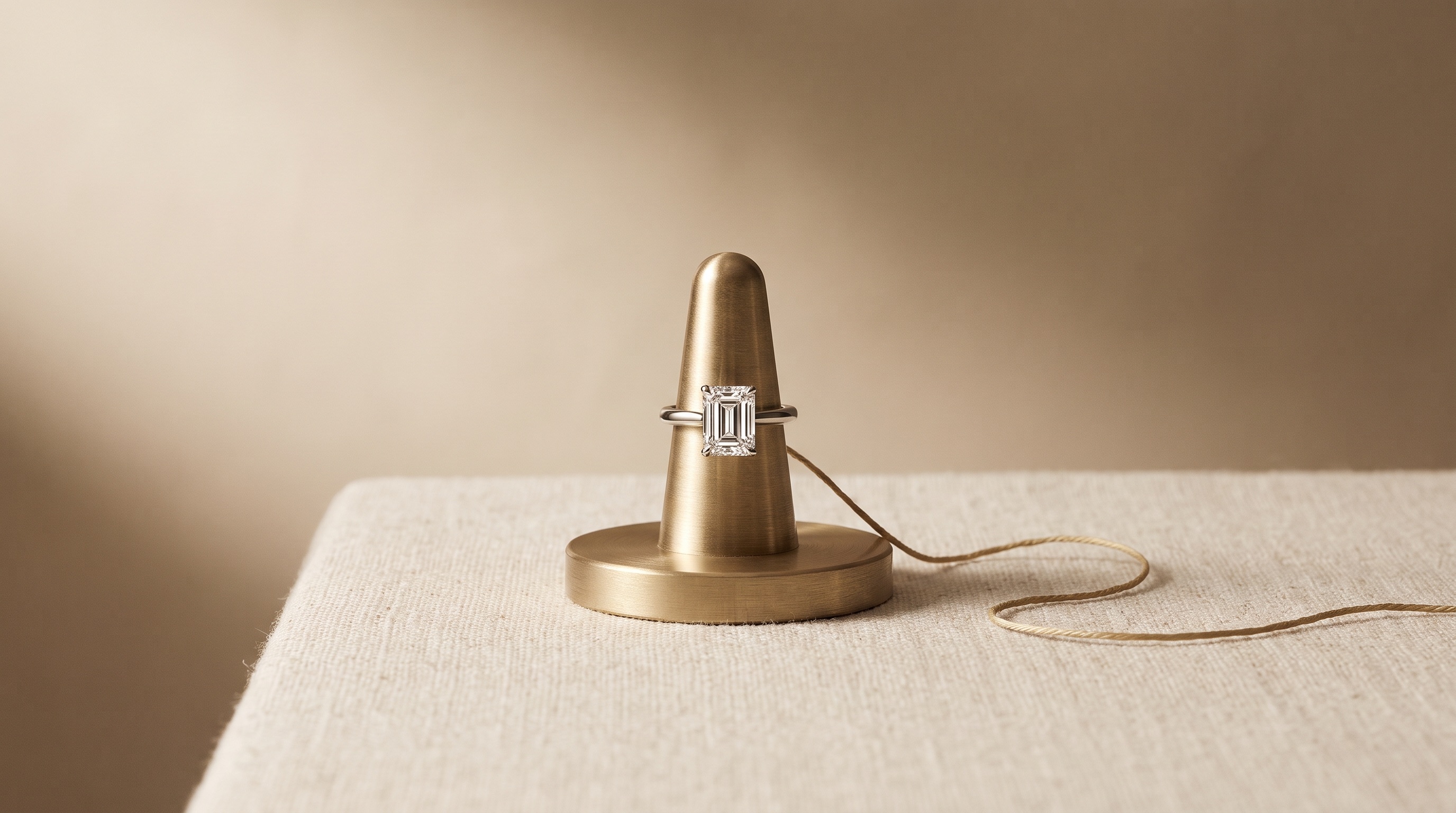
Emerald
The signature step cut — a rectangular outline with cut corners and long, flat facets. Because inclusions and color are more visible in a step cut, emerald-cut buyers should be steered toward VS2 clarity or better and a warmer color floor than they might otherwise choose. The open table also makes emerald cuts read larger per carat than their actual weight suggests.
Asscher
A square version of the emerald cut with a slightly higher crown and more cropped corners, giving it a more geometric, Art Deco-associated look. Shares emerald's clarity/color sensitivity.
Radiant
A rectangular or square brilliant-cut shape with cropped corners, effectively a hybrid designed to combine the emerald cut's outline with brilliant-cut faceting and sparkle. A good option for buyers who like the emerald silhouette but want more forgiveness on clarity and color grade.
Heart
The least common mainstream engagement ring shape, symbolically distinctive but the most demanding to cut symmetrically — a lopsided or shallow-cleft heart is visually obvious in a way that a slightly off-round round brilliant is not. Requires the most scrutiny of proportions and symmetry grade of any shape on this list.
Shape Comparison Table
| Shape | Family | Face-Up Size vs. Round (same carat) | Durability Notes | Relative Cost per Carat |
|---|---|---|---|---|
| Round | Brilliant | Baseline | No vulnerable points | Highest |
| Oval | Brilliant | Larger | No vulnerable points; watch for bow-tie | High |
| Cushion | Brilliant | Slightly larger | Corners need light protection | Mid-high |
| Pear | Brilliant | Larger | Point needs protective prong | Mid-high |
| Marquise | Brilliant | Largest | Both tips need protective prongs | Mid |
| Princess | Brilliant | Similar | Corners are the most vulnerable point of any shape | Mid |
| Radiant | Brilliant/step hybrid | Larger | Cropped corners are moderately protected | Mid |
| Emerald | Step | Largest | Cut corners help; open table shows inclusions | Mid-low |
| Asscher | Step | Similar | Same clarity sensitivity as emerald | Mid-low |
| Heart | Brilliant | Similar | Cleft is the vulnerable point; needs careful symmetry | Mid |
Antique and Exotic Shapes Beyond the Mainstream List
Trade buyers serving a design-forward or vintage-inspired retail segment increasingly stock shapes beyond the ten above. Old mine and old European cuts (the historical precursors to the modern round brilliant, with smaller tables, higher crowns, and larger culets) produce a warmer, more candlelight-flattering sparkle prized by antique-style buyers — GD's old mine cut guide and old European cut guide cover the differences in depth. Rose cuts (flat-backed, faceted only on top, with little to no brilliance but a distinctive glassy glow) and their close relative the Portuguese cut serve a similar niche market, detailed in GD's rose cut guide and Portuguese cut guide. Salt and pepper diamonds — heavily included stones prized specifically for their visible inclusions rather than despite them — have become a genuine engagement ring category of their own among buyers seeking an unconventional, one-of-a-kind look, covered in GD's salt and pepper diamond guide.
How Shape Interacts With Setting Choice
Shape and setting decisions aren't independent — some shapes pair more naturally with certain settings because of how their vulnerable points and proportions interact with prong placement. Pointed shapes (marquise, pear, princess, heart) generally need a setting style with dedicated corner or tip protection rather than a plain four-prong that leaves points exposed. Elongated shapes (oval, marquise, emerald, radiant) read well in a cathedral or hidden-halo setting that emphasizes length, while round and cushion diamonds are more setting-flexible since they have no directional orientation to accommodate.
Halo settings deserve a specific note here: because a halo surrounds the center stone with smaller melee, it visually extends whichever shape it's built around, making it one of the most effective ways to add perceived size to a smaller center stone regardless of shape. A hidden halo (melee set beneath the center stone rather than fully visible around it) achieves a similar effect with a more subtle look from a straight-on angle — GD's hidden halo ring guide covers the sourcing and build details for that specific setting style.
Advising a Retail Customer Through the Shape Decision
For jewelers and sales staff, the shape conversation usually goes better as a short set of questions than as a catalog walkthrough. Three questions cover most of what determines a good-fit recommendation:
- "Do you want it to look bigger, or do you care more about brilliance?" Elongated shapes win on apparent size per carat; round wins on brilliance per carat. Most customers have an intuitive answer to this once it's framed as a tradeoff rather than left implicit.
- "Do you do a lot of hands-on work — sports, gardening, manual labor?" Pointed shapes (marquise, pear, princess) need more setting protection and are more likely to chip without it; round and cushion have no vulnerable points and tolerate daily wear-and-tear better.
- "Is there a specific era or aesthetic you're drawn to?" This surfaces antique-shape interest (old mine, old European, rose cut) that a customer might not otherwise think to ask about, since those shapes aren't part of the standard ten-shape mental model most shoppers walk in with.
Framing the conversation this way also naturally surfaces upsell and cross-sell opportunities — a customer drawn to an elongated shape for size is a good candidate for a hidden-halo setting that adds further apparent size, while a customer prioritizing brilliance above all else is well-served by steering toward round or a well-cut oval rather than a step cut.
Three-Stone and Multi-Shape Ring Designs
Not every engagement ring uses a single shape. Three-stone rings — a center stone flanked by two side stones — are a significant enough sub-category that shape selection has to account for how shapes pair, not just how one shape performs alone. Common pairings include a round or cushion center with trapezoid or half-moon side stones, an emerald center with tapered baguette sides, and an oval or pear center with round or pear-shaped sides. The side stones' total weight and shape need to complement rather than compete with the center stone visually — side stones that are too large or too brilliant can pull visual attention away from the center stone they're meant to frame. Retailers stocking loose stones for custom three-stone builds should keep matched pairs of common side-stone shapes on hand specifically, since sourcing two visually matched side stones after a center stone sale is already committed is a much higher-friction process than having pre-matched pairs available to show at the point of sale.
Shape Selection at Different Price Points
Shape choice interacts with budget in a way that's worth making explicit to retail customers rather than assuming price sensitivity rules out fancy shapes. Because round commands the highest per-carat premium of any shape, a customer working within a fixed budget can often move up meaningfully in total carat weight by choosing a well-cut fancy shape instead — the same dollar amount buys a visibly larger oval, cushion, or emerald than it buys in round. This is a genuinely useful piece of guidance for budget-conscious customers who assume fancy shapes are automatically a downgrade from round, when in practice the opposite is often true on a size-for-price basis. Lab-grown CVD diamonds compound this effect further, since the per-carat savings versus natural stones apply on top of whatever savings the shape choice already provides.
What Drives Real Retail Demand by Shape
Round brilliant remains the largest single shape by sales volume across the trade, typically representing somewhere around half of engagement ring diamond sales depending on market and price tier. Oval has grown the fastest of the fancy shapes over the past several years, driven by its size-per-carat efficiency and strong performance on social media and engagement-ring-focused content, where its elongated silhouette photographs distinctively. Cushion and emerald maintain steady, loyal followings tied to specific aesthetic preferences (vintage-romantic and Art Deco-geometric, respectively) rather than broad mainstream appeal. Marquise and pear see cyclical demand tied to broader fashion trends more than the other shapes, with marquise in particular experiencing a strong resurgence in recent years after a long period of relatively lower demand.
For jewelers deciding how to allocate a fixed inventory budget across shapes, this demand pattern argues for a core stock of round and oval in a range of common sizes, a smaller but present selection of cushion, pear, marquise, and emerald to cover steady niche demand, and an ability to special-order less common shapes (princess, radiant, Asscher, heart, antique cuts) on request rather than holding them as standing inventory. Retailers who try to stock every shape in every size evenly usually end up overexposed on the slower-moving shapes; matching stock depth to actual demand pattern by shape is a more capital-efficient approach.
A Certification Detail Retailers Should Know: Cut Grade Varies by Shape
One detail that trips up even experienced sales staff: GIA assigns an overall cut grade (Excellent through Poor) only to standard round brilliant diamonds. Fancy shapes — oval, cushion, pear, marquise, emerald, and the rest — receive a full grading report covering the 4Cs, but without an overall cut grade, because there's no single industry-standard proportion formula for fancy shapes the way there is for round. IGI does assign cut grades to a broader set of fancy shapes than GIA, which is one reason some retailers prefer IGI reports specifically for fancy-shape inventory. Either way, evaluating a fancy-shape diamond's cut quality relies more heavily on the individual proportions listed on the report (table percentage, depth percentage, and the stone's actual face-up appearance) than on a single letter grade, and sales staff advising fancy-shape buyers should be comfortable walking through those numbers rather than pointing to a cut-grade line the way they would on a round stone.
Sourcing Shape-Specific Inventory Through Guru Diam
Guru Diam carries all standard, antique, and exotic diamond shapes — from commodity round brilliant through the full fancy-cut range to antique styles like old mine, old European, kite, and rose cut — in both CVD lab-grown and natural stock, certified through IGI, GIA, or GCAL as applicable. This breadth matters for retailers who want a single account covering both mainstream demand and the growing antique/exotic segment rather than splitting shape-specific sourcing across multiple suppliers. In-stock inventory ships same-day (before 6pm EST from New York, before 4pm PST from Los Angeles), and custom engagement rings built around any of these shapes are finished in 4-6 days, unbranded by default for retail resale.
Browse current shape inventory through the wholesale hub, or set up a trade account through trade partner to access shape-specific catalogs. For antique and fancy-color shape pairings, check fancy color loose diamonds and matching pairs, and for custom builds around a specific shape, start through custom jewelry. Retailers weighing shape against total budget should also see GD's 4Cs guide for how shape choice interacts with the other grading factors when balancing a customer's price target against size and quality expectations.
Frequently Asked Questions
Which engagement ring shape looks the biggest for the price?
Elongated shapes — oval, marquise, pear, and emerald — all show more surface area face-up per carat than a round diamond of the same weight, since a round sacrifices more rough material in cutting and concentrates its weight in depth rather than spread. Marquise typically shows the largest face-up size of any common shape at a given carat weight.
What is a bow-tie effect and which shapes get it?
A bow-tie is a dark, shadow-like band across the center of an elongated stone, caused by light leaking out through the pavilion instead of reflecting back to the eye. It shows up most in oval, marquise, and pear shapes and varies significantly between individual stones depending on cutting proportions — it should be checked visually on each stone rather than assumed from carat weight or grade alone.
Is round always the most expensive shape per carat?
Yes, in almost all cases. Cutting a round brilliant from rough diamond material wastes more of the original rough than cutting a fancy shape that can be planned to follow the rough's natural outline, and round's cutting process is also the most labor- and skill-intensive to execute well, both of which push its per-carat price above fancy shapes of comparable clarity and color.
Do step-cut diamonds need higher clarity than brilliant-cut diamonds?
Generally yes. Step cuts like emerald and Asscher have large, flat, open facets that show inclusions and color tint more clearly than the fragmented facet pattern of a brilliant cut, so buyers choosing a step cut are usually advised to select at least VS2 clarity and a slightly warmer color floor than they'd need for an equivalent brilliant-cut shape.
Which shapes need extra protection in the setting?
Any shape with a pointed corner or tip — marquise, pear, princess, and heart — needs a setting with dedicated protection at that point, typically a V-tip prong or protective metal bead, since those points are the most likely place for a chip to occur under everyday impact.
Are antique diamond shapes more expensive than modern fancy shapes?
Often, yes, particularly for genuinely antique-cut stones (old mine, old European) sourced or recut to match historical proportions, since supply is thinner and cutting them well requires more specialized skill than mainstream modern shapes. They're priced as a premium category rather than a discount alternative to standard fancy shapes.
Does GIA give a cut grade to fancy-shape diamonds?
No — GIA only assigns an overall cut grade (Excellent through Poor) to standard round brilliant diamonds. Fancy shapes still receive a full grading report with the other 4Cs, but evaluating their cut quality requires looking at individual proportions like table and depth percentage rather than a single grade line, since there's no universal proportion formula for fancy shapes the way there is for round.
Can two different shapes be combined in one engagement ring?
Yes — three-stone rings commonly pair a center shape with different side-stone shapes, such as an emerald center with tapered baguette sides or an oval center with round or pear side stones. The side stones' size and shape should be chosen to complement the center stone rather than compete with it for visual attention.