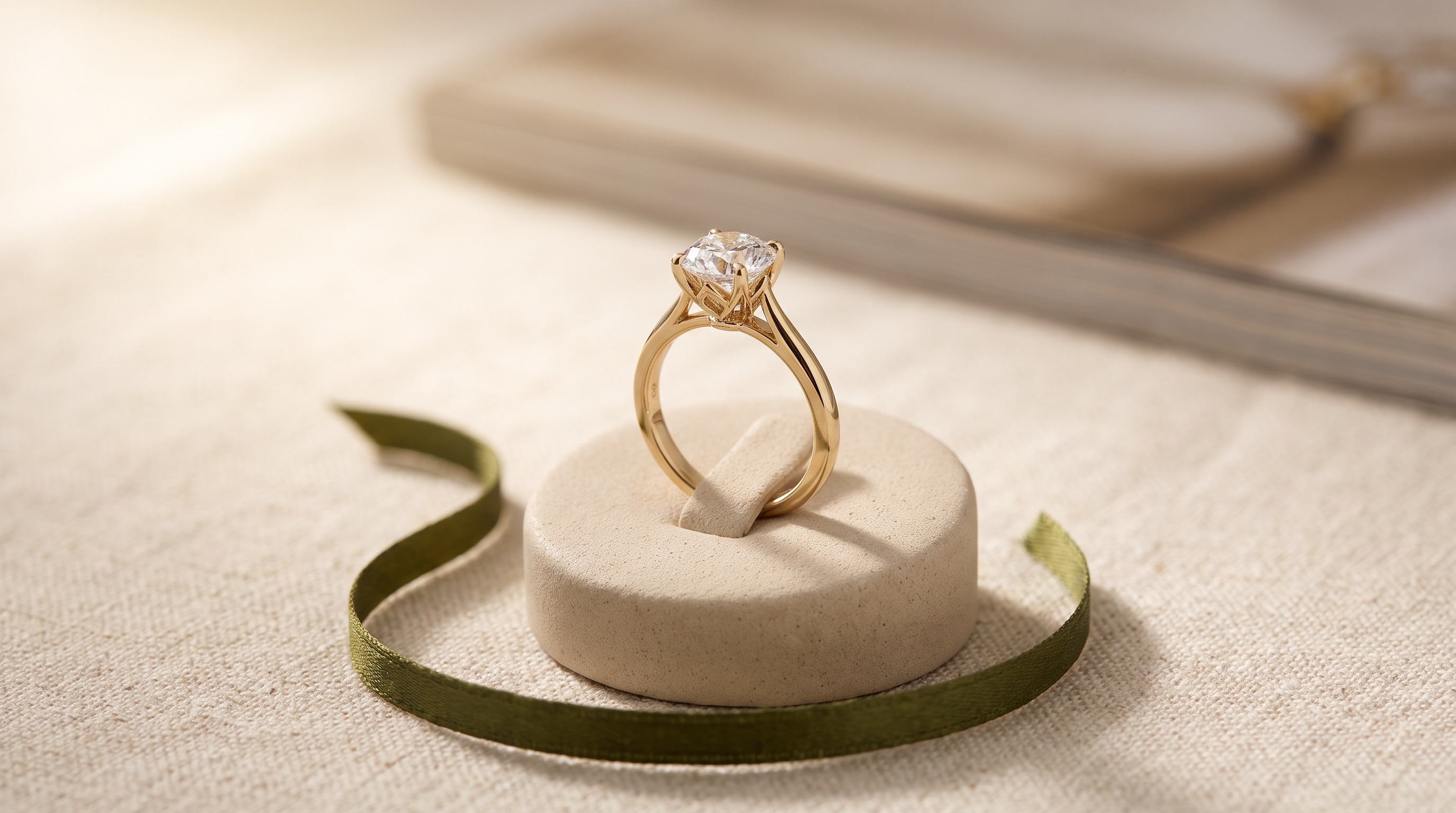
An engagement ring setting is the metal structure that holds the center diamond in place — prongs, a bezel rim, a halo of accent stones, and dozens of variations on those basic mechanisms — and the right choice depends on the center stone's shape, the wearer's lifestyle, and how much visual weight the customer wants the setting itself to carry. For jewelers, matching setting to stone and customer correctly the first time avoids the two most common complaints in this category: a stone that looks smaller than expected, or a setting that doesn't hold up to daily wear.
The Core Mechanism: What a Setting Actually Has to Do
Every setting style, however different they look, is solving the same two problems: holding the stone securely enough that it won't loosen or fall out under normal wear, and doing so while blocking as little light as possible from reaching the stone. Those two goals are often in tension — more metal touching the stone generally means more security and less light, while less metal means more brilliance and less security. Understanding a setting style mainly means understanding where it sits on that tradeoff, and being able to explain that tradeoff clearly is usually more useful to a retail customer than a purely aesthetic description of what each style looks like.
Setting Styles, One by One
Prong setting
The default setting for most center stones: four or six thin metal claws grip the stone at its girdle, leaving the rest of the stone exposed to light from nearly every angle. Four-prong settings show slightly more of the stone and work well on round and square shapes; six-prong settings offer more security, which matters more on larger or heavier stones. Prongs are also the easiest setting style to inspect and re-tighten during a routine jewelry check, which is part of why it remains the volume leader across the trade.
Bezel setting
A thin rim of metal wraps completely or partially around the stone's girdle. Full bezels offer the best day-to-day protection of any common setting — the metal rim absorbs impacts that would otherwise hit the stone directly — making it a strong recommendation for customers with active hands or manual jobs. The tradeoff is reduced light entry from the sides, which slightly mutes brilliance compared to an equivalent prong setting, and a full bezel makes resizing marginally more involved than a prong setting.
Halo setting
A ring of smaller melee diamonds surrounds the center stone, adding visual size and additional sparkle around the main stone. Halos are one of the most effective ways to make a smaller or budget-conscious center stone read larger, since the eye perceives the halo and center stone together as one larger unit. A hidden halo variation sets the accent melee beneath the center stone rather than fully around it, giving a similar size-boosting effect with a cleaner look from a straight-on view — GD's hidden halo ring guide covers that build in detail.
Pavé setting
Small diamonds set closely together along the band, held by tiny shared beads of metal, adding continuous sparkle down the shank without a single dominant accent element. Pavé is typically paired with another primary setting style (a pavé band under a prong or halo center setting) rather than used to hold the center stone itself.
Cathedral setting
The band rises in two arches on either side of the center stone before meeting the head, creating a lifted, architectural profile that shows off the stone from the side as well as face-up. Cathedral settings read as more formal and traditional, and the raised profile does require slightly more care around catching on fabric than a low-profile setting.
Solitaire setting
Technically a description of the overall ring style (one center stone, no accent stones) rather than a single mechanism, but almost always executed with a simple four- or six-prong head. Solitaires are the clearest way to let a well-cut, high-quality center stone be the entire visual story, which is why solitaire remains the standard recommendation when a customer has spent most of their budget on the center stone itself and wants nothing competing with it visually.
Tension setting
The stone appears to float between two ends of the band, held entirely by pressure rather than visible prongs or a bezel rim. Strikingly modern and light-maximizing, but structurally demanding — tension settings require precise metal engineering (and typically platinum or a similarly strong alloy) to maintain consistent pressure over years of wear, and resizing is more specialized than any other setting on this list. Best positioned to customers who understand and accept that tradeoff, not sold as a drop-in replacement for a standard prong setting.
Three-stone setting
A center stone flanked by two side stones, traditionally read as representing past, present, and future, though the symbolism is secondary to the visual effect of a wider, more substantial-looking ring front. Side-stone shape and size selection matters as much as center-stone choice here — see the shape-pairing notes in GD's engagement ring shapes guide.
Channel setting
Diamonds sit in a groove between two parallel metal rails with no visible prongs, most often used along the band rather than for the center stone. Protects stone girdles well and gives a smooth, catch-free profile, at some cost to light entering from the sides compared to prong-set accent stones.
Cluster setting
Multiple smaller diamonds are grouped together to visually mimic one larger stone, an approach that maximizes apparent size for a given total carat weight and total budget. A well-executed cluster can be difficult to distinguish from a single larger stone at typical viewing distance, which makes it a genuinely useful option for budget-conscious customers who want size to read strongly.
Toi et moi setting
Two stones (sometimes matching, sometimes contrasting in shape or color) sit side by side rather than one dominant center stone, a historically rooted style that has seen a significant revival in recent years as an alternative to the traditional single-center-stone ring.
Invisible setting
Stones are cut with small grooves and slotted into a metal framework with no visible prongs or metal between adjacent stones, creating an unbroken surface of diamonds. Technically demanding to produce and to repair, generally reserved for high-end custom work rather than standard retail inventory.
Setting Comparison Table
| Setting | Security Level | Light/Brilliance Impact | Best For | Resizing Difficulty |
|---|---|---|---|---|
| Prong (4 or 6) | Good (6-prong higher) | Minimal — most light reaches stone | Most shapes, especially round and square | Easy |
| Bezel | Highest | Moderate reduction from the side | Active lifestyles, manual work | Moderate |
| Halo | Good (center + surround) | Adds sparkle, boosts apparent size | Budget-conscious sizing, elongated shapes | Easy to moderate |
| Tension | Requires precision engineering | Maximum — nothing blocks the stone | Modern aesthetic, durable metals like platinum | Specialized |
| Channel | Good, girdle-protected | Moderate reduction from the side | Band accent stones | Moderate to difficult if full coverage |
| Cathedral | Good (typically prong-based) | Minimal, adds side visibility | Traditional, formal aesthetic | Easy |
Matching Setting to Diamond Shape
Some settings are effectively shape-agnostic (prong, bezel, cathedral all adapt to nearly any outline), while others interact more specifically with shape choice. Pointed shapes — marquise, pear, princess, heart — need a setting with dedicated tip or corner protection built into the prong design, since a generic prong placement can leave the most vulnerable point of the stone unguarded. Elongated shapes pair especially well with hidden halo and cathedral settings, both of which emphasize length. Step-cut shapes (emerald, Asscher) are almost always set with straight, architectural prongs or a bezel that echoes their geometric outline rather than the rounded prong style common on brilliant cuts.
Setting Choice and Metal
Setting style and metal choice interact directly on durability. Tension and full-bezel settings put more continuous stress on the metal itself (holding the stone under pressure, or wrapping it entirely) and perform best in platinum or a high-karat, well-alloyed gold. Simple prong settings are more forgiving of metal choice, since the load is distributed across several discrete points rather than concentrated in a continuous rim or spring-tension mechanism. Rose gold, increasingly popular for its warm tone, is typically a lower-karat alloy blended with copper for color, which makes it slightly softer than white or yellow gold at the same karat — worth flagging to customers choosing rose gold for a setting style that already carries more mechanical stress, like tension or channel.
Platinum's density also makes it the standard choice for settings holding unusually large or heavy center stones, since the metal needs to resist deformation under the stone's own weight over years of wear in addition to everyday impact. For customers weighing platinum's higher upfront cost against 18k white gold, it's worth noting that platinum doesn't require the periodic rhodium replating that white gold does to maintain its bright white color — a maintenance cost difference that narrows the total cost-of-ownership gap between the two metals over the life of the ring.
Aftercare by Setting Style
Maintenance needs vary enough by setting that it's worth a specific conversation at the point of sale rather than a generic "bring it in once a year" line, and setting this expectation early also gives a retailer a natural reason for repeat customer contact well after the original sale. Prong settings need periodic checking because prongs wear thin with repeated contact over years and can eventually let a stone shift or fall out if not caught early — an annual visual check and a professional re-tipping every several years for daily-worn rings is the standard recommendation. Bezel and channel settings are more forgiving between checks since the stone is more fully enclosed, but a bezel that's been struck hard enough to dent can pinch or misalign the stone, which is a repair a customer might not recognize as urgent. Pavé settings are the most failure-prone under heavy daily wear, since the small shared metal beads holding each stone are thinner than a standard prong; pavé bands should be checked more frequently than the main setting on the same ring. Tension settings are the one style that should never be attempted as a DIY or non-specialist repair — even a small adjustment to the pressure balance by an unfamiliar jeweler can compromise the setting's structural integrity.
Common Setting-and-Stone Mismatches to Avoid
A few pairings come up often enough as after-the-fact complaints that they're worth heading off during the initial sale:
- Deep pavilion stones in low-profile settings. A diamond cut with an unusually deep pavilion sits lower in a shallow prong head, which can expose the culet to contact with other surfaces more than the customer expects. Confirm setting height accommodates the specific stone's depth, not just its shape and carat weight.
- Soft or thin metal on high-stress settings. Tension and full channel settings need a metal with enough strength to hold their structure — pairing either with a very high-karat, softer gold alloy increases the risk of the setting deforming over time.
- Pointed shapes with generic four-prong heads. As covered above, marquise, pear, and princess stones need prong placement specifically designed to protect their points; a standard rounded four-prong head built for round stones and adapted casually to a pointed shape leaves the most vulnerable part of the stone under-protected.
- Halo melee that doesn't match the center stone's color and clarity tier. This is one of the more common post-sale complaints, since the mismatch is easy to miss under bright showroom lighting and only becomes obvious later under different, more neutral light. A center stone several color grades whiter than its surrounding halo melee (or vice versa) creates a visible mismatch under close inspection — halo melee should be selected to sit within a close color range of the center stone, not just any parcel on hand.
- Undersized settings ordered ahead of a final stone selection. When a setting is cast or ordered before the exact center stone is finalized, even small variances in the stone's actual measurements versus its nominal size can leave it sitting loose in the head or, at the other extreme, unable to seat fully. Confirming exact stone measurements before finalizing setting dimensions avoids a costly resize or rebuild after the fact.
Setting Trends Shaping Current Retail Demand
A few setting-style shifts are worth tracking for inventory and custom-build planning. Hidden halo demand has grown steadily as a way to add apparent size without the fully visible halo look some customers find too ornate, particularly paired with oval and cushion center stones. East-west settings — where an elongated stone like oval or marquise is set horizontally rather than in the traditional vertical orientation — have moved from a niche fashion statement into steadier mainstream demand. Toi et moi styles, historically a small niche, have seen a genuine resurgence driven by customers wanting a distinctive alternative to the single-center-stone convention, often paired with two different but complementary shapes rather than two matching stones. Antique-style settings — filigree-inspired basket heads, milgrain edging, cathedral shanks — track closely with the broader antique-cut diamond demand covered in GD's shape and cut guides, since customers drawn to antique stones typically want a setting that reads as period-appropriate rather than a modern mount.
How Setting Choice Affects Wholesale Cost
Setting complexity is one of the larger labor-cost variables in a finished ring build, often larger than the difference between two adjacent diamond clarity grades. A plain four-prong solitaire is the fastest and least expensive setting to produce; halo, three-stone, cluster, and pavé-band builds add meaningfully more bench time because of the accent-stone setting work involved; and tension and invisible settings sit at the top of the labor-cost scale because of the precision engineering or specialized cutting they require. Retailers quoting a custom build should treat setting style as its own line item in the estimate rather than folding it into a blended "ring cost," since two rings with identical center stones can have very different total costs purely based on setting complexity.
Sourcing Setting Builds Through Guru Diam
Guru Diam builds custom engagement rings across every setting style covered here — prong, bezel, halo and hidden halo, cathedral, tension, three-stone, channel, cluster, toi et moi, and invisible — finished in 4-6 days and unbranded by default so retailers can resell as their own. Because setting and stone sourcing happen through the same account, jewelers building a specific setting style around a specific diamond shape can source both in one order rather than coordinating a stone supplier and a separate bench. Diamonds used in these builds are cut and polished in Guru Diam's Surat, India workshop before final grading and shipment from the New York and Los Angeles locations.
Start a custom build through custom jewelry, or browse loose stones sized and shaped for a specific setting through the wholesale hub. Trade accounts can be set up through trade partner, and matched side-stone pairs for three-stone and halo builds are available under matching pairs. For fancy-color center or accent stones in a custom setting, see fancy color loose diamonds. Jewelers deciding on a shape-setting pairing before placing a build order should also review GD's engagement ring shapes guide and, for melee sourced into halo, pavé, or channel work, GD's solitaire setting guide for how simple prong builds compare on cost to the more accent-heavy styles.
Frequently Asked Questions
What is the most secure engagement ring setting?
Full bezel settings offer the highest day-to-day security of any common setting, since the metal rim wraps completely around the stone's girdle and absorbs impacts that would otherwise strike the diamond directly. This makes bezel a strong recommendation for customers with active hands or manual jobs, at some cost to the brilliance a fully open prong setting would show.
Which setting makes a diamond look bigger?
Halo settings are the most effective option, since a ring of smaller melee diamonds surrounding the center stone reads visually as one larger unit. Cluster settings achieve a similar size effect using several smaller stones grouped together instead of a ring around one center stone.
Is a tension setting a good choice for everyday wear?
It can be, but it requires precise metal engineering (typically in platinum or a similarly strong alloy) to hold consistent pressure over years of wear, and resizing is more specialized and expensive than for a standard prong or bezel setting. Customers should understand this tradeoff before choosing tension purely for its modern look.
What setting works best for a pear or marquise diamond?
Pointed shapes need a setting with dedicated protection at the tip — usually a V-tip prong or protective metal bead — rather than a generic prong placement, since the point is the most vulnerable spot on the stone for chipping under everyday impact.
Does setting style affect how much a custom ring costs?
Yes, often significantly. Setting complexity is one of the largest labor-cost variables in a finished ring, with a plain prong solitaire on the low end and tension or invisible settings on the high end due to the precision engineering or specialized stone-cutting they require.
Can a halo setting be added to an existing solitaire ring later?
In many cases, yes — a halo of melee can often be added around an existing center stone in a later remount or redesign, though this depends on the original setting's structure and the center stone's current prong configuration. It's worth having a bench jeweler evaluate the specific ring before quoting the addition.
How often should prong settings be checked or re-tipped?
An annual visual check is the standard recommendation for daily-worn rings, since prongs gradually wear thin from repeated contact over years. A professional re-tipping (adding a small amount of metal back to a worn prong) every several years keeps the setting secure well before a stone is at real risk of loosening.
What's the difference between a halo and a hidden halo setting?
A standard halo sets melee diamonds fully visible around the center stone, adding both size and sparkle from every angle. A hidden halo sets the melee beneath the center stone instead, so it's not visible from a straight-on view but still adds apparent size and a hint of extra sparkle when viewed from the side — a subtler alternative for customers who like the size boost but not the fully halo-ringed look.