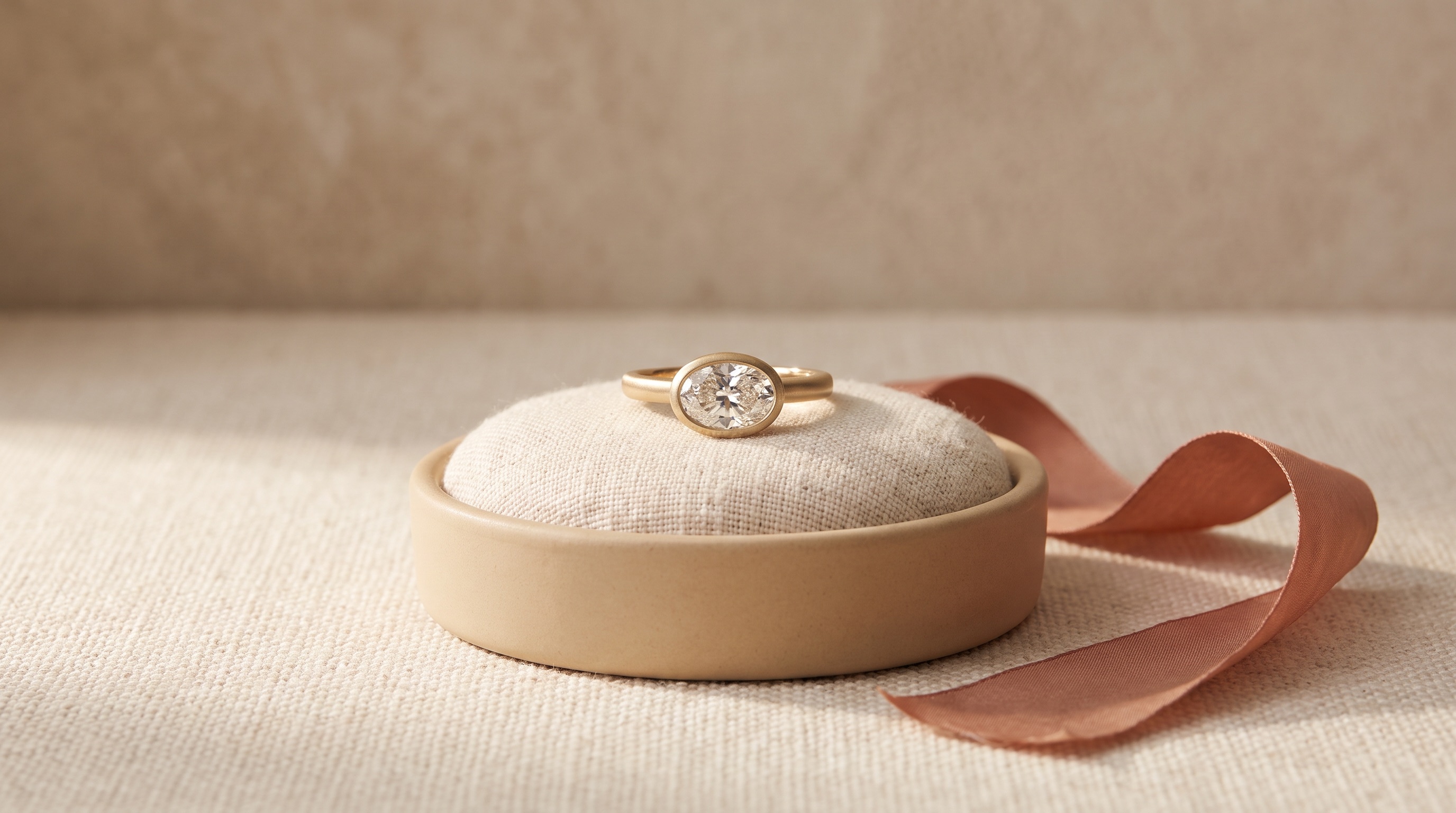
An east-west setting orients an elongated diamond — most commonly oval, marquise, or pear — horizontally across the finger rather than in the traditional north-south vertical orientation. The name comes from a compass-direction convention used in the trade to describe stone orientation: north-south is the standard lengthwise-up-the-finger placement, and east-west rotates that ninety degrees so the stone's long axis runs across the finger instead. What started as a niche fashion statement has moved into steadier mainstream demand over the past several years, appearing across engagement rings, stacking bands, and statement fashion pieces.
This guide is written for the trade — jewelers, designers, and manufacturers sourcing diamonds and evaluating setting approaches for east-west designs. It covers which shapes suit the orientation, stone selection and proportion considerations specific to east-west placement, setting security and durability, and what to look for in a wholesale supplier and manufacturing partner for this category.
Why Orientation Matters for Elongated Shapes
For a round or square stone, orientation is irrelevant — the shape reads identically no matter how it's rotated. Elongated shapes are different: an oval, marquise, pear, or emerald-cut stone has a clear long axis, and rotating that axis changes both the visual silhouette of the finished ring and, in some cases, the structural demands the setting has to meet. A north-south oval or marquise elongates the finger visually, following the hand's natural line; an east-west orientation instead creates a horizontal accent that reads as more architectural and fashion-forward, breaking from the traditional lengthwise convention that's dominated engagement and statement ring design for most of the format's history.
Which Shapes Work Best East-West
| Shape | East-West Suitability | Design Notes |
|---|---|---|
| Oval | Excellent — the most common east-west choice | Smooth, elongated silhouette reads well in either orientation; no pointed ends to protect |
| Marquise | Excellent — a strong, dramatic statement | Both pointed ends need V-prong protection regardless of orientation; east-west accentuates the shape's drama |
| Pear | Good — distinctive, asymmetric look | The single point still needs protection; east-west placement is a bolder, less traditional choice than the standard point-down orientation |
| Emerald | Good, less common | Step-cut faceting reads differently on its side; works best in a minimalist, architectural design context |
| Round, princess, cushion, asscher | Not applicable | No meaningful long axis, so orientation doesn't change the shape's appearance |
Setting Security for East-West Oriented Stones
Rotating an elongated stone ninety degrees changes how it interacts with the hand during normal daily activity and wear, which has real, practical implications for setting security that a jeweler should plan for deliberately. A north-south marquise or pear has its points aligned along the finger's length, generally out of the most direct line of everyday knocks; rotated east-west, those same points now project toward the sides of the hand, a position more exposed to catching on door frames, bag straps, and other objects encountered during normal daily movement. This makes robust point protection — sturdy V-prongs or reinforced tips at both ends of a marquise, or at the single point of a pear — even more important for an east-west setting than for the same shape in its traditional orientation, and buyers sourcing melee or center stones for east-west designs should confirm the setting plan accounts for this added exposure rather than defaulting to standard prong specifications used for north-south settings.
Proportion Considerations for East-West Center Stones
Because an east-west stone's long axis runs across a finger that's narrower than most fingers are long, an east-west center stone generally needs to be sized with the finger's actual width in mind rather than simply matching whatever length would look proportional in a north-south setting. A stone cut with a very elongated length-to-width ratio can end up overhanging the sides of a narrower finger when rotated horizontally, in a way that wouldn't be an issue in the traditional vertical orientation — buyers specifying a center stone for an east-west design should provide the intended ring size and shank width to a cutter or supplier so the stone's length can be matched to what will actually sit comfortably and proportionally across the specific finger the ring is being made for, rather than sourcing to a generic length-to-width target.
East-West Settings in Engagement Rings
East-west has grown from a fashion-ring novelty into a genuine, if still minority, engagement ring choice, appealing to buyers who want a distinctive silhouette that breaks from convention while still centering a single, substantial diamond the way a traditional solitaire does. Solitaire and simple three-stone designs both adapt to an east-west orientation, though a three-stone east-west design requires more deliberate planning for how the side stones relate to the horizontally placed center stone than a standard vertical three-stone layout does, since the visual flow between center and side stones changes when the center stone's axis is rotated.
East-West in Fashion and Statement Jewelry
Beyond bridal use, east-west orientation appears frequently in cocktail rings, stacking bands, and other statement fashion pieces, where the horizontal accent reads as a deliberate, modern design choice distinct from the vertical convention dominating most traditional ring design. A row of several smaller east-west-oriented stones across a wider band face is a increasingly common contemporary design, offering a horizontal visual rhythm distinct from the vertical elongation a north-south row of stones would create along the same band.
Certification and Sourcing for East-West Center Stones
Certification standards for east-west center stones follow the same thresholds as any other loose diamond — IGI, GIA, or GCAL certification is standard at 0.30ct and above, regardless of the intended setting orientation, since a stone's grading (color, clarity, cut, carat weight) doesn't change based on how it will eventually be rotated in a setting. What does matter at the sourcing stage is confirming actual measured length and width dimensions from the supplier, rather than relying on carat weight alone, since orientation-specific fit against a finger's width depends on the stone's actual proportions rather than its weight.
Natural vs. Lab-Grown Diamonds for East-West Designs
Both natural and CVD lab-grown diamonds work identically in an east-west setting, since the orientation choice is a design and setting decision rather than one connected to the stone's origin. Lab-grown material lets a buyer source a larger elongated center stone — where the visual impact of the horizontal orientation scales with size — at a more accessible price point, while natural stones remain the choice for buyers positioning an east-west piece at a higher luxury tier or building around a specific natural fancy-shape stone already in hand.
Common Sourcing and Setting Mistakes
- Underestimating point exposure on a rotated marquise or pear. Points that sit relatively protected in a north-south orientation become more exposed when rotated east-west, and prong specifications should be adjusted accordingly rather than carried over unchanged from a standard vertical setting.
- Sourcing to a generic length-to-width ratio without confirming finger width. An elongated stone proportioned well for a north-south setting can overhang a narrower finger once rotated horizontally — proportion should be checked against the actual intended ring size.
- Treating east-west as a simple ninety-degree rotation with no other design changes. Side stones, halo shape, and shank profile often need to be reconsidered for an east-west layout rather than simply carried over unchanged from a north-south design template.
Merchandising East-West Designs
East-west pieces merchandise well when presented alongside their north-south equivalent so a customer can directly compare the two orientations on the same shape and size — since the visual difference between the two is significant enough that customers often have a strong, immediate preference once they see both side by side, but may not have considered the horizontal option at all without seeing it presented as a real alternative. Staff should be prepared to explain the point-protection considerations specific to a rotated marquise or pear honestly, since a customer choosing this style for its distinctive look benefits from understanding the setting requirements that keep it durable for daily wear — a brief, matter-of-fact explanation at the counter tends to build more trust than either omitting the topic or over-emphasizing it as a risk.
Building an East-West Product Line
A well-rounded east-west offering typically includes oval as the most versatile and widely appealing entry point, marquise or pear for buyers wanting a bolder, more dramatic statement, and at least one three-stone or halo variation for buyers wanting more than a simple solitaire silhouette. Retailers building this category benefit from a supplier who can source elongated center stones specifically measured and matched to common ring-size and shank-width combinations, since the proportion-to-finger-width consideration is more central to this category's sourcing than it is for a standard north-south solitaire.
History and Rise of East-West as a Named Trend
East-west placement isn't a new construction technique — jewelers have occasionally set elongated stones horizontally for as long as fancy shapes have existed — but its emergence as a specifically named, actively marketed design category is a more recent development, tracking closely with the broader shift toward non-traditional engagement ring styling over the past decade. As buyers increasingly sought engagement rings that felt personal and distinctive rather than following a single dominant template, orientation itself became one of the more accessible ways to differentiate a design without changing the underlying shape or stone choice — a buyer who loves oval but wants something visibly different from the standard oval solitaire can get that distinction simply by rotating the stone, without needing to choose an entirely different shape or take on the added cost and sourcing complexity of an unusual center-stone shape. This makes east-west a relatively low-cost way for both retailers and custom-design buyers to offer genuine visual differentiation within a familiar, well-understood shape category.
Manufacturing Considerations for East-West Settings
Setting an elongated stone horizontally changes the shank and head geometry a manufacturer has to account for relative to a standard vertical setting. Because the stone's long axis now runs across the band rather than along it, the setting head typically needs a wider footprint across the shank than a vertical setting of the same stone would require, which affects how the head transitions into the shank on either side and how comfortably the finished ring sits against an adjacent ring in a stack. Manufacturers building east-west designs should confirm the setting head's width is proportioned to the specific shank width and ring size the piece is being made for, since a head sized generically without this consideration can end up feeling disproportionate or uncomfortable on the hand compared with a properly fitted vertical setting of similar visual weight. Prong placement also differs: rather than prongs positioned at the traditional twelve, three, six, and nine o'clock points relative to the finger, an east-west setting's prongs are typically rotated with the stone, meaning the points needing the most protection — a marquise or pear's tips — now sit at the ring's most exposed lateral positions rather than along its more protected lengthwise axis, reinforcing the point made above about prong specification needing to account for the rotation. A manufacturer new to east-west production should build and review a physical sample before committing to a full run, since these geometry differences are easier to catch and correct on a single sample than after a batch of finished pieces has already been produced to an unproven head design.
Comparing East-West to Other Non-Traditional Orientations
| Orientation Trend | What Rotates | Typical Shapes |
|---|---|---|
| East-west | The center stone's long axis, from vertical to horizontal | Oval, marquise, pear, emerald |
| Toi et moi | Not a rotation — two co-equal stones placed side by side | Any pairing of complementary shapes |
| Asymmetric / off-center | The stone's position relative to the shank's centerline, not its axis | Any shape, most often paired with an off-center halo or accent cluster |
These trends are sometimes combined — an east-west oriented stone set slightly off-center, for instance, or paired with a second smaller stone in a toi-et-moi-adjacent design — giving retailers and custom-design buyers a range of ways to differentiate a piece from the conventional single-stone, centered, vertical solitaire without abandoning familiar shapes and stone choices customers already understand, recognize, and actively want to buy.
Durability and Everyday Wear Considerations
Beyond the point-protection concerns already covered for marquise and pear shapes, buyers should also consider how an east-west stone's rotated profile interacts with everyday hand movements more broadly — a horizontally oriented elongated stone can project slightly further to the sides of the hand than the same stone would in a vertical orientation, which is worth factoring into prong height and overall setting height decisions for a customer with an active lifestyle or a manual occupation. This isn't a reason to avoid the style, but it is a legitimate durability conversation worth having with a customer choosing east-west for a ring intended for genuine daily wear rather than occasional-wear statement jewelry, similar to the durability conversations that apply to other statement-forward setting choices covered elsewhere on this site — an honest conversation up front generally produces a happier long-term customer than glossing over the tradeoff at the point of sale.
Photographing and Displaying East-West Pieces
Because an east-west ring's defining feature is specifically the horizontal orientation, product photography should be shot from an angle that makes the rotation immediately clear — a straight top-down shot works well for this, more so than an angled hand-shot that can make it harder for an online shopper to immediately register that the stone is oriented differently from a standard vertical setting. In-store, displaying an east-west piece directly beside its vertical equivalent, as noted above for merchandising purposes, also serves a secondary photography and marketing purpose: a single comparison image often communicates the design distinction more effectively than a written product description could on its own, particularly for online shoppers who may not be familiar with "east-west" as trade terminology.
Custom vs. Ready-to-Wear East-West Sourcing
Because east-west remains a minority style choice relative to standard vertical settings, retailers have to decide whether to stock ready-to-wear east-west pieces in standard sizes and common shapes, rely on custom production for customer-specific requests, or some combination of both. A ready-to-wear approach works best for the most popular east-west combination — typically a moderate-carat oval solitaire — where demand is predictable enough to justify standing inventory, while custom production makes more sense for marquise, pear, or larger statement pieces where individual proportion matching to the customer's finger and stone preference matters more and demand for those combinations is less predictable across a broader retail customer base than a standard oval solitaire. Retailers new to the category often start with a small ready-to-wear oval offering to gauge customer interest before investing more heavily in a broader east-west program across additional shapes and price tiers, expanding into marquise and pear once the initial offering demonstrates real sell-through.
Sourcing East-West Setting Diamonds Wholesale
Guru Diam supplies certified loose diamonds across oval, marquise, pear, and other fancy shapes suited to east-west design, in both CVD lab-grown and natural material, with IGI, GIA, and GCAL certification available at 0.30ct and above and measured dimensions confirmed rather than estimated from carat weight. Cutting, setting, and polishing are handled in-house, and in-stock inventory ships same-day (before 6pm EST from New York, before 4pm PST from Los Angeles). Trade buyers can browse certified center stones through certified diamonds, and a custom east-west design — solitaire, three-stone, or halo — can be started through custom jewelry. New trade accounts can review terms at the wholesale hub or apply through trade partner. For sourcing guidance on the shapes most commonly used east-west, see our marquise diamond buying guide and engagement ring settings guide.
Frequently Asked Questions
What is an east-west setting?
An east-west setting orients an elongated diamond — most commonly oval, marquise, or pear — horizontally across the finger rather than in the traditional vertical (north-south) orientation, creating a distinctive, fashion-forward silhouette.
Which diamond shapes work best in an east-west setting?
Oval is the most common and versatile choice, since it has no pointed ends to protect and reads smoothly in either orientation. Marquise and pear are also popular for a bolder statement, though both need robust point protection given their added exposure once rotated horizontally.
Is an east-west setting less secure than a traditional vertical setting?
Not inherently, but the points of a marquise or pear are more exposed to everyday knocks once rotated east-west, so those points need sturdier V-prong protection than the same shape would typically require in its traditional vertical orientation.
Can an east-west stone overhang the finger?
It can, if the stone's length-to-width ratio isn't matched to the actual ring size and shank width — a proportion that reads well in a north-south setting can overhang a narrower finger once rotated horizontally, so sourcing should account for the specific finger the ring is made for.
Are east-west engagement rings a growing trend?
Yes — east-west has moved from a niche fashion statement into steadier mainstream demand over the past several years, appearing across engagement rings, stacking bands, and statement fashion pieces alongside its more traditional vertical orientation.
Should east-west center stones be lab-grown or natural?
Both work identically once set, since orientation is a design choice unrelated to origin. Lab-grown material lets a buyer source a larger elongated center stone at a more accessible price point, while natural stones suit buyers positioning the piece at a higher luxury tier.
Can an east-west setting be combined with a halo or three-stone design?
Yes — both work with an east-west center stone, though the side stones and halo shape typically need to be reconsidered rather than carried over unchanged from a standard vertical design, since the visual flow between the center stone and its surrounding elements changes once the center stone's axis is rotated.
Does an east-west setting require a wider shank?
Often a somewhat wider setting head is needed to accommodate the stone's horizontal footprint across the band, though this should be proportioned to the specific ring size and stone dimensions rather than applied as a fixed rule — a manufacturer experienced with east-west construction can confirm the right head width for a given design.