Diamond windowing is a cut-quality defect where, viewed face-up, light passes straight through the stone's pavilion instead of reflecting back to the eye — creating a visible "window" through the center of the diamond, where you can see the setting, a finger, or a printed page underneath, instead of internal brilliance and fire. It happens when the pavilion is cut too shallow (or, less often, too deep) relative to the crown and table, and it's a term used constantly in wholesale QC but rarely explained clearly for buyers screening stones before resale.
What Causes Windowing
A diamond returns light to the eye through a specific internal path: light enters through the crown and table, travels down through the stone, hits the pavilion facets, and — if those facets are angled correctly — reflects internally off two or more pavilion walls before exiting back out through the crown as brilliance and fire. That reflection depends entirely on the pavilion's angle and depth relative to the crown angle and table size sitting above it. When the pavilion is cut too shallow, light hits the pavilion facets at an angle too close to perpendicular and simply passes through and out the bottom of the stone instead of bouncing back up, so instead of internal fire and sparkle the eye sees straight through to whatever is beneath the stone. A pavilion cut noticeably too deep can produce a related but distinct problem — light escaping out the sides before it completes the reflection path — which more often shows up as a dark center ("nailhead") than a true see-through window, though severe over-depth on certain shapes can still produce partial windowing at the stone's edges.
The economic driver behind shallow-cut windowing is straightforward and worth understanding, because it isn't accidental. Cutting a pavilion shallower than optimal preserves more face-up diameter — and therefore more visual size and spread — from a given piece of rough or a given carat weight, compared to cutting it to ideal proportions. A cutter prioritizing yield and face-up spread over light performance will shave pavilion depth to keep the stone looking larger for its weight, and the tradeoff shows up exactly where you'd expect: reduced brilliance, sometimes to the point of a visible window. This is a deliberate cutting choice, not a manufacturing accident, which is why windowing shows up disproportionately in commercial-grade goods cut to maximize carat retention rather than optical performance.
Why Step Cuts Show Windowing More Than Round Brilliants
Windowing can technically occur on any diamond shape, but it's far more visually obvious on some cuts than others, and the reason comes down to facet structure rather than anything inherent to the shape itself.
Emerald, Asscher, and Other Step Cuts
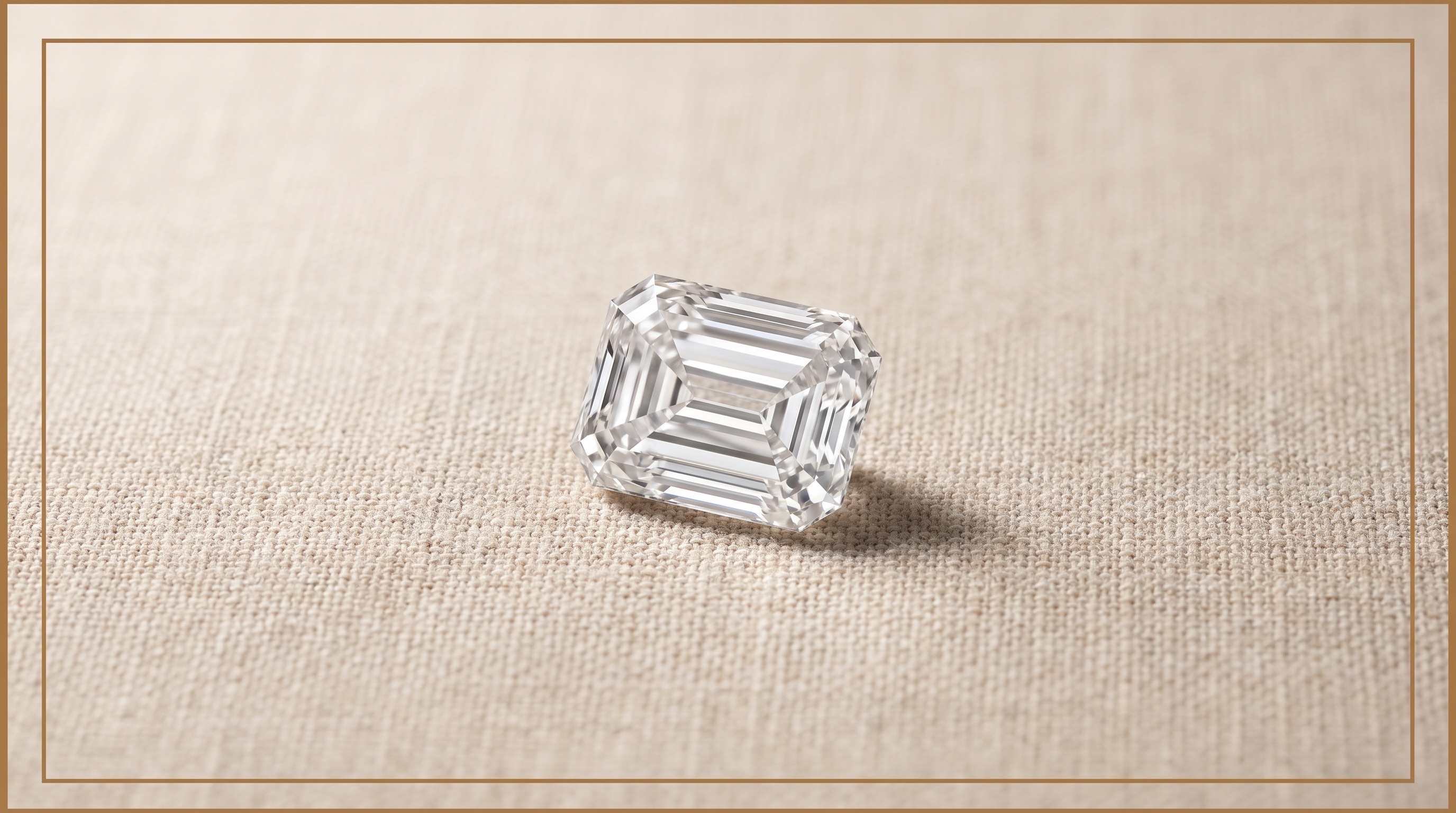
Step-cut shapes — emerald and Asscher chief among them — are built from broad, parallel, rectangular or trapezoidal facets arranged in concentric "steps," with a large, open, unbroken table. That open facet structure is exactly what gives a well-cut emerald cut its distinctive hall-of-mirrors flash, but it also means there's nothing breaking up the view straight through the stone if the pavilion fails to reflect light properly. A windowed emerald cut shows a large, obvious, uninterrupted dead zone across the center of the table, because the same open facets that create the shape's signature look also remove any visual noise that would otherwise camouflage a light-leakage problem. This is the core reason "windowing" is discussed constantly in trade contexts around emerald and Asscher cuts specifically — the defect isn't more common on step cuts, it's simply far more visible.
Round Brilliants and Other Small-Facet Cuts
A round brilliant is cut with 57 or 58 small facets in a specific pattern designed to break light into many small reflective zones. That fragmented facet structure means that even when a round brilliant's pavilion is cut too shallow, the resulting light leakage tends to show up as a diffuse, less obviously "see-through" effect — sometimes described as a washed-out or grayish look, or a "fisheye" ring reflecting the girdle back through the table — rather than one clean window you could read a newspaper through. The underlying optical problem is the same; the round brilliant's dozens of small facets are just much better at disguising it than a step cut's handful of large ones. This doesn't mean round brilliants are exempt from windowing — a severely shallow round brilliant absolutely windows — it means the defect has to be considerably worse before it becomes as visually obvious as it would be on an equivalently shallow emerald cut.
Mixed and Modified Cuts (Radiant, Cushion, Oval)
Radiant, cushion, oval, and similar mixed cuts sit in between, combining brilliant-style faceting with some larger step-cut-style facets depending on the specific cutting house's pattern. These shapes carry a moderate windowing risk — more visually obvious than a round brilliant if the pavilion is off, but less immediately obvious than a true step cut, since some facet fragmentation is still present to help disguise a shallow center. Elongated shapes like oval, marquise, and pear also carry a separate, related optical issue worth distinguishing from windowing: the "bowtie" effect, a dark (not see-through) band across the center of the stone caused by facets at the points not reflecting light back correctly. Windowing and bowtie can occur in the same stone but are different phenomena — one is a bright see-through zone, the other a dark shadow zone — and a buyer should evaluate each separately rather than assuming a comment about one covers the other.
How to Spot Windowing With the Naked Eye
Identifying windowing doesn't require lab equipment — it's a visual check anyone can do with the stone in hand and a bit of ambient light, and it's worth doing as a standard part of inspecting any loose stone before stocking it.
- The printed-page test: Hold the stone face-up over a piece of printed text — newsprint, a business card, a printed page — under normal room light. If you can clearly read letters or make out distinct print through the stone's table, that's windowing. A well-cut stone should scatter and obscure whatever is underneath it with internal brilliance, not transmit a legible image of it.
- The finger or setting test: Hold the stone face-up over a finger, or look at it in its setting from directly above. If you can clearly see the shape of the finger or the prongs/setting metal through the center of the stone, rather than seeing fire and scintillation obscuring what's underneath, that's the same effect at work.
- The dead-zone tilt test: Under a single point-light source, slowly rock and tilt the stone. A well-cut stone shows sparkle and scintillation shifting across the entire face as it moves. A windowed stone shows a flat, unchanging, often grayish or washed-out zone at the center that doesn't sparkle along with the rest of the stone, regardless of the angle.
- Direct visual comparison: Placed next to a well-cut stone of the same shape and similar size under the same lighting, a windowed stone's central dead zone is usually obvious by contrast even to an untrained eye, which is why side-by-side comparison is standard practice when screening incoming parcels.
Proportions Behind Windowing: Depth, Table, and Pavilion Angle
Windowing tracks a stone's core proportions — pavilion angle and depth percentage relative to table percentage and crown angle — closely enough that these numbers, where available on a report, are a useful first-pass screening tool before ever looking at the physical stone. These are general trade rules of thumb rather than official lab thresholds (particularly for step cuts, which no major lab reduces to a single ideal-proportion range the way round brilliants are commonly discussed), so they should guide a closer visual check rather than substitute for one.
| Shape category | Proportion pattern | Windowing likelihood | Typical visual effect |
|---|---|---|---|
| Round brilliant | Shallow pavilion, low overall depth %, often paired with a larger table % | Elevated | Washed-out center or "fisheye" ring reflecting the girdle |
| Round brilliant | Depth and table % within commonly cited well-cut ranges, pavilion angle in the low-to-mid 40s | Low | Even brilliance and scintillation across the face |
| Round brilliant | Notably deep pavilion, high overall depth % | Low for true windowing, moderate for a dark center | "Nailhead" dark zone more often than a see-through window |
| Emerald / Asscher (step cut) | Shallow pavilion relative to table size | High | Large, obvious see-through zone across most of the table |
| Emerald / Asscher (step cut) | Pavilion depth proportioned to the table and crown for the specific cutting house's standard | Low | Characteristic step-cut "hall of mirrors" flash with no dead zone |
| Radiant / Cushion (mixed cut) | Shallow pavilion | Moderate | Partial see-through zone, softened somewhat by brilliant-style facets |
Because these thresholds are trade rules of thumb rather than lab-defined cutoffs — especially outside round brilliants — proportions on a report are best used to flag a stone for closer visual inspection, not as a final pass/fail decision on their own.
Windowing by Shape: Relative Risk at a Glance
| Shape | Facet style | Relative windowing risk | Why |
|---|---|---|---|
| Round Brilliant | 57-58 small brilliant facets | Low-moderate | Fragmented facets disguise moderate light leakage; severe cases still show a diffuse dead zone |
| Princess | Brilliant-style facets in a square outline | Low-moderate | Similar facet fragmentation to round brilliant, somewhat less forgiving at the corners |
| Emerald | Open, rectangular step-cut facets | High | Large unbroken table offers no visual camouflage for a shallow pavilion |
| Asscher | Square step-cut facets | High | Same open step-cut structure as emerald cut in a square outline |
| Radiant | Hybrid brilliant + step facets | Moderate | Partial facet fragmentation softens, but doesn't eliminate, a shallow-pavilion window |
| Cushion | Brilliant-style facets, larger and fewer than a round | Moderate | Larger individual facets than a round brilliant provide less camouflage |
| Oval / Pear / Marquise | Brilliant-style, elongated | Moderate | Can combine windowing with a separate bowtie effect at the points; evaluate each independently |
Windowing and Value: The Spread-for-Brilliance Tradeoff
Windowing is not a scam or a hidden manufacturing flaw — it's a real, visible tradeoff a buyer should be able to identify and price accordingly. A windowed stone genuinely does face up larger for its carat weight than an equivalently sized, properly cut stone, because the shallow pavilion that causes the window is the same shallow pavilion that preserves face-up diameter. For a buyer or end customer prioritizing visual size over light performance — and some genuinely do, particularly at lower price points where spread matters more to the eye than fire — a windowed stone isn't necessarily the wrong purchase. The problem is when a windowed stone is priced or represented as though its proportions were optically ideal, without the buyer understanding what they're trading away. A wholesale buyer screening inventory should treat windowing as a proportion-driven characteristic to price into the stone, the same way color and clarity are priced in, rather than either an automatic disqualifier or something to ignore entirely.
What Grading Reports Do (and Don't) Show About Windowing
For round brilliants, GIA's overall cut grade — Excellent through Poor — already factors in pavilion angle, table percentage, depth percentage, crown angle, girdle thickness, and symmetry together, so a stone graded Excellent or Very Good cut has already been screened against the proportion combinations most associated with windowing. That summary cut grade is round-brilliant-specific, though: GIA does not assign an overall cut grade to fancy shapes, including emerald and Asscher — the exact shapes where windowing is most visually obvious in the first place. Other labs vary in how broadly they extend a summary cut grade beyond round brilliants, so it's worth checking what a specific report actually includes rather than assuming none exists.
For any stone without a summary cut grade, the individual proportion fields still on the report — table percentage, depth percentage, pavilion angle, crown angle, girdle thickness — become the buyer's own proxy for windowing risk, used the way described in the proportion table above. But because these are proxies rather than a pass/fail summary, and because two stones with near-identical proportion numbers can still cut noticeably differently in practice, a report alone can flag risk but can't confirm the absence of a window. For fancy shapes specifically, a physical or video inspection remains the only reliable final check.
How Wholesale Buyers Should Screen Inventory for Windowing
For a trade buyer stocking inventory for resale, windowing is a QC issue worth building into a standard intake process rather than catching after a customer complaint:
- Pull proportions before physical inspection. Request table %, depth %, pavilion angle, crown angle, and girdle thickness for every incoming stone, particularly step cuts and other fancy shapes without a summary cut grade — this flags likely problem stones before you even open the parcel.
- Never buy fancy shapes sight-unseen on numbers alone. Proportions are a screening tool, not a substitute for a face-up video or in-person look, especially for emerald, Asscher, and other open-table shapes where windowing is easiest to see and most damaging to resale if missed.
- Run the printed-page and tilt tests on every step-cut stone at intake. These take seconds per stone and catch the defect that's hardest to disguise on exactly the shapes most prone to it.
- Screen matched pairs for consistency, not just individually. Two stones can each pass an individual inspection while still mismatching badly once set side by side as earrings — a mild window on one twin reads as an obvious flaw next to a twin without one, even if neither stone alone would be rejected. See GD's matching pairs category for stones pre-screened as sets rather than assembled after the fact.
- Price windowed stones for what they are, not against ideal-cut comparables. A spready, windowed stone can still move as inventory at the right price point and with honest representation — the QC failure is selling it at a well-cut stone's price, not stocking it at all.
Is Windowing Worse in Lab-Grown Diamonds?
No — windowing is purely a function of cutting proportions, not growth origin. A CVD lab-grown diamond cut to a shallow pavilion windows exactly the same way a natural diamond cut to the same proportions would, because the underlying physics is identical: both are chemically, optically, and physically the same material, and light behaves identically through both once the rough or grown crystal has been faceted. Whatever drives a cutter's decision to prioritize face-up spread over light performance — yield economics, a specific market's preference for larger-looking stones at a given price point — applies independently of whether the crystal started as mined rough or a lab-grown boule. A buyer comparing a natural and a lab-grown stone of the same shape and similar proportions should expect windowing risk to track the numbers and the physical inspection identically on both, with origin simply not a relevant variable in the assessment.
Practical Buying Guidance
A few habits go a long way toward avoiding an unpleasant surprise on a windowed stone, whether buying for personal use or for resale inventory: always ask for the actual proportion numbers, not just carat, color, and clarity, especially on emerald, Asscher, radiant, and cushion cuts; request a face-up video under normal light rather than relying on a studio-lit product photo, since photography under controlled lighting can make a windowed stone's face-up appearance look better than it does under everyday conditions; run the printed-page or finger test yourself whenever a physical stone is in hand before finalizing a purchase; and if a stone does show some windowing, treat it as a factor in the price negotiation rather than either a dealbreaker or something to ignore — a spready, budget-friendly stone with a known, disclosed window is a legitimate product for the right buyer, as long as everyone involved understands what they're getting.
Sourcing Windowing-Screened Inventory Through Guru Diam
Guru Diam supplies certified loose diamonds — CVD lab-grown and natural, across round, step-cut, and antique shapes — with full proportion data, including table percentage, depth percentage, and pavilion angle, available on every graded stone, so buyers can screen for windowing risk before a stone ever ships. IGI, GIA, and GCAL certification are all available depending on the stone. Because fancy color stones and step-cut shapes are a real part of the catalog rather than an afterthought, buyers sourcing emerald, Asscher, or radiant cuts specifically — the shapes where windowing is most visible and most worth checking — get full proportion reporting rather than certificate numbers alone. In-stock loose stones ship same-day from Guru Diam's New York and Los Angeles locations (NYC orders before 6pm EST, LA before 4pm PST); a stone destined for a custom setting can move directly into a build finished in 4-6 days once mounted.
Browse certified stones with full proportion reporting through certified diamonds, review fancy color step-cut and round options under fancy color loose diamonds, and check matched-set inventory pre-screened for consistency under matching pairs. Set up a trade account through trade partner to review full proportion data directly, or start at the wholesale hub for general wholesale sourcing. A windowed stone already on hand can also be reset into a design — like a halo or bezel — through custom jewelry, which can soften a visible window's impact on the finished piece's overall look.
Frequently Asked Questions
What is diamond windowing?
Diamond windowing is a cut-quality defect where, viewed face-up, light passes straight through the stone's pavilion instead of reflecting back to the eye, creating a visible see-through zone at the center of the diamond. Instead of internal brilliance and fire, you see the setting, a finger, or whatever is underneath the stone.
What causes diamond windowing?
Windowing is caused by a pavilion cut too shallow relative to the crown and table, so light exits through the bottom of the stone instead of reflecting internally back up through the crown. It's usually a deliberate cutting choice that preserves more face-up size and spread from a given piece of rough, traded off against light performance.
Why do emerald cut diamonds window more than round diamonds?
Emerald and other step cuts use large, open, unbroken facets and a wide table, so there's nothing to visually break up a see-through zone if the pavilion doesn't reflect light properly. Round brilliants have 57-58 small facets that fragment the view and disguise moderate light leakage far more effectively, even though the same underlying proportion problem can still occur.
How do you check for windowing before buying a diamond?
Hold the stone face-up over a printed page or your finger under normal light — if you can clearly see print or the shape of your finger through the center, that's windowing. You can also tilt the stone under a point light source and look for a flat, unchanging dead zone at the center while the rest of the stone sparkles.
Does a diamond report show windowing?
Not directly as a labeled defect, but the proportion fields on the report — table percentage, depth percentage, pavilion angle, and crown angle — act as a proxy for windowing risk. GIA's overall cut grade for round brilliants already accounts for these together, but no major lab issues a summary cut grade for emerald, Asscher, or most other fancy shapes, so a physical or video inspection is still the reliable final check on those.
Is diamond windowing worse in lab-grown diamonds than natural diamonds?
No. Windowing is purely a function of cutting proportions, not growth origin — a CVD lab-grown diamond and a natural diamond cut to the same shallow pavilion angle will window identically, since both are optically and physically the same material. Origin isn't a relevant variable in windowing risk; the proportions and the cutter's choices are what matter.