A diamond wedding band is a ring — worn by any partner in a marriage, not gender-specific — set with diamonds along part or all of its circumference, typically worn stacked with or in place of a plain metal band. For a jeweler or manufacturer, "diamond wedding band" isn't one product but a wide category spanning eternity coverage, channel and prong settings, and a broad carat-weight range, and building a wholesale inventory position in this category means understanding how those sub-types differ before placing a stocking order.
This guide covers diamond wedding bands from the sourcing side: the style and setting sub-categories that make up wholesale demand, how carat weight and diamond quality drive pricing, and what to evaluate in a supplier before committing to a stocking program.
What Counts as a Diamond Wedding Band
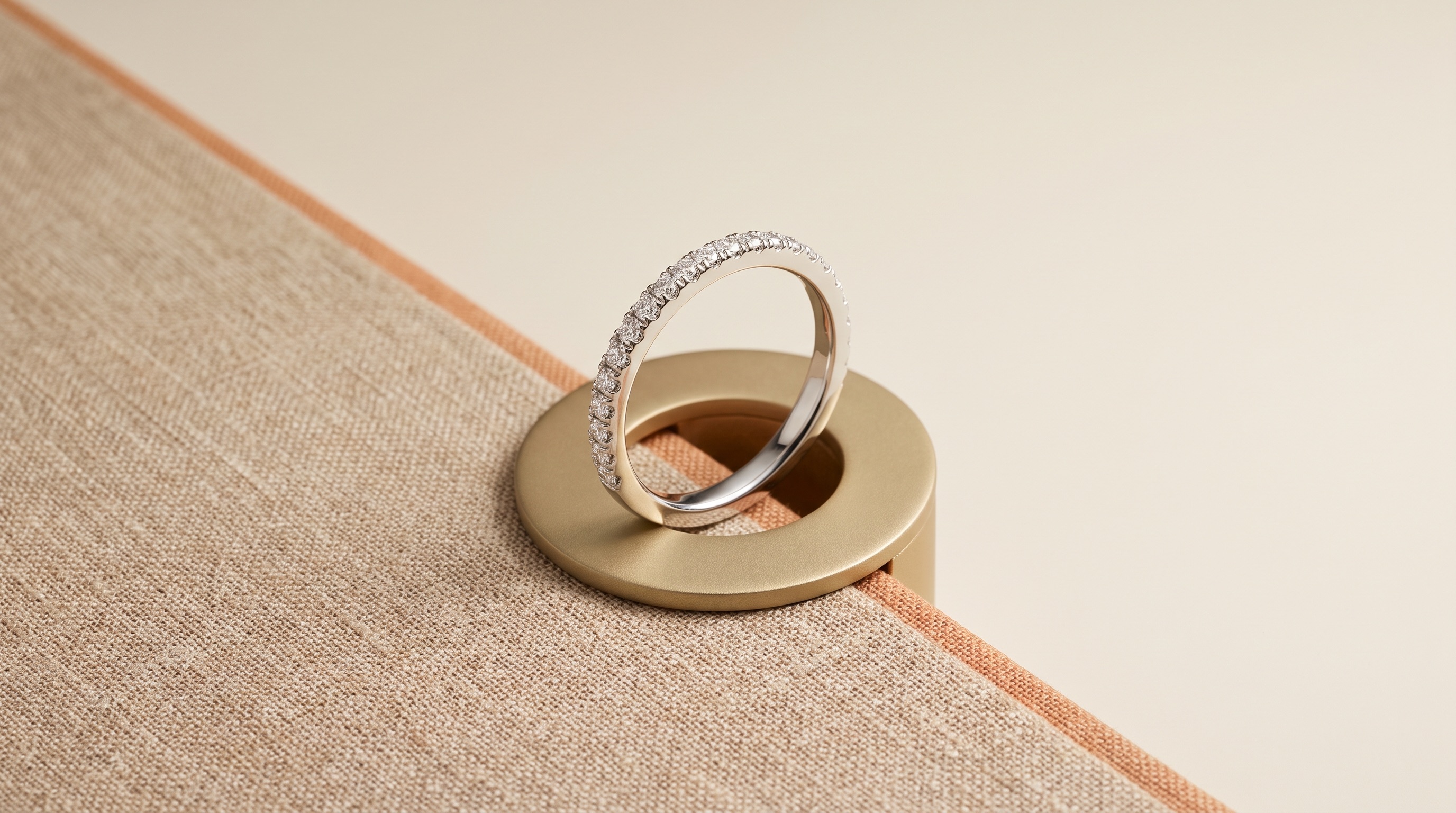
A diamond wedding band sits in the same product family as a plain metal wedding band, but with diamonds set into the ring — usually as an eternity band (diamonds continuously around the full circumference), a half-eternity or three-quarter-eternity band (diamonds across the top or top three-quarters, plain metal underneath for comfort and cost), or a channel or shared-prong band with a lighter diamond accent. Guru Diam treats eternity band as the umbrella product — full, three-quarter, and half eternity, plus plain and diamond wedding variants, are configuration options on one builder rather than separate SKUs, which mirrors how most wholesale buyers actually think about the category: one core product with coverage and setting-style variables layered on top.
Comparing Diamond Wedding Band Styles
| Style | Diamond Coverage | Typical Use Case | Relative Cost |
|---|---|---|---|
| Full eternity | Diamonds around the entire band | Statement piece, worn alone or stacked | Highest |
| Three-quarter eternity | Diamonds across the top ~270° | Balances look of full coverage with comfort/cost of open back | High |
| Half eternity | Diamonds across the top ~180° | Most common everyday-wear compromise | Moderate |
| Channel-set band | Diamonds recessed between two metal rails | Durable, snag-resistant, understated | Moderate |
| Shared-prong band | Diamonds set with shared prongs between stones | Maximizes visible diamond surface for the carat weight used | Moderate to high |
| Plain metal (no diamonds) | None | Traditional band, often paired with a diamond band on the other hand | Lowest |
Carat Weight Tiers a Retailer Should Stock
Diamond wedding bands are typically sold and quoted by total carat weight (TCW) across all stones in the band, not a single center stone, which makes them a different pricing conversation than an engagement ring. A useful stocking range runs from roughly 0.25ct TCW at the entry tier, up through 1ct, 2ct, and 3ct+ TCW for full-eternity statement pieces, with the middle of that range — 0.5ct to 1.5ct TCW half- and three-quarter-eternity bands — covering the bulk of everyday wholesale reorder volume. A retailer building a first diamond wedding band assortment should weight inventory toward that middle tier rather than spreading evenly across the full range, since it reflects where most retail demand actually sits.
Metal and Setting Choices
Diamond wedding bands are most commonly sourced in platinum, 14k or 18k white gold, yellow gold, and rose gold, with white metals (platinum and white gold) historically dominant but rose and yellow gold seeing steady demand growth as a stacking or contrast piece against a white-metal engagement ring. Prong, channel, and shared-prong are the three settings that make up the large majority of wholesale diamond wedding band orders — bezel-set and flush-set bands exist but are a smaller, more specialized request, usually for a buyer specifically seeking a low-profile, catch-free everyday band.
Lab-Grown vs. Natural Diamond Wedding Bands
Because a wedding band typically uses many smaller stones rather than one large center diamond, the cost difference between lab-grown and natural diamonds compounds meaningfully across a full-eternity or high-TCW band — a category where lab-grown's per-carat cost advantage often has the biggest practical effect on final retail price. A retailer building a wedding band assortment should expect steady demand for both origins: lab-grown for buyers prioritizing size and TCW at a given budget, natural for buyers specifically wanting a natural-origin stone regardless of size, and stocking both under one supplier relationship — as Guru Diam does — avoids managing two separate sourcing relationships for what is, from a manufacturing standpoint, the same product built on two different stone origins.
Sizing and Stackability Considerations
Diamond wedding bands are frequently worn stacked against an engagement ring, which means band profile and stone height matter more here than in a standalone ring — a band with high-set prongs or a domed profile can sit awkwardly against a solitaire or halo engagement ring, while a flatter, lower-profile band stacks more comfortably. Retailers building out a wedding band assortment should stock a range of profiles specifically to give customers stacking options against whatever engagement ring style they already own, rather than assuming one universal band shape fits every pairing.
Men's Diamond Wedding Bands as a Distinct Sub-Category
Men's diamond wedding bands have grown into a meaningful sub-category of their own, typically in wider profiles (6mm-9mm vs. 2mm-4mm for a typical women's band), lower-profile flush or channel settings for durability, and often a single row or subtle accent of diamonds rather than full eternity coverage. This is different enough in sizing, setting style, and typical carat weight from the broader diamond wedding band category covered here that a retailer building a men's-specific assortment should treat it as its own planning line rather than assuming general wedding band inventory covers it — Guru Diam's dedicated men's diamond wedding band sourcing guide covers that sub-category directly.
Certification and Quality Standards
Individual stones set into a diamond wedding band are typically small enough (often melee-range, under 0.30ct each) that they ship as uncertified parcel goods against a quality baseline (DEF+ color, VS+ clarity is Guru Diam's standard) rather than individually graded — the same convention used across the melee category generally. A wedding band built around one or more larger center-style stones above 0.30ct would use individually certified stones instead, but this is uncommon for the format; most diamond wedding band demand is melee-driven. A supplier's stated melee quality baseline, not a certification claim, is the right thing to evaluate for this category.
Evaluating a Wholesale Supplier for This Category
A few criteria matter specifically for diamond wedding band sourcing: consistent melee quality and color/clarity matching across a run (visible inconsistency reads poorly in a continuous eternity setting more than almost any other product), availability across the full carat-weight and metal range a retailer wants to stock, turnaround on ring-sizing requests (wedding bands are sized more often post-sale than engagement rings, since they're frequently gifted or purchased slightly ahead of a final fitting), and whether the supplier offers both lab-grown and natural under one relationship. A supplier that can't demonstrate consistent melee matching at scale is a real risk specifically for this category, more so than for single-stone products where matching isn't a factor.
Pricing a Diamond Wedding Band for Resale
Wholesale cost on a diamond wedding band scales primarily with total carat weight and diamond origin (lab-grown vs. natural), with metal type and labor as smaller, more predictable additions on top. Retail markup conventions vary by market and retailer positioning, but the underlying math — wholesale stone cost, plus metal and labor cost, times a retailer's standard margin — is the same as any other diamond jewelry category. Retailers pricing a new wedding band line for the first time should build the calculation stone-cost-first (since that's the largest and most variable input, especially at higher TCW) rather than anchoring on a target retail price and working backward, which can lead to under- or over-estimating true margin at different carat tiers.
Custom and White-Label Wedding Band Programs
Beyond standard catalog bands, many wholesale buyers work with a supplier on custom wedding band programs — a retailer's own branded line, built to specific profile, metal, and carat-weight preferences and sold under the retailer's own name rather than a supplier's. Guru Diam's custom engagement ring program (finished in 4-6 days) extends to wedding bands built alongside a matching engagement ring, unbranded by default so retailers can resell the finished piece as their own.
Seasonal Demand Patterns
Diamond wedding band demand tracks the broader bridal calendar, with the heaviest ordering windows in the months leading into peak wedding season (spring into early summer) and again ahead of the holiday engagement season, when a wave of new engagements in December and January converts into wedding band orders three to twelve months later. A retailer planning wedding band inventory should stock ahead of these windows rather than reactively, given that reorder turnaround on a specific carat weight or metal combination isn't always same-day even with a responsive supplier.
Sourcing Diamond Wedding Bands from Guru Diam
Guru Diam is a trade-only, B2B wholesale diamond and jewelry supplier with locations in New York and Los Angeles, carrying diamond wedding bands across the full eternity-coverage range (full, three-quarter, half, channel, and shared-prong), in both CVD lab-grown and natural diamonds, with IGI, GIA, and GCAL certification available where individual stones qualify for grading. In-stock inventory ships same-day (before 6pm EST from New York, before 4pm PST from Los Angeles), and custom wedding band and engagement ring builds are finished in 4-6 days. As with the rest of Guru Diam's lab-grown catalog, stones are cut and polished at the company's India workshop before final grading and shipment from the New York and Los Angeles locations. New trade accounts can apply through trade partner, and current wedding band and eternity band inventory is browsable at the wholesale hub.
Common Sourcing Mistakes to Avoid
The most common mistake retailers make when building a diamond wedding band assortment is treating it as a scaled-down engagement ring category and stocking accordingly, when in practice wedding band demand skews more toward mid-TCW half- and three-quarter-eternity styles than the carat-weight distribution seen on engagement ring center stones. A second common mistake is under-stocking men's diamond wedding bands as an afterthought category rather than planning for it explicitly, given how much its sizing, profile, and setting preferences diverge from women's bands. Confirming a supplier's melee-matching consistency before a first large order, rather than after receiving a visibly mismatched run, is a third mistake worth avoiding proactively.
Pairing Diamond Wedding Bands with Engagement Ring Styles
Because wedding bands are so frequently purchased and worn alongside an existing engagement ring, retailers benefit from stocking wedding band profiles that pair cleanly with the engagement ring styles they already sell most — a low-profile channel band for a solitaire, a curved or contoured band to nest against a halo setting, or a matching-metal three-quarter eternity band to complement a three-stone ring. Guru Diam's engagement ring styles guide covers the setting styles a wedding band most commonly needs to pair against, and is a useful reference when planning a coordinated bridal assortment rather than sourcing bands and rings as fully separate categories.
Diamond Shape Choices Within a Wedding Band
Round brilliant is by far the dominant shape used in diamond wedding bands, since its faceting is optimized for consistent sparkle at small melee sizes and it's the easiest shape to source in large, matched-quality quantities. Baguette-cut stones (straight or tapered) are the most common alternative, typically used in channel-set bands for a more geometric, Art Deco-influenced look, and occasionally mixed with round melee in an alternating pattern for a band with more visual texture than an all-round design. Fancy calibrated shapes beyond baguette — princess, emerald, or marquise melee — appear occasionally in higher-end custom wedding band orders but represent a small fraction of overall category volume compared to round and baguette, since matching fancy shapes consistently across a full band is more demanding on a supplier's cutting and sorting process.
Return, Exchange, and Resize Policies Retailers Should Set
Because wedding bands are frequently purchased ahead of a final ring-sizing appointment or as a gift, retailers typically need a clearer resize policy for this category than for a standalone fashion ring — most jewelers build in one complimentary resize within a defined window post-purchase, since sizing a diamond-set band (as opposed to a plain metal band) requires more care to avoid disturbing channel or shared-prong settings. When evaluating a wholesale supplier, it's worth confirming whether they offer resizing support or guidance for their own eternity and wedding band settings specifically, since not every setting style resizes with equal ease — full eternity bands with diamonds continuously around the shank are generally the most resize-limited of the styles covered here.
Comparing Wedding Band Sourcing to Engagement Ring Sourcing
Wholesale buyers sometimes assume that a supplier strong in engagement ring center stones will automatically be equally strong in wedding band melee sourcing, but the two categories draw on different parts of a supplier's operation — engagement ring sourcing is about matching one larger stone (or a small number of accent stones) to a specific cut and clarity target, while wedding band sourcing is about consistent quality and color matching across many small stones at scale. A retailer building both categories should confirm a prospective supplier's melee-matching track record specifically, rather than assuming strength in one category implies strength in the other, and a supplier like Guru Diam that carries center-stone diamonds, melee, and finished jewelry under one relationship removes the need to manage that distinction across separate vendors.
Marketing a Diamond Wedding Band Assortment at Retail
Retailers get the most out of a diamond wedding band assortment when it's merchandised as a stacking system rather than as isolated single-ring listings — showing a customer how a specific band pairs with the engagement ring styles already on display, or how two or three thinner bands stack together as an alternative to one wider eternity band, tends to increase attach rate more than presenting wedding bands as a standalone category disconnected from the engagement ring sale. Photography that shows a band worn stacked, not just flat on a tray, reflects how the majority of customers actually intend to wear it, and product copy that calls out coverage type (full, three-quarter, half) and setting style in plain language helps online shoppers self-select the right option without needing to ask a sales associate to explain the difference.
Working With One Supplier Across the Full Bridal Category
Because engagement rings, wedding bands, and anniversary or stacking bands are so frequently purchased as a connected set — either together or over time by the same customer — retailers benefit from a supplier relationship that spans the full bridal category rather than sourcing each piece type separately. A single supplier that carries loose diamonds, finished engagement rings, and wedding bands, in both lab-grown and natural origins, under one account and one shipping relationship simplifies reordering and makes it easier to guarantee a metal and diamond-quality match across a customer's full bridal set. This is the practical version of the "one vendor, one shipment, one relationship" consolidation benefit that recurring wholesale buyers consistently cite as a reason to narrow from several suppliers down to one or two primary relationships.
Durability Considerations for Everyday Wear
A wedding band is worn daily, far more consistently than most other jewelry categories, which makes durability a bigger factor in style selection than it is for an occasion piece. Channel settings, where diamonds sit recessed between two metal rails, tend to hold up best against daily knocks since the metal rail protects the stone's girdle from direct impact, while prong and shared-prong settings offer more visible diamond surface but require periodic prong-tightening checks over years of wear. Platinum, while more expensive than gold, resists prong wear better over time due to its density, which is part of why it remains the most requested metal for full-eternity bands specifically — the style with the most total prongs or channel length exposed to daily contact. Retailers advising customers on band selection should factor in the customer's actual lifestyle and profession (manual work, frequent hand-washing, athletic activity) alongside pure aesthetic preference, since durability mismatches are a common source of post-sale repair requests.
Frequently Asked Questions
What's the difference between a diamond wedding band and an eternity band?
They're largely the same product family — "eternity band" specifically describes full diamond coverage around the ring, while "diamond wedding band" is the broader umbrella term that includes full, three-quarter, and half eternity coverage as well as channel and shared-prong styles with lighter diamond accents.
Should I stock lab-grown or natural diamond wedding bands?
Most retailers stock both — lab-grown for buyers prioritizing total carat weight and size at a given budget, natural for buyers specifically wanting natural-origin stones. Sourcing both from one supplier avoids managing two separate wholesale relationships for the same product category.
What carat weight should a retailer stock most of?
The 0.5ct to 1.5ct total-carat-weight range in half- and three-quarter-eternity styles covers the bulk of everyday wholesale reorder demand, ahead of either the lowest entry tier or full-eternity statement pieces at the top of the range.
Are the diamonds in a wedding band individually certified?
Usually not — most wedding bands use melee-range stones (under 0.30ct each) sold as uncertified parcel goods against a quality baseline like DEF+/VS+, rather than individually graded. A band built around a larger center-style stone above 0.30ct would use certified stones instead, but that's uncommon for this product format.
How is a men's diamond wedding band different from a standard band?
Men's bands typically run wider (6mm-9mm vs. 2mm-4mm), favor lower-profile flush or channel settings for durability, and usually carry a single row or subtle accent of diamonds rather than full eternity coverage — different enough that it's worth planning as its own inventory line.
When is diamond wedding band demand highest?
Demand tracks the bridal calendar, peaking ahead of spring/early-summer wedding season and again several months after the holiday engagement season, as new engagements convert into wedding orders.
Guru Diam is a trade-only wholesale diamond supplier with locations in New York and Los Angeles, carrying diamond wedding bands across the full eternity-coverage range in both lab-grown and natural diamonds. Browse current inventory at the wholesale hub or apply for a trade account through trade partner.