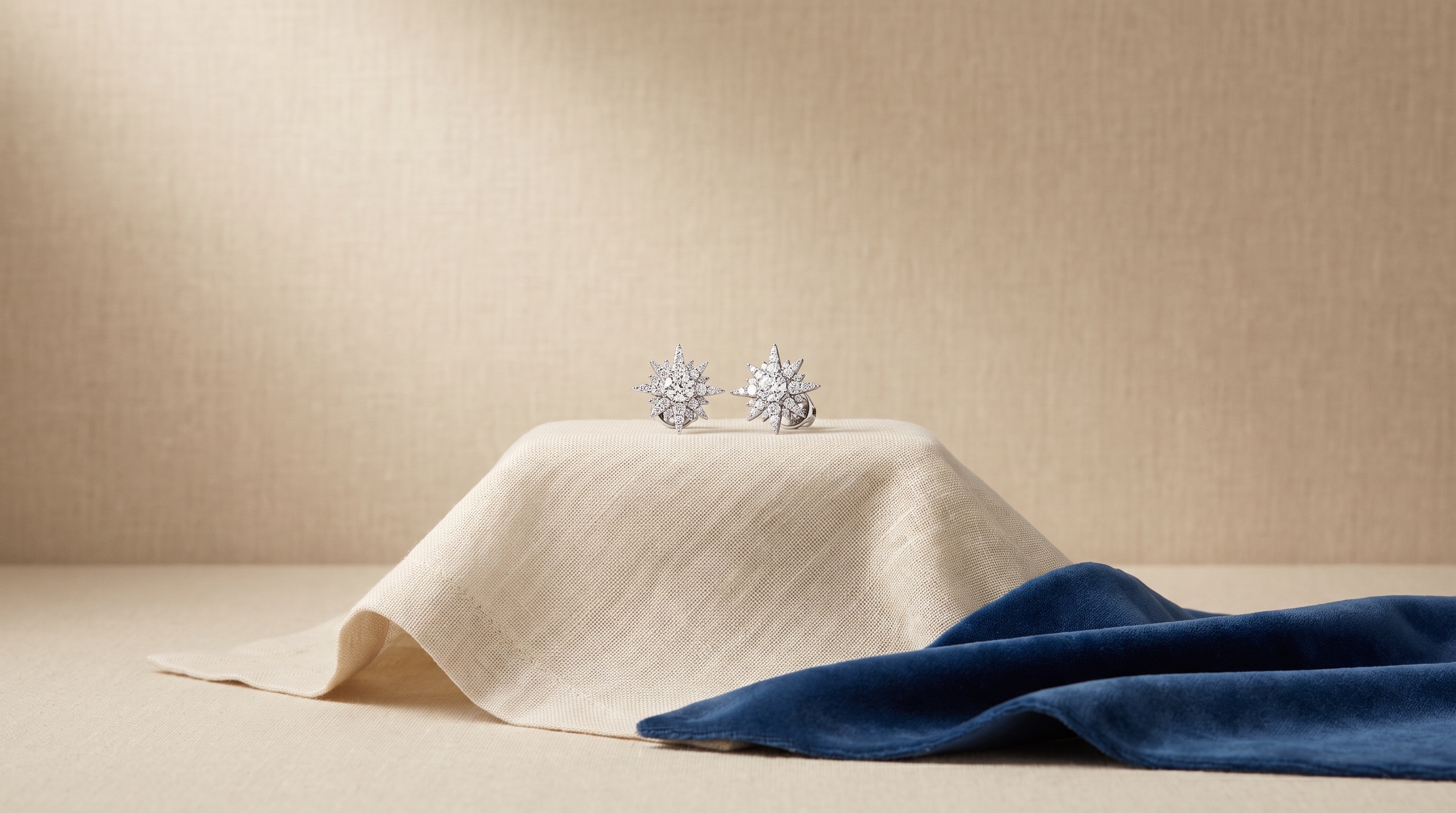
A diamond starburst earring is a stud or drop design built around a radial pattern — small diamonds, typically round brilliant melee, set in lines radiating outward from a central point to create a "sunburst" or "star" shape, sometimes with a slightly larger stone anchoring the center. For a jeweler or manufacturer, the starburst is a pattern-and-stone-count sourcing problem rather than a single-stone one: the finished look depends on how many rays the design carries, how consistently the melee is graded ray to ray, and how precisely the setting work executes a radial layout rather than a simple line or cluster.
This guide is written for the trade — retailers, designers, and manufacturers sourcing loose diamonds and melee to build or expand a starburst earring line, not a consumer shopping guide. It covers construction variants, stone and melee grading standards, setting methods, sizing tiers, certification, private-label considerations, and what to confirm with a wholesale supplier before committing to a starburst production run.
What Defines a Starburst Earring, From a Sourcing Standpoint
Where a cluster earring groups stones into a dense, roughly circular mass and a halo earring rings a single center stone with melee, a starburst earring is organized around radial symmetry — diamonds set in discrete rays or lines running outward from a central axis, with visible negative space (metal or open air) between each ray rather than the packed, edge-to-edge stone coverage of a true cluster. That structural difference matters for sourcing: a starburst design typically needs fewer total stones than an equivalently sized cluster to fill the same visual footprint, but it needs tighter graduation control along each ray, since a starburst's rays are usually built from graduated stone sizes — larger near the center, tapering smaller toward the tips — rather than uniform melee throughout. A buyer specifying a starburst order should think in terms of ray count, per-ray stone graduation, and overall diameter rather than simply requesting "melee for a sunburst design," since those three variables drive both manufacturing complexity and finished cost more than total carat weight alone does.
Stud vs. Drop Starburst Styles
Starburst earrings come in two dominant formats, and the sourcing and pricing profile differs meaningfully between them.
| Factor | Stud Starburst | Drop Starburst |
|---|---|---|
| Typical diameter | 6mm–12mm | 12mm–22mm+, often with a smaller secondary burst above |
| Stone count per earring | 12–24 melee | 18–40+ melee, sometimes across two connected burst elements |
| Matched-pair requirement | High — worn close to the face, symmetry differences are immediately visible | High, plus hang-angle and movement matching between the two drops |
| Manufacturing complexity | Moderate — single flat or slightly domed disc setting | Higher — connector/bail engineering plus a second matched burst if a top stud element is included |
| Typical retail position | Everyday fashion, gifting | Statement, evening, bridal party |
Stud starburst designs are the higher-volume, faster-turning SKU for most retail programs, since the smaller size and flatter setting geometry make them a lower per-unit manufacturing cost and a more universally wearable everyday piece. Drop versions carry more design and engineering variables — connector strength, hang angle, and sometimes a second, smaller burst element at the earlobe — and are typically positioned as a higher price-point statement piece rather than an everyday staple.
Center-Stone Anchored vs. All-Melee Starburst Builds
A starburst design can be built one of two ways, and this is the single most important sourcing decision a manufacturer makes before placing a diamond order. The first approach anchors the design around a modestly larger center stone — often 0.05ct to 0.15ct — with melee rays radiating outward from it, giving the piece a defined visual focal point. The second approach uses graduated melee throughout, with the largest stones simply sitting nearest the center point rather than a single individually distinguished stone, producing a more uniform, textural sparkle without a clear focal stone. Center-stone-anchored builds are marginally easier to certify and describe at retail (the center stone can carry its own grade and, at 0.30ct and above, its own certificate), while all-melee builds are typically priced and sold purely on total carat weight and lot quality grade. Neither approach is more "correct" — the choice is a design and price-point decision, but it needs to be settled before requesting a stone quote, since the two builds pull from different parts of a supplier's inventory (individually graded stones versus graded melee lots).
Melee Grading and Graduation Requirements
Because most starburst designs graduate stone size from center to tip along each ray, melee sourcing for this category needs tighter size-tier discipline than a uniform-size application like a straight pavé line. A typical starburst ray might run three to five distinct size steps — for example 1.5mm at the base tapering to 1.0mm at the tip — and every ray in the finished earring needs to graduate identically, or the burst pattern reads as uneven and asymmetric even when each individual stone is well cut and graded. Buyers should request melee pre-sorted into the specific size tiers a given starburst design calls for, rather than a single mixed-size parcel the setter is expected to sort during production, since sorting error at the bench is one of the more common sources of an uneven-looking finished starburst. Color and clarity consistency matter as much here as size — a commercial-grade DEF+/VS+ standard is typical, with tighter tolerances for a premium line, and the standard should be held consistently across every ray and, critically, across both earrings in a pair.
Setting Methods for Starburst Patterns
Prong-Set Rays
Each stone along a ray is held by individual prongs, which is the more common approach for larger drop starburst designs and for pieces using a distinguishable center stone. Prong setting on graduated melee requires the setter to size each prong to its specific stone rather than using a uniform prong template down the ray, adding bench time relative to a flat pavé approach.
Pavé-Set Rays
Stones sit in channels or shared-bead settings with minimal visible metal between them, producing a denser, more continuous line of sparkle along each ray than individual prong-per-stone construction. Pavé is the more common approach for smaller stud starburst designs, where the compact scale makes individual prong work impractical, but it demands precise channel width control since a graduated ray needs a channel that narrows correctly along its length rather than a single fixed width.
Bead-Set or Micro-Pavé Combination
Some starburst designs mix setting styles within one piece — bead-set melee along the outer rays and prong-set at the center — trading some manufacturing simplicity for a distinctive layered look. This hybrid approach is more common in premium or private-label lines where the added bench complexity is justified by differentiation from standard catalog starburst styles.
Certification Considerations for Starburst Builds
A center-stone-anchored starburst can carry individual certification (IGI, GIA, or GCAL) for the center stone once it reaches 0.30ct, following the same certification threshold used across other center-plus-accent jewelry categories — the surrounding ray melee ships as graded parcel goods against a stated quality baseline rather than individual paperwork. An all-melee starburst build, where no single stone crosses the certification threshold, is typically represented entirely by the supplier's lot-grading statement rather than any individual report. Buyers should confirm which certification model applies to a specific starburst SKU before quoting a retail price, since customers shopping a certified-center piece expect to see that documentation, while an all-melee build is priced and sold on lot quality alone.
Carat Weight and Sizing Tiers
| Starburst Tier | Diameter Range | Typical TCW (per pair) | Common Retail Position |
|---|---|---|---|
| Petite stud | 6mm–8mm | 0.15–0.35 TCW | Everyday fashion, entry price point |
| Standard stud | 8mm–12mm | 0.35–0.75 TCW | Core fashion assortment, gifting |
| Statement drop | 14mm–22mm+ | 0.60–1.50+ TCW | Evening, bridal party, milestone gifting |
As with other melee-driven categories, starburst pricing runs primarily on total carat weight and stone count rather than any single stone's size, since the visual effect comes from the radial pattern rather than one dominant stone. Manufacturers planning a new starburst SKU should specify a target TCW and ray count together, since two starburst designs at the same TCW can look meaningfully different in density and diameter depending on how many rays that weight is spread across.
Metal Choices for Starburst Construction
White gold and platinum are the most common settings for starburst earrings, since a neutral metal tone lets the radial diamond pattern read clearly without visual competition from the setting itself, particularly important in a pattern where negative space between rays is part of the design. Yellow gold starburst designs have grown as a distinct style choice, especially in smaller stud versions where the warmer metal shows through the gaps between rays as an intentional two-tone effect rather than a distraction. Rose gold appears less frequently but has a following in vintage-adjacent and bridal-party gifting lines. Metal choice should be confirmed with a setting partner before finalizing a melee order, since prong and channel dimensions for graduated ray work are sometimes adjusted slightly by metal to account for differences in workability and durability.
Backing Hardware and Structural Considerations
Stud starburst earrings are generally light enough for a standard friction push-back, though larger, denser stud designs benefit from a wider-diameter back to keep the piece from tilting given its broader flat surface area relative to a simple round stud. Drop starburst designs carry an additional structural requirement at the connector between the top stud element and the hanging burst — this joint sees repeated flexing during wear and should be engineered for that stress rather than treated as a simple static connection point, since connector failure is one of the more common points of return or repair in drop-format starburst pieces. Manufacturers should specify backing and connector hardware based on the finished piece's actual size and weight rather than defaulting to standard stud hardware across an entire starburst line that spans both petite and statement sizes.
Private-Label and Custom Starburst Programs
Starburst earrings are a strong candidate for a private-label or custom production program, since the pattern itself is a design category rather than a proprietary construction — a retailer can commission a proprietary ray count, diameter, or graduation pattern that differentiates its own starburst SKU from generic catalog versions without needing to develop an entirely new setting technique from scratch. Custom rings built to a retailer's own specification are unbranded by default at Guru Diam, letting the jeweler resell the finished piece under its own name rather than a supplier's, and the same white-label approach extends to custom finished jewelry more broadly, including starburst earring programs — a relevant option for a retailer building a signature starburst design it wants to own rather than stock as an undifferentiated catalog item. Custom production timelines vary by design complexity, ray count, and setting style, so buyers evaluating a custom starburst program should ask a supplier directly for a timeline specific to that design rather than assuming a standard turnaround applies across all finished-jewelry categories.
Natural vs. Lab-Grown Diamonds for Starburst Production
Because a starburst design typically uses a meaningful number of small stones rather than one dominant stone, the natural-versus-lab-grown decision has an outsized effect on total piece cost relative to a single-stone product of comparable size. CVD lab-grown melee lets a manufacturer either offer a larger, denser starburst pattern at a given price point or hold the same visual density at a meaningfully lower price point than natural stones of comparable color and clarity would allow — a relevant lever for a retailer trying to position a starburst line competitively against solitaire or simple stud alternatives at the same price tier. Guru Diam's lab-grown catalog is CVD-only, and CVD stones are cut and polished at the company's India workshop before final grading and shipment from its New York and Los Angeles locations, a detail worth knowing when evaluating supply chain and lead-time questions for a recurring melee order. Both natural and lab-grown material can meet the same commercial quality standard for starburst work, and the origin decision is primarily a pricing and merchandising choice for the retailer rather than a construction constraint.
Wholesale Pricing Structure for Starburst Earring Diamonds
Starburst earring diamonds are typically quoted with either one blended per-carat rate for a full graduated melee set (common for all-melee builds) or two separate figures — a per-stone or per-carat rate for an individually certified center stone plus a per-carat rate for the surrounding graduated ray melee (for center-anchored builds). Buyers should request both components broken out separately when a center stone is involved, since the two prices can move independently of each other and understanding each separately makes it easier to model margin as either input shifts. Because graduated melee requires more precise size sorting than uniform melee, buyers should also expect a modest premium over flat-size melee of comparable overall quality, reflecting the additional sorting and grading labor a supplier puts into preparing a graduated set rather than shipping from an undifferentiated bulk parcel.
Common Manufacturing Defects to Screen For
Because a starburst pattern is judged almost entirely on symmetry, finished pieces should be checked for uneven ray spacing, inconsistent graduation (a ray that doesn't taper smoothly, or tapers at a visibly different rate than its neighbors), and — critically for a stud or drop pair — any visible size or color mismatch between the two earrings in a set. A starburst pattern makes asymmetry more obvious than most other earring styles, since the human eye is naturally drawn to radial patterns and quickly registers when one ray doesn't match the others around it or when a pair doesn't mirror cleanly. Retailers receiving a new starburst production run should inspect ray-to-ray consistency within each earring as carefully as they inspect earring-to-earring consistency across the pair.
Merchandising and Positioning Starburst Earrings at Retail
Starburst earrings sell well across a wide range of price points precisely because the pattern scales cleanly from a small, affordable everyday stud to a large, dramatic statement drop using the same underlying construction logic, which makes the category a useful anchor for a retailer building out a multi-tier earring assortment rather than a single standalone SKU. Product photography should show the radial pattern clearly — a straight-on macro angle typically communicates the burst shape and graduation better than an angled shot that can flatten or foreshorten the rays — and a worn or scale-reference image helps online shoppers judge actual finished diameter, since a tightly cropped photo can make a petite stud starburst look considerably larger than it is in hand. Retailers should also consider stocking at least two size tiers (a petite everyday stud and a larger statement version) rather than a single diameter, since the pattern's appeal spans both an everyday-wear customer and a gift or occasion buyer looking for a more prominent piece.
Sourcing Diamond Starburst Earrings Wholesale
Guru Diam supplies both graduated calibrated diamond melee and certified loose center stones for jewelers and manufacturers building starburst earring lines, across natural and CVD lab-grown material and across the color and clarity ranges used in standard commercial and premium starburst production. Melee is available in round brilliant sizes suited to graduated ray work at DEF+/VS+ and tighter tiers, sold as consistent, gradable lots rather than mixed parcel stock, and in-stock inventory ships same-day (before 6pm EST from New York, before 4pm PST from Los Angeles). Trade accounts can browse current melee stock in matching pairs, source certified center stones in certified diamonds, or check fancy color options for a colored starburst variation in fancy color loose diamonds. Manufacturers developing a proprietary or private-label starburst design can start at custom jewelry, and new trade accounts can apply through trade partner, with current terms at the wholesale hub. For related sourcing fundamentals, see our diamond cluster earrings guide and diamond stud earrings guide.
Frequently Asked Questions
What makes a starburst earring different from a cluster or halo earring?
A starburst is built on radial symmetry — diamonds set in discrete rays running outward from a central point, with visible space between rays — rather than the dense, packed stone coverage of a true cluster or the single ring of melee surrounding one center stone in a halo. This structural difference means starburst sourcing prioritizes per-ray graduation consistency over the uniform-size matching a cluster or halo requires.
Are diamond starburst earrings individually certified?
Only if the design uses an individually distinguishable center stone at 0.30ct or above, which can carry IGI, GIA, or GCAL certification. All-melee starburst builds, where no single stone crosses that threshold, are represented by the supplier's lot-grading statement rather than individual paperwork.
How many diamonds are typically used in a starburst earring?
It varies by size and ray count — a petite stud starburst commonly uses 12 to 24 melee stones, while a larger statement drop can use 18 to 40 or more, sometimes spread across two connected burst elements.
Should starburst earrings use natural or lab-grown diamonds?
Either can meet the same commercial quality standard once set. CVD lab-grown melee lets a manufacturer build a denser, larger starburst pattern at a given price point, which is a meaningful advantage in a category where visual impact comes from stone count and pattern rather than one dominant stone.
Can a retailer commission a custom or private-label starburst design?
Yes — the starburst pattern is a design category rather than a proprietary construction, so a retailer can specify its own ray count, diameter, and graduation to differentiate its line, and finished pieces can be produced unbranded for resale under the retailer's own name. Custom production timelines vary by design complexity, so ask a supplier directly for a timeline specific to the design before committing to a launch date.
What setting style works best for a starburst pattern?
Prong setting is more common for larger drop designs and pieces with a distinguishable center stone, while pavé is more practical for smaller stud versions where individual prong work isn't feasible at scale. Some premium or private-label designs mix both within one piece for a layered look.
Guru Diam is a trade-only wholesale diamond supplier with locations in New York and Los Angeles, supplying calibrated diamond melee and certified loose stones — natural and CVD lab-grown — for jewelers and manufacturers producing starburst earrings and other multi-stone jewelry. Browse current melee inventory in matching pairs or apply for a trade account through trade partner.