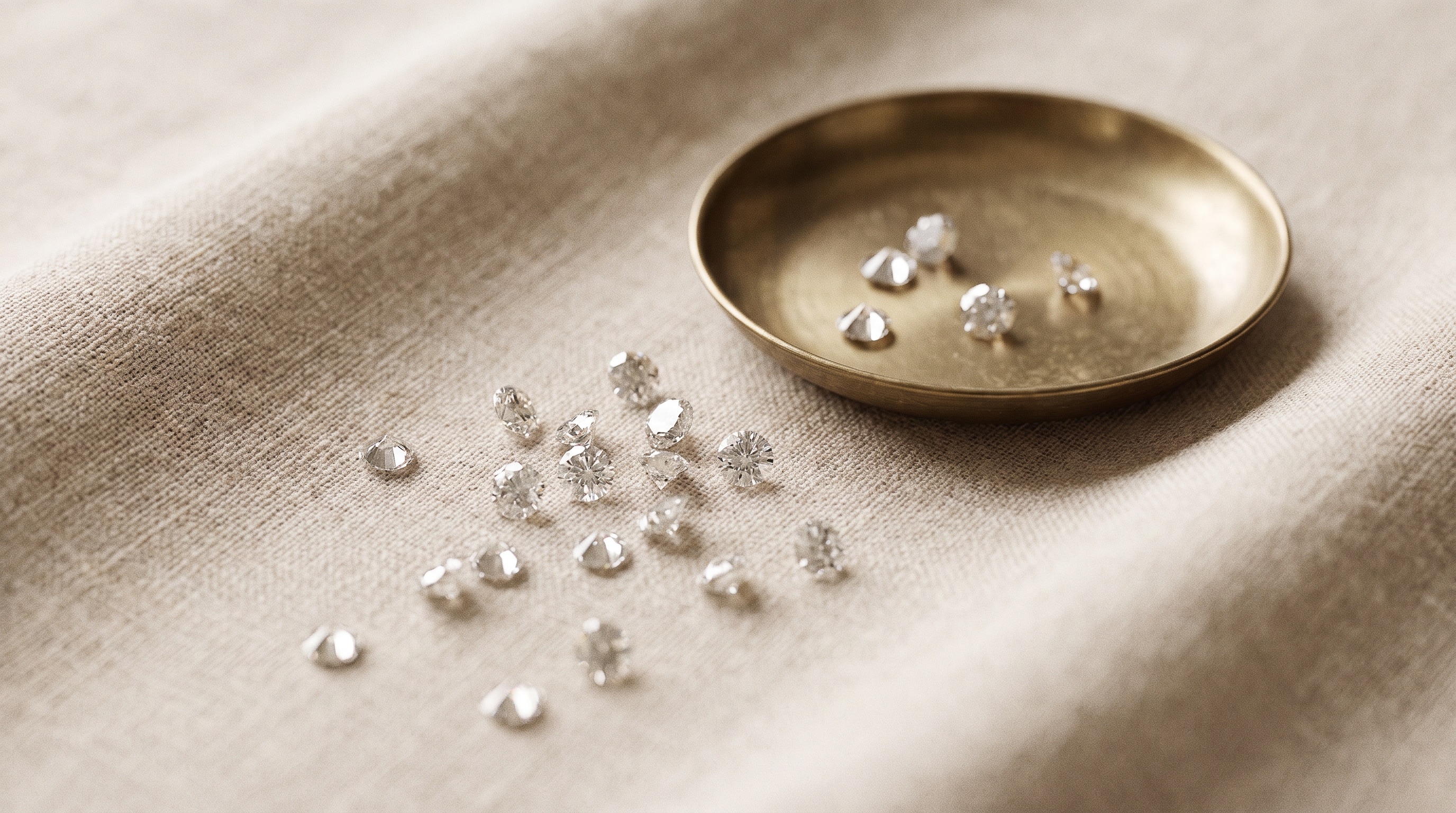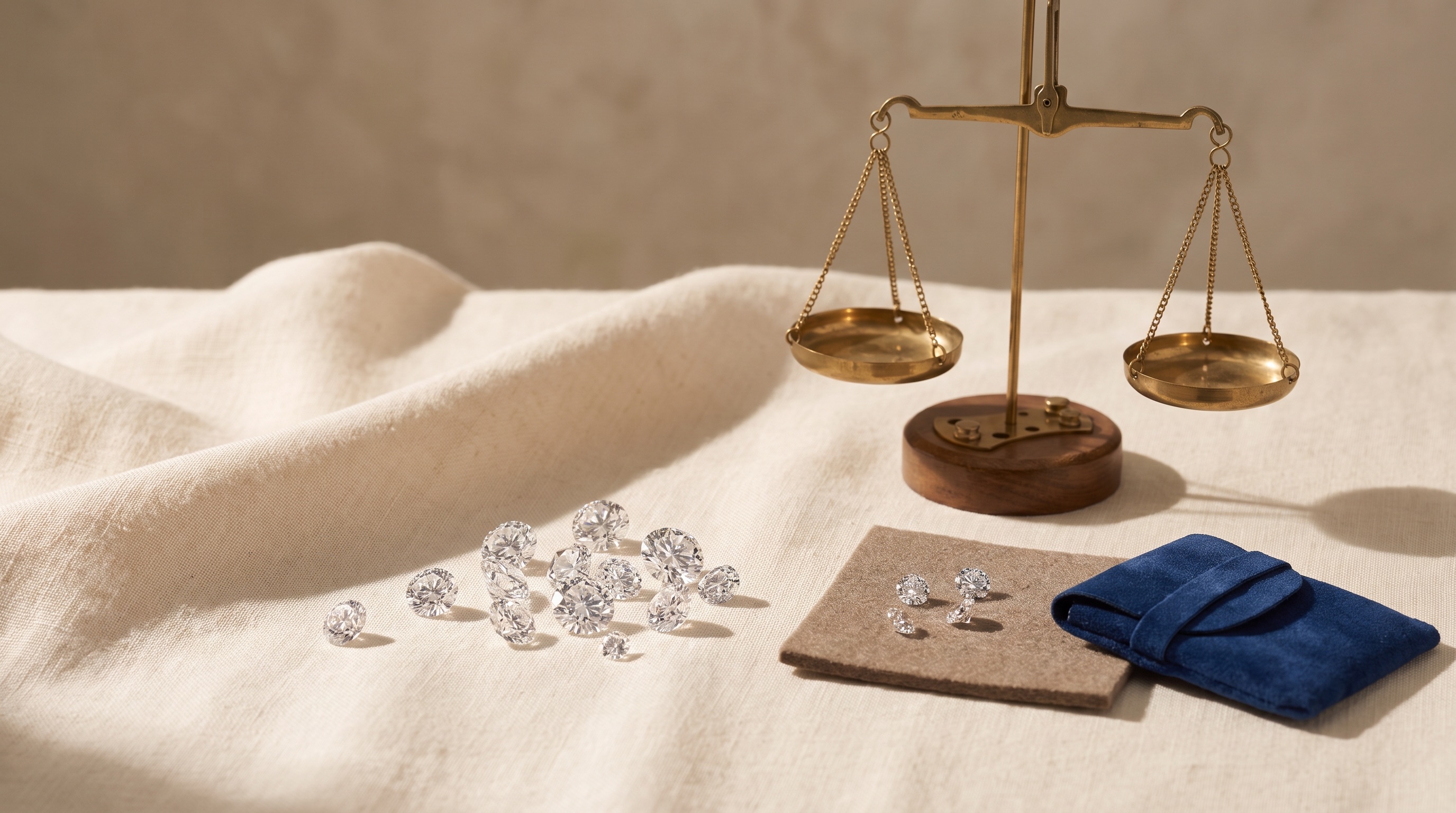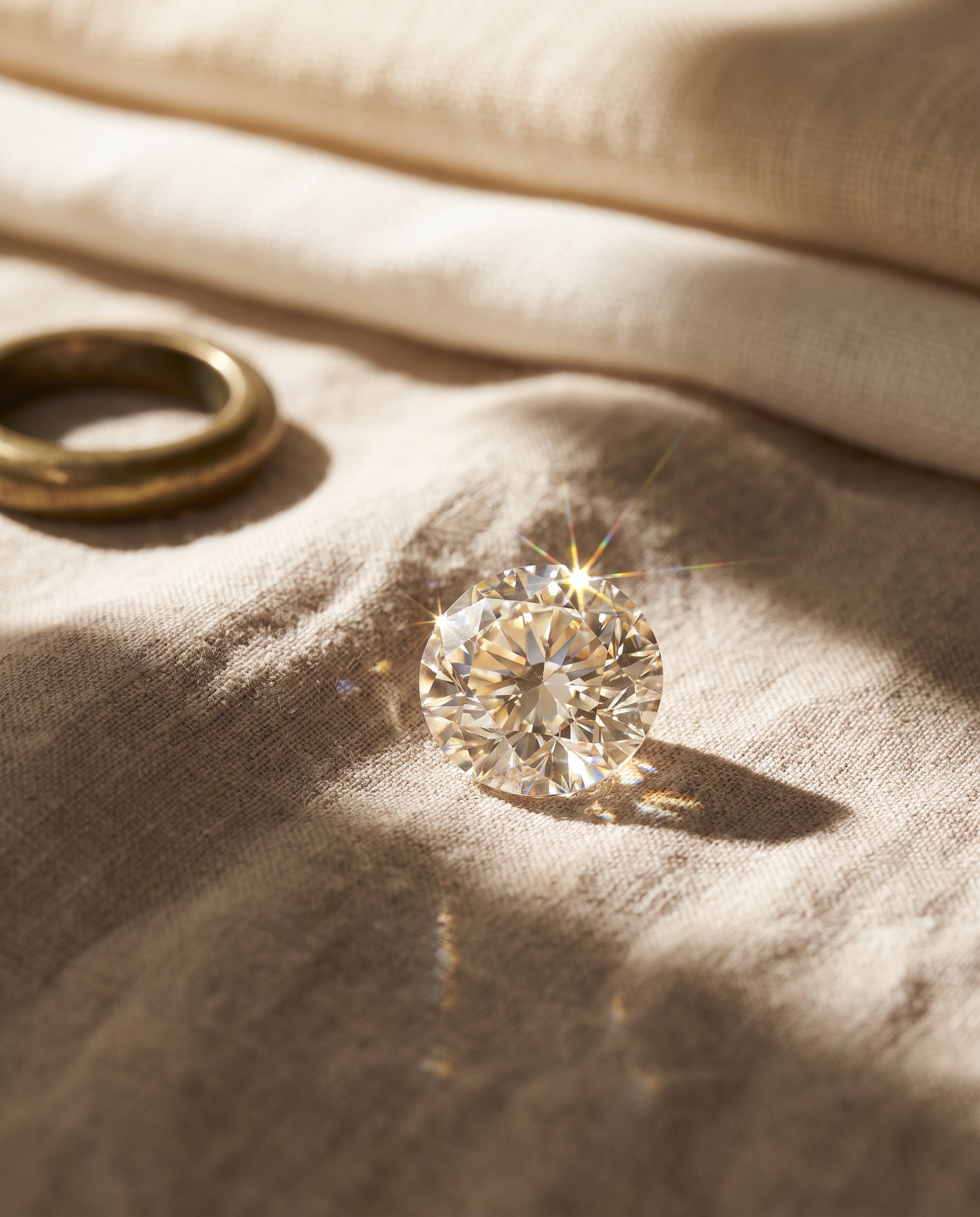
Scintillation is the flashing pattern of light and dark you see across a diamond's surface the moment the stone, the light source, or your eye moves — the sparkle effect, technically distinct from the white light a diamond returns (brilliance) and the colored light it splits into a rainbow (fire). A diamond with strong scintillation shows a lively, high-contrast pattern of bright flashes and dark facets that shifts constantly with the smallest motion, rather than a static, evenly lit surface.
Scintillation is one of three light-performance properties graders and buyers evaluate in a cut diamond, alongside brilliance and fire, and it's the one most directly tied to how "alive" a stone looks in normal movement — at a dinner table, on a hand gesturing in conversation, under a jeweler's spotlight. This guide covers what scintillation actually is at the optical level, how it differs from brilliance and fire, the two components that make it up, what cut factors control it, how shape affects scintillation differently, how graders and buyers assess it in practice, how lighting environment changes what you see, common misconceptions, and what to actually look for when evaluating a stone for scintillation before buying.
What Scintillation Actually Is
Scintillation happens because a diamond's facets don't all reflect light back to your eye at the same instant. As the stone, the light, or the viewer moves even slightly, different facets rotate into and out of the correct angle to return light — some facets flash bright while adjacent ones go dark, and that pattern keeps reorganizing itself with motion. The result is the flickering, sparkling effect people describe when they say a diamond "comes alive" or "dances."
This is fundamentally a dynamic property. A photograph or a stone sitting perfectly still under fixed lighting can show brilliance (how bright the white light return looks) and fire (how much colored light splits out), but it can't fully capture scintillation, because scintillation only exists as a function of movement. That's part of why scintillation is harder to judge from a product photo or video than the other two light-performance properties, and why in-person or video-under-motion evaluation matters more for this specific quality than for color or clarity.
Scintillation vs. Brilliance vs. Fire
| Property | What It Is | Depends On | Best Observed |
|---|---|---|---|
| Brilliance | The total white light returned to the eye from the stone's crown | Cut proportions, polish, overall light return efficiency | Static viewing under bright, even light |
| Fire (dispersion) | White light split into spectral colors as it exits the stone | Facet angles, crown height, light source's spectral range | Under a point light source (spotlight, single bulb) more than diffuse light |
| Scintillation | The flashing pattern of bright and dark areas as the stone or viewer moves | Facet count, facet size and arrangement, symmetry, faceting precision | Under motion — tilting the stone, moving the hand, or moving around it |
These three properties are related but genuinely separable. A stone can be cut for strong brilliance but show muted scintillation if its facet pattern is too large or too few in number to break light up into many small, independently flashing zones. Conversely, a stone can scintillate actively without necessarily having the single brightest possible static brilliance reading, because the two properties reward slightly different facet geometries.
The Two Components of Scintillation
Graders and researchers generally break scintillation into two related but distinct sub-effects:
- Flashes (or fire scintillation in some older terminology). The larger, more intense bursts of light that appear as bigger facets catch and release light with motion — fewer, bigger, punchier flashes.
- Sparkle. The finer, more numerous pattern of tiny bright pinpoints that appear and disappear rapidly, usually associated with smaller facets and higher facet counts, giving the stone a busier, more textured glitter effect layered on top of the larger flashes.
A well-cut diamond typically shows a balance of both — enough large flashes to read as bright and lively from a normal viewing distance, and enough fine sparkle to add texture and liveliness up close. Cutting choices that favor one can come at some cost to the other, which is part of why cut grading treats scintillation holistically rather than scoring flashes and sparkle as fully independent numbers.
What Controls Scintillation in a Cut Stone
- Facet count and size. More, smaller facets generally produce finer, busier scintillation (more sparkle), while fewer, larger facets produce bigger, bolder flashes with less fine texture. Cut style is the biggest single driver here — a round brilliant's standard 57-58 facet arrangement is specifically engineered around this tradeoff.
- Facet arrangement and symmetry. Precisely aligned, evenly spaced facets create an organized, balanced flashing pattern as the stone moves. Misaligned or asymmetric faceting (a cutting or polishing flaw, not a deliberate stylistic choice) disrupts this pattern and can make scintillation look uneven or patchy rather than evenly distributed across the stone's face.
- Polish quality. Poorly polished facets scatter light diffusely instead of reflecting it in a clean, mirror-like return, which mutes the crisp on/off contrast that makes scintillation visually striking. High polish is a prerequisite for strong scintillation, not just a separate grading category.
- Proportions (depth, table size, crown angle). Cut proportions that are well outside ideal ranges for a given shape — too shallow, too deep, an oversized table — tend to blunt scintillation along with brilliance, because both properties depend on light entering and exiting the stone at angles that produce a strong return rather than leaking out through the pavilion.
How Shape Affects Scintillation
| Shape / Cut Style | Typical Scintillation Character | Why |
|---|---|---|
| Round brilliant | Strongest, most balanced flash-and-sparkle pattern of any shape | 57-58 facets specifically engineered over decades for maximum light return and scintillation across a wide range of viewing angles |
| Cushion, oval, pear, marquise (brilliant-cut styles) | Strong, lively scintillation, broadly similar in character to round but with some variation across the stone's length | Share a brilliant-style facet arrangement adapted to a non-round outline, generally retaining most of round's light-return advantages |
| Emerald, Asscher (step cuts) | Fewer, larger, more architectural flashes — a "hall of mirrors" effect rather than fine sparkle | Long, rectangular step facets produce broad, geometric flashes instead of numerous small ones; scintillation reads as bold rather than busy |
| Old Mine, Old European (antique cuts) | Warmer, softer, less uniform scintillation with distinctive broad flashes | Fewer, larger, less precisely calibrated facets than modern cutting standards intentionally produce a different, more romantic flash pattern than a modern round brilliant |
| Rose cut | Minimal scintillation, favors a soft glow over flash | Flat-bottomed, faceted-dome construction with no pavilion facets to bounce light back through distinct return zones |
None of these are objectively "better" scintillation — they're different, and buyers who prioritize maximum flash-per-motion generally lean toward round brilliants or other well-cut brilliant-style shapes, while buyers drawn to the bolder, more architectural light play of step cuts or the softer character of antique cuts are making a legitimate, different aesthetic tradeoff rather than accepting a lesser stone.
How Grading Labs Assess Scintillation
GIA's cut grading system (applied to round brilliants, and increasingly to some fancy shapes) formally evaluates scintillation as one of seven components contributing to the overall cut grade, alongside brilliance, fire, weight ratio, durability, polish, and symmetry. Labs assess it using controlled viewing conditions — standardized lighting and a defined range of viewing angles and motion — rather than a single static photograph, because scintillation genuinely can't be judged from a still image alone. This is part of why an official cut grade on a lab report carries more weight than a buyer's own snapshot-based judgment of how sparkly a stone looks in a product photo.
Lighting Environment Changes What You See
Scintillation looks meaningfully different depending on the light source, which is worth knowing before drawing conclusions from any single viewing:
- Point-source lighting (a single spotlight, a bare bulb, direct sun) produces the most dramatic, high-contrast scintillation — sharp flashes against clearly dark facets.
- Diffuse lighting (overcast daylight, broad fluorescent panels, a softbox) produces gentler, less contrasty scintillation, since light arrives from many angles at once rather than one concentrated direction.
- Retail jewelry lighting is typically engineered with concentrated spotlights specifically because it flatters scintillation and brilliance — a stone that looks spectacular under a jewelry counter's lighting rig can look noticeably calmer under an office's flat overhead lighting, which is a legitimate, expected difference rather than a sign the stone was misrepresented.
Evaluating a stone under more than one lighting condition, where possible, gives a more realistic sense of how it will actually look day to day rather than judging it purely under the most flattering single-spotlight setup. Buyers who fall in love with a stone under a retailer's dramatic spot lighting are sometimes surprised by how much calmer it looks under home lighting later — not because the stone changed, but because the lighting environment did, which is worth setting expectations around before purchase rather than after.
Common Misconceptions About Scintillation
- "More facets always means more sparkle." Not reliably true — beyond a certain point, excessive facets on a stone that's proportioned poorly can actually mute scintillation by breaking light into pieces too small and too weak to register as distinct flashes, rather than adding meaningful sparkle.
- "A bigger diamond automatically scintillates more." Carat weight and scintillation are largely independent — a smaller, well-cut stone can out-scintillate a larger stone with mediocre proportions or poor polish.
- "Scintillation is the same thing as clarity or color quality." No — scintillation is purely a cut-and-light-performance property. A diamond can have excellent clarity and color and still scintillate poorly if it's badly proportioned, and a diamond with lower clarity or color grades can still scintillate beautifully if it's well cut, since most clarity inclusions don't interfere with the light-return mechanics that drive scintillation.
- "Lab-grown diamonds scintillate differently than natural diamonds." They don't — a CVD lab-grown diamond has identical optical and physical properties to a natural diamond of the same cut, so scintillation depends entirely on how well the individual stone is cut, not on whether its carbon originated naturally or in a lab.
How to Evaluate Scintillation Before Buying
- Ask for or watch a video under motion, not just a static photo — tilting, rotating videos are the closest a buyer can get to an in-person impression of scintillation without physically handling the stone.
- Check the cut grade on the certificate for round brilliants specifically, since GIA's Excellent and Very Good cut grades already factor scintillation directly into the overall score.
- Compare the same shape and rough size across a couple of options rather than judging scintillation in isolation, since relative comparison surfaces differences that are harder to notice looking at a single stone alone.
- Weigh shape expectations honestly — a step-cut emerald or an antique Old European cut isn't going to scintillate like a round brilliant, and judging it against that standard sets up a mismatch between what a buyer expects and what the shape is actually designed to deliver.
How Setting Style Affects Visible Scintillation
A diamond's cut sets its scintillation potential, but the setting it's mounted in determines how much of that potential is actually visible day to day, since a setting controls how much light reaches the stone and from which angles:
- Prong settings. Open settings that expose most of the stone's crown and much of its pavilion to ambient light from multiple directions, generally letting a stone's full scintillation potential show through with minimal interference — the reason prong settings remain the default choice when maximizing light performance is the priority.
- Bezel settings. A metal rim wraps the stone's girdle, blocking some light entry from the sides. This trims some scintillation compared to an open prong setting, though a well-proportioned stone still shows meaningful flash and sparkle from the crown facets that remain fully exposed.
- Halo settings. The ring of smaller accent stones surrounding the center stone adds its own scintillation, which can visually compound with the center stone's flashing pattern — sometimes making the overall piece read as sparklier even when the center stone's individual scintillation is unchanged.
- Pavé and cluster designs. Many small stones set close together create an amplified, collective scintillation effect as different stones catch light at different moments during movement, which is part of why pavé bands and clusters read as continuously sparkling rather than flashing all at once.
- Cathedral and other raised settings. Elevating the stone and opening up the gallery beneath it lets more ambient light reach the pavilion from underneath, which can noticeably improve visible scintillation compared to a flush, low-profile setting holding an identical stone.
This is one reason two buyers can compare the "same" cut grade stone in different settings and come away with different impressions of how sparkly it looks — the stone's underlying scintillation potential hasn't changed, but how much of it reaches the eye has.
Why Scintillation Is Hard to Market Accurately
Scintillation's motion-dependence creates a genuine challenge for anyone trying to represent a stone honestly online or in a catalog. A single static product photo, no matter how well lit, can only show one frozen instant of a constantly shifting pattern — it can capture whether a stone looks bright and clean in that instant, but not whether it flashes actively as a hand moves. This is different from color and clarity, which a well-controlled photo can represent reasonably faithfully. Retailers and suppliers who take scintillation seriously tend to supplement static photography with short rotating or tilting video specifically because it's the only format that can show the property at all — a buyer relying purely on still images is evaluating brilliance and color, not scintillation, even if they don't realize the distinction.
Scintillation and Perceived Quality
Because scintillation is the most immediately noticeable light-performance property in everyday movement, it disproportionately shapes a buyer's gut impression of a stone's quality — often more than color or clarity grades that require closer inspection to appreciate. Two stones with identical carat weight, color, and clarity certificates can leave very different impressions on a buyer standing at a counter, purely because one is cut and polished to scintillate more actively than the other. This is a legitimate reason cut quality deserves at least as much attention as the other three Cs when comparing options at a similar price point, rather than treating cut as a secondary factor behind carat, color, and clarity. It's also why two people can disagree about which of two similarly graded stones "looks better" — they may genuinely be responding to a real difference in scintillation that a certificate's summary grades don't fully capture in a single letter or number.
Sourcing Well-Cut Diamonds for Scintillation at Wholesale
Because scintillation is inseparable from cut precision, sourcing decisions that affect it happen upstream of any individual stone — consistent faceting standards, careful polish, and proportion control across an inventory matter more than any single marketing claim about sparkle. Guru Diam supplies certified loose diamonds, natural and CVD lab-grown, across round brilliants and the full range of fancy and antique shapes, with IGI, GIA, and GCAL certification all available so buyers can verify cut grade and proportions directly rather than relying on photos alone. Jewelers and designers sourcing stones specifically for scintillation-forward pieces — pavé work, halo settings, or any design meant to maximize movement-driven sparkle — can review inventory through the certified diamonds category, with calibrated matched sets available through matching pairs for multi-stone designs where consistent scintillation across every stone matters. Fancy color options are available through fancy color loose diamonds, and custom pieces built around a chosen stone's light performance move through the custom jewelry program. Trade accounts can review terms at the wholesale hub or apply through trade partner. For jewelers advising retail clients on scintillation specifically, requesting a short rotating video alongside the standard certificate and static photos, rather than relying on stills alone, is a simple, practical way to set accurate expectations before a stone or a finished piece ships.
Frequently Asked Questions
What is diamond scintillation, in simple terms?
Scintillation is the flashing, sparkling pattern of light and dark you see across a diamond as it, the light source, or the viewer moves — distinct from brilliance (overall white light return) and fire (colored light dispersion), both of which can be seen even when the stone is perfectly still.
Is scintillation the same as sparkle?
Sparkle is one of two components of scintillation — the finer, more numerous pinpoint flashes, usually tied to smaller facets. The other component, sometimes called "flashes," refers to the larger, bolder bursts of light from bigger facets. Together they make up what's generally called scintillation.
Does a higher facet count always improve scintillation?
Not reliably — more facets can add fine sparkle up to a point, but excessive faceting on a poorly proportioned stone can actually mute scintillation rather than improve it. Facet count matters far less than overall cut precision, symmetry, and polish.
Which diamond shape has the best scintillation?
Round brilliant generally shows the strongest, most balanced scintillation of any shape, since its 57-58 facet arrangement has been refined specifically for light performance. Other brilliant-cut shapes (oval, cushion, pear, marquise) come close; step cuts like emerald and Asscher scintillate differently, with fewer, bolder flashes rather than fine sparkle.
Can you judge scintillation from a photo?
Not fully — scintillation is a motion-dependent effect, so a static photo can't capture it the way it captures color or even brilliance to some extent. A video showing the stone tilted or rotated under light gives a much more accurate impression.
Does clarity grade affect scintillation?
Generally no — scintillation is primarily a function of cut quality (facet arrangement, symmetry, polish, proportions), not clarity. A diamond with a lower clarity grade can still scintillate beautifully if it's well cut, since most inclusions don't interfere with the light-return paths that create scintillation.
Does the setting a diamond is mounted in change its scintillation?
Yes — a stone's cut sets its scintillation potential, but the setting determines how much ambient light actually reaches it. Open prong settings generally let a stone show its full scintillation, while bezel settings, which wrap the girdle in metal, block some light entry from the sides and can noticeably mute the effect compared to the same stone in an open setting.