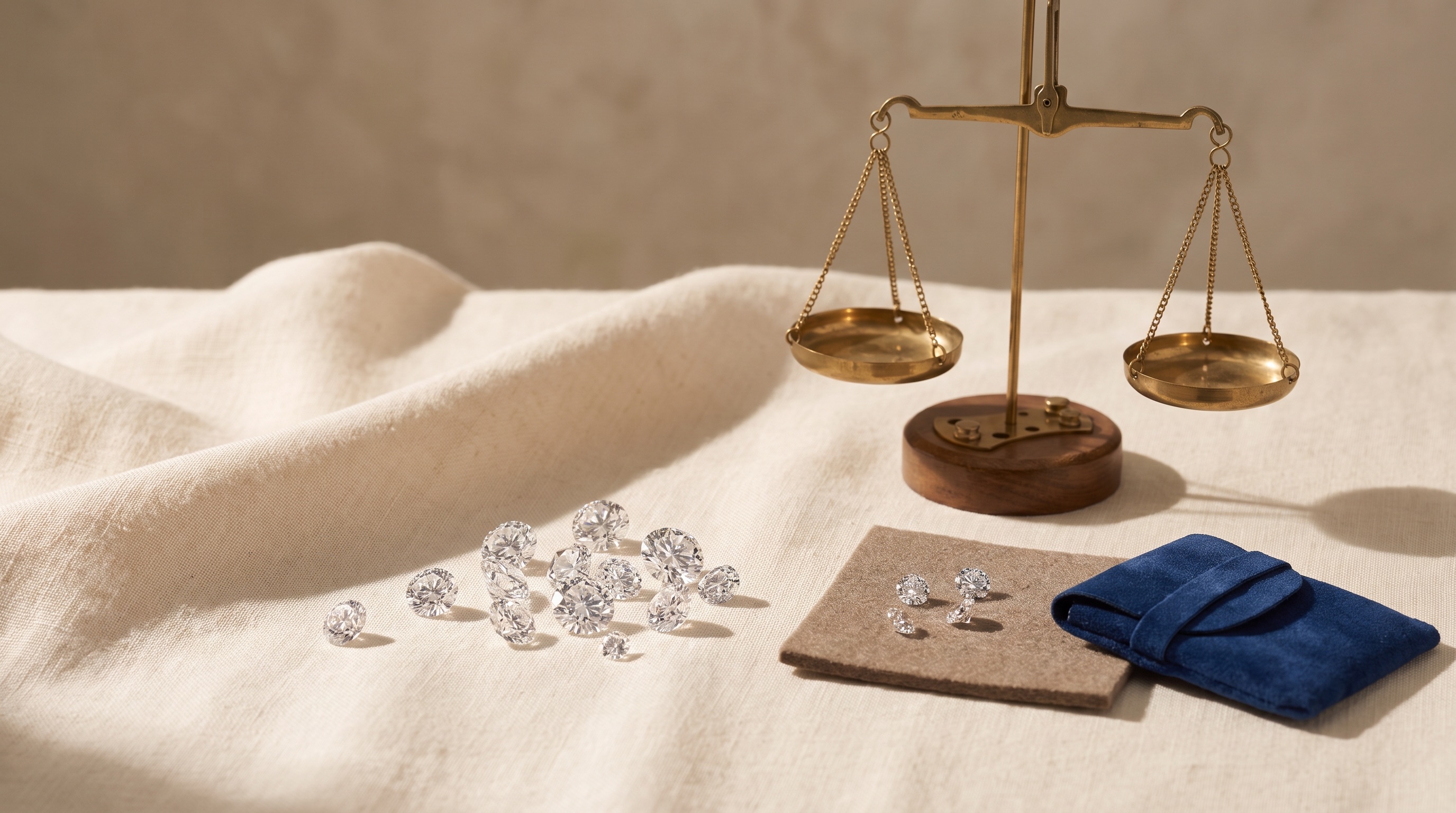

A diamond price index is a published benchmark that tracks how wholesale diamond prices move over time across standardized carat, color, clarity, and cut combinations, giving the trade a common reference point for evaluating whether a specific quote is in line with the broader market. Unlike a single commodity like gold or oil, diamonds don't trade on a centralized public exchange with one universal spot price, which is exactly why price indices exist — they aggregate real transaction and asking-price data across many stones into a structured reference that a buyer or seller can use to sanity-check an individual quote. This guide explains how diamond price indices actually work, what they track for both natural and lab-grown diamonds, the best-known indices in the trade, and how a wholesale buyer should realistically use one.
"Diamond price index" gets searched by a wide range of people — from wholesale buyers benchmarking a quote to retail customers and journalists trying to understand why diamond prices seem to move the way they do. This guide is written primarily for the trade audience: what an index actually measures, its real limitations, and how to use one as a tool rather than as a single authoritative price a buyer can quote directly.
Who Actually Uses a Diamond Price Index
Dealers and manufacturers use an index most heavily on the natural side, where "Rap plus/minus" quoting is deeply embedded in day-to-day negotiation between cutters, dealers, and retailers. Retail jewelers use it more occasionally, primarily to sanity-check a wholesale quote or to explain to a retail customer why a stone's price sits where it does relative to comparable stones. Appraisers reference published benchmarks as one input among several when establishing replacement or resale value, alongside recent comparable sales and direct market quotes. Financial and investment-adjacent audiences occasionally reference a price index when discussing diamonds as an asset class, though this is a smaller and more niche use case than the index's core function as a trade pricing tool.
Why Diamonds Don't Have One Universal Price
Unlike gold, which trades as a fungible commodity where one ounce of a given purity is functionally identical to any other, every diamond is a unique combination of carat weight, cut, color, clarity, shape, fluorescence, and certification — no two stones are perfectly interchangeable the way two ounces of gold are. This is the core reason diamonds have never traded on a centralized public exchange the way commodities or equities do. A diamond price index solves this by tracking price movement for standardized "buckets" of comparable specifications rather than for diamonds as an undifferentiated whole, giving the market a workable proxy for price movement even without true fungibility.
How a Diamond Price Index Actually Works
Most diamond price indices work by collecting asking prices, transaction data, or dealer-submitted price lists across a defined grid of carat weight, color, and clarity combinations, then publishing the resulting benchmark figures on a recurring schedule — commonly weekly or monthly. Some indices track natural diamonds exclusively, some track polished natural diamonds specifically as distinct from rough, and a smaller but growing number now track lab-grown diamond pricing separately, reflecting how differently that side of the market has moved. The methodology — what data is actually collected, from how many sources, and how outliers are handled — varies meaningfully between indices, which is why the same nominal category can show different figures across different published benchmarks at the same point in time.
The Best-Known Diamond Price Benchmarks in the Trade
The Rapaport Diamond Report (often called "Rap" or "the Rap list" in trade conversation) is the most widely referenced polished-diamond price list in the natural diamond trade, publishing benchmark high-cash-asking-price figures across a grid of carat, color, and clarity combinations, against which individual stones are commonly quoted at a percentage discount or premium ("Rap minus X%" or "Rap plus X%"). Other published benchmarks and price-tracking services exist alongside Rapaport, some focused on polished natural diamonds, some specifically tracking lab-grown diamond pricing trends as that segment has grown large enough to warrant its own dedicated tracking. No single index is universally treated as "the" definitive number the way a stock ticker functions for a public company — different segments of the trade reference different benchmarks depending on region, specialty, and habit.
How Natural Diamond Price Indices Have Moved
Natural diamond price indices have shown relatively modest, uneven movement over recent years compared to the sharp declines seen on the lab-grown side, reflecting natural diamond supply constraints tied to mine output and major producers' sales policies rather than a manufacturing cost curve. Natural pricing at the top of the quality range — exceptional color, clarity, and larger carat weights — has generally held up better against downward pressure than mid-market natural stones, which increasingly compete directly against high-quality lab-grown alternatives at a fraction of the price.
How Lab-Grown Diamond Price Indices Have Moved
Lab-grown diamond price tracking tells a very different story: a consistent, substantial downward trend as CVD growth technology has scaled, more growers and larger facilities have come online, and competition among producers has intensified. This decline has been steepest in the most commoditized categories — round brilliant in common bridal sizes and standard color/clarity grades — and has meaningfully outpaced any comparable movement on the natural side. A lab-grown price index, where one exists for a specific category, is generally a more useful real-time reference than relying on a memory of pricing from even a year or two prior, given how much movement has occurred in that window.
| Index Characteristic | Natural Diamond Indices | Lab-Grown Diamond Indices |
|---|---|---|
| General price trend, recent years | Relatively stable to modestly softening | Substantial, consistent decline |
| Primary driver of movement | Mine supply, producer sales policy, macro demand | Production scale, grower competition, technology efficiency |
| Coverage maturity | Long-established (Rapaport since 1978) | Newer, still standardizing across providers |
| Best use for a buyer | Benchmarking a quote against recent market levels | Confirming a quote reflects current, not stale, pricing |
What a Diamond Price Index Is Actually Useful For
A price index is most useful as a sanity check, not a final answer — it tells a buyer whether a specific quote sits broadly in line with, above, or below where the market for that general carat/color/clarity combination currently sits. It's genuinely useful for spotting a quote that's dramatically out of line with current market levels in either direction (unusually high, which might signal an uncompetitive supplier, or unusually low, which might warrant checking certification and disclosure more carefully). It is not a substitute for a real quote on the actual stone in question, since no index captures the specific cut quality, fluorescence, and exact clarity characteristics of an individual stone.
What a Diamond Price Index Can't Tell You
An index tracks a standardized grid of specifications, not any individual stone, which means it can't account for a specific stone's exact cut proportions, precise clarity plot, fluorescence, or shape beyond round brilliant, since most indices are built primarily around round brilliant natural diamonds and only recently, unevenly, extended to fancy shapes and lab-grown material. It also can't fully capture regional pricing variation, a specific supplier's margin structure, or the premium attached to antique cuts and other specialty categories that fall outside standard modern shape-and-grade grids entirely. A buyer relying solely on an index number without getting an actual quote on the specific stone in question is working from a proxy, not a real price.
How Wholesale Buyers Actually Use an Index Day to Day
In practice, a working wholesale buyer uses a price index less as a strict pricing formula and more as a shared vocabulary for negotiation — quoting or evaluating a stone in terms of its discount or premium relative to a known benchmark makes it faster to compare offers across multiple suppliers on the natural side of the trade specifically. On the lab-grown side, where standardized index referencing is less universally embedded into everyday negotiation, buyers more often compare direct supplier quotes against each other and against their own purchase history rather than against a single published benchmark. Either way, the discipline that matters is refreshing the reference point regularly rather than working from a memorized number that may be significantly out of date.
Price Index Limitations for Fancy Colors and Antique Cuts
Fancy color diamonds and true antique-style cuts — Old Mine, Old European, Trillion, Kite, and similar — are poorly served by standard price indices, which are built primarily around colorless-to-near-colorless standard shapes. Fancy color pricing is driven heavily by hue, saturation, and tone in ways a standard D-to-Z color grid doesn't capture at all, and antique cuts trade in a smaller, more specialized market where rarity and aesthetic command a premium that a modern-shape index simply has no comparable category for. Buyers and sellers in these categories rely much more heavily on direct supplier relationships and specialist dealer networks than on any published index figure.
How an Index Relates to Retail Pricing
A published wholesale price index reflects trade-level pricing, not retail shelf price — retail includes significant additional markup covering a retailer's overhead, marketing, and margin layered on top of the underlying wholesale cost an index approximates. A retail customer researching "diamond price index" and expecting it to explain the price tag on a specific ring at a jewelry counter is conflating two different layers of the market; the index is a wholesale-trade tool, and the gap between it and any specific retail price reflects everything that happens between a wholesale transaction and a finished, marketed retail sale.
Why Index Methodology Differences Matter
Two published indices can show meaningfully different figures for what looks like the same nominal category, because the underlying methodology differs — how many transactions or asking prices are sampled, whether outlier submissions are filtered, how frequently the index updates, and whether it reflects actual closed transactions versus asking prices that may not reflect what stones actually traded at. A buyer comparing figures across two different index sources should understand which methodology each uses before treating a discrepancy between them as evidence that one is simply wrong, since a genuine methodology difference is a more likely explanation than an error.
Using a Price Index Alongside a Trusted Supplier Relationship
The most reliable pricing approach for a wholesale buyer combines a general awareness of current index-level trends with a consistent, transparent relationship with a supplier who quotes clearly against the buyer's actual specification needs. An index tells a buyer roughly where the market sits; a supplier relationship built on consistent, verifiable quotes over time tells a buyer whether they're actually getting fair, current pricing on the specific stones they need, which is ultimately the more actionable information for day-to-day purchasing decisions.
A Brief History of the Rapaport Price List
Martin Rapaport launched the Rapaport Diamond Report in 1978 with the explicit goal of bringing pricing transparency to a trade that had historically operated on closely held, dealer-to-dealer pricing knowledge rather than any shared public reference. The list quickly became the de facto benchmark for polished natural diamond pricing worldwide, and "Rap plus" or "Rap minus" language remains standard shorthand in natural diamond trade conversation nearly five decades later. Its longevity is itself informative: a benchmark only stays relevant that long if enough of the trade continues to reference it in actual negotiations, which is a different kind of validation than a newer index has yet had the chance to earn.
Why Newer Lab-Grown Indices Are Still Standardizing
Because lab-grown diamond production at wholesale scale is a comparatively recent development, price-tracking services covering that segment are still working out consistent methodology in the way Rapaport's natural-diamond benchmark did over its first years of operation. Different lab-grown trackers currently vary more in their sampling approach, update frequency, and shape/quality-grid coverage than the more mature natural-diamond benchmarks do, which means a buyer comparing two lab-grown price references should expect more day-to-day divergence between them than they'd see comparing two natural-diamond benchmarks against each other for the same category.
How Index Data Gets Collected
Price index providers generally gather data through some combination of dealer-submitted asking prices, actual reported transactions from participating trade members, and in some cases automated collection from wholesale trading platforms and marketplaces. Each method carries its own bias: asking-price data can run higher than actual closing prices if sellers routinely list above what stones ultimately trade for, while transaction data depends on enough market participants actually reporting real sales for the sample to be statistically meaningful. Reputable index providers disclose their general methodology, and a buyer relying heavily on a specific index for negotiation leverage should understand which type of data underlies the number being quoted.
Regional Variation in Index Relevance
A published diamond price index, even a well-established one, reflects an aggregated global or major-market view that doesn't necessarily capture regional pricing variation exactly — sourcing conditions, import duties, currency movement, and local demand can all cause a specific region's actual trade pricing to sit somewhat above or below the headline index figure. Buyers operating across multiple markets, or comparing quotes from suppliers based in different regions, should factor this regional variance in rather than expecting every quote worldwide to track a single global benchmark with no local deviation.
How to Talk to a Supplier About Index-Relative Pricing
When negotiating against a published benchmark, the most productive framing specifies the exact carat, color, and clarity cell being referenced along with the discount or premium percentage being discussed, rather than a vague reference to "market price." A supplier who can quote clearly and consistently in these terms, stone to stone, is working transparently against a shared reference point; a supplier who resists specifying which index cell a quote is being measured against, or who gives inconsistent percentages for similar stones without a clear reason, is a signal worth following up on before committing to a larger order.
Sourcing Diamonds at Current Market Pricing Through Guru Diam
Guru Diam provides current, dated wholesale quotes across its full catalog of natural and CVD lab-grown diamonds, calibrated melee, certified loose stones, and finished jewelry, rather than relying on a static published price list that can go stale within a single quarter. Buyers benchmarking a quote against index-level market conditions are welcome to request a current spec sheet for direct comparison. Same-day shipping applies to in-stock inventory ordered before 6pm EST from New York or 4pm PST from Los Angeles, and custom engagement rings are finished in 4–6 days.
Common Mistakes When Using a Price Index
The most common mistake is treating an index figure as a fixed, current price rather than checking when it was last updated — a natural-diamond benchmark that refreshes weekly is a reasonably current reference, but a lab-grown figure pulled from an older article or a bookmarked page can be badly out of date given how fast that segment has moved. A second common mistake is applying a discount or premium percentage learned for one carat/color/clarity cell to a completely different combination, assuming the relationship holds constant across the whole grid when it typically doesn't. A third is using an index built for round brilliant natural diamonds as if it applies equally well to a fancy shape, an antique cut, or a fancy color stone, none of which the standard grid was designed to represent.
Frequently Asked Questions
What is the most commonly used diamond price index?
The Rapaport Diamond Report is the most widely referenced polished natural diamond price benchmark in the trade, with individual stones commonly quoted at a percentage discount or premium relative to its published figures, a convention dating back to the list's 1978 launch.
Is there a price index for lab-grown diamonds?
Several price-tracking services now cover lab-grown diamond pricing specifically, reflecting how significant that segment has become, though standardized index referencing is less universally embedded in everyday lab-grown trade negotiation than Rapaport is on the natural side.
Why do diamonds need a price index if gold doesn't?
Gold is a fungible commodity where one ounce of a given purity is interchangeable with any other, while every diamond is a unique combination of carat, cut, color, and clarity. A price index solves this by tracking standardized specification "buckets" rather than diamonds as one undifferentiated commodity.
Can I use a diamond price index to know exactly what my diamond is worth?
Not precisely — an index reflects a standardized grid of specifications, not your specific stone's exact cut proportions, clarity plot, or fluorescence. It's a useful sanity check against market levels, not a substitute for an actual appraisal or a current quote on your specific stone.
Has the lab-grown diamond price index moved differently than the natural index?
Yes, significantly. Lab-grown pricing has shown a consistent, substantial downward trend as production has scaled, while natural diamond pricing has moved more modestly and unevenly, driven by supply constraints rather than a manufacturing cost curve. Buyers comparing the two segments should expect the gap between them to keep evolving rather than settling at a fixed ratio.
Do fancy color diamonds have their own price index?
Standard price indices generally don't cover fancy color diamonds well, since color-driven pricing (hue, saturation, tone) doesn't fit a standard D-to-Z colorless grading grid. Fancy color pricing relies much more on direct supplier relationships and specialist dealer knowledge.
How often do diamond price indices update?
It varies by provider — established natural-diamond benchmarks like Rapaport typically publish on a weekly basis, while some lab-grown and specialty trackers update monthly or on a less predictable schedule, which is worth confirming before relying on a figure as current.
What a Rising or Falling Index Actually Signals to a Buyer
A sustained move in a price index is more informative than a single week's fluctuation, since short-term noise from a handful of large transactions or thin trading in a specific category can shift a weekly figure without reflecting a genuine market trend. A buyer watching for a real signal — a sustained multi-month move up or down in a specific carat/color/clarity cell — has a more reliable basis for timing a larger purchase or adjusting retail pricing than one reacting to every weekly update. This is especially relevant on the lab-grown side, where the overall multi-year trend has been consistently downward even though individual short-term readings can occasionally tick sideways or even up slightly before resuming the broader decline.
Related Reading
For more on how individual diamond pricing works, see Guru Diam's guides to how diamond pricing actually works, how diamond value is calculated, and diamond investment.
Browse Guru Diam's certified diamonds and wholesale hub, or learn about our trade partner program and custom jewelry services.