Wholesale diamond pendants are finished pendant jewelry set with one or more diamonds, sold to retail jewelers and designers at trade pricing rather than direct-to-consumer retail. As a category, pendants span an unusually wide range of styles, price points, and occasions relative to most other diamond jewelry, which makes deliberate sourcing decisions especially worthwhile. Sourcing them wholesale means navigating a wider range of variables than a single loose stone purchase — pendant style, setting type, chain pairing, metal, and certification on the center stone all interact to determine both the finished look and the price point a retailer can realistically hit.
This guide covers the main diamond pendant styles a wholesale buyer is likely to encounter, how setting type affects durability and cost, chain and bail pairing considerations, certification options for center stones, seasonal demand patterns, and what to check before placing a wholesale pendant order — the full set of practical decisions that separate a well-merchandised pendant program from a scattered, inconsistent one.
Common Diamond Pendant Styles
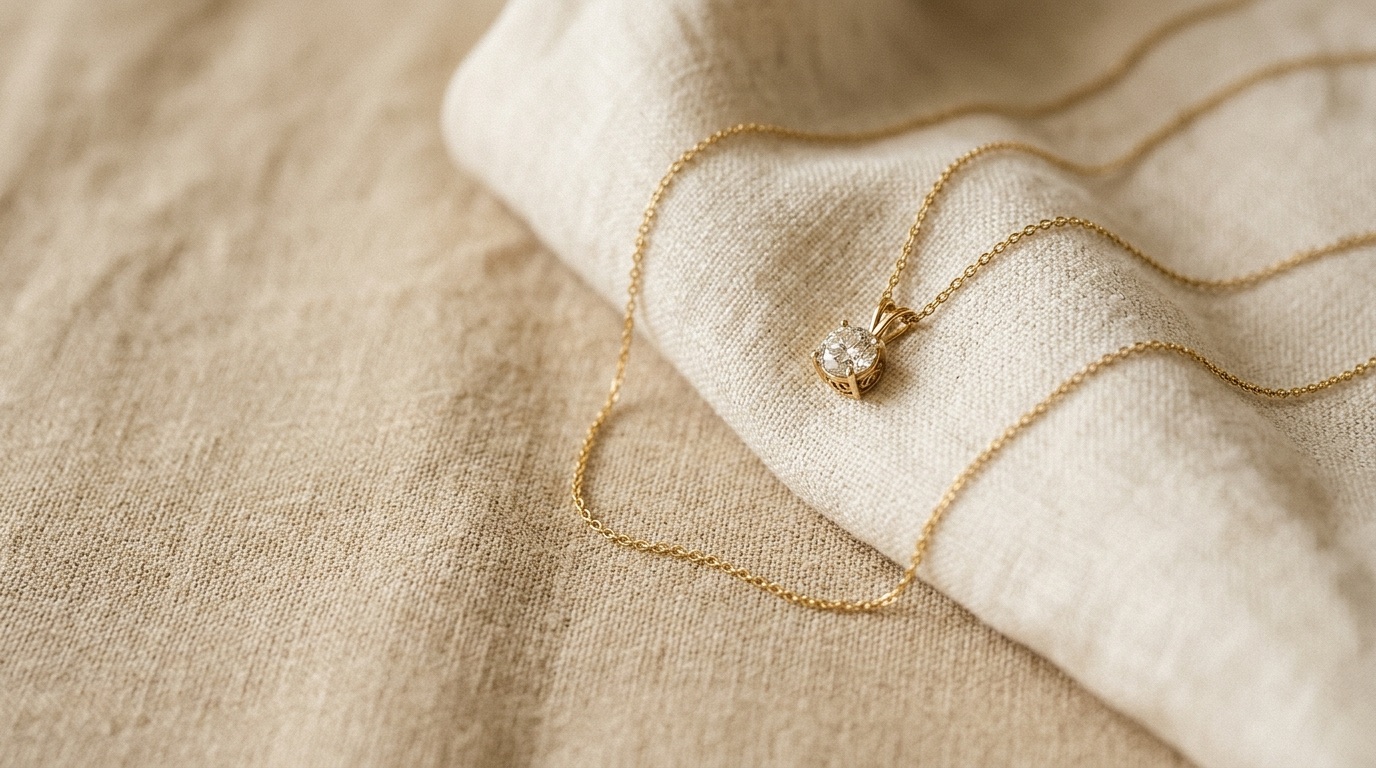
- Solitaire pendants — a single diamond, typically prong- or bezel-set, on a simple chain. The most classic and consistently in-demand style across price points.
- Halo pendants — a center stone surrounded by a ring of smaller melee, which visually increases apparent size and adds sparkle at a lower cost than upsizing the center stone alone.
- Cluster pendants — multiple diamonds grouped together, often in a floral or geometric arrangement, giving more visual presence per carat of total diamond weight than a single larger stone would.
- Line and drop pendants — a vertical row of diamonds, often graduated in size, that hangs below the chain's point of contact — a popular style for a more elongated, minimalist look.
- Pavé pendants — a metal shape (a bar, initial, or simple geometric form) densely set with small melee rather than built around one dominant center stone.
- Shape-specific pendants — crosses, hearts, initials, and other symbolic shapes set with diamonds, which carry their own seasonal and occasion-driven demand patterns distinct from the general pendant category.
Setting Types and How They Affect Durability and Cost
| Setting Type | Description | Durability | Relative Cost |
|---|---|---|---|
| Prong | Metal claws hold the stone, maximizing light exposure | Good, but prongs can catch on fabric and need periodic inspection | Lower labor cost than bezel |
| Bezel | A metal rim fully or partially encircles the stone | Excellent — the most protective setting for daily wear | Moderate — more metal and labor than a simple prong |
| Halo | A center stone surrounded by pavé-set melee | Good — melee setting adds some additional maintenance points | Higher — more total stones and labor |
| Bail-set / floating | Stone appears to float with a minimal, nearly invisible setting | Lower — minimal metal support means more careful handling required | Higher — requires precise, skilled setting work |
Chain and Bail Pairing Considerations
A pendant is only half the finished product — chain length, chain style, and bail design all affect how the pendant sits and reads on the body, and a wholesale buyer stocking pendants should think about chain pairing as part of the sourcing decision, not an afterthought, since a beautifully made pendant paired with a mismatched or poorly finished chain undercuts the perceived quality of the whole piece regardless of how good the pendant itself actually is. An 16-18 inch chain is standard for a pendant meant to sit at the collarbone, while an 18-20 inch length suits a slightly lower placement; box chains and cable chains read more substantial and masculine-leaning, while finer curb and rope chains suit a more delicate, feminine-leaning pendant. The bail — the small loop connecting pendant to chain — should be sized appropriately to the chain's link width; a bail too tight to slide freely, or too loose and prone to tangling, is a common quality complaint on lower-quality wholesale pendant lines.
Center Stone Certification for Pendants
Diamond pendant center stones at 0.30ct and above should carry individual certification — GIA, IGI, or GCAL — giving the retailer and end customer a documented record of the stone's carat weight, color, clarity, and cut grade. Smaller accent and halo stones typically ship as uncertified melee sorted to a documented quality baseline (commonly DEF+/VS+) rather than individually graded, which is standard trade practice and not a quality shortcut, given that individually certifying sub-0.30ct stones isn't economically practical for either supplier or buyer.
CVD Lab-Grown vs. Natural Diamond Pendants
Both CVD lab-grown and natural diamond center stones are available across most pendant styles, with lab-grown running at a meaningful discount to natural at comparable carat weight, color, and clarity. For a wholesale buyer building out a pendant assortment across multiple price points, offering both origins side by side under clear, distinct labeling lets a single style be merchandised at different price tiers without redesigning the setting — the same halo pendant design, for example, can be offered with a lab-grown or natural center stone at two different price points, appealing to different customer budgets and preferences.
Seasonal Demand Patterns for Diamond Pendants
Diamond pendants see meaningfully more demand around specific calendar moments than a category like engagement rings, which trades on a more evenly distributed, life-event-driven purchase pattern. Valentine's Day, Mother's Day, and the December holiday season each drive a noticeable spike in pendant sales specifically, since a pendant is a common gift-giving category at a lower average price point and lower personalization requirement than an engagement ring. A wholesale buyer planning inventory should build in lead time ahead of these windows — placing a wholesale pendant order close to a demand spike risks missing the selling window entirely if the supplier's own lead time doesn't leave room for it.
Pricing Structure: What Drives Wholesale Pendant Cost
- Center stone size, color, clarity, and origin — typically the single largest cost component on a solitaire or halo pendant.
- Total melee weight — halo and pavé styles with more total accent-stone weight cost more than a simple solitaire.
- Metal type and weight — platinum costs more per gram than gold; heavier settings use more metal.
- Setting complexity — bezel and floating settings generally require more skilled labor than a standard prong setting.
- Chain inclusion — whether a chain is bundled with the pendant or sold separately affects the total unit cost and how it should be merchandised.
What to Check Before Placing a Wholesale Pendant Order
- Confirm certification status on the center stone explicitly — ask for the certificate number and lab, not just a stated carat weight and grade.
- Ask whether the chain is included or sold separately, and if included, confirm chain length, style, and clasp type.
- Check bail sizing against the intended chain to avoid a mismatch that shows up only after the pieces are paired at retail.
- Confirm whether lab-grown and natural options are clearly and separately labeled if both are offered in the same style, to avoid any ambiguity for the end customer.
- Ask about minimum order quantities per style, particularly for a new or unproven pendant design being tested in limited quantity first.
Layering and Multi-Pendant Trends
Layered pendant necklaces — two or three pendants at staggered chain lengths, worn together as a single styled look rather than one dominant piece — have grown into a meaningful merchandising category in their own right, distinct from the single-statement-pendant approach that dominated for decades. For a wholesale buyer, this trend has a direct sourcing implication: it favors offering smaller, simpler pendant designs sold as a coordinated set or designed to pair well together, rather than exclusively stocking larger single statement pieces. A retailer building out a layering-friendly assortment should look for pendant styles available at a range of chain lengths within the same design line, since the layering look depends on a customer being able to combine pieces at genuinely different lengths rather than several similar-length pendants that overlap awkwardly when worn together.
Merchandising Diamond Pendants at Retail
Pendants sell well when presented with context — a range of chain lengths displayed together, or a few styles grouped by occasion (a "gift under $500" case section, for example) tends to outperform a single pendant style displayed in isolation with no visual anchor for comparison. Photography that shows the pendant actually worn, at the intended chain length, helps a customer visualize scale and placement far better than a flat product photo alone, since pendant size is one of the more common points of customer confusion or disappointment relative to expectation.
Packaging and Presentation for Wholesale Pendant Orders
How a pendant arrives from a wholesale supplier affects how quickly and confidently it can go straight into a retailer's case. A pendant that ships already paired with an appropriately sized chain, in retail-ready packaging with the certificate for the center stone included, saves a retailer meaningful handling time compared to receiving loose components that need to be matched, boxed, and documented in-house. For a retailer running a leaner operation without dedicated back-of-house staff for this kind of assembly work, asking a wholesale supplier specifically about retail-ready packaging and documentation can be a meaningful efficiency gain, not just a cosmetic preference.
Comparing Wholesale Pendant Suppliers: What Actually Differentiates Them
Beyond price, wholesale pendant suppliers differentiate on a handful of concrete factors worth comparing directly: breadth of style range (a supplier offering only solitaire and basic halo styles versus one covering cluster, line, and shape-specific designs as well), consistency of center-stone certification practices, whether both lab-grown and natural options are available under the same styles, minimum order flexibility for new or unproven designs, and turnaround on both standing catalog reorders and custom pendant requests. A supplier strong on price but narrow on style range may still be the right fit for a retailer focused on a small, focused pendant assortment, while a retailer building a broader pendant program benefits more from a supplier with wider style breadth even at a modest price premium.
Custom Diamond Pendants vs. Catalog Wholesale
Beyond a standing wholesale catalog, many retailers also source custom pendant designs for a specific customer request — a family heirloom stone reset into a new pendant, or a fully custom design built from a sketch or reference image. Custom pendant work follows the same general custom-jewelry production process as a ring: CAD design, casting, setting, and finishing, typically over a matter of days depending on the manufacturer's capacity, rather than the immediate turnaround of an in-stock catalog pendant. A retailer building a pendant offering should decide upfront how much of the assortment is standing catalog inventory versus custom-on-request, since the two require different sourcing relationships and lead-time expectations — a catalog-heavy assortment favors a supplier with deep in-stock breadth and fast reorder turnaround, while a custom-heavy offering favors a manufacturer relationship built around design flexibility and realistic one-off production turnaround rather than standing inventory depth.
Metal Choices for Diamond Pendants
Metal selection affects both cost and how a pendant reads visually against a diamond center stone. Platinum offers the strongest durability and a naturally white tone that some buyers prefer for maximizing perceived diamond brightness, at a meaningfully higher per-gram cost than gold. 18k and 14k white gold deliver a similar white-metal look at a lower price point, with 14k offering better scratch resistance for daily wear due to its higher alloy content. Yellow and rose gold have both seen sustained demand growth in pendant styles specifically, often paired with a warmer, vintage-inspired setting aesthetic that contrasts more visibly against a white diamond than a white-metal setting does. A wholesale buyer assembling a pendant assortment benefits from offering at least one white-metal and one warm-metal option across popular styles, since metal preference is one of the more polarizing and personal choices a customer makes.
Pendant Sizing: Center Stone Proportion to Setting
A common design misstep in lower-quality wholesale pendant lines is a center stone that's disproportionately small relative to the overall setting size, which can make even a well-cut diamond look underwhelming once worn. As a general design guideline, a center stone should occupy enough of the setting's visual field that it reads as the clear focal point rather than being visually diminished by an oversized halo or an overly ornate frame. Buyers evaluating a wholesale pendant line should look at actual worn photography, not just a flat top-down product shot, since proportion issues are far more visible once a piece is seen at the scale and angle it's actually worn.
Clasp Types and Everyday Wearability
Clasp choice affects how easily a customer can actually put a pendant necklace on and take it off unassisted — a real, practical consideration that gets less attention than style but drives real customer satisfaction over time. Spring-ring and lobster clasps remain the most common choice for their reliability and relatively low cost, while a toggle clasp offers easier one-handed operation at a slightly higher cost and a small tradeoff in security. For a finer, more delicate chain paired with a lightweight pendant, a smaller, well-finished clasp keeps the overall proportions balanced; an oversized clasp on a delicate chain is a common quality complaint that's easy to avoid by matching clasp scale to chain weight during sourcing.
Diamond Pendants as an Entry Price Point for New Customers
Because diamond pendants span a wider price range than almost any other diamond jewelry category — from a small accent-stone pendant well under a few hundred dollars to a substantial center-stone piece running into the thousands — they function well as an entry price point for bringing new customers into a store's diamond jewelry offering. A customer's first diamond purchase is disproportionately likely to be a modestly priced pendant rather than an engagement ring or a larger fashion piece, which makes pendant merchandising and presentation quality worth disproportionate attention relative to its average transaction size, since it often sets a customer's first impression of a retailer's overall diamond jewelry quality and value, and a positive first purchase at this entry price point meaningfully increases the likelihood of that same customer returning later for a larger, higher-margin piece.
Minimum Order Considerations for a New Pendant Style
Testing a new pendant style in the market carries real inventory risk, since diamond jewelry ties up more capital per unit than most other retail categories. Many wholesale suppliers offer smaller trial quantities on a new style before requiring a full production-run minimum, which lets a retailer gauge actual sell-through before committing significant capital to a design that may not resonate with their specific customer base. It's worth asking a supplier directly whether trial quantities are available on unproven styles, and what reorder minimums look like once a style has demonstrated real sell-through at retail.
Sourcing Diamond Pendants at Wholesale
Guru Diam offers finished diamond pendants alongside certified loose stones and custom jewelry manufacturing, with in-house casting, setting, and polishing at its New York and Los Angeles locations. Center stones are available with IGI, GIA, or GCAL certification across both CVD lab-grown and natural material, and custom pendant designs finish in 4-6 days from approved design. In-stock catalog inventory ships same-day (NYC before 6pm EST, LA before 4pm PST).
Buyers can browse certified center-stone inventory in the certified diamonds category, start a custom pendant build through custom jewelry, or apply for a trade account at trade partner. The wholesale hub and fancy color loose diamonds category cover related sourcing options for a broader pendant and jewelry assortment.
Frequently Asked Questions
What's the most popular diamond pendant style for wholesale?
Solitaire pendants remain the most consistently in-demand style across price points, though halo pendants have grown in popularity for offering more visual sparkle at a lower cost than a larger single center stone.
Do diamond pendant center stones need certification?
Center stones at 0.30ct and above should carry individual certification (GIA, IGI, or GCAL). Smaller accent and halo stones typically ship as uncertified melee sorted to a documented quality baseline instead, which is standard trade practice.
Is lab-grown or natural diamond better for a wholesale pendant line?
Neither is inherently "better" — lab-grown offers a meaningful cost advantage at comparable size and quality, while natural carries different customer appeal. Many retailers offer both across the same style, clearly labeled, to serve different price points and preferences.
Should a wholesale pendant order include the chain?
This varies by supplier and buyer preference — confirm explicitly whether chain is bundled or sold separately, and if bundled, confirm length, style, and clasp type before ordering, since chain choice significantly affects how the finished pendant reads.
How far ahead should I order pendants for seasonal demand?
Diamond pendants see spikes around Valentine's Day, Mother's Day, and the December holidays. Order with enough lead time to account for the supplier's production and shipping time, so inventory arrives well ahead of the actual selling window rather than during or after it.
Can I get a custom diamond pendant design made, not just catalog styles?
Yes — custom pendant designs follow the same CAD-design, casting, setting, and finishing process as custom rings, typically turning around in a matter of days depending on the manufacturer's capacity and the design's complexity.
What metal is best for a diamond pendant?
There's no single best choice — platinum offers the strongest durability and a naturally white tone, white gold delivers a similar look at a lower cost, and yellow or rose gold suit a warmer, vintage-inspired aesthetic. A wholesale assortment benefits from offering both white and warm metal options across popular styles.
Should a wholesale pendant ship with retail-ready packaging?
It's worth asking a supplier about this directly — a pendant that arrives already paired with a chain, packaged for retail, and accompanied by the center stone's certificate saves meaningful in-house handling time compared to receiving unassembled components.
Can I order a small trial quantity before committing to a full pendant style run?
Many wholesale suppliers offer trial quantities on new or unproven styles before requiring a full production-run minimum, which lets a retailer test sell-through before committing significant inventory capital. Ask directly about trial-order availability and reorder minimums.