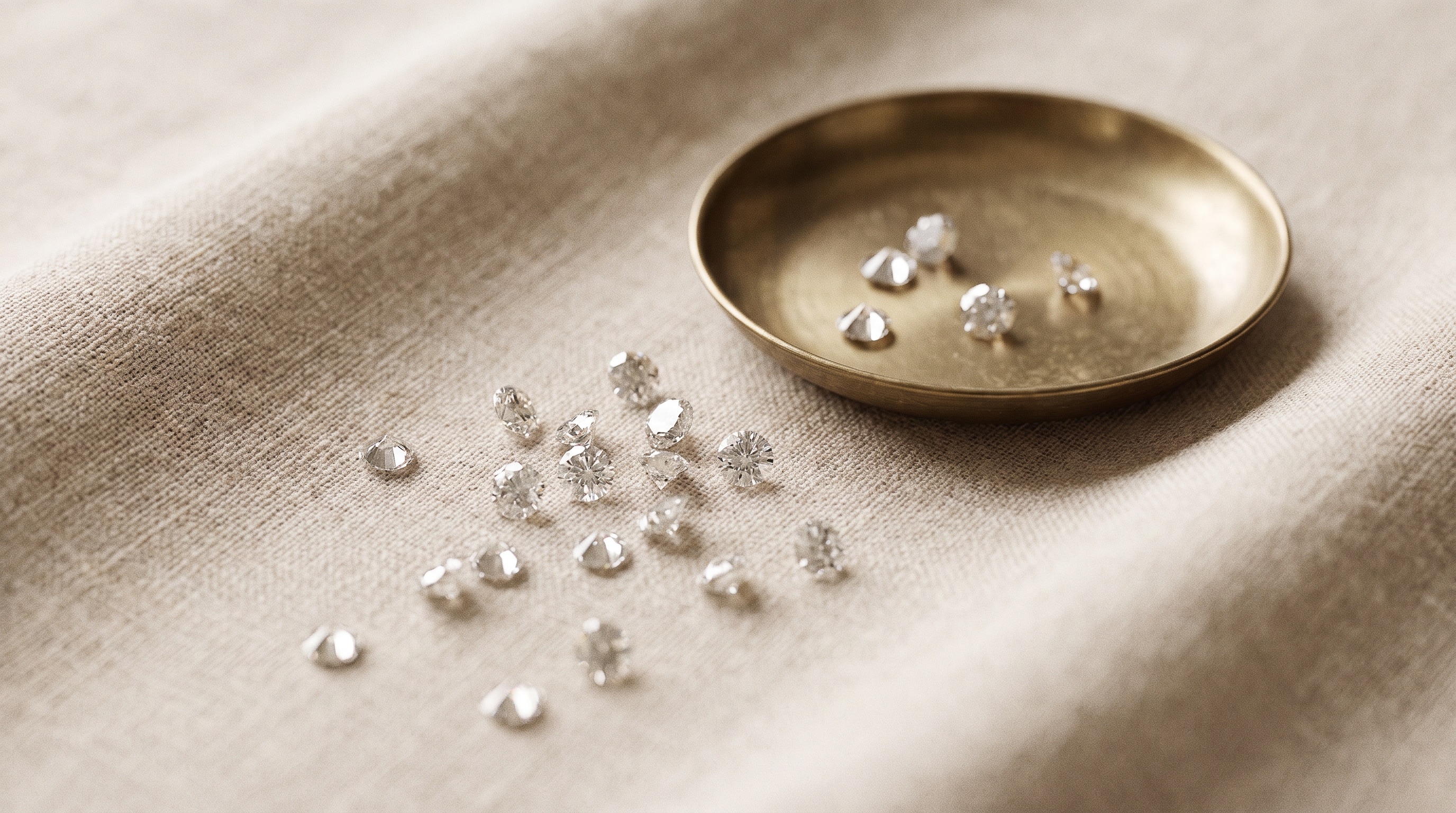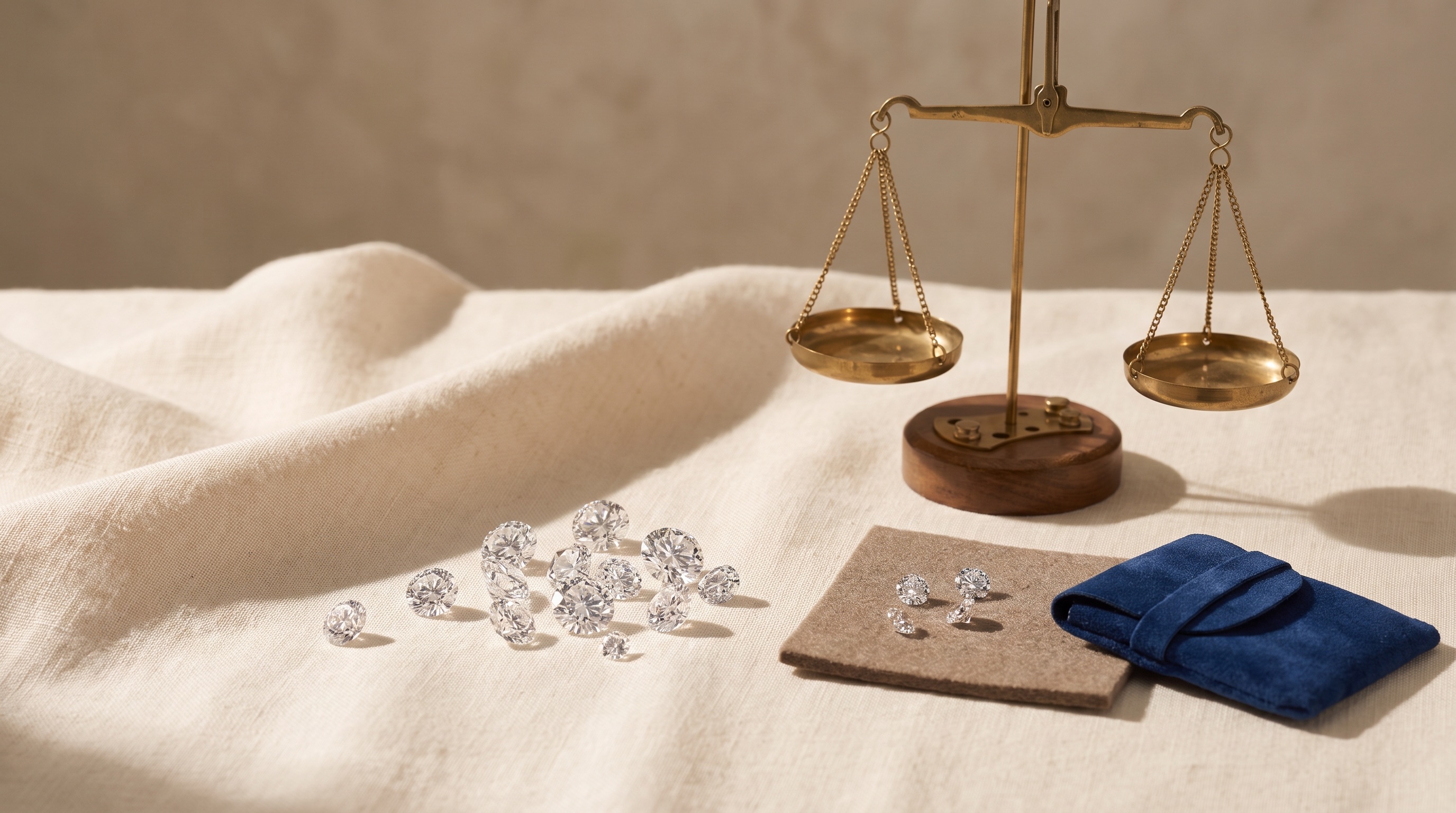
A diamond parcel is a bulk lot of small, loose diamonds sold together as a batch, priced and graded against a shared quality baseline rather than certified stone by stone. Parcels are the standard way jewelers source melee — the small accent diamonds used in pavé, halos, and side-stone work — and understanding how they're priced and sold is fundamental to buying them well.
For independent jewelers and designers who mostly work with individually certified center stones, parcel goods can feel like an unfamiliar corner of the trade. There's no grading report to hand a customer, no single stone to inspect under 10x before committing, and pricing works on a completely different logic than a certified stone's per-stone quote. None of that makes parcels a lesser or riskier product — it makes them a different product, built for a different job: outfitting dozens or hundreds of small stones into a single piece of jewelry, where certifying each one individually would be neither practical nor useful. This guide walks through what a diamond parcel actually is, how parcels are priced and sold, how parcel sizing and quality baselines work, how buying a parcel differs from buying a certified stone, and what to look for when sourcing parcel goods.
What Is a Diamond Parcel?
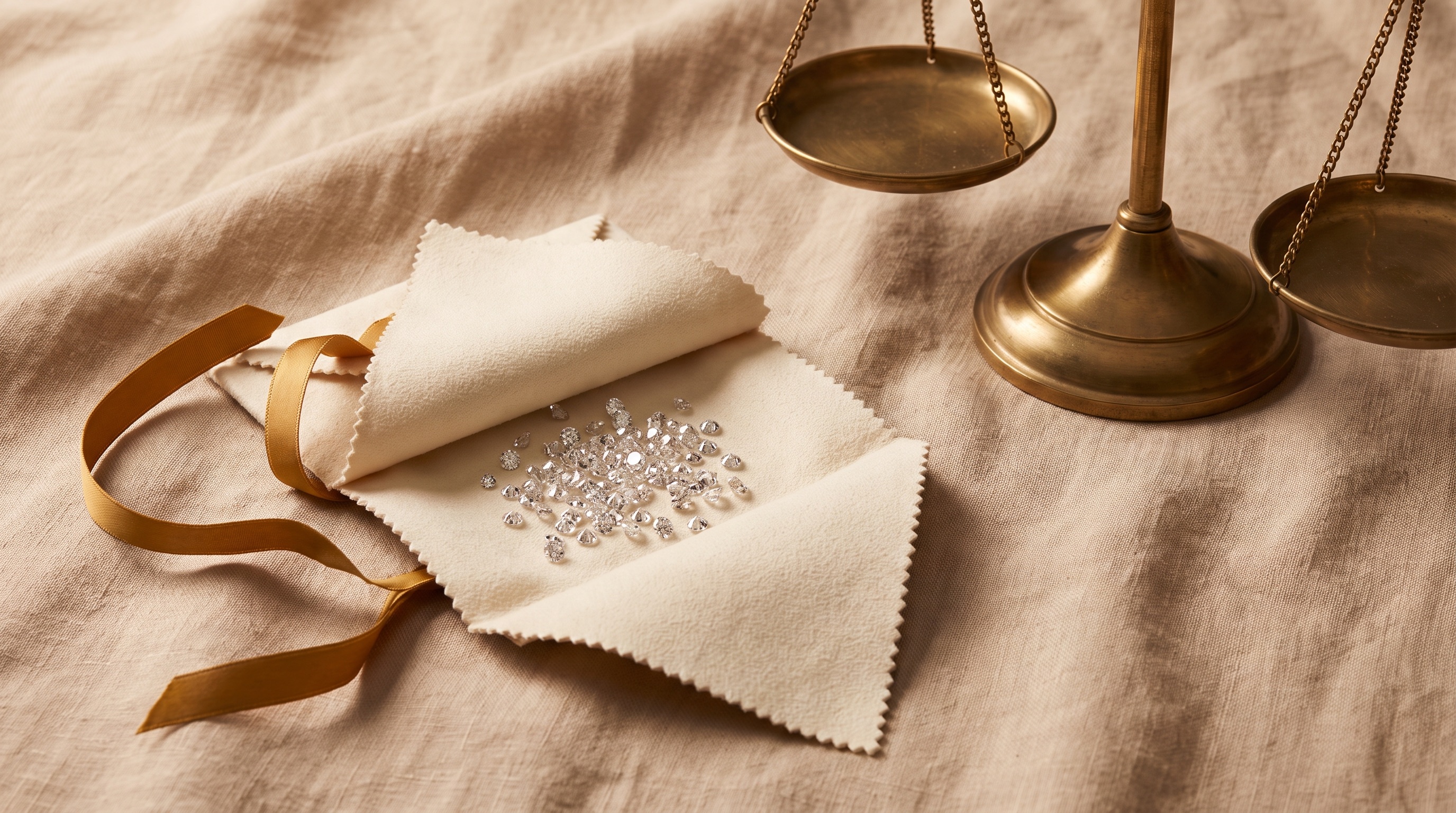
In trade terms, a "parcel" is simply a quantity of loose diamonds — almost always melee, meaning small diamonds generally under a carat and frequently well under a tenth of a carat — packaged and sold together as one unit rather than as individually inspected, individually documented stones. A parcel might be a folded diamond paper holding a few carats of matched round melee for a single ring, or it might be a sealed lot running into hundreds of carats destined for a manufacturer's production line. Either way, the defining feature is the same: the stones inside are treated, priced, and warranted as a group against an agreed quality standard, not evaluated one by one.
This isn't a shortcut or a lesser form of quality control — it's a structural necessity of the size involved. A 1.2mm round melee diamond is smaller than a grain of table salt. Submitting each one individually to a gemological lab, waiting on turnaround, and paying a per-stone certification fee for a stone that costs a few dollars would multiply the cost of the goods many times over, for a level of documentation the end use doesn't call for. Parcel goods solve this by shifting quality assurance from a per-stone certificate to a batch-level standard: a quality control baseline the entire parcel is checked against, backed by the supplier's inspection process and reputation rather than a lab report accompanying each stone.
How Diamond Parcels Are Priced and Sold
Parcel pricing works on a per-carat basis applied to the whole lot, not a per-stone quote. A buyer is quoted a price per carat for a parcel meeting a stated size range and quality baseline, and the total price is that per-carat rate multiplied by the total carat weight of the parcel — whether the parcel contains 200 stones or 2,000. This is a fundamentally different pricing mechanism than a certified stone, where carat weight, cut, color, and clarity are each individually assessed and the price reflects that one stone's specific combination of the 4Cs.
A few things follow directly from that per-carat, batch-level pricing model:
Quality Is Expressed as a Baseline, Not a Grade
Rather than a graded color and clarity (like G-VS2 on a certificate), a parcel is sold against a quality baseline — a floor the stones in the parcel are expected to meet or exceed, expressed as a color-and-clarity range. The most common baseline in the trade, and the one used across Guru Diam's melee catalog, is DEF+/VS+: color in the D-E-F range or better, clarity at VS (very slightly included) or better. Every stone in a parcel sold against that baseline is expected to fall within it, but individual stones aren't separately labeled with their exact position inside that range.
Size Is Sold as a Range, Not a Single Carat Weight
Melee parcels are typically sold by a millimeter size range (for example, 1.3mm–1.5mm) rather than by a single carat weight, since the stones inside a parcel of a given mm range will vary slightly in actual weight. Sizing this way also matches how melee is actually used: a jeweler setting a pavé band needs stones that fit a specific hole size, so mm range is the more directly useful spec than carat weight for that application.
Pricing Moves With Size, Shape, and Baseline
Smaller melee (well under 1mm) generally prices lower per carat than larger melee approaching a full carat's worth of weight, calibrated round shapes tend to be the most cost-efficient to produce and price accordingly, and fancy calibrated shapes (emerald, radiant, pear, marquise-cut melee, for instance) typically carry a premium over round for the same size range, reflecting the more complex cutting involved in producing a consistent calibrated fancy shape at melee scale.
Diamond Parcels vs. Individually Certified Loose Stones
The clearest way to understand parcel goods is to see them side by side with the product they're most often confused with: individually certified loose diamonds. These are genuinely different products serving different needs in a jeweler's inventory, and the table below lays out where they diverge.
| Factor | Diamond Parcel (Melee) | Individually Certified Loose Stone |
|---|---|---|
| Certification | Uncertified as individual stones; sold against a batch quality baseline (e.g. DEF+/VS+), not a per-stone lab report | Individually graded and certified by a gemological lab (IGI, GIA, or GCAL), typically at 0.30ct and above |
| Typical size range | 0.8mm–9.0mm (melee through small accent sizing) | Generally 0.30ct and up, where individual grading is economically practical |
| Pricing basis | Per-carat rate applied to the total weight of the lot | Per-stone price reflecting that stone's specific carat, cut, color, and clarity combination |
| Quality documentation | Batch-level QC against a stated baseline, supplier-warranted | Stone-specific grading report detailing the individual 4Cs and, for lab-grown, growth method |
| Common use case | Pavé, halo settings, channel-set accents, side stones — many small stones in one piece | Center stones, solitaires, and any setting where the buyer or end customer needs individual stone documentation |
| Shape availability | Round Brilliant plus fancy calibrated shapes (emerald, radiant, pear, marquise, and other calibrated shapes on request) | Full range of standard, antique, and exotic shapes |
| Buying unit | By the parcel (a defined carat-weight lot within a size and quality range) | By the individual stone |
Neither column is a "better" way to buy diamonds — they're matched to different jobs. A center stone that a customer will want documentation for calls for individual certification. Eighty small stones going into a pavé shank call for a parcel, because certifying each one would add cost without adding anything the finished piece needs.
Why Parcels Aren't Individually Certified — and Why That's Not a Quality Gap
This is worth stating plainly, because it's a point of real confusion in the market: a diamond parcel is not, and cannot accurately be described as, "certified" in the way an individual stone is. There is no such thing as a lab issuing one certificate that individually verifies every stone inside a bulk parcel — a gemological lab report is, by definition, a document about one specific stone's measured characteristics. What a reputable parcel does carry is a quality baseline commitment from the supplier: an assurance that the stones inside meet or exceed a stated color-and-clarity floor (DEF+/VS+, for example), verified through the supplier's own sorting and quality control process rather than third-party lab grading of each stone.
Buyers should be cautious of any listing or supplier language that blurs this line — a phrase like "certified parcel" is misleading unless it's referring to individually certified stones that happen to be grouped together for sale, which is a different and much less common product than standard melee parcel goods. A batch quality baseline and an individual lab certificate are two different forms of assurance, and a straightforward supplier will be clear about which one applies to a given product. At Guru Diam, melee always ships as uncertified parcel goods against the DEF+/VS+ baseline; individual lab certification (IGI, GIA, or GCAL) applies to the separate product tier of loose stones at 0.30 carat and above, where per-stone documentation is both practical and expected.
Melee Sizing and Quality Baseline Reference
Melee parcels are specified along three axes: millimeter size, shape, and quality baseline. The table below summarizes the range most commonly available in the trade.
| Spec | Range / Options | Notes |
|---|---|---|
| Size range | 0.8mm – 9.0mm | Smaller sizes toward the low end are typical for tight pavé; larger sizes approach small accent or three-stone-adjacent use |
| Shapes | Round Brilliant; Fancy Calibrated Shapes (Emerald, Radiant, Pear, Marquise, and other calibrated shapes on request) | Round is the most common and most cost-efficient melee shape; calibrated fancy shapes typically carry a size-for-size premium |
| Quality baseline | DEF+/VS+ | Color D-E-F or better, clarity VS or better, expressed as a batch floor rather than a per-stone grade |
| Origin | Natural or lab-grown | Lab-grown melee is CVD-grown only; natural and lab-grown melee are always sold and specified as separate, distinct catalogs, never blended |
| Certification | None (uncertified parcel goods) | Applies to both natural and CVD melee — individual certification is reserved for loose stones at 0.30ct and above |
It's worth flagging one distinction inside that table that trips buyers up: natural melee and lab-grown (CVD) melee are genuinely separate product lines, priced on different cost bases, and a straightforward supplier will never present the two as interchangeable on the same page or the same parcel. If a jeweler needs both natural and lab-grown melee for different lines of the same collection, that's two separate orders against two separate catalogs, not one blended parcel.
How Parcel Buying Differs From Buying Certified Stones
Beyond the pricing mechanics already covered, the actual buying process differs in a few practical ways that matter to how a jeweler plans an order.
Inspection Happens at the Lot Level
When buying a certified stone, a buyer typically reviews the certificate and, often, the stone itself before committing. With a parcel, inspection is realistically done at the sample or lot level — reviewing a representative sample of the parcel against the stated baseline, or relying on an established relationship with a supplier whose QC process the buyer already trusts. This is standard practice across the melee trade, not a corner being cut; it mirrors how bulk goods are bought and inspected in plenty of other industries where per-unit inspection isn't economically sensible.
Consistency Matters More Than Peak Quality
A single certified stone is evaluated on its own merits — a buyer might accept a slightly lower clarity grade in exchange for exceptional cut or color, for instance, because the tradeoffs are visible on one document. A parcel is judged on consistency across the lot: are the stones within it reasonably uniform in size and color, do they fall inside the stated baseline as a whole, and will they read as a matched set once they're set side by side in a pavé row or halo. A parcel with a few outstanding stones and a few noticeably weaker ones is a worse buy than a parcel that sits evenly across the baseline, even if the outstanding stones alone would beat a comparable individually graded stone.
Reorders Depend on Supplier Consistency, Not Stone-Specific Availability
A specific certified stone, once sold, is gone — there's no reordering the exact same stone. A parcel spec (a given mm range, shape, and baseline) is something a jeweler can typically reorder repeatedly from the same supplier, assuming the supplier maintains consistent sourcing and QC against that spec. This matters for a jeweler running a recurring pavé or accent-stone line in production, where predictable, repeatable sourcing of the same spec matters more than any single lot's peak characteristics.
Minimum Order Sizes Work Differently
Certified stones are generally bought one at a time, or in small handfuls for a matched-pair or three-stone setting. Parcels are typically bought in defined carat-weight minimums appropriate to the size range — a small pavé project might only need a fraction of a carat of melee, while a manufacturer stocking a production line might buy in bulk carat lots well beyond what any single piece requires, planning for a run of future work rather than one order.
Common Uses of Diamond Parcels
Melee parcels are a foundational input across a wide range of jewelry work, not a niche product. The most common applications include:
- Pavé settings — rows or fields of tightly set small diamonds covering a band, halo, or surface, where dozens to hundreds of matched melee stones are needed per piece and individual certification would be entirely impractical.
- Halo settings — a ring of small diamonds surrounding a center stone, typically sourced as a matched parcel sized to fit a specific halo diameter and stone count.
- Side stones — the pair or small cluster of diamonds flanking a center stone in a three-stone or accented solitaire setting, often drawn from a matched parcel to ensure visual consistency with the rest of the piece.
- Channel-set accents — melee set into a straight or curved channel along a band, where uniform sizing across the parcel is critical to a clean, gap-free set line.
- Bulk production stock — manufacturers producing jewelry lines at volume keep melee parcels on hand as standing inventory, drawing from stock rather than sourcing per-project.
What unites all of these uses is scale and repetition: many small stones, used together, where the finished piece's visual consistency matters more than any individual stone's documented pedigree. That's precisely the gap parcel goods are built to fill.
Fancy Color and Fancy Shape Considerations in Parcels
Melee parcels aren't limited to colorless-range round stones. Fancy calibrated shapes — emerald, radiant, pear, and marquise-cut melee, along with other calibrated shapes available on request — are sourced and priced as their own category within parcel goods, generally at a premium to round of the same size, reflecting the more involved cutting required to produce a consistent calibrated shape at small scale. Fancy color melee is a further distinct line: parcels of small stones in colors like yellow, pink, blue, and green are sourced and specified separately from colorless-range DEF+/VS+ melee, since color melee is priced and sorted on its own basis rather than folded into the standard baseline. A jeweler designing a piece that mixes a fancy color center stone with matching color melee accents needs to source both pieces of that order with a supplier who actually carries fancy color melee as a standing catalog line, not as a special, one-off request.
Natural vs. Lab-Grown (CVD) Melee Parcels
As already flagged in the sizing table above, natural and lab-grown melee are separate catalogs, and that separation is worth its own short explanation because it affects both pricing and how an order should be structured. Natural melee pricing tracks the broader natural diamond market and the cost of sourcing genuinely mined small stones at scale. Lab-grown melee, where a supplier's catalog is CVD-only, is grown rather than mined, which generally puts it on a different — and typically lower — cost basis than natural melee of the same size and baseline. Both are sold as uncertified parcel goods against the same style of DEF+/VS+ quality baseline, and both cover the same 0.8mm–9.0mm size range in Round Brilliant and fancy calibrated shapes, but a parcel of one type is never blended with or substituted for the other. A jeweler who needs to disclose growth method to their own customers — a real and growing expectation in the trade — depends on their supplier keeping that separation clean at the sourcing stage, since there's no way to sort it out after the fact once stones from two sources are mixed in inventory.
Sourcing Considerations for Parcel Buyers
A few practical questions are worth working through before committing to a melee parcel supplier, regardless of the specific size or shape being sourced:
Does the Stated Baseline Match What You Actually Need?
DEF+/VS+ is a strong, workable baseline for most fine jewelry applications, but not every project calls for the same floor. A high-visibility halo on a premium piece may warrant confirming the baseline is genuinely being held tight to its stated floor rather than drifting toward its lower bound; a dense pavé field viewed at a distance has more tolerance. Matching the baseline to the actual end use avoids overpaying for quality the piece doesn't need, or underbuying for a piece that does.
Is the Size Range Specified in a Way You Can Actually Use?
Because melee is bought and set by physical size, confirm the mm range quoted matches what your setting or CAD design actually calls for, rather than assuming a nearby size will do. A parcel quoted 1.1mm–1.3mm and one quoted 1.3mm–1.5mm are not interchangeable once stones need to sit flush in pre-drilled holes or a fitted channel.
Can the Supplier Reorder the Same Spec Consistently?
For any jeweler running a repeating line rather than a single project, supplier consistency matters more than any single lot's characteristics. Ask how the supplier maintains baseline consistency across reorders, and whether the same mm-range-and-baseline combination will be available again in three months, not just today.
Are Natural and Lab-Grown Lines Kept Genuinely Separate?
As covered above, a supplier whose sourcing and inventory keep natural and CVD lab-grown melee cleanly separated — rather than treating them as interchangeable stock — makes it possible to give an honest answer to any customer or downstream buyer who asks about growth method.
Does the Supplier Also Carry What the Rest of the Piece Needs?
Melee rarely ships in isolation from the rest of a jeweler's sourcing needs. A center stone, matched side stones, and the melee accents around them often come from the same order, and working with a supplier who covers certified loose stones alongside parcel goods can simplify sourcing a full piece rather than splitting it across multiple vendors.
Sourcing Diamond Parcels from Guru Diam
Guru Diam is a trade-only wholesale supplier working with independent jewelers, designers, and manufacturers rather than end consumers, and melee parcel goods are a standing part of that catalog rather than a special-order item. Our melee spans the 0.8mm–9.0mm size range in Round Brilliant and Fancy Calibrated Shapes — including Emerald, Radiant, Pear, and Marquise, with additional calibrated shapes available on request — sold against a DEF+/VS+ quality baseline as uncertified parcel goods, consistent with how melee is sourced and sold across the trade. Lab-grown melee in our catalog is CVD-grown exclusively, kept as a separate line from natural melee so buyers always know which they're ordering.
Because melee parcels are typically part of a larger order, we also carry individually certified loose stones at 0.30ct and above (IGI, GIA, and GCAL certification all available), natural diamonds, and finished jewelry, across standard, antique, and exotic shapes — so a jeweler sourcing a center stone, matched side stones, and pavé melee for a single piece can work with one supplier rather than splitting the order. In-stock inventory ships same-day from both our New York and Los Angeles locations (before 6pm EST from NYC, before 4pm PST from LA), and custom pieces — including designs built around melee-set pavé or halo work — are typically finished in 4–6 days once the design and stones are confirmed.
Jewelers sourcing individually certified center or accent stones alongside melee can start in our certified diamonds category, and those building matched sets for side-stone or pavé work may find our matching pairs inventory useful for the certified portion of a piece. Buyers working in fancy color can browse fancy color loose diamonds for certified color center stones to pair with fancy color melee accents. Trade accounts can review current terms at the wholesale hub or apply for an account through trade partner, and jewelers designing a full piece around parcel-sourced melee can start that process through custom jewelry.
Frequently Asked Questions
What is a diamond parcel?
A diamond parcel is a bulk lot of small, loose diamonds — typically melee — sold together as a batch, priced per carat, and graded against a shared quality baseline like DEF+/VS+ rather than certified stone by stone. Parcels are the standard way jewelers source diamonds for pavé, halo, and side-stone work.
Are diamond parcels certified?
No, not as individual stones. Melee parcels ship as uncertified goods checked against a batch quality baseline such as DEF+/VS+, which is a supplier-verified floor for the lot rather than a per-stone lab report. Individual grading reports (IGI, GIA, GCAL) apply to a separate product tier — loose stones generally 0.30ct and above — not to parcel goods.
How is a diamond parcel priced?
Parcels are priced per carat and applied to the total carat weight of the lot, rather than priced stone by stone. The per-carat rate depends on the melee's size range, shape (round versus a calibrated fancy shape), and quality baseline, with fancy calibrated shapes and larger melee sizes generally pricing higher per carat than small round melee.
What size are diamonds in a parcel?
Melee parcels commonly range from 0.8mm up to about 9.0mm, sold by millimeter size range rather than a single carat weight, since actual stone weight varies slightly within any given mm range. The size needed depends on the setting — tight pavé calls for smaller sizes, while accent or small side-stone work uses sizes toward the upper end of that range.
What's the difference between a diamond parcel and a certified loose diamond?
A parcel is a batch of small, uncertified stones priced per carat against a quality baseline, typically used for pavé, halo, and accent work. A certified loose diamond is an individually graded stone, generally 0.30ct or larger, priced on its own specific carat, cut, color, and clarity combination and documented with a lab report — typically used as a center stone or wherever individual documentation matters.
Can lab-grown diamonds come in parcels?
Yes. Lab-grown melee is sourced and sold as parcel goods the same way natural melee is, against the same style of DEF+/VS+ baseline and the same 0.8mm–9.0mm size range. Where a supplier's lab-grown line is CVD-only, that applies to lab-grown melee parcels as well, and natural and lab-grown melee are kept as separate catalogs rather than blended into one parcel.