A diamond mounting is the metal structure that holds a diamond in a piece of jewelry — the prongs, bezel, or basket that secures the stone, plus the shank and any surrounding metalwork. "Mounting style" refers to which of several standard structural approaches a jeweler uses: prong, bezel, halo, cathedral, tension, channel, and a handful of others, each with different tradeoffs for security, visible carat weight, everyday durability, and cost.
This guide walks through the mounting styles a jeweler or manufacturer is most likely to stock or field questions about, how they differ mechanically (not just visually), and what actually drives a customer or retailer to pick one over another — plus where several of these styles overlap with named "settings" that get their own dedicated treatment elsewhere.
Mounting vs. Setting: A Quick Clarification
In everyday trade language, "mounting" and "setting" are often used interchangeably, and this guide treats them the same way most working jewelers do. Technically, a "setting" more precisely refers to the specific mechanism holding the stone (a prong, a bezel rim, a channel of metal), while "mounting" can refer more broadly to the entire metal structure of a ring before a center stone is placed in it — which is why you'll sometimes hear "semi-mount" used for a ring sold without its center diamond, ready for a jeweler or customer to set their own stone into later. For this guide's purposes, "mounting style" and "setting style" describe the same thing: the structural approach used to secure a diamond in a finished piece.
Prong Setting
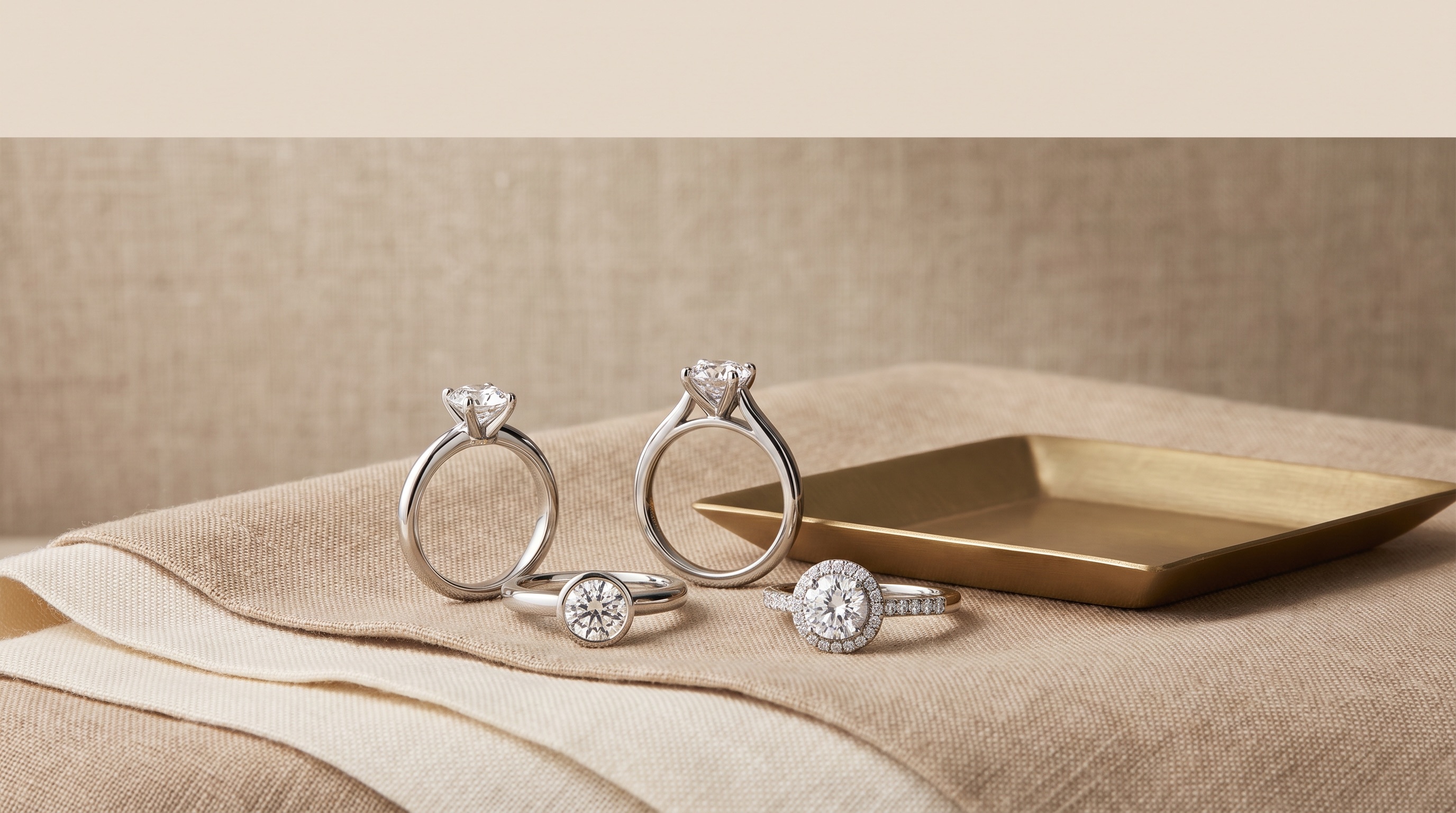
The prong setting is the most common mounting style in the trade, using four or six thin metal claws bent over the stone's girdle to hold it in place while leaving the maximum amount of the diamond exposed to light. A four-prong setting shows slightly more of the stone and gives a cleaner silhouette; a six-prong setting distributes pressure across more contact points and is often preferred for larger center stones or softer metals where extra security matters. Prong settings sit at the more affordable end of mounting styles to manufacture, since they use comparatively little metal, and they're the default choice for solitaire engagement rings specifically because they maximize the stone's visible brilliance.
The tradeoff is exposure: prongs snag on fabric and hair more than a flush-mounted style, and they require periodic inspection, since a bent or worn prong is the single most common cause of a stone coming loose in day-to-day wear.
Bezel Setting
A bezel setting surrounds the diamond's girdle with a continuous thin band of metal rather than individual prongs, fully or partially encircling the stone. Full bezels wrap the entire girdle; partial (or "half") bezels leave the sides open while still framing the top and bottom. Because there's no raised metal claw to catch or bend, bezel settings are the most snag-resistant and durable mounting style available, which is why they're a common recommendation for customers with active hands-on jobs, hobbies, or lifestyles.
The visible tradeoff is light performance: a full bezel blocks light from entering the stone through the sides, which can slightly mute a diamond's brilliance and make the stone appear marginally smaller than the same diamond in an open prong setting. Bezel settings also read as more modern and minimalist, which has made them increasingly popular outside of purely durability-driven purchases.
Halo Setting
A halo setting surrounds a center stone with a ring of smaller pave or micro-pave diamonds, visually increasing the apparent size of the center stone and adding overall sparkle to the piece. Halos can be a single ring of accent stones or a "double halo" with two concentric rings, and the center stone itself is typically still held with its own prong or bezel mechanism — the halo is an addition around that core setting, not a replacement for it.
Halo settings are popular specifically because they let a buyer stretch a given carat budget further on visual size, since a smaller center stone in a halo can read as noticeably larger than the same stone alone. The tradeoff is more metalwork and more small stones to maintain, since a halo introduces additional prongs (for the accent stones) that need the same periodic inspection as any prong-set piece.
Cathedral Setting
A cathedral setting raises the center stone above the band using arched shoulders of metal that curve up from the shank to meet the setting, resembling the arches of a cathedral ceiling — hence the name. The center stone sits in its own prong or bezel head at the top of those arches. Cathedral settings give a taller, more dramatic profile and make the center stone appear more prominent from a side angle, without necessarily requiring a larger stone.
The added height is also the main practical tradeoff: a cathedral-set ring sits higher off the finger than a flush or low-profile setting, which some wearers find catches more on gloves, pockets, or tight-fitting sleeves. It pairs well with an intentionally ornate or vintage-inspired band design, since the arched shoulders give a designer more surface to work with than a plain straight shank.
Tension Setting
A tension setting holds the diamond using the compressive spring force of the metal band itself, gripping the stone at two points along its girdle with no visible prongs or bezel at all — the metal band appears to simply hold the stone suspended between its two ends. This gives the most light exposure of any mounting style, since there's no metal above or around most of the stone's crown and pavilion.
Tension settings require precise, specialized manufacturing and metal with enough tensile strength to maintain constant pressure over years of wear (typically platinum or a high-karat white gold alloy engineered for the purpose), and they're generally harder and more expensive to resize than other styles because resizing changes the exact tension geometry the setting depends on. They're a smaller share of the overall mounting market for these reasons, but they remain a distinct, recognizable style that jewelers get specific customer requests for.
Channel Setting
A channel setting holds a row of smaller diamonds between two parallel walls of metal, with no individual prongs visible between stones — the metal channel itself does the securing along both edges of the row. It's most commonly used for accent diamonds along a shank (rather than as a center-stone mounting) and is a common choice for wedding bands and eternity-adjacent designs where a clean, low-profile row of stones is the goal.
Because there are no raised prongs between stones, channel-set pieces are relatively snag-resistant along that row, though the channel itself must be manufactured to a precise, consistent width, since the stones rely entirely on the channel walls for security rather than individual claws.
Pave Setting
A pave setting (from the French for "paved") uses very small beads or prongs of metal, raised from the surface of the piece, to secure a dense field of small diamonds set close together across a band or halo — the goal is maximum sparkle with minimal visible metal, so the surface reads as "paved" in diamonds rather than showing individual settings. Micro-pave refers to the same technique executed at an even smaller scale, typically for stones under about 0.02 carats each.
Pave work is labor-intensive to manufacture well, since each tiny bead has to be raised and shaped by hand or precision machine without chipping the surrounding stones, and a poorly executed pave job is one of the more common quality-control complaints jewelers hear about from less experienced manufacturers.
Comparing the Main Mounting Styles
| Mounting Style | Light Performance | Durability / Snag Resistance | Typical Use |
|---|---|---|---|
| Prong | Highest | Moderate — prongs can bend or catch | Solitaire engagement rings, classic look |
| Bezel | Reduced (full bezel) | Highest — no raised metal to snag | Active lifestyles, minimalist/modern design |
| Halo | High, plus added sparkle | Moderate — more prongs to maintain | Maximizing apparent center-stone size |
| Cathedral | High | Moderate — raised profile can catch fabric | Dramatic, elevated profile; vintage-inspired designs |
| Tension | Very high | Good day-to-day, but specialized resizing needed | Modern, architectural look; smaller share of the market |
| Channel | Moderate | High along the row | Wedding bands, accent-stone rows |
| Pave | High, dense sparkle | Moderate — depends on execution quality | Maximum surface sparkle, halo and shank accents |
How Mounting Style Interacts With Metal Choice
Some mounting styles have a stronger practical relationship with metal choice than buyers often expect. Tension settings, for instance, are almost always executed in platinum or a specifically engineered white gold alloy because the setting depends on the metal holding constant spring pressure over years — a softer, lower-karat gold isn't well suited to the mechanism. Prong settings, by contrast, work across the full range of common jewelry metals (platinum, 14k and 18k gold in yellow, white, or rose), since the mechanism doesn't depend on the metal's tensile properties the way tension settings do. Bezel settings in a softer metal will show wear on the rim faster than the same bezel in platinum, which is worth flagging to a customer who's choosing between metal and mounting style at the same time rather than treating the two decisions as fully independent.
How Mounting Choice Affects Manufacturing and Sourcing
For a jeweler or manufacturer sourcing mountings — whether as finished semi-mounts ready for a center stone or as part of a fully custom build — mounting style is one of the biggest drivers of both labor cost and lead time. A plain four-prong solitaire mounting is comparatively fast and inexpensive to produce at scale; a double-halo cathedral mounting with a pave-set shank combines several labor-intensive techniques into one piece and takes meaningfully longer to manufacture well. Buyers sourcing semi-mounts in volume for their own retail inventory benefit from understanding which styles their supplier can turn around quickly versus which require a longer custom lead time, since mixing both into one order without accounting for the difference is a common cause of delivery-date surprises.
Matching Mounting Style to Customer Lifestyle
Retail sales staff fielding a mounting-style question directly from a customer get better outcomes asking about lifestyle before aesthetics. A customer who works with their hands, plays sports regularly, or simply reports catching rings on things in the past is generally better served by a bezel or channel-heavy design than a high-prong halo, regardless of which style they initially pointed to in a photo. Conversely, a customer prioritizing maximum sparkle and visible carat size for an occasion piece is better served understanding the light-performance tradeoffs of a full bezel before committing to one for those reasons alone. Framing the conversation around daily wear rather than only initial appearance tends to produce fewer post-purchase resizing or re-setting requests.
Resizing and Repair Considerations by Mounting Style
Mounting style also affects how straightforward future resizing or repair will be, a factor worth mentioning to a customer at time of sale rather than only when a problem arises. Simple prong and bezel settings on a plain shank resize in a relatively routine way, since the setting mechanism itself is largely independent of the shank's exact circumference. Tension settings are the clear exception, as noted above — resizing changes the precise geometry the setting depends on, so it typically requires more specialized work and, in some cases, isn't practically resizable at all beyond a very narrow range. Pieces with continuous channel-set or pave-set shanks also require more careful resizing than a plain band, since cutting and rejoining metal near set stones risks disturbing them if not done by someone experienced with that specific technique.
Vintage and Antique-Inspired Mounting Details
Several mounting styles borrow specific structural details from earlier jewelry-making eras that remain popular in current vintage-inspired design. Filigree work — delicate, lace-like metal detailing along the gallery or shoulders of a mounting — often appears alongside cathedral or basket-style settings to reinforce a vintage aesthetic. Milgrain edging, a row of tiny beaded metal detail along an edge, is another period-inspired detail frequently paired with prong or bezel mountings on vintage-style pieces. These are decorative additions layered onto one of the core structural mounting styles above rather than separate mounting mechanisms in their own right, which is a useful distinction for a buyer who assumes "vintage setting" describes a mechanically distinct category when it's really a decorative treatment applied to a standard mounting.
Three-Stone and Side-Stone Mountings
Beyond single-center-stone designs, several mounting approaches are built specifically to accommodate additional stones flanking the center diamond. A three-stone mounting sets a center diamond between two side stones — often smaller round or matching fancy-shape diamonds — typically in their own prong or bezel heads that connect to the main shank through a shared gallery structure. Side-stone mountings more broadly can pair a center stone with baguettes, trapezoids, or half-moons set into the shoulders of the ring, which requires the manufacturer to source or cut side stones to a precise custom shape and size matched to that specific mounting rather than pulling from standard stock sizes. This is one of the more common points where a mounting's manufacturing complexity — and therefore lead time — increases beyond a simple solitaire, since matched side stones typically need to be selected or cut as a coordinated set rather than sourced independently.
Basket Settings and the Broader Prong Family
"Basket setting" describes the small cage-like structure of metal beneath a center stone's prongs that holds the stone at the correct height and angle above the shank — most prong-set stones sit in some form of basket, even when a buyer doesn't hear the term used directly. Baskets can be closed (solid metal beneath the stone) or open (cut through, showing more light and a lighter overall look), and the choice affects both the piece's weight and how much light reaches the pavilion of the stone from underneath. A closed basket also offers marginally more protection to the stone's culet and lower pavilion facets in daily wear, which is worth knowing when a customer specifically asks about extra security without wanting to move away from a classic prong look entirely.
Common Mounting Mistakes Retailers See
A handful of avoidable issues account for a large share of the mounting-related complaints and repairs jewelers see after a sale. Undersized or thin prongs relative to the center stone's weight are a frequent cause of stones loosening well before a customer expects any wear-related issue, particularly on larger center stones set into mountings originally designed for a smaller stone. Bezels set too thin at the rim wear through faster than a properly proportioned bezel, especially in softer gold alloys. And channel-set rows manufactured with inconsistent channel width put uneven pressure on individual stones, occasionally popping one loose while leaving its neighbors secure. Buyers sourcing mountings wholesale benefit from asking a supplier directly about prong gauge relative to stone weight and bezel wall thickness rather than assuming every mounting labeled with the same style name was built to the same underlying spec.
How Mounting Style Shows Up in Custom Design Conversations
When a customer or retailer commissions a fully custom piece rather than choosing from existing semi-mounts, mounting style is usually one of the first structural decisions a designer locks down, since it shapes nearly every other choice that follows — how much metal the piece needs, which stone shapes will sit well in it, and how the piece will photograph and wear day to day. A CAD-based custom process lets a manufacturer show a customer how a given mounting style will actually look with their chosen center stone before committing to production, which meaningfully reduces the odds of a customer being surprised by the finished piece's proportions or light performance compared to choosing a style from a photo alone. This is also where lifestyle questions (see above) are most useful to raise early, since a custom build gives more room to adjust mounting style to fit daily wear than a semi-mount selected after the fact.
Sourcing Mountings and Semi-Mounts Wholesale
Guru Diam supplies finished jewelry and custom engagement rings across the mounting styles covered here, alongside certified loose diamonds — natural and CVD lab-grown — for jewelers who prefer to set their own inventory. Custom engagement ring builds finish in 4-6 days, and trade accounts sourcing loose stones for their own settings can pull from certified natural inventory or place a fully custom order through the same relationship, rather than managing separate vendors for stones and finished mountings.
Frequently Asked Questions
What is the most durable diamond mounting style?
Bezel settings are generally the most durable and snag-resistant, since the continuous metal rim leaves no raised prongs to bend or catch on fabric, hair, or daily activities. Channel settings offer similar durability for rows of accent stones specifically.
Which mounting style shows the most brilliance?
Prong and tension settings expose the most surface area of a diamond to light, since neither uses continuous metal around the stone's crown or pavilion. A full bezel setting, by contrast, blocks some light from entering through the sides and can slightly mute brilliance.
What's the difference between a mounting and a setting?
In everyday trade use, the terms are interchangeable and both describe the structural approach used to secure a stone. More technically, "setting" refers to the specific mechanism holding the stone, while "mounting" can describe the entire metal structure of the piece, including a "semi-mount" sold before a center stone is added.
Can a tension-set ring be resized?
Tension settings are harder to resize than most other mounting styles, since the setting relies on precise spring pressure from the band that resizing can disturb. Some tension-set rings have a narrow resizable range; a jeweler should evaluate the specific piece before promising a resize.
Is a halo setting a separate mounting mechanism?
Not on its own — a halo is a ring of small accent diamonds added around a center stone, which is still secured by its own prong or bezel head. The halo adds surrounding sparkle and apparent size rather than replacing the center stone's core setting mechanism.
Which mounting style is best for an active lifestyle?
Bezel and channel settings are typically the best fit for hands-on work, sports, or frequent activity, since neither has raised prongs that catch on gloves, equipment, or fabric the way a prong or cathedral setting can.
Guru Diam is a trade-only wholesale supplier of certified natural and CVD lab-grown loose diamonds, antique and fancy diamond shapes, and custom finished jewelry, with locations in New York and Los Angeles. Trade accounts can review mounting-ready inventory in certified diamonds, explore custom jewelry for fully built mountings, or apply through trade partner. Current wholesale terms are available at the wholesale hub.