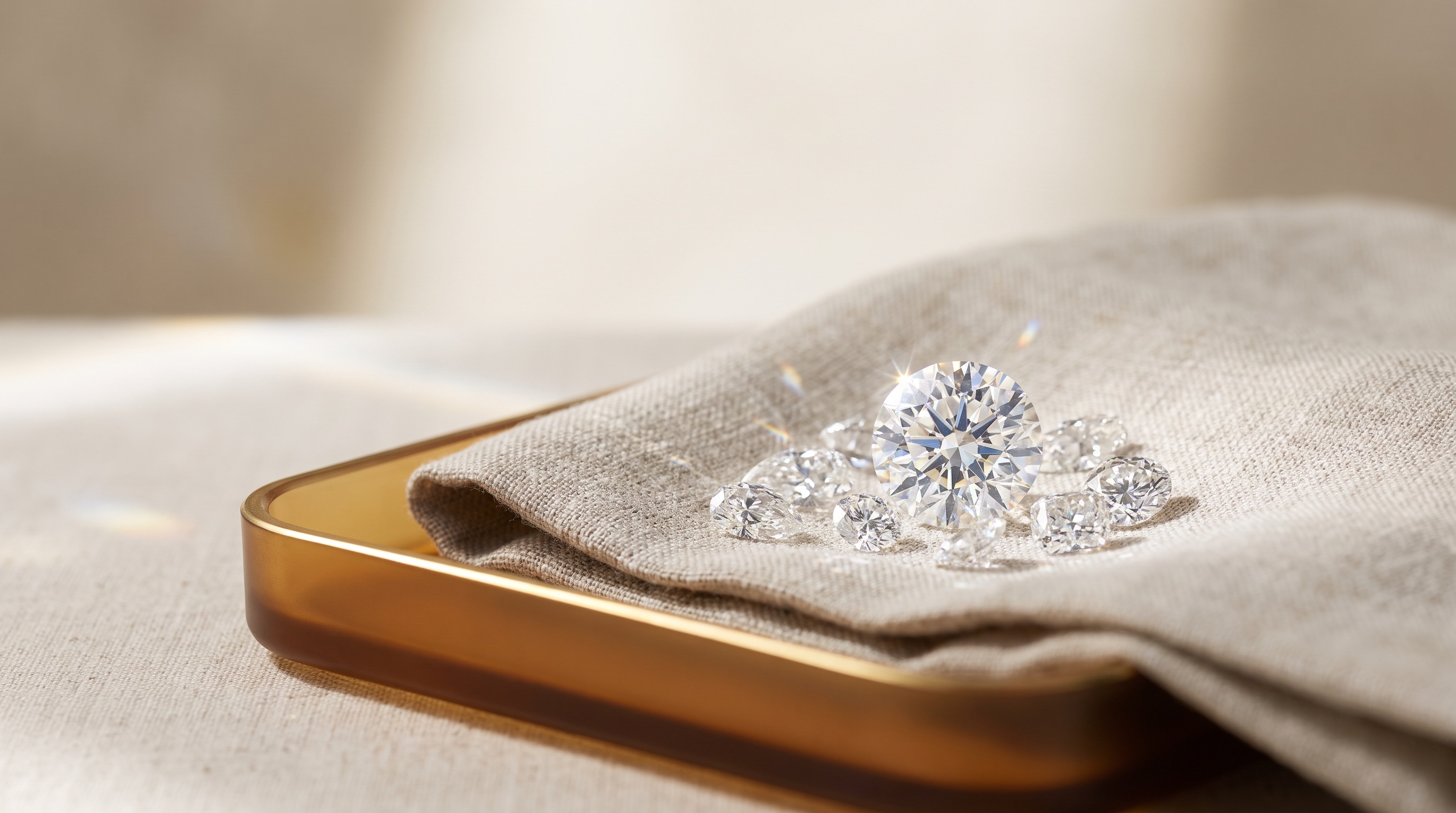
Diamond light performance describes how effectively a cut diamond returns light to the eye as brightness, fire, and scintillation — the combined visual effect of a stone's proportions, symmetry, and polish working together, rather than any single measurement on a certificate. A diamond can carry an excellent cut grade and still show noticeably different light performance from another excellent-grade stone of the same shape, because cut grade summarizes proportions into a broad category while light performance is the actual, observable result of light entering, reflecting inside, and exiting the stone. Understanding this distinction helps a buyer or jeweler evaluate two similarly graded stones side by side rather than assuming an identical grade guarantees an identical look, and it becomes especially relevant when a client asks why one stone "sparkles more" than another despite both carrying the same paperwork.
This guide covers the three components that make up light performance, how they differ from cut grade, how light performance varies by shape, what tools and methods exist for assessing it, and how to talk about it with a client comparing stones that look different despite similar certificates.
The Three Components of Light Performance
| Component | What it describes | What drives it |
|---|---|---|
| Brightness | The total quantity of white light reflected back to the eye, both internal and external | Overall proportions, table and crown angles, pavilion depth |
| Fire | The dispersion of light into flashes of spectral color | Facet angles and how light splits into its component wavelengths as it exits the stone |
| Scintillation | The pattern of light and dark flashes as the stone, light source, or viewer moves | Facet arrangement, symmetry, and the number and placement of facets relative to stone size |
These three components interact rather than operating independently — a stone can be optimized heavily for brightness at some cost to fire, or vice versa, depending on how its proportions are cut. No single component alone defines "good" light performance; the combination, weighed against a buyer's own visual preference, is what actually matters.
Light Performance vs. Cut Grade: Why They're Not the Same Thing
A cut grade (Excellent, Very Good, Good, and so on, as assigned by GIA, IGI, or GCAL) is a categorical summary based on a defined range of proportions, symmetry, and polish measurements. Light performance is the actual visual result those proportions produce. Two diamonds can both carry an Excellent cut grade while sitting at different points within that grade's proportion range, producing visibly different brightness-to-fire balance even though both certificates report the identical grade. This is why two Excellent-cut stones of the same shape, color, and clarity can still look noticeably different side by side — the grade confirms both stones fall within a defined range, not that they perform identically within it.
How Light Performance Is Assessed
Labs and independent tools assess light performance through a mix of proportion analysis and, increasingly, imaging-based technology that maps how light actually travels through a specific stone rather than relying purely on proportion ranges. Proportion-based assessment checks table size, crown and pavilion angles, girdle thickness, and symmetry against ranges associated with strong light return for a given shape. Imaging-based assessment, less universally available but increasingly used by labs and independent graders, photographs or scans the stone under controlled lighting to map its actual light-return pattern, which can catch performance differences that pure proportion measurement misses — particularly relevant for fancy shapes, where "ideal" proportion ranges are less standardized than for round brilliant.
Light Performance by Shape
| Shape | Light performance characteristic |
|---|---|
| Round brilliant | Most standardized proportion-to-performance relationship; 57-58 facet structure optimized specifically for brightness and fire |
| Emerald, Asscher (step cuts) | Emphasize clarity and flash over fire; large open facets show a hall-of-mirrors effect rather than sparkle, making clarity grade more visually consequential |
| Oval, pear, marquise (brilliant-cut fancy shapes) | Prone to a visible "bowtie" effect — a dark shadow across the center — that varies significantly by individual cutting rather than a proportion range alone |
| Cushion, radiant | Facet arrangement varies more by cutter than round brilliant; light performance differs meaningfully between individual stones even at the same reported proportions |
| Antique cuts (Old Mine, Old European) | Deliberately cut for a softer, larger-faceted brilliance rather than modern maximum-sparkle optimization; light performance should be judged against period-cut character, not modern round-brilliant standards |
The Bowtie Effect: A Shape-Specific Light Performance Issue
Elongated brilliant-cut fancy shapes — oval, pear, marquise, and to a lesser degree cushion and radiant — can show a bowtie effect, a dark shadow-like band across the stone's center caused by light escaping through the pavilion rather than reflecting back to the eye at that specific point. A subtle bowtie can read as an attractive contrast feature; a heavy, obvious bowtie is generally considered a light performance flaw. Because bowtie severity depends on individual cutting rather than a proportion range that shows up cleanly on a certificate, visual review (in person, or through video/photo from the supplier) is the most reliable way to evaluate it before committing to a specific stone in these shapes.
Does Carat Weight Affect Light Performance?
Carat weight itself doesn't directly determine light performance, but cutters sometimes retain extra weight in the pavilion or adjust proportions specifically to preserve carat weight during cutting, which can come at the cost of ideal light-return proportions. A "spready" cut — one that maximizes visible diameter relative to carat weight — can look larger face-up but may sacrifice some brightness or fire if proportions drift outside optimal ranges to achieve that visual size. This tradeoff is worth flagging to buyers specifically prioritizing face-up size over maximum light performance, since the two goals aren't always fully aligned in how a stone gets cut.
Light Performance in Lab-Grown vs. Natural Diamonds
Light performance is governed entirely by cutting proportions and optical physics, not by whether a diamond formed naturally or was grown via CVD — a lab-grown and natural diamond cut to identical proportions perform identically for brightness, fire, and scintillation. This means a buyer evaluating light performance should apply the same standards regardless of origin, and a wholesale supplier carrying both categories should be equally rigorous about cut quality across natural and CVD inventory rather than treating either origin as inherently better- or worse-performing.
Reading a Certificate for Light Performance Clues
A GIA, IGI, or GCAL report doesn't print a single "light performance score," but the underlying proportion data (table percentage, crown and pavilion angles, girdle thickness, symmetry, and polish grades) gives a trained reader a reasonable prediction of how a stone will likely perform, particularly for round brilliant where proportion-to-performance correlation is best understood. For fancy shapes, proportion data alone is a weaker predictor, which is one reason visual review or supplier-provided video matters more for these shapes than it does for round brilliant.
Polish and Symmetry: The Overlooked Light Performance Factors
Cut proportions get most of the attention in light performance discussions, but polish and symmetry grades matter meaningfully too — a facet with poor polish scatters light unevenly rather than reflecting it cleanly, and symmetry issues (facets misaligned relative to each other) disrupt the precise light path that good proportions are designed to create. A stone with excellent proportions but only good polish or symmetry won't perform to its full potential; conversely, excellent polish and symmetry on slightly less ideal proportions can sometimes outperform expectations. This is part of why cut grade weighs all three factors together rather than proportions alone.
Common Misconceptions About Light Performance
- "A higher cut grade always means better light performance than a lower one." Generally true on average, but two stones with the same grade can still perform differently, and grade categories cover a range rather than a single fixed proportion set.
- "Light performance is the same thing as sparkle." Sparkle is really scintillation specifically; brightness and fire are separate, equally important components of overall light performance.
- "Fancy shapes can't have strong light performance." Fancy shapes perform differently than round brilliant by design, not worse — a well-cut oval or cushion has excellent light performance judged against its own shape's characteristics, not against round brilliant's proportions.
- "A bowtie effect always means a poorly cut stone." A subtle bowtie is a normal, sometimes attractive characteristic of elongated shapes; only a heavy, dominant bowtie is a genuine light-performance flaw.
Comparing Light Performance Across Multiple Stones
When comparing several stones at a similar price point, the most reliable practical method is direct visual comparison — in person under consistent, moderate lighting (avoiding both very dim rooms and direct, harsh spotlighting that can flatter or distort any stone), or through consistent video from a supplier showing each stone under the same conditions. Comparing raw proportion numbers side by side is a reasonable starting filter, especially for round brilliant, but shouldn't replace an actual visual comparison before a final decision, particularly for fancy shapes where proportion data is a weaker standalone predictor of performance. When several stones are being compared remotely rather than in person, requesting consistent, comparable video or photography from a single supplier under matched lighting conditions is a meaningfully better basis for judgment than pulling separate photos from different listings, since inconsistent lighting and camera setup between sources can distort comparisons as much as an actual difference in the stones themselves.
Light Performance and Setting Choice
A setting can meaningfully affect how a stone's light performance is perceived, independent of the stone's own cut quality. A setting that blocks too much light from entering through the pavilion (a closed-back or heavily built-up setting, for instance) can dampen brightness that the stone would otherwise deliver in an open setting. Prong placement and metal color also interact with perceived light performance — white metal settings generally read as brighter and cooler, while yellow or rose gold can warm the overall look, which sometimes matters more to a client's perception of "sparkle" than the stone's underlying cut quality alone.
Talking to Clients About Light Performance
Clients rarely ask about "light performance" using that exact term, but the underlying question — why does this diamond look different from that one even though they're graded the same — comes up constantly. Framing the explanation around the three components (brightness, fire, scintillation) rather than a single abstract concept gives a client a concrete way to describe what they're actually seeing and preferring, which also makes it easier to guide them toward a stone that matches their stated preference (some clients prioritize maximum sparkle/scintillation, others prefer a calmer, brighter look) rather than defaulting purely to the highest available cut grade.
Antique Cuts and a Different Light Performance Standard
Old Mine, Old European, and other true antique-style cuts were cut by hand using period techniques and proportions genuinely different from modern ideal-cut standards, producing a characteristically softer, larger-faceted brilliance rather than the maximum-fire, small-facet sparkle modern round brilliant is optimized for. Evaluating an antique cut's light performance against modern round-brilliant proportion standards misses the point of the cut style entirely; the right comparison is against other antique-cut stones and against the specific aesthetic a buyer is seeking, which is often exactly this softer, more romantic light character rather than maximum modern brilliance.
Light Performance and Lighting Environment
The same diamond can appear to perform quite differently depending on the lighting environment it's viewed in, which is one of the more common sources of confusion when a client compares how a stone looked in a showroom against how it looks at home. Fluorescent office lighting, warm incandescent lighting, direct sunlight, and diffused daylight each interact differently with a stone's fire and brightness — direct, point-source lighting (a single spotlight or bright sun) tends to maximize visible fire and scintillation, while diffused, even lighting shows brightness more than dramatic flash. Neither environment is more "correct" for judging a stone, but a jeweler explaining light performance to a client benefits from acknowledging this variability directly, rather than letting a client assume something is wrong with a stone that looked more subdued at home than it did under a jewelry counter's deliberately bright point-source lighting.
Why Two Certificates With Identical Numbers Can Still Look Different
Buyers who compare two certificates line by line and find nearly identical proportion numbers sometimes still notice a visible difference between the actual stones, which can be genuinely puzzling without understanding why. Certificates report proportions to a limited precision and don't capture every variable that affects light performance — facet junction quality, minor variations in individual facet angles that average out to the same reported number, and subtle polish differences all fall outside what a standard certificate documents numerically. This is precisely why visual comparison remains valuable even when paperwork looks identical, and why two "identical-on-paper" stones are a reasonable starting point for comparison shopping but not a substitute for actually looking at both side by side before a final decision.
Light Performance Technology and Independent Grading Tools
Beyond the proportion and symmetry data on a standard grading report, a handful of independent imaging technologies exist specifically to visualize and, in some cases, score a stone's actual light-return pattern — mapping where light enters, reflects, and exits across the entire stone rather than inferring performance from proportion ranges alone. These tools are most useful for fancy shapes and antique cuts, where proportion-based prediction is weaker, and for buyers or jewelers comparing multiple similarly graded stones who want an objective visual reference beyond a verbal description or a single photograph. Availability and specific methodology vary by lab and by independent grading service, so a buyer relying on this kind of analysis should confirm exactly what the specific report or image is measuring and how it was generated before treating it as a definitive comparison tool.
How Cutters Balance Competing Light Performance Priorities
Every diamond cutter faces tradeoffs when deciding final proportions for a specific rough stone — maximizing carat weight retention, maximizing light performance, and minimizing visible inclusions all pull in somewhat different directions, and a cutter rarely achieves the theoretical maximum on all three simultaneously. A rough stone with an inclusion positioned near where an ideal-proportion cut would place the culet, for example, might be cut with slightly different proportions specifically to position that inclusion where it's less visible, at some small cost to theoretical light performance. Understanding that finished proportions reflect these real tradeoffs, rather than a cutter simply falling short of a single universal ideal, helps explain why proportion variation exists even among well-cut stones from experienced cutters.
Light Performance as a Wholesale Sourcing Criterion
For a wholesale buyer sourcing inventory rather than a single stone for a single client, light performance consistency across a supplier's catalog matters more than any individual stone's exceptional performance. A jeweler who orders round brilliants sight-unseen from a supplier's certified catalog is implicitly trusting that supplier's proportion standards and quality control to deliver consistent light performance across every order, not just the specific stone photographed in a listing. This is one of the more overlooked reasons an established, high-volume wholesale relationship tends to outperform sourcing individual stones from scattered smaller sellers: consistency in cutting standards across hundreds or thousands of stones is a harder thing to verify from a single transaction than it is from an ongoing account history with a supplier whose inventory has proven reliable order after order.
Frequently Asked Questions
What is diamond light performance?
Diamond light performance describes how effectively a cut diamond returns light as brightness, fire, and scintillation — the actual visual result of a stone's proportions, symmetry, and polish, as opposed to a single grade or measurement.
Is light performance the same as cut grade?
Related but not identical. Cut grade is a categorical summary based on proportion ranges; light performance is the specific visual outcome a given stone produces, which can vary somewhat even among stones sharing the same cut grade.
Does carat weight affect light performance?
Not directly, but cutting choices made to preserve carat weight can sometimes shift proportions away from ideal light-return ranges, which is why a "spready" cut can occasionally trade some brightness or fire for larger face-up size.
Do lab-grown diamonds have different light performance than natural diamonds?
No — light performance depends on cutting proportions and optical physics, not origin. A lab-grown and natural diamond cut to identical proportions perform identically.
What is the bowtie effect and does it mean poor light performance?
The bowtie effect is a dark shadow band seen in elongated shapes like oval, pear, and marquise. A subtle bowtie is a normal characteristic; only a heavy, dominant bowtie should be considered a genuine light-performance concern.
How can I compare light performance between two similar diamonds?
Direct visual comparison under consistent lighting, in person or via supplier video, is the most reliable method — especially for fancy shapes, where proportion data alone predicts performance less precisely than it does for round brilliant. Requesting matched video from the same source for every stone under consideration removes lighting and camera inconsistency as a variable in the comparison.
Can polish and symmetry affect light performance even with good proportions?
Yes. Poor polish scatters light unevenly and symmetry errors misalign facets relative to each other, both of which can reduce a stone's light performance even when its underlying proportions are within a strong range for its shape.
Sourcing Diamonds Evaluated for Light Performance from Guru Diam
Guru Diam carries certified CVD lab-grown diamonds, natural diamonds, and certified loose stones across antique cuts, standard fancy shapes, and round brilliant, with IGI, GIA, and GCAL certification available on every stone so buyers can review full proportion, symmetry, and polish data before purchase. Our team can provide direct video review of any specific stone's light performance, particularly useful for fancy shapes and antique cuts where a certificate's proportion data alone doesn't tell the full story, so a jeweler can confirm a stone's actual visual character before presenting it to a client.
Browse certified inventory through the certified diamonds category, review fancy color and antique options through fancy color loose diamonds, and source matched stones through matching pairs. In-stock inventory ships same-day from New York (before 6pm EST) and Los Angeles (before 4pm PST); trade accounts can review terms at the wholesale hub or apply through trade partner.