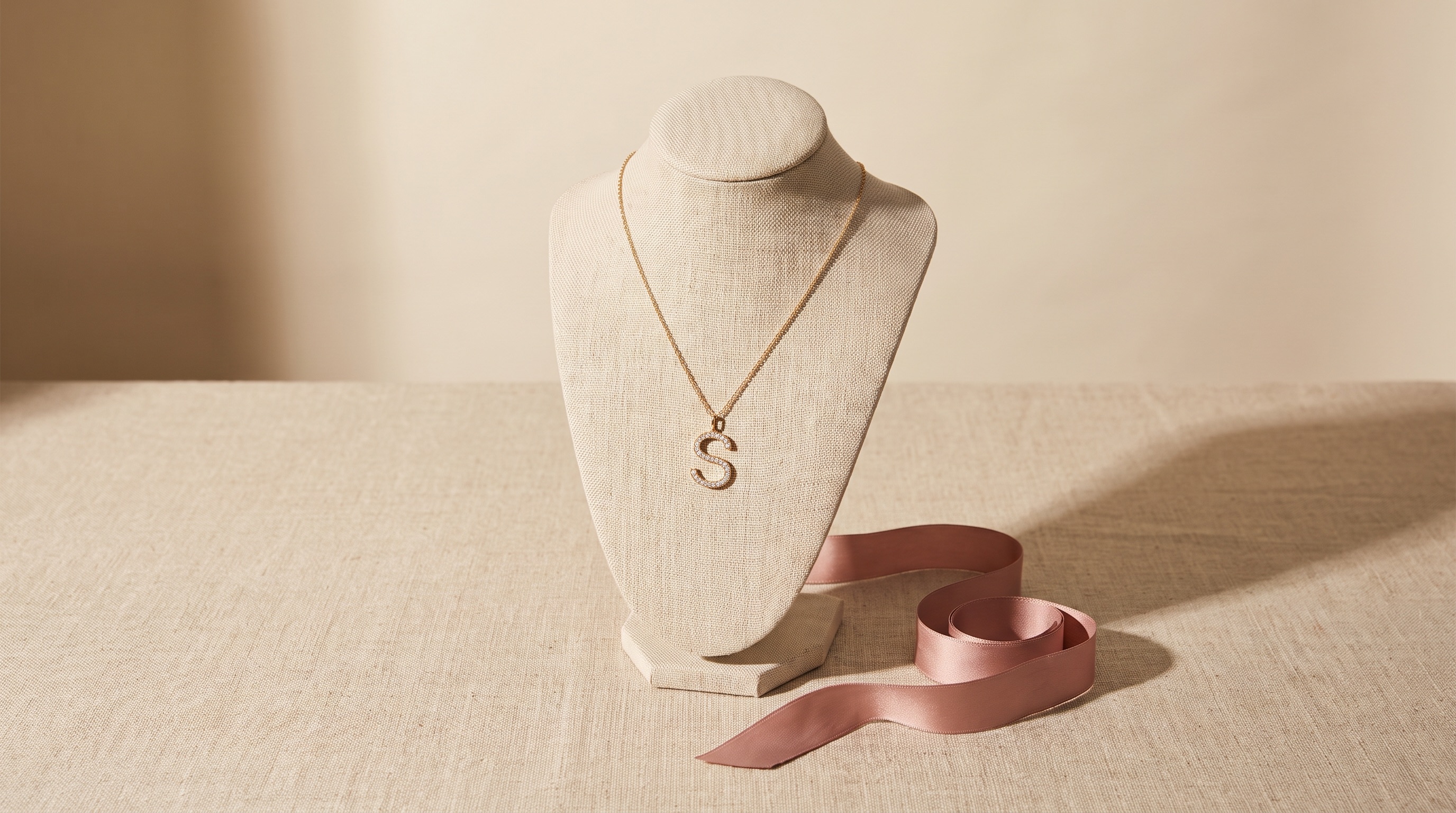
A diamond letter necklace is a pendant featuring one or more diamond-set letters — most commonly a single initial — hung from a fine chain. For a jeweler or manufacturer, this is a construction and legibility problem before it's a diamond-sourcing problem: the melee has to be sized and placed so the letterform reads clearly at typical pendant scale, and font choice, outline vs. full-pavé construction, and multi-letter layout all affect how much melee a given design needs and how it has to be set.
This guide is written for the trade — jewelers, designers, and manufacturers sourcing diamonds and melee to build letter and initial necklace lines for their own retail or wholesale assortment. It covers construction types, font and legibility considerations, melee sizing, multi-letter and monogram formats, and what to ask a wholesale supplier before placing a first order in this category.
Why Letterform Legibility Drives Sourcing Decisions
Unlike most diamond pendant categories, where the design's visual appeal comes from the diamonds themselves rather than from conveying specific information, a letter necklace fails at its basic job if the letter isn't legible at the finished pendant's actual size. This makes font choice and melee scale a functional requirement, not purely an aesthetic one — a letterform with thin strokes or tight interior counters (the enclosed or partially enclosed spaces inside letters like A, B, O, and R) needs proportionally smaller melee and tighter setting tolerances than a bold, simple letterform like L, I, or T, which can carry larger stones without losing legibility. Manufacturers should choose melee size based on the specific letters being produced across a full alphabet run rather than picking one size that happens to work for a few easy letters and then struggling to make it legible on more complex ones.
Construction Types
Outline (Open) Letter
Diamonds trace only the outer stroke of the letterform, leaving the interior open — the most common construction for smaller pendants, since it requires meaningfully less total melee than filling the entire stroke width, and reads cleanly even at a small scale because the open interior keeps the letterform from looking cluttered.
Full-Pavé Letter
Diamonds fill the entire width of each stroke rather than just tracing its outline, giving a bolder, more substantial look at the cost of a meaningfully higher total carat weight for the same letter size. This construction generally needs a larger overall pendant scale than an outline letter to avoid the strokes reading as visually merged, particularly on letters with tight interior counters.
Mixed Diamond-and-Metal Letter
A solid metal letterform with diamond accents at select points — often the letter's terminal ends or a single accent at a visually prominent stroke — rather than diamonds along the full outline or stroke width. This construction reduces total melee cost significantly while still giving the piece a clear diamond element, and is a common choice for an accessible entry-tier letter necklace design.
Melee Sizing by Letter Complexity
| Letterform Type | Example Letters | Recommended Melee Size |
|---|---|---|
| Simple, bold strokes | I, L, T, V, X | 1.2mm–1.5mm, more forgiving on placement |
| Moderate complexity, some curves | C, J, N, S, U, Z | 1.0mm–1.3mm |
| Tight interior counters | A, B, D, O, P, Q, R | 0.8mm–1.1mm, tighter setting tolerance required |
Letters with tight interior counters — B, O, R, and similar shapes with enclosed or near-enclosed spaces — require the finest melee and the most precise setting to keep the counter space visually open rather than crowding it with stones that are too large for the available room. A manufacturer producing a full alphabet run should expect meaningfully more setting labor per piece on these letters than on simple bold strokes like I or L, and should price accordingly rather than assuming uniform labor cost across every letter in the alphabet.
Font and Style Choices
Letter necklaces are commonly offered across a small number of font styles — a classic serif block letter, a modern sans-serif block letter, and a cursive or script letterform — each of which has different legibility and melee-placement implications. Script letters, with their thinner, flowing strokes and connected letterform shapes, are generally the most challenging to render clearly in diamond outline at small pendant scale and often require a larger overall pendant size than a block letter of otherwise comparable visual weight to remain legible. Retailers offering multiple font options should confirm the melee size and pendant scale recommended for each font individually rather than assuming one melee spec fits all styles equally well.
Multi-Letter and Monogram Formats
Beyond a single initial, common variations include a two- or three-letter monogram (traditionally arranged with a larger center letter representing the surname initial flanked by smaller first and middle initials, in the classic monogram convention), a short name or word spelled out in a horizontal line of individually diamond-set letters, and a date or number rendered in the same diamond-letter construction. Multi-letter designs require the individual letters to be sized and spaced consistently relative to each other, and a monogram's traditional larger-center-letter convention specifically requires the center letter's melee to be scaled up proportionally rather than simply enlarging the whole letter's outline uniformly, since a naive scale-up can make the center letter's strokes look disproportionately thick relative to the flanking initials.
Certification Approach
Because letter necklace pendants are built almost entirely from fine melee-range stones, the diamonds ship as graded parcel goods against a stated commercial standard, commonly DEF+/VS+, following standard melee practice. A design that adds a single larger accent stone — for example, at a letter's terminal point — can have that specific stone individually certified through IGI, GIA, or GCAL if it's 0.30ct or above, though this is uncommon in the category given how small individual letter-outline stones typically are. Retailers should confirm melee grading consistency across a full alphabet run specifically, since a supplier's stated grading standard should apply uniformly whether a customer orders an "I" or an "O," not just on the easier, larger-stone letters.
Natural vs. Lab-Grown Diamonds for Letter Necklaces
Letter necklaces carry a modest total carat weight even in full-pavé construction, given the small scale most pendants are produced at, which keeps the absolute dollar difference between natural and CVD lab-grown material relatively small in this category compared to higher-carat-weight pieces. Given that letter and initial necklaces are frequently purchased as an accessible personalized gift — for a child, a partner, a friend, or as a self-purchase — lab-grown material is the more common choice, letting a retailer offer a fuller, more finished-looking pavé or full-stroke letter at a price point that fits the category's typical gifting budget.
What to Ask a Supplier When Sourcing Letter Necklaces
- What melee sizes are available as a consistent, matched lot across the full alphabet, given that letters with tight interior counters need finer stones than bold, simple letters?
- Does the supplier offer multiple font styles, and can they confirm the recommended pendant scale for each font to maintain legibility?
- Is monogram center-letter scaling handled proportionally rather than as a simple uniform enlargement, for multi-letter designs following the traditional monogram convention?
- What's the reorder consistency for a specific letter's melee spec, given that a retailer selling personalized pieces needs every letter in the alphabet reliably available, not just the more commonly ordered initials?
Chain and Bail Pairing
As with most small pendant categories, letter necklaces are commonly sold pre-strung on a fine cable or box chain in the 16–18 inch range, though some retailers offer the letter pendant separately so a customer can choose their own chain. Bail placement needs particular attention on letter pendants specifically because an asymmetric letterform (most letters other than perfectly symmetrical shapes like I, O, or X) can hang slightly off-center if the bail isn't positioned to account for the letter's actual visual weight distribution, which is a more pronounced concern here than on many other pendant shapes given how immediately noticeable a tilted letter reads to anyone glancing at the piece.
Personalization and Customization
Letter necklaces are inherently a personalization category, and retailers frequently extend the customization further with metal color choice, an optional birthstone or colored accent stone set at a specific point on the letter, or a paired chain length chosen to sit at a customer's preferred neckline. Because the base product is already a single-letter personalization, offering these additional customization layers is a natural upsell that doesn't require building an entirely separate custom program — the same production process used for a standard letter order can typically accommodate a birthstone accent or metal choice without significant additional tooling.
Layering and Pairing With Other Necklaces
Letter and initial pendants are commonly worn as part of a layered necklace stack, often paired with a second, longer pendant or a plain chain, and multiple family members' or loved ones' initials are sometimes worn together as a small cluster of individual letter pendants on the same chain or on adjacent chains of slightly different lengths. Retailers should consider merchandising letter necklaces explicitly as a layering and stacking category — offering the same letter across two or three chain lengths, and displaying letter pendants alongside complementary plain-chain or symbolic pendant options — since this consistently drives a higher average order value than treating each letter pendant as an isolated single-item purchase.
Metal Choices
Letter necklaces are produced across the standard range of finished-jewelry metals — 14k and 18k white, yellow, and rose gold — with metal choice in this category often tied to a customer's existing chain or jewelry collection, since the piece is frequently added to an existing layered stack rather than purchased as a customer's first fine jewelry item. Offering the same letter design across all three common gold tones is a standard practice in this category specifically because personalization purchases are less price-sensitive to a small metal-tone premium than they are to getting the specific letter and style right.
Common Manufacturing Defects to Screen For
Because letterforms with tight interior counters concentrate the most precise setting work into a small area, that part of the design is the most common point of manufacturing defect — melee crowding the interior counter space, uneven stone spacing along a curved stroke (particularly on letters like C, S, and O), or a stroke that reads as visually broken where two segments of the letter meet. A physical inspection under magnification, checking specifically that the letter remains legible and that no interior counter space looks crowded or filled in, is a more useful quality-control step for this category than a general visual scan of overall diamond quality alone.
Building a Letter Necklace Line Across Price Tiers
A well-built letter necklace line typically spans a mixed diamond-and-metal entry tier for accessible personalized gifting, a standard outline-letter mid-tier, and a premium full-pavé tier for a bolder, more substantial look. As with other melee-driven pendant categories, sourcing melee for the whole tier structure and the full alphabet through one supplier relationship — rather than sourcing letter by letter or tier by tier from different vendors — keeps grading and reorder consistency uniform across every letter and price point a customer might request.
Comparing Letter Necklaces to Other Symbolic Pendant Categories
| Category | Typical TCW | Sourcing Complexity |
|---|---|---|
| Diamond letter/initial necklace | 0.10–0.35 TCW | Moderate — melee sizing tied directly to letterform legibility |
| Diamond infinity necklace | 0.08–0.45 TCW | Moderate — small melee, tight crossover curve, hang-balance dependent |
| Diamond tennis necklace | 3.00–15.00+ TCW | High — long line, large stone count, strict color/size matching |
Letter necklaces sit toward the accessible end of this comparison in total diamond investment, but their sourcing complexity is driven by a factor — legibility across a full alphabet of visually distinct shapes — that doesn't apply to most other symbolic pendant categories, which typically work with a single fixed motif rather than 26 structurally different letterforms.
Wholesale Pricing Structure and Order Quantities
Letter necklace pendants are typically quoted per-piece, with pricing varying by letter within the same construction type and metal, since letters with tight interior counters require more setting labor than simple bold-stroke letters even at an identical melee grade and total carat weight target. A retailer placing a first wholesale order should ask whether a supplier quotes a single blended price across the whole alphabet or prices individual letters differently to reflect this labor variance, since a blended price can obscure real margin differences a retailer would otherwise want to account for when setting retail prices letter by letter. It's also worth confirming minimum order quantities per letter rather than assuming an even split works, since real-world personalization demand skews heavily toward common initials (particularly vowels and letters common in first names) and a retailer stocking every letter of the alphabet in equal quantity will typically find several less-common letters moving far more slowly than the rest of the assortment.
Quality Control Checklist on Receipt
A receiving inspection for letter necklace pendants should focus first on legibility at actual wear distance — holding the piece at roughly arm's length, the letter should read clearly as its intended character rather than as an ambiguous shape, which is a more useful practical test than close-up magnified inspection alone, since a letter that looks fine under a loupe can still read poorly at the distance a piece is actually seen from in daily wear. Under magnification, check specifically for melee crowding in any interior counter space and for consistent stone spacing along curved strokes, since these are the failure points most specific to this category. As with other pendant categories, hang balance should be checked on a physical sample, confirming the letter sits level and facing forward on its intended chain rather than tilted, which is a particular risk on asymmetric letterforms where the bail placement has to account for uneven visual weight distribution across the letter's shape.
Seasonal and Gifting Demand Patterns
Letter necklace demand is driven primarily by personal gifting occasions rather than seasonal fashion cycles — birthdays, Mother's Day, graduation, and new-baby gifting (a parent's or child's initial) are consistent demand drivers throughout the year rather than concentrated in one narrow window the way some symbolic categories are. Retailers should treat this as a steady core category with modest seasonal lifts around the major gifting holidays, rather than planning inventory around a single anticipated demand spike.
Photography and Product Listing Considerations
Letter necklace product photography needs to prioritize legibility above all else — a flat-lay or angled shot that makes an ambiguous letterform (particularly C vs. G, or O vs. Q) hard to distinguish at listing thumbnail size is a real conversion risk specific to this category, since a customer shopping for a specific initial needs to be confident the listing shows the correct letter before purchasing. A straight-on macro shot, supplemented by an on-model shot showing the pendant at its natural hanging scale and orientation, gives a more reliable basis for a customer's purchase decision than a single artfully angled hero shot that prioritizes visual style over letter clarity.
Frequently Asked Questions
What is a diamond letter necklace?
A pendant necklace featuring one or more diamond-set letters — most often a single initial — hung from a fine chain, typically built as either an outline, full-pavé, or mixed diamond-and-metal construction.
Why do some letters need smaller melee than others?
Letters with tight interior counters (enclosed or near-enclosed spaces), like A, B, O, and R, need finer melee and tighter setting tolerance to keep the interior space visually open — bold, simple letters like I, L, and T can carry larger stones without losing legibility.
What's the difference between an outline and a full-pavé letter?
An outline letter traces only the outer stroke, leaving the interior open and using less total melee; a full-pavé letter fills the entire stroke width with diamonds for a bolder look at a meaningfully higher carat weight for the same overall letter size.
Can a letter necklace include more than one letter?
Yes — common multi-letter formats include a traditional monogram (a larger center initial flanked by smaller initials) and a short name or word spelled out in a horizontal line of individually set letters, both requiring consistent sizing and spacing across each letter used.
Should letter necklace diamonds be lab-grown or natural?
CVD lab-grown melee is the more common choice for this category since letter necklaces are frequently purchased as an accessible personalized gift, and lab-grown material lets a retailer offer a fuller-looking letter at a price point that fits typical gifting budgets.
Are diamond letter necklaces certified?
The melee that forms the letter ships as graded parcel goods against a commercial standard like DEF+/VS+. Individual certification is uncommon in this category given how small the individual outline or pavé stones typically are.
Numbers and Symbols Alongside Letters
Many letter necklace programs extend the same construction and sourcing logic to numbers (commonly used for a birth year or anniversary date) and a small set of symbols like a heart or star used alongside an initial. Numbers generally follow the same complexity pattern as letters — bold, simple digits like 1 and 7 tolerate larger melee than digits with tighter interior counters like 8 and 0 — so a retailer extending a letter program to include numbers should apply the same per-character melee sizing logic covered above rather than treating numeral sourcing as a separate problem.
Sourcing Diamonds for a Letter Necklace Line Wholesale
Guru Diam supplies calibrated CVD lab-grown and natural melee in the fine, consistent sizes letter and monogram pendant construction requires across a full alphabet, with IGI, GIA, and GCAL certification available on any larger accent stones at 0.30ct and above. Trade buyers can review current melee and matched-pair inventory through matching pairs and certified diamonds, and work with Guru Diam's custom jewelry team on font, scale, and monogram layout through custom jewelry. In-stock inventory ships same-day from Guru Diam's New York and Los Angeles locations. New trade accounts can apply through trade partner, with current terms available at the wholesale hub. For related sourcing fundamentals, see our diamond infinity necklace guide and diamond tennis necklace guide.
Guru Diam is a trade-only wholesale diamond supplier with locations in New York and Los Angeles, supplying calibrated CVD lab-grown and natural melee alongside certified loose diamonds, with IGI, GIA, and GCAL certification available, for jewelers building necklace, pendant, and finished jewelry lines. Browse current inventory in matching pairs or apply for a trade account through trade partner.