A diamond jewelry manufacturer is a company that produces finished diamond jewelry — rings, earrings, bracelets, and necklaces — from raw materials or loose stones, typically handling design, casting, stone-setting, and polishing under one operation. In the wholesale trade, manufacturers sell to jewelers, designers, and retailers rather than directly to the public.
For an independent jeweler or designer, understanding what a manufacturer actually does — and how that differs from a wholesaler or a distributor — matters more than it might seem. It affects your pricing, your turnaround time, whether you can put your own name on the finished piece, and how much control you have over quality. This guide walks through the terminology, the questions worth asking before you commit to a supplier, the red flags that tend to precede bad experiences, and how to think about sourcing loose stones and finished jewelry from the same place.
What Does a Diamond Jewelry Manufacturer Actually Do?
At its core, a diamond jewelry manufacturer takes a design — whether from a catalog, a CAD file, or a jeweler's sketch — and turns it into a physical piece of jewelry set with diamonds. That process usually includes several distinct stages: designing or rendering the piece (often in CAD software), producing a wax or 3D-printed model, casting the metal, setting the stones, and polishing and finishing the piece for delivery. Some manufacturers handle every one of those stages themselves. Others handle only part of the process and subcontract the rest — casting to one shop, setting to another, polishing to a third. Both models exist in the trade, and neither is inherently good or bad, but they produce very different experiences for the buyer in terms of consistency, timeline, and accountability when something goes wrong.
Manufacturers in the diamond trade generally fall into a few overlapping categories: those who focus on bridal and engagement rings, those who produce fashion jewelry (tennis bracelets, hoops, pendants), and those who offer full custom work built to a jeweler's or designer's exact specifications. Many manufacturers do all three, but it's worth asking which segment a given supplier actually specializes in before assuming they can handle your specific request.
Manufacturer vs. Wholesaler vs. Distributor: What's the Difference?
These three terms get used almost interchangeably in casual trade conversation, but they describe different roles in the supply chain, and the distinction affects what you should expect from each one.
A manufacturer physically produces the jewelry — designing, casting, setting, and finishing pieces. A wholesaler typically buys finished jewelry or loose stones in bulk and resells them to jewelers and retailers, often without doing any production work themselves. A distributor sits between manufacturers and the retail trade, usually carrying multiple manufacturers' lines and functioning more like a logistics and sales layer than a production one. In practice, many companies blur these lines — a manufacturer might also wholesale loose diamonds it didn't cut, and a wholesaler might have a small in-house setting operation for last-minute repairs or customizations. The table below breaks down the practical differences that matter to a buyer.
| Attribute | Manufacturer | Wholesaler | Distributor |
|---|---|---|---|
| Primary function | Designs and physically produces jewelry | Buys and resells finished goods or loose stones in bulk | Carries and moves multiple brands' or makers' product lines |
| Custom work capability | Usually yes — CAD, casting, and setting in-house or closely managed | Rarely — limited to what's already produced | Rarely — depends entirely on the manufacturer behind the line |
| Typical MOQ | Varies widely; often lower for custom, higher for stock designs | Often higher, geared toward volume resale | Set by the manufacturer or brand, not the distributor |
| White-label / private-label | Commonly available | Uncommon unless they also manufacture | Rarely — product is usually branded by the source |
| Accountability for defects | Direct — they made it | Indirect — they pass along the maker's response | Indirect — routed back through the manufacturer |
| Certification sourcing | Can source stones and issue matched paperwork directly | Passes along whatever certification came with the stone | Depends on upstream manufacturer |
None of these models is universally "better." A wholesaler with strong relationships and consistent stock can be exactly what a busy retail jeweler needs for fast turnaround on popular styles. A manufacturer is generally the better fit when you need something built to spec, want more control over quality and certification, or want to build a private-label line. Knowing which one you're actually talking to — and not assuming a "manufacturer" label on a website reflects real production capability — is the first step in vetting a supplier.
What "In-House Manufacturing" Really Means
"In-house manufacturing" is one of the most overused phrases in the jewelry trade, and it means very different things depending on who's saying it. At one end, it genuinely means every step — design, casting, setting, polishing — happens under direct control of the company you're dealing with. At the other end, it can mean a company owns a showroom and a sales team, and everything else is subcontracted to third parties with no direct oversight. Both get marketed the same way. Here's what each stage actually involves.
CAD Design and Prototyping
Computer-aided design (CAD) is where a custom piece starts. A jeweler or designer provides reference images, a sketch, or a rough description, and the manufacturer's design team builds a 3D render that can be adjusted — band width, prong style, stone placement — before any metal is cast. A manufacturer with in-house CAD capability can turn revisions around quickly because there's no back-and-forth with an outside design shop. This is also the stage where sample or prototype requests typically happen, and it's worth asking upfront what that process costs and how many rounds of revisions are included before extra fees kick in.
Casting
Once a design is approved, the CAD file is used to create a mold, and molten metal — gold, platinum, or a specified alloy — is cast into that mold to form the piece's basic structure. Casting quality affects everything downstream: a poorly cast piece will show porosity, weak prongs, or inconsistent metal thickness that no amount of polishing can fully hide.
Setting
Setting is where diamonds are placed and secured into the cast piece, using prongs, bezels, pavé, channels, or another setting style. This is one of the most skill-dependent steps in the whole process — a stone set slightly off-axis or under uneven tension can loosen or chip over time. Ask any prospective manufacturer directly whether setting happens on their own premises or is sent out, since this single step causes a disproportionate share of quality complaints in the trade.
Polishing and Finishing
The final stage removes tool marks, refines edges, and brings the metal to its finished shine (or matte, brushed, or hammered texture, if specified). Rhodium plating for white gold pieces typically happens here as well. A rushed polish job is one of the easier defects to spot on delivery — look for uneven shine, visible seams, or sharp edges along the shank.
In-House vs. Outsourced Production: Why It Matters to a Buyer
When every stage of production happens under one roof, a manufacturer can generally offer faster turnaround, tighter quality control, and a single point of accountability if something needs to be redone. When steps are subcontracted — which is extremely common in the trade and not automatically a red flag — the buyer is really relying on the manufacturer's ability to manage several outside relationships consistently. That can still produce excellent results, but it usually means longer lead times, more variability between orders, and more difficulty getting a fast answer when something goes wrong, since the company you're talking to has to check with a third party before responding.
The practical takeaway: don't take "in-house" at face value. Ask specifically which stages happen on-site, and don't be shy about asking a manufacturer to walk you through, in plain terms, what happens between the moment you place an order and the moment it ships.
Questions to Ask a Prospective Manufacturer
Before placing a first order — especially a custom one — it's worth running through a short list of questions. A manufacturer confident in its own operation should be able to answer all of these clearly and without hedging.
| Question | What a strong answer looks like |
|---|---|
| What is your minimum order quantity? | A clear number for stock designs, and a straightforward answer (often "one piece") for custom orders — not a vague "it depends" with no follow-up. |
| What's your turnaround time? | A specific day-count for finished jewelry, distinct from timelines for loose-stone sourcing, which shouldn't be quoted in days since it's typically already in stock. |
| Which certification labs do you work with? | Named labs — such as IGI, GIA, or GCAL — rather than a generic claim of being "fully certified." |
| Do you offer white-label or private-label options? | A direct yes or no, along with whether branding (or lack of it) is the default or an add-on request. |
| What does your sample or prototype process look like? | A described workflow — CAD render, revision rounds, physical sample if requested — with a real cost and timeline attached. |
| Which parts of production happen in-house vs. outsourced? | A specific breakdown by stage (design, casting, setting, polishing), not a blanket "everything is in-house" without detail. |
| Can you source both natural and lab-grown diamonds? | A clear answer on which growth methods and shapes are stocked, especially if you need both in the same order. |
If a manufacturer answers most of these with confidence and specifics, that's a good early signal. If the answers are consistently vague, or the person you're speaking with has to "check and get back to you" on basic operational questions, treat that as useful information in itself.
Red Flags When Vetting a Diamond Jewelry Manufacturer
A few warning signs come up repeatedly in trade complaints and are worth watching for during initial conversations, not after an order is already placed.
- No willingness to name their certification labs. A manufacturer that's vague about whether stones come with GIA, IGI, or GCAL paperwork — or claims certification without naming a lab — is a legitimate concern, especially on larger stones where certification materially affects resale value.
- Unclear or shifting MOQs. If the minimum order quantity changes depending on who you ask, or increases after you've expressed interest, that's a sign of disorganized inventory management or inconsistent policy.
- No sample or prototype option for custom work. A manufacturer unwilling to show a CAD render or physical sample before full production on a custom piece is asking you to take a costly leap of faith.
- Turnaround estimates that don't hold up. Ask for a specific day-count and watch whether it matches what happens in practice. Chronic delays without proactive communication are one of the most common sourcing complaints among independent jewelers.
- No clear point of contact for problems. If it's unclear who owns a quality issue after delivery — the manufacturer, a subcontractor, or a reseller — resolving it will be slow and frustrating.
- Pressure to commit before terms are in writing. Reputable manufacturers put pricing, turnaround, and certification terms in writing before expecting a deposit.
Minimum Order Quantities: What's Normal in the Trade
MOQs vary enormously depending on what's being ordered. Stock designs sold in bulk — a manufacturer's existing catalog of ring or earring styles — often carry higher minimums because they're produced in batches to keep unit costs down. Custom work is different: many manufacturers that offer true custom production will take a single-piece order, since each item is built individually rather than cast in a batch. If a manufacturer quotes a high minimum on what you thought was a custom request, it's worth clarifying whether they're actually treating it as a custom order or slotting it into an existing production run.
For loose stones, minimums tend to be more about practical logistics than production batching — a supplier may set a minimum dollar value per order rather than a piece count, particularly for certified stones or matched pairs where sourcing a small quantity isn't cost-effective to process separately.
Turnaround Time: Custom Rings, Loose Stones, and Bulk Orders
Turnaround time means different things depending on what's being ordered, and conflating them is a common source of frustration. Finished custom jewelry — a ring built from CAD through casting, setting, and polishing — has a real production timeline attached, because it doesn't exist until it's made. Loose certified stones, by contrast, are typically already cut, polished, and graded, sitting in inventory ready to ship; a manufacturer quoting a multi-day "turnaround" on an in-stock loose stone is usually describing shipping logistics, not production, and that distinction is worth clarifying so you're not comparing incompatible numbers between suppliers.
Bulk finished-jewelry orders — say, twenty identical wedding bands for a retail program — usually take longer than a single custom piece, since batch casting and quality-checking each unit adds time even when the design itself isn't complex. Ask for a turnaround estimate broken out by order type rather than accepting a single blanket number that's supposed to cover everything from a one-off custom ring to a hundred-piece production run.
Certification: Why the Lab Matters
Certification affects both the confidence a jeweler can offer their own customer and the resale value of a stone down the line. The major independent labs — IGI, GIA, and GCAL — each grade diamonds against the same core criteria (cut, color, clarity, carat weight) but are viewed somewhat differently across different price points and markets. A manufacturer that can source stones with any of the three, rather than being locked into a single lab, gives a buyer more flexibility to match certification to the customer or market a piece is headed for. When vetting a manufacturer, ask not just "are your stones certified" but which labs specifically, and whether that choice is available per order or fixed across their whole catalog.
White-Label and Private-Label Manufacturing
For independent jewelers and designers building their own brand, white-label manufacturing — where a piece ships without the manufacturer's branding, ready for the jeweler to represent as their own — is often the deciding factor in choosing a supplier. Not every manufacturer offers this by default; some brand every piece and treat unbranded orders as a special request with added cost or a higher minimum. Others build white-label into their standard process, since custom and wholesale orders are the majority of what they produce in the first place. It's worth confirming upfront, in writing, whether unbranded fulfillment is the default or an exception — this is easy to assume and awkward to discover the hard way after a piece arrives with someone else's mark on it.
Loose Stones vs. Finished Jewelry: Why Sourcing Both From One Place Simplifies Things
Many jewelers end up managing two or three separate supplier relationships — one for loose certified stones, one for finished jewelry production, and sometimes a third for fancy shapes or fancy-color melee that their primary supplier doesn't stock. Each relationship means separate invoicing, separate shipping schedules, and separate quality standards to track. A supplier that can genuinely handle both loose stones and finished production — including antique and fancy shapes, not just round brilliants — removes a layer of coordination that otherwise falls on the jeweler.
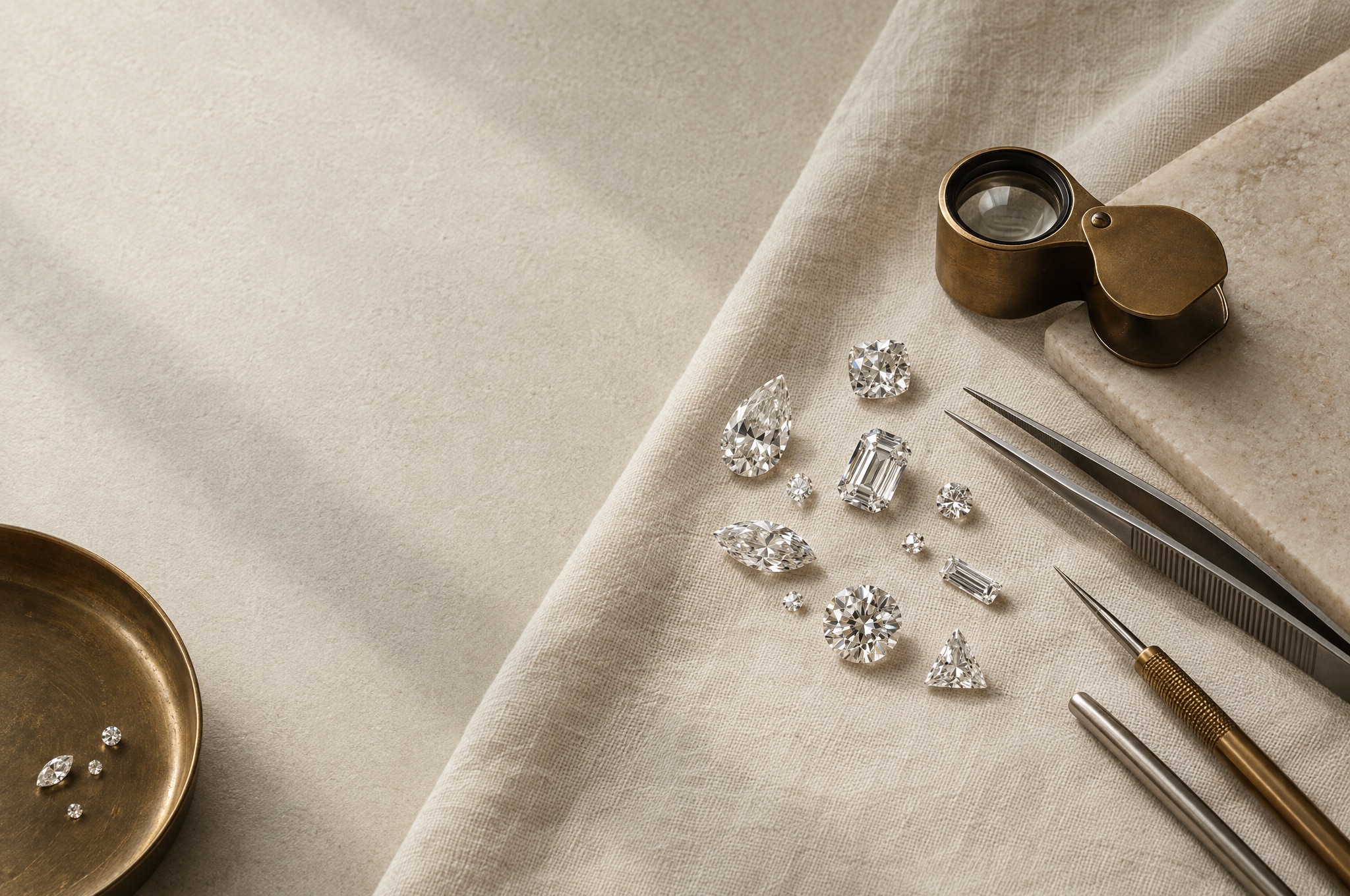
This matters most for antique and exotic cuts. Round brilliants are a commodity item stocked broadly across the trade, but Old Mine, Old European, hexagonal, moval, lozenge, kite, trillion, criss-cut, and similar antique or exotic shapes are far less commonly stocked in depth. A manufacturer that treats these as a specialty rather than an afterthought is a meaningfully different resource than one that only carries standard round and princess cuts alongside a handful of common fancy shapes like emerald, cushion, and oval.
How Guru Diam Fits This Picture
Guru Diam is a trade-only, B2B wholesale diamond supplier working with independent jewelers, designers, and manufacturers placing recurring orders — not a direct-to-consumer storefront. The catalog spans certified loose diamonds (natural and lab-grown, the latter CVD-grown), fancy-color stones, matched pairs for earrings and eternity work, and finished jewelry, with cutting, setting, and polishing handled in-house rather than passed through a chain of subcontractors. On the antique and exotic side — Old Mine, Old European, hexagonal, moval, lozenge, kite, trillion, criss-cut, Padparadscha, and similar shapes — Guru Diam treats that depth of inventory as a core specialty rather than a niche add-on, alongside the more familiar mid-market fancy shapes (emerald, Asscher, cushion, oval, pear, marquise, radiant, princess, heart) and standard round brilliants. Certification is available through IGI, GIA, and GCAL, so jewelers aren't locked into a single lab across every order. Custom engagement rings are finished in four to six days, and in-stock loose stones and inventory ship the same day when ordered before the cutoff — 6pm EST from the New York office, 4pm PST from Los Angeles. Custom rings ship unbranded by default, so jewelers can resell finished pieces as their own. For a jeweler comparing suppliers, the practical benefit of working with one vendor across categories is straightforward: one shipment, one relationship, and one set of quality standards to track — rather than reconciling separate suppliers for loose stones, fancy colors, and finished jewelry. Jewelers exploring wholesale sourcing can review certified stone inventory in the certified diamonds category, browse matched pairs in the matching pairs collection, or look at fancy-color loose diamonds directly. For custom engagement rings and finished jewelry programs, the custom jewelry page outlines the design-to-delivery process, and trade buyers setting up an account can start at the wholesale hub or apply directly through the trade partner program.
Building a Sourcing Checklist Before You Commit
Before signing on with a new manufacturer — whether for a single custom order or an ongoing wholesale relationship — it helps to have a short checklist rather than relying on memory during a sales conversation. At minimum, confirm: which production stages are genuinely in-house, what the MOQ is for both stock and custom orders, what certification labs are available and whether that's flexible per order, what the sample or prototype process costs and how long it takes, whether white-label fulfillment is available and at what cost, and what the real turnaround time is for the specific type of order you're placing — not a blended average across everything they make. Get these answers in writing where possible. A manufacturer worth a long-term relationship will not hesitate to put its own terms on paper.
Frequently Asked Questions
What is the difference between a diamond jewelry manufacturer and a jewelry wholesaler?
A manufacturer physically produces jewelry — handling design, casting, setting, and polishing — while a wholesaler typically buys finished goods or loose stones in bulk and resells them without doing production work. Some companies do both, but a pure wholesaler generally can't offer custom production the way a manufacturer can.
How long does it take a diamond jewelry manufacturer to make a custom engagement ring?
Timelines vary by manufacturer and design complexity, but many manufacturers with in-house CAD, casting, and setting can complete a custom engagement ring in roughly four to six business days once the design is approved. This applies to finished jewelry production specifically — it's a different timeline than sourcing an already-cut loose stone, which is typically ready to ship immediately from stock.
What is a minimum order quantity (MOQ) and do all diamond manufacturers require one?
An MOQ is the smallest quantity a supplier will produce or sell per order. Stock jewelry designs often carry a higher MOQ tied to batch production, while true custom orders are frequently available as single pieces since each item is made individually rather than cast in bulk. MOQs and terms should always be confirmed directly with the manufacturer rather than assumed.
Can a diamond jewelry manufacturer supply loose certified diamonds as well as finished jewelry?
Some can, and it's a meaningful convenience for jewelers who would otherwise manage separate suppliers for loose stones and finished production. Look for a manufacturer that stocks certified natural and lab-grown loose diamonds — including antique and fancy shapes — alongside a finished jewelry line, so both needs can be met through one relationship.
What does white-label or private-label manufacturing mean for a jeweler?
White-label (or private-label) manufacturing means the finished piece ships without the manufacturer's own branding, so the jeweler or retailer can present and sell it under their own name. Not every manufacturer offers this by default — some brand every piece unless a jeweler specifically requests otherwise — so it's worth confirming in writing before placing an order.
Which diamond certifications should a manufacturer be able to provide?
The most widely recognized independent labs in the trade are IGI, GIA, and GCAL. A manufacturer that can source stones certified by any of the three — rather than being limited to just one — gives jewelers more flexibility to match certification to a specific customer or market.