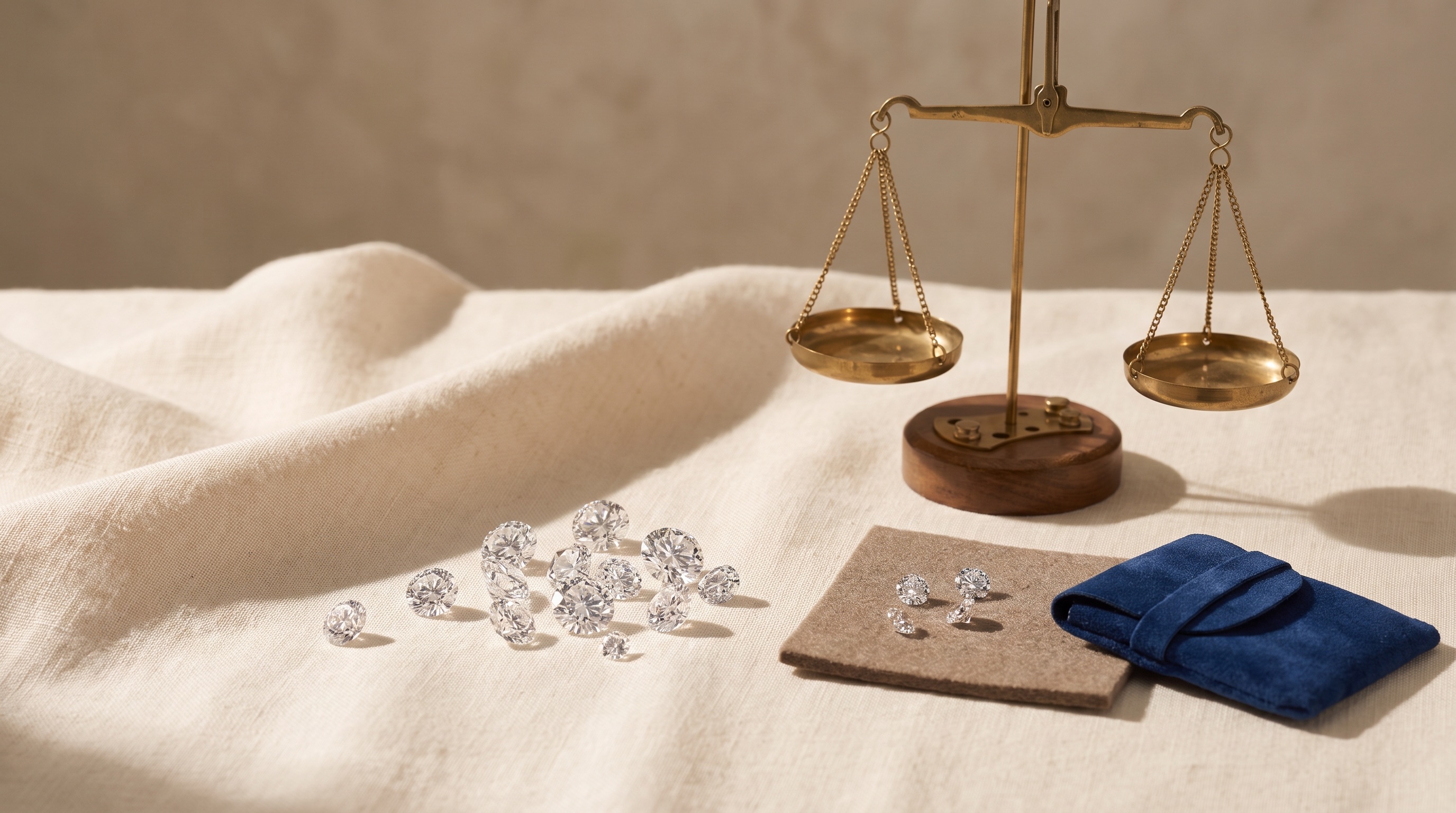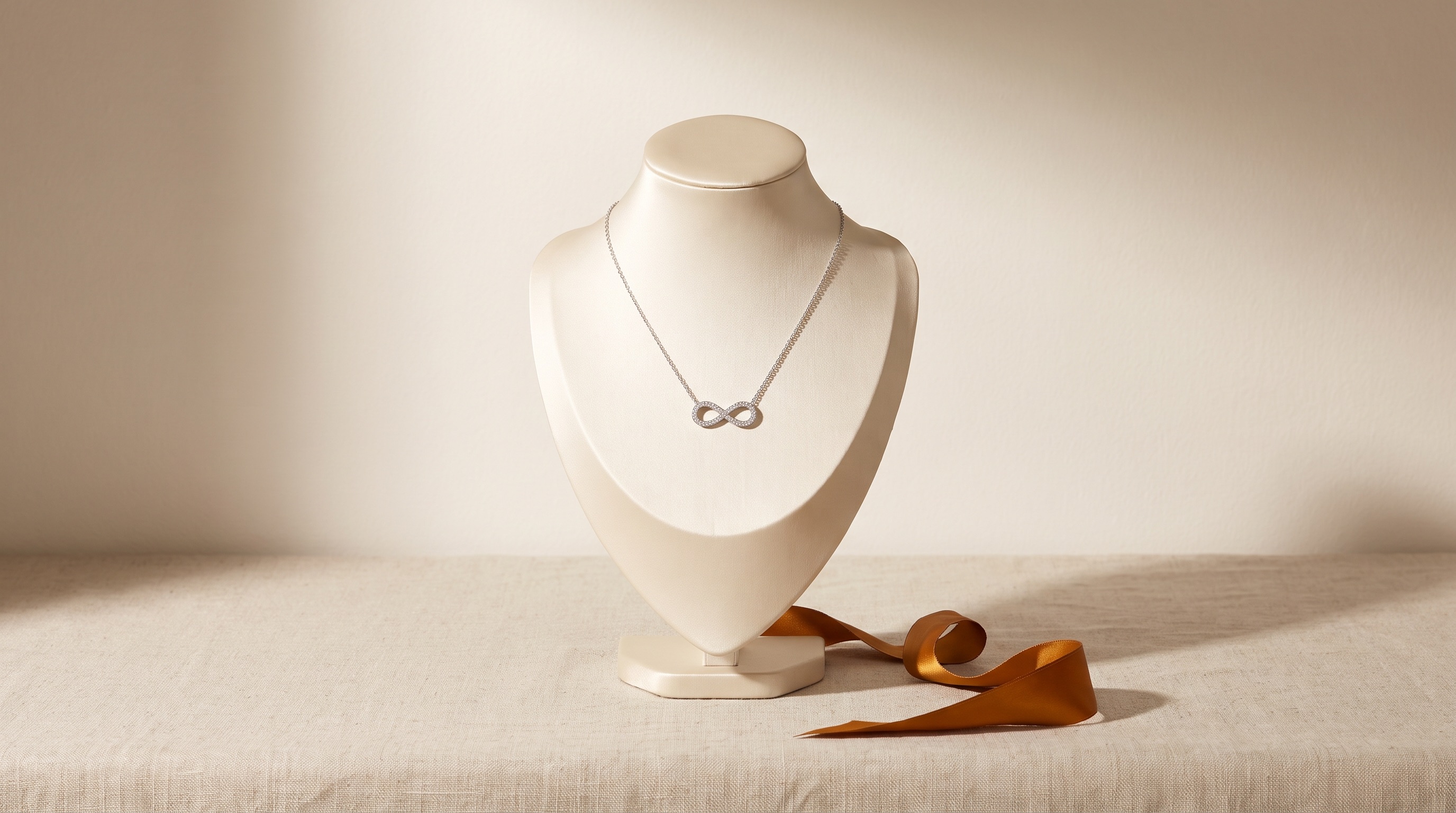
A diamond infinity necklace sets diamonds along a figure-eight or looped infinity symbol, most often as a small pendant hanging from a fine chain, though the same motif also appears as a horizontal "sideways infinity" bar pendant and, less commonly, as a fuller line-set element sitting flat against the collarbone. For a jeweler or manufacturer, this is a pendant-construction and melee-matching category rather than a single fixed product: the infinity symbol's continuous curve and tight center crossover create the same sourcing constraint whether it's built as a small drop pendant or a wider statement piece, and the chain, bail, and pendant proportions all have to be planned together for the finished necklace to hang and face correctly.
This guide is written for the trade — jewelers, designers, and manufacturers sourcing loose diamonds and melee to build infinity necklace and pendant lines for their own retail or wholesale assortment. It covers pendant construction types, melee sizing along the curve, chain and bail pairing, and what to ask a wholesale supplier before placing a first order in this category.
Why the Infinity Motif Behaves Differently as a Necklace Than as a Ring
The core sourcing challenge in any infinity design — small, consistently sized melee that can follow a continuously curving line without gaps, especially through the tight crossover point at the symbol's center — is the same whether the motif sits on a ring, a bracelet, or a necklace. What changes for a necklace specifically is that the pendant also has to hang correctly: unlike a ring, where the motif is fixed in orientation by the band, a pendant hangs from a bail and needs its weight distributed so the infinity symbol faces forward rather than twisting to one side once worn. Manufacturers who source pendant components without accounting for this often end up with a technically well-set piece that doesn't hang flat, which is a returns driver specific to pendant categories that doesn't come up in ring or bracelet production.
Pendant Construction Types
Vertical Figure-Eight Pendant
The traditional orientation, with the infinity symbol's crossover sitting roughly at the pendant's vertical center and the bail attached at the top loop. This is the most common construction and the easiest to balance for even hanging, since the bail sits directly above the pendant's natural center of mass.
Sideways (Horizontal) Infinity Pendant
The infinity symbol rotated 90 degrees so it reads as a horizontal "∞" across the collarbone, with the bail typically set at the top of one loop rather than centered. This orientation is more prone to tilting if the bail placement doesn't account for the pendant's actual weight distribution, so manufacturers should test hang balance on a physical sample before committing to a production run rather than assuming a design that renders correctly in CAD will hang flat once built.
Double-Infinity Pendant
Two interlocking infinity symbols, commonly marketed as representing two people, a family, or an anniversary milestone. The added second loop increases total melee count meaningfully over a single-symbol design and requires more careful crossover planning since there are now two crossover points needing tight, gap-free stone spacing instead of one.
Melee Sizing and Stone Count
| Infinity Necklace Style | Typical Melee Size | Common TCW Range |
|---|---|---|
| Delicate single-line pendant | 1.0mm–1.3mm | 0.08–0.20 TCW |
| Standard pendant (full loop pavé) | 1.2mm–1.5mm | 0.15–0.35 TCW |
| Double-infinity pendant | 1.0mm–1.3mm | 0.20–0.45 TCW |
| Statement flat-set line pendant | 1.3mm–1.8mm | 0.35–0.70 TCW |
As with infinity rings, the tightest curve point — the crossover — sets the practical ceiling on melee size for the whole design, since a stone that fits comfortably along the wider parts of the loop can still be too large to sit cleanly through the crossover without visible crowding. Manufacturers should size melee to the crossover constraint first and treat the wider sections of the loop as the more flexible part of the design.
Chain and Bail Pairing
Infinity pendants are most commonly sold pre-strung on a fine cable or box chain in the 16–18 inch range, though some retailers sell the pendant separately to let a customer choose their own chain length and style. When a supplier offers pre-strung and standalone pendant options side by side, it's worth asking whether the bail is sized for a specific chain gauge, since a bail cut too narrow for a customer's preferred chain thickness is a common point of customer friction after the sale. Bail placement should also sit high enough that the pendant doesn't sit too low against the collarbone for the intended chain length — a mismatch between bail height and chain length is one of the more common design oversights in pendant categories generally, not just infinity designs specifically.
Setting Styles
Shared-Prong Line Setting
The standard approach for infinity pendants, using small shared prongs along the curve to maximize light entry while keeping the metal frame as unobtrusive as possible — appropriate for most delicate and standard pendant designs.
Channel Setting
Metal rails formed to follow the infinity curve hold stones with no visible prongs, giving a smooth, low-profile line. This construction requires tighter tolerances than a straight channel because the rail itself must be pre-formed to the curve before stones are set, and is more commonly used on flat statement-style infinity pendants than on delicate drop designs.
Bezel-Set Infinity Accents
Occasionally used on designs with slightly larger stones at the loop's widest points, trading some brilliance for added security — a reasonable option for a pendant a customer will wear daily, since a pendant sees more incidental contact than a ring worn primarily on the hand.
Certification Approach
Because infinity necklace pendants are built almost entirely from melee-range stones, the great majority of the diamonds in this category ship as graded parcel goods against a stated commercial standard (commonly DEF+/VS+) rather than individually certified. A design that adds a single larger accent stone at the crossover or at one loop's widest point can have that specific stone individually certified through IGI, GIA, or GCAL if it's 0.30ct or above, with the surrounding melee still following the standard parcel-grading approach. Retailers should confirm which stones, if any, in a given design carry individual certification before representing the piece to a retail customer.
Natural vs. Lab-Grown Diamonds for This Category
Infinity necklaces typically carry a modest total carat weight relative to categories like tennis necklaces or full eternity bands, which narrows the absolute dollar gap between natural and CVD lab-grown material even though the percentage savings from choosing lab-grown remains consistent across categories. Given that infinity necklaces are frequently positioned as an accessible gifting piece — anniversaries, friendship jewelry, milestone gifts — lab-grown material is the more common choice in this segment, letting a retailer offer a fuller, more finished-looking pavé line at a price point that fits the category's typical gifting budget.
What to Ask a Supplier When Sourcing for Infinity Necklaces
- What's the smallest melee size available as a consistent, matched lot, since the crossover point on most infinity designs needs finer stones than a standard pavé application?
- Does the supplier offer pre-strung pendant-and-chain sets, standalone pendants, or both, and does bail sizing match the chain gauges offered?
- Can the supplier confirm hang balance on a physical sample before a full production run, particularly for sideways or double-infinity designs where weight distribution is less intuitive than a simple vertical figure-eight?
- What's the reorder consistency for the specific fine melee size used, if the design becomes a standing retail item rather than a one-off run?
The Infinity Symbol's Appeal as a Necklace Gifting Category
The infinity symbol's association with eternal love, friendship, and connection gives necklace and pendant designs in this category a strong, self-explanatory gift narrative that shortens the sales conversation considerably — a customer buying an infinity pendant as an anniversary, friendship, or "always" gift generally already understands what the symbol represents without needing it explained on the sales floor. This is part of why infinity pendants perform reliably as an accessible entry-price gifting item across anniversaries, Valentine's Day, graduation, and friendship-focused gifting occasions throughout the year, rather than being tied to a single seasonal spike the way some symbolic categories are.
Layering and Pairing With Other Necklaces
Delicate infinity pendants are commonly worn as part of a layered necklace stack alongside a slightly longer pendant or a plain chain, which is a relevant merchandising consideration — retailers who present an infinity pendant as part of a layering set, rather than as an isolated standalone item, tend to see a higher average order value than retailers merchandising the same pendant on its own. Manufacturers building an infinity pendant line should consider offering the same design across two or three chain lengths specifically to support layering, since a customer building a stack typically wants pieces that sit at visibly different heights rather than several pendants competing at the same length.
Metal Choices
Infinity necklaces are produced across the standard range of finished-jewelry metals — 14k and 18k white, yellow, and rose gold, and platinum for premium tiers — with metal choice in this category driven mostly by fashion preference and by whatever metal the customer's existing chain or jewelry collection favors, rather than by any technical constraint tied to the motif itself. Because infinity pendants are frequently gifted to be worn daily and layered with existing pieces, offering the same design across multiple metal tones is a common way retailers make the piece work across a broader range of a customer's existing jewelry box.
Engraving and Personalization
Many infinity necklace designs are offered with a personalization option on the pendant's back or on an accompanying tag — initials, a date, or a short phrase — since the symbol's permanence-and-connection meaning lends itself directly to milestone gifting. Retailers offering engraving should confirm with their setting partner what pendant thickness and metal are needed to engrave legibly without weakening a delicate design, since infinity pendants are often built thin to keep the overall look understated, which can limit how much text fits without compromising the piece structurally.
Common Manufacturing Defects to Screen For
As with infinity rings, the crossover point is the most common location for a manufacturing defect in a necklace pendant — uneven melee spacing, a visible gap where the curve reverses direction, or prongs sitting awkwardly due to the tight radius. For necklaces specifically, hang balance is an additional inspection point: a finished pendant should hang with the infinity symbol facing forward and level when worn on its intended chain, not twisted to one side, which is worth checking on a physical sample rather than assuming a CAD render will translate correctly to a finished, weighted piece.
Building an Infinity Necklace Line Across Price Tiers
A well-built infinity necklace line typically spans a delicate entry-tier pendant for accessible gifting, a standard mid-tier design with fuller pavé coverage around the loop, and a premium tier that adds a certified accent stone at the crossover or loop. As with other melee-driven categories, it's worth planning melee sourcing across the whole tier structure with one supplier relationship rather than sourcing each tier separately, since consistent grading and certification language across every price point a customer might compare side by side matters more in a category this visually simple, where the diamond quality is one of the few real differentiators between a budget and a premium version of essentially the same design.
Photography and Product Listing Considerations
Infinity pendants photograph poorly when shot flat on a jewelry tray, since the motif's meaning and visual appeal depend on how it drapes and catches light when worn — a flat product shot tends to compress the figure-eight curve into something that reads as an abstract loop rather than a recognizable infinity symbol. Retailers building an e-commerce listing or lookbook for this category get meaningfully better conversion from an on-model or mannequin shot that shows the pendant at its natural hanging length and orientation, supplemented by a macro detail shot of the crossover point to show melee quality and setting precision up close. A single flat-lay shot can work as a secondary supporting image but shouldn't be the primary listing photo for a pendant category where drape and orientation are part of the product's actual appeal.
Comparing Infinity Necklaces to Other Symbolic Pendant Categories
| Category | Typical TCW | Sourcing Complexity |
|---|---|---|
| Infinity necklace/pendant | 0.08–0.45 TCW | Moderate — small melee, tight crossover curve, hang-balance dependent |
| Diamond letter necklace | 0.10–0.35 TCW | Moderate — melee outline plus font/legibility constraints |
| Diamond tennis necklace | 3.00–15.00+ TCW | High — long line, large stone count, strict color/size matching |
Infinity necklaces sit toward the accessible end of this comparison in both total diamond investment and construction complexity, which is a large part of why the category performs well as an approachable gifting entry point for independent jewelers sourcing at modest volume.
Wholesale Pricing Structure and Order Quantities
Infinity necklace pendants are typically quoted per-piece inclusive of metal, melee, and setting labor, with pricing breaking into fairly clean tiers by construction type (delicate single-line, standard pavé, double-infinity, statement flat-set) rather than varying continuously within a tier. A retailer placing a first wholesale order should ask for minimum order quantities by SKU rather than by total order value, since a supplier's stated MOQ often assumes a single chain length and metal color — ordering the same pendant design across three metal tones and two chain lengths can multiply the effective SKU count well beyond what the retailer expected from a single quoted MOQ. It's also worth confirming whether reorders on a proven design carry the same per-piece price as the initial order or step down at higher volume, since melee and labor costs for this category are consistent enough across runs that a supplier with genuine production scale should be able to offer a modest volume discount on repeat orders of an already-tooled design.
Quality Control Checklist on Receipt
Because infinity necklace pendants are small and the crossover point concentrates the design's most failure-prone geometry into a compact area, a receiving inspection should focus there first rather than doing a uniform once-over of the whole piece. Under 10x magnification, check for even melee spacing through the crossover, no visible gaps where the curve reverses direction, and prongs or channel walls sitting flush rather than proud or recessed. Separately, hang the pendant on its intended chain and confirm it settles with the infinity symbol facing forward and level rather than twisting — this should be checked on a small sample from each production batch, not just a single pre-production sample, since minor weight variance between individual castings in the same run can occasionally shift how a given piece hangs even when the design itself is sound. A retailer who catches a hang-balance issue at receiving, before pieces reach the sales floor, avoids what is otherwise a difficult defect to explain to a retail customer after the fact.
Seasonal Demand Patterns
Infinity necklace demand skews toward gifting occasions rather than self-purchase — Valentine's Day, anniversaries, graduation, and Mother's Day are the strongest windows, with friendship-focused gifting adding a secondary lift around graduation season specifically. Retailers building inventory plans for this category should time larger reorders roughly six to eight weeks ahead of these windows to account for setting and QC lead time, rather than reordering reactively once a design starts selling through.
Sourcing Diamonds for an Infinity Necklace Line Wholesale
Guru Diam supplies calibrated CVD lab-grown and natural melee in the fine, consistent parcel sizes infinity pendant construction requires, alongside loose accent stones for premium-tier designs, with IGI, GIA, and GCAL certification available at 0.30ct and above. Trade buyers can review current melee and matched-pair inventory through matching pairs and certified diamonds, and work with Guru Diam's custom jewelry team on pendant and bail sizing through custom jewelry. In-stock inventory ships same-day from Guru Diam's New York and Los Angeles locations. New trade accounts can apply through trade partner, with current terms available at the wholesale hub. For related sourcing fundamentals, see our diamond infinity ring guide and diamond tennis necklace guide.
Frequently Asked Questions
What is a diamond infinity necklace?
A pendant necklace featuring diamonds set along a figure-eight or looped infinity symbol, typically hung from a fine cable or box chain, symbolizing eternal connection, love, or friendship.
What melee size works best for an infinity pendant?
Most designs use 1.0mm–1.5mm melee, sized to the tightest radius at the symbol's center crossover rather than to the wider, more open parts of the curve.
Should infinity necklace melee be lab-grown or natural?
CVD lab-grown melee is the more common choice for this category since the visual effect depends on overall pavé consistency rather than individual stone provenance, letting a retailer offer a fuller-looking line at an accessible gifting price point.
Why does hang balance matter for infinity pendants specifically?
Unlike a ring, a pendant hangs freely from a bail, so its weight has to be distributed so the infinity symbol faces forward when worn rather than twisting to one side — a design consideration that doesn't apply to ring or bracelet versions of the same motif.
What's the difference between a vertical and a sideways infinity pendant?
A vertical design keeps the traditional figure-eight orientation with the bail centered above it; a sideways design rotates the symbol 90 degrees to read horizontally across the collarbone, which requires more careful bail placement to hang level.
Are infinity necklace diamonds certified?
The melee that makes up the infinity motif ships as graded parcel goods against a commercial standard like DEF+/VS+. A single larger accent stone at 0.30ct or above can be individually certified through IGI, GIA, or GCAL if the design includes one.
What drives price differences between infinity necklace designs?
Total melee carat weight, crossover construction precision, and whether the design includes a certified accent stone are the main cost drivers — not a single dominant feature stone, since the category is built around the line-set motif itself.
Guru Diam is a trade-only wholesale diamond supplier with locations in New York and Los Angeles, supplying calibrated CVD lab-grown and natural melee alongside certified loose diamonds, with IGI, GIA, and GCAL certification available, for jewelers building necklace, pendant, and finished jewelry lines. Browse current inventory in matching pairs or apply for a trade account through trade partner.