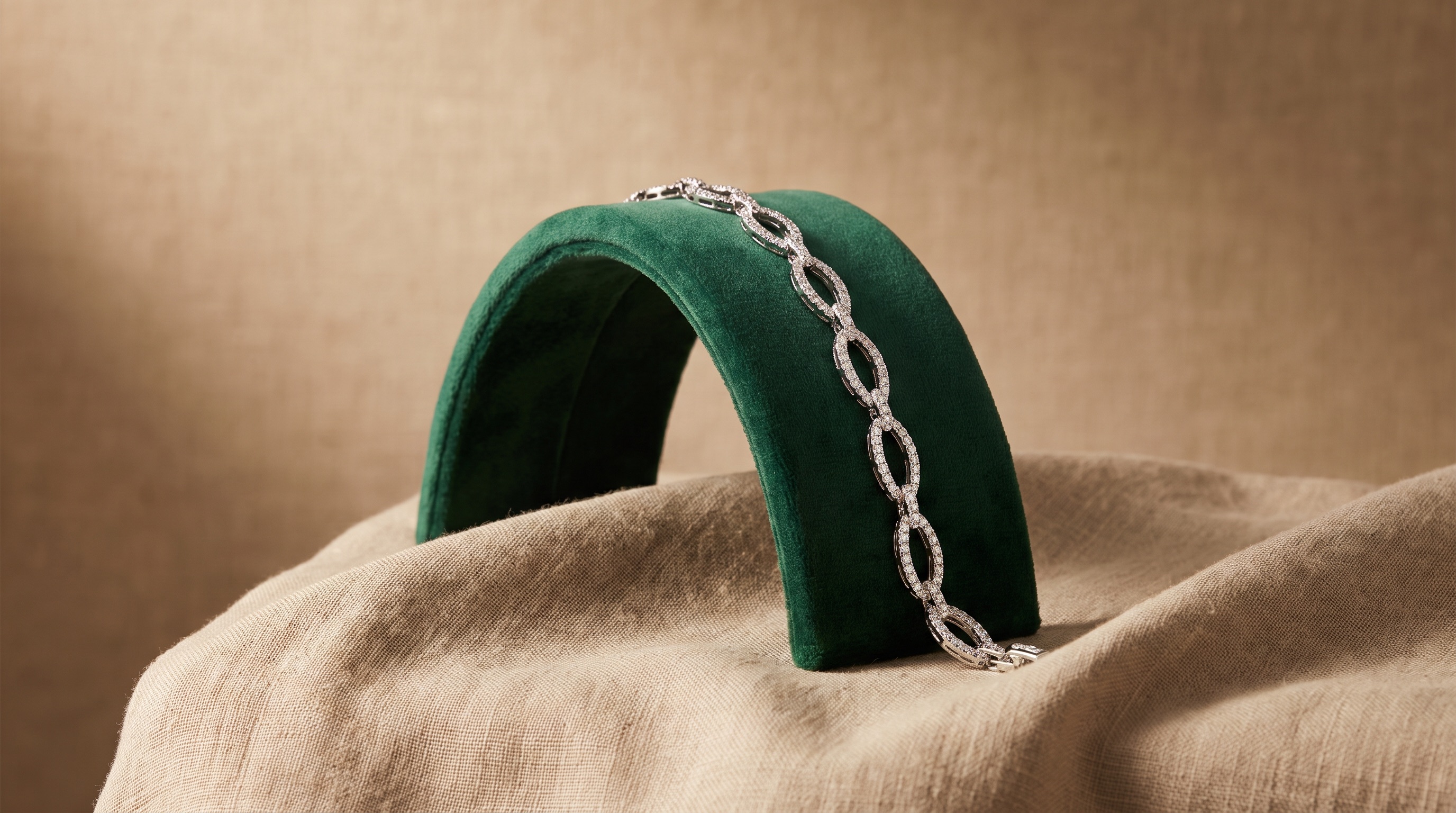
A diamond infinity bracelet is a bracelet built around the infinity symbol — a horizontal figure-eight loop, usually rendered as a small diamond-set station along a delicate chain, though it also appears as the bracelet's entire clasp or as a continuous line motif running the length of the piece. For a jeweler sourcing this category, the infinity symbol's small, repeatable footprint makes it one of the more approachable diamond-accented pieces to stock and produce, since it typically uses a modest total carat weight compared to a full line-set bracelet.
This guide is written for the trade — jewelers, designers, and manufacturers sourcing loose diamonds, melee, and chain components to build or restock an infinity bracelet line, not a consumer shopping guide. It covers the common motif and construction styles, chain and finding considerations, stone size and total carat weight math, quality standards, metal choices, wholesale pricing structure, and what to look for in a supplier for this specific product category.
What an Infinity Bracelet Actually Is
The infinity symbol — a continuous horizontal figure eight, sometimes called a lemniscate — has become one of the most requested small-motif jewelry designs of the past decade, largely because its meaning ("endless," "forever") maps directly onto gift-giving occasions: anniversaries, graduations, friendship gifts, and push presents all lean on the symbol heavily. In bracelet form, the motif shows up in a handful of recognizable constructions, and knowing which one a buyer is asking for changes the sourcing approach meaningfully.
- Station infinity bracelet. A single small diamond-set infinity charm sits as one station along an otherwise plain delicate chain — the most common and lowest-cost construction, since it requires only a handful of accent stones rather than a continuous line.
- Line/pavé infinity bracelet. Diamonds run continuously along the entire infinity-shaped element, which is itself the whole bracelet (rather than a charm on a chain) — a higher stone count and a more line-set-adjacent sourcing profile, closer to a small tennis bracelet in its sourcing logic.
- Double or interlocking infinity bracelet. Two infinity symbols set side by side or interlocked, doubling the stone count of a single-station design and reading as a more substantial piece.
- Infinity clasp bracelet. The infinity shape functions as the bracelet's actual clasp mechanism rather than a decorative station, which shifts part of the sourcing conversation toward findings and clasp manufacturing rather than diamond setting alone.
Chain and Finding Styles Commonly Paired With Infinity Motifs
Because most infinity bracelets built around a single station or interlocked-station design spend most of their length as plain chain rather than diamond-set material, chain selection is a meaningful part of sourcing the finished piece, not an afterthought:
| Chain Style | Look | Sourcing Note |
|---|---|---|
| Cable chain | Simple, classic uniform links | Lowest cost, most widely available in matching karat and finish to the infinity station's metal |
| Box chain | Squared, structured links that catch light evenly | Slightly higher cost than cable; reads as more modern and substantial for the same gauge |
| Rope chain | Twisted, textured, higher-sparkle chain | Pairs well with a heavier or more elaborate infinity station; higher per-inch material cost |
| Adjustable slider chain | Chain with a sliding bead or knot mechanism for size adjustment | Popular for gift-category pieces sold without a custom sizing step; simplifies inventory since one length fits a size range |
A manufacturer building an infinity bracelet line should confirm the chain gauge and finish match the infinity station's own metal purity and color before committing to a production run — a mismatch between a heavier, more saturated station and a very fine, lightweight chain is one of the more common visual complaints that surfaces in finished-piece quality review.
Total Carat Weight and Stone Count Math
Because most infinity bracelets are station-based rather than fully line-set, total carat weight runs much lower than a tennis bracelet or full pavé piece — typically well under half a carat TCW for a standard single-station design, which keeps the category accessible at a range of price points:
| Construction | Typical Stone Count | Common TCW Range |
|---|---|---|
| Single-station infinity, outline only | 6–12 small melee outlining the symbol | 0.05–0.15 TCW |
| Single-station infinity, pavé-filled | 15–30 small melee | 0.15–0.35 TCW |
| Double/interlocking infinity | 25–50 small melee | 0.25–0.60 TCW |
| Full line infinity (diamond runs the entire shape's length) | 30–60+ melee depending on scale | 0.30–0.75+ TCW |
These ranges assume small, uniform melee sized for a delicate accent piece rather than a statement piece — a buyer wanting a bolder, larger-format infinity bracelet should expect the TCW and stone count to scale up accordingly, closer to the line-bracelet ranges covered in our diamond line bracelet sourcing guides.
Diamond Quality Standards for Infinity Bracelets
Because infinity bracelets are a small-accent-stone category worn frequently and viewed up close (the wrist is one of the more visually inspected areas of jewelry in casual conversation), most manufacturers standardize on a DEF+/VS+ commercial quality baseline — near-colorless to colorless, very slightly included or better — which reads bright and clean at melee scale without pricing the category above its typical gift-purchase price point. Buyers building a premium infinity line sometimes step up to a tighter color range for a whiter overall look, since even small stones show a noticeable yellow cast at wider color ranges when viewed in a cluster.
Setting Styles Used on Infinity Motifs
Pavé Setting
Small stones are set closely together with minimal visible metal between them, maximizing sparkle across the infinity shape's outline or fill — the most common setting style for this category because it suits the motif's continuous, looping line.
Prong Setting
Used less often on infinity motifs specifically because the shape's tight curves don't always accommodate individual prong heads cleanly, but it appears on larger-format or single-accent-stone infinity designs where a bolder, more dimensional look is wanted.
Bezel/Flush Setting
A low-profile option where each stone sits recessed into the metal with minimal protrusion — a durable, snag-resistant choice that suits the bracelet's frequent contact with sleeves, bags, and desks.
Metal Choices and How They Affect Sourcing
Infinity bracelets are most commonly produced in 14k gold across yellow, white, and rose finishes, with 18k and platinum offered as an upgrade tier for buyers positioning the category at a higher price point. Because the category leans heavily on gift-occasion purchasing, offering all three gold tones at a consistent price point (rather than pricing rose or white gold at a premium) is common trade practice, since color preference in this category is largely aesthetic rather than tied to a specific buyer segment.
Lab-Grown vs. Natural Diamonds for Infinity Bracelet Production
Given the modest total carat weight typical of this category, the natural-versus-lab-grown cost gap has a smaller absolute effect on finished-piece price than it does on a higher-TCW piece like a tennis bracelet or necklace — but it still meaningfully affects margin at the retail price points this category typically targets. CVD lab-grown melee lets a manufacturer either hold a lower retail price point that suits gift-category purchasing, or offer a larger, more visually substantial infinity motif at the same price point as a smaller natural-diamond version. Both origins can meet the same DEF+/VS+ commercial standard; the choice is a pricing and positioning decision rather than a visible difference in the finished piece.
Matched-Lot Consistency: What to Ask a Supplier
- Is the melee sold as a calibrated, graded lot sized specifically for small-accent work, or pulled from general mixed parcel stock? Consistent sizing matters more in a tightly clustered pavé motif than in a widely spaced design.
- What's the color and clarity consistency across the lot? A visibly mismatched stone in a small, dense cluster is more noticeable proportionally than the same mismatch would be in a longer, more spread-out line.
- Can findings and chain be sourced from the same supplier as the diamond component, or does the manufacturer need to coordinate metal matching separately? Consolidating both under one relationship simplifies quality control on the finished piece.
- What's the reorder lead time for a gift-category item that may see seasonal demand spikes around graduation, Valentine's Day, and the winter holidays?
Wholesale Pricing Structure for Infinity Bracelet Diamonds
Because total carat weight is modest in this category, wholesale diamond pricing for infinity bracelets is typically quoted per finished-piece stone count and total carat weight together, rather than per carat alone, since a buyer ordering dozens of nearly identical low-TCW pieces benefits more from a per-piece production quote than from carat-based pricing alone. Manufacturers ordering at production volume — multiple dozen units for a retail assortment, or a standing seasonal reorder — should expect per-unit diamond cost to improve with order size, particularly around the gift-occasion seasonal windows where volume orders are common.
Gift-Occasion Seasonality and Inventory Planning
Infinity bracelets see pronounced seasonal demand tied to specific gifting occasions — graduation season in spring, Valentine's Day in February, and the general holiday gifting window from late November through December all drive concentrated demand for this category more than for most other bracelet styles. A retailer or manufacturer planning an infinity bracelet assortment should place diamond and component orders well ahead of these windows rather than reordering reactively, since melee lead times and finished-piece production time can compress a retailer's ability to restock mid-season if an initial order sells through faster than expected.
Personalization and Engraving Considerations
A meaningful share of infinity bracelet sales include a personalization add-on — an engraved initial, date, or short phrase on the back of the infinity station or on a small accompanying tag — since the motif's symbolic meaning lends itself naturally to a personalized gift purchase. Manufacturers building a line with engraving as a standard option should confirm with their setting and finishing partner that the station's back surface is left smooth and adequately sized for legible engraving before finalizing a design, since some more elaborate pavé-filled stations leave very little usable flat back surface.
Common Manufacturing Defects to Screen For
Because infinity motifs involve tight curves and closely clustered small stones, a few defect patterns show up more often in this category than in simpler single-stone pieces: stones sitting at slightly uneven depth across the curve of the figure-eight (which reads as an inconsistent sparkle pattern rather than a uniform one), metal thinning at the tightest points of the infinity curve where the design is most structurally vulnerable, and solder joints at the point where the station attaches to the chain that are visible or poorly finished. Requesting a physical sample under magnification before approving a full production run is standard practice, the same as with any small-format diamond piece.
Men's and Unisex Infinity Bracelet Sourcing
The infinity motif has crossed successfully into men's and unisex jewelry over the past several years, typically in a more restrained construction than the traditional women's version — a single, smaller infinity station on a heavier-gauge cable or box chain, often in white gold, platinum, or blackened metal finishes rather than the lighter rose or yellow tones more common on women's pieces. Stone count and TCW generally run lower still than a standard single-station women's design, since the men's and unisex category tends to favor a more subtle, understated presence over a highly sparkled look. A manufacturer expanding an existing infinity line into men's or unisex product should plan this as a genuinely separate SKU with its own chain gauge and finish specification, rather than simply resizing the women's design, since chain proportions that read as delicate on a women's piece often read as flimsy on a heavier-format men's bracelet.
Matching Sets: Infinity Necklaces, Earrings, and Bracelets
Because the infinity motif scales down cleanly to a small, self-contained station, it's one of the more natural jewelry categories for building a coordinated matching set — a bracelet, necklace, and pair of stud or drop earrings all built around the same infinity station design and the same metal and diamond quality specification. Retailers report that matching-set presentation meaningfully increases average order value in the gift-purchase occasions this category depends on, since a buyer shopping for a single gift item is frequently open to a coordinated two- or three-piece set at a modest additional cost once it's presented as an option. A manufacturer planning an infinity line should consider sourcing melee and chain in quantities that support a matching set from the outset, rather than developing the bracelet in isolation and only later reverse-engineering matching necklace and earring components, which typically costs more in incremental design and tooling than planning the full set together upfront.
The History of the Infinity Symbol in Jewelry
The infinity symbol itself — the mathematical lemniscate — long predates its use in jewelry, but its adoption as a mainstream jewelry motif is a comparatively recent development, gaining real commercial traction in the early 2010s as a "meaningful symbol" category alongside other sentiment-driven motifs like the heart and the knot. Its appeal for jewelers lies specifically in its open-ended interpretive value: unlike a motif tied to one specific relationship type or occasion, "endless" or "forever" works equally well for a romantic gift, a friendship gift, a family milestone, or a personal purchase, which is a meaningful part of why the category has sustained steady demand across multiple gifting occasions rather than being tied to a single calendar moment the way some other symbolic motifs are. Retailers positioning an infinity line in marketing copy can lean on this flexibility directly — the same physical product genuinely suits a wider range of purchase occasions and buyer relationships than most single-symbol jewelry categories.
Return, Exchange, and Warranty Considerations for a Gift Category
Because infinity bracelets skew heavily toward gift purchases, retailers in this category typically see a higher rate of post-purchase sizing exchanges than in categories bought primarily for the wearer's own selection — a gift buyer is choosing a size on the recipient's behalf, often without a precise measurement, which makes exchanges a normal and expected part of the category rather than a signal of product quality issues. Manufacturers and retailers building an infinity bracelet program should plan inventory and warranty policy with this in mind: stocking a slightly wider range of standard adjustable-chain lengths, or leaning into a slider-chain construction specifically to reduce the exchange rate, is common practice in this category for exactly this reason. A clear, gift-friendly exchange policy communicated at the point of sale — separate from a general damage warranty — is also worth building explicitly into the category's retail terms, given how much of its volume comes through gift-giving rather than self-purchase.
Displaying and Merchandising Infinity Bracelets at Retail
Because infinity bracelets are a small-footprint, gift-driven category, retail presentation has an outsized effect on sell-through compared to categories where a customer arrives already committed to a specific piece. Grouping the full range of infinity constructions — station, double, and clasp styles — together on a single display, rather than scattering them across a broader delicate-jewelry case, helps a browsing gift buyer see the full range of options at a glance and self-select toward a price point without needing extensive sales-floor explanation. Pairing a physical display with a small printed or digital card explaining the symbol's meaning is a low-cost merchandising addition that several retailers in this category report helps close gift-occasion sales, since it gives an undecided buyer language to use when presenting the gift, not just a product to purchase.
Sourcing Infinity Bracelet Diamonds Wholesale
Guru Diam supplies calibrated diamond melee sized for small-accent work like infinity motifs, across natural and CVD lab-grown material and the standard color and clarity ranges used in commercial gift-category production. Melee is available as consistent, gradable lots rather than mixed parcel stock, which matters for a tightly clustered design where any single mismatched stone is visually obvious. In-stock inventory ships same-day from Guru Diam's New York and Los Angeles locations, and trade accounts can review current melee stock in matching pairs or browse certified larger stones for any bolder single-accent designs through certified diamonds. Manufacturers building a custom infinity design can start at custom jewelry, and new trade accounts can apply through trade partner, with current terms available at the wholesale hub. For buyers sourcing beyond infinity bracelets into other line-set gift jewelry, Guru Diam's fancy color loose diamonds at fancy color loose diamonds are worth reviewing for a differentiated colored-stone infinity design.
Frequently Asked Questions
How much does a diamond infinity bracelet typically weigh in total carats?
Most infinity bracelets run well under half a carat total carat weight — a simple single-station outline design might use as little as 0.05–0.15 TCW, while a fuller pavé-filled or double-infinity design can run 0.30–0.75+ TCW. The category is generally lower-TCW than a full line-set bracelet or tennis bracelet.
What's the difference between a station infinity bracelet and a line infinity bracelet?
A station bracelet has a single diamond-set infinity charm along an otherwise plain chain, using relatively few stones. A line (or pavé) infinity bracelet has diamonds running continuously along the entire infinity shape, which is itself the whole bracelet rather than a charm — a higher stone count and a sourcing profile closer to a small tennis bracelet.
What diamond quality is standard for infinity bracelets?
A DEF+/VS+ standard (near-colorless to colorless, very slightly included or better) is the common commercial baseline for this category, chosen to read clean and bright at melee scale without pricing above the category's typical gift-purchase price point.
Should an infinity bracelet use natural or lab-grown diamonds?
Either can meet the same quality standard and look identical in the finished piece. CVD lab-grown melee lets a manufacturer hold a lower retail price point suited to gift-category buying, or offer a more substantial infinity motif at the same price as a smaller natural-diamond version — the choice is a pricing decision rather than a visible difference.
What metal is most common for diamond infinity bracelets?
14k gold in yellow, white, and rose finishes is most common, with 18k gold and platinum offered as an upgrade tier. All three gold tones are typically priced consistently in this category, since color preference here is aesthetic rather than tied to a specific buyer segment.
Why are infinity bracelets popular as gifts?
The infinity symbol's meaning — "endless" or "forever" — maps directly onto common gifting occasions like anniversaries, graduations, and milestone celebrations, which drives pronounced seasonal demand around those windows and makes the category a reliable gift-assortment staple for retailers.
Guru Diam is a trade-only wholesale diamond supplier with locations in New York and Los Angeles, supplying calibrated diamond melee and certified loose stones — natural and CVD lab-grown — for jewelers and manufacturers producing infinity bracelets and other small-accent gift jewelry. Browse current melee inventory in matching pairs or apply for a trade account through trade partner.