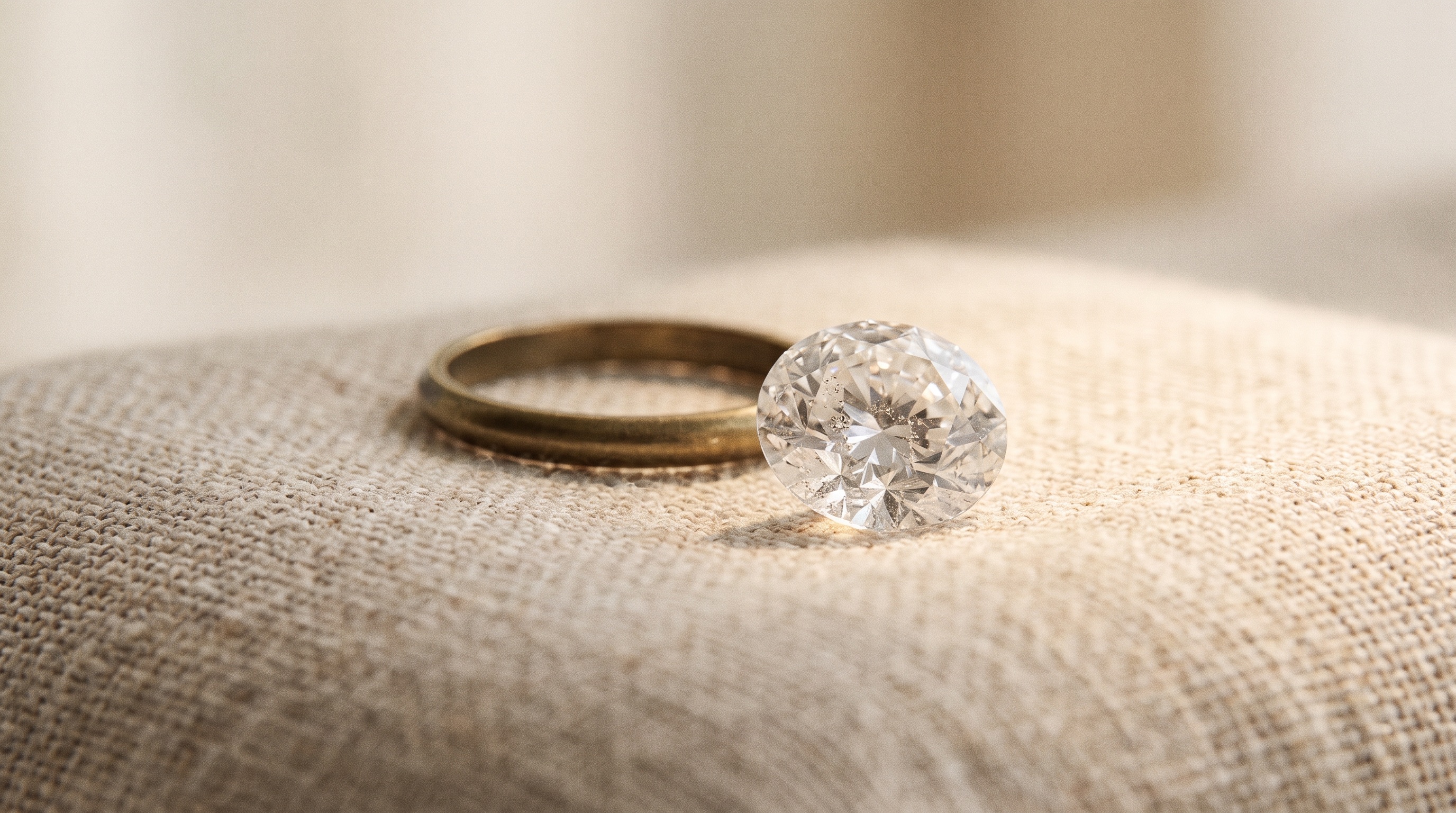
Diamond inclusions are the internal characteristics — trapped crystals, fractures, clouds of pinpoints, and other growth-related features — that form while a diamond crystallizes, and that a grader maps and weighs when assigning a clarity grade. Not every inclusion type carries the same risk: some are purely cosmetic, while others can affect a stone's durability or how it should be set and handled.
For a wholesale buyer, the clarity grade on a certificate is a summary number, not the full picture. Two SI1 stones can carry completely different inclusion types in completely different positions, and that difference matters when you're deciding what to stock, what to set into a pavé line, or what to flag before it goes out the door on a recurring order. This guide works through the inclusion types you'll actually encounter on a lab report or under a loupe — what each one is, how it forms, how it reads on a clarity plot, and when it's worth a second look rather than a routine pass.
What Is a Diamond Inclusion?
An inclusion is an internal characteristic that formed inside a diamond while it was still crystallizing — a trapped mineral crystal, a tiny internal fracture, a hazy cluster of pinpoints, or a growth irregularity sealed inside the stone before it was ever cut. Inclusions are distinct from blemishes, which are surface-level characteristics (scratches, nicks, polish lines, extra facets) introduced mostly during cutting and polishing rather than natural formation. Both categories feed into a stone's clarity grade, but only inclusions are sealed inside the diamond and permanent in a way polishing generally can't reach.
Every inclusion type gets evaluated by a grader against the same five factors: size (larger reads worse), number (more inclusions compound the grade), position (something under the table is easier to spot than something tucked at the girdle), nature (whether the inclusion reaches the surface changes how seriously it's treated), and relief (how much an inclusion's color or reflectivity contrasts against the surrounding diamond). Those five factors are why two stones with the "same" inclusion type — say, two feathers — can land at different clarity grades depending on where and how each one sits.
Why Inclusion Type Matters More Than the Clarity Grade Alone
A clarity grade tells you how much a grader had to work to find something; it doesn't tell you what that something is. That distinction matters for three practical reasons a wholesale buyer runs into constantly. First, appearance risk varies by type independent of grade — a cloud can create a hazy, low-contrast area that's genuinely hard to spot even at a lower grade, while a single dark crystal at the same grade can read as a visible pinprick because of its high relief against the diamond. Second, durability risk is concentrated in a small number of inclusion types (mainly feathers and cavities that reach the surface), not spread evenly across the clarity scale — an SI1 with a surface-reaching feather near the girdle is a different risk profile than an SI1 with a fully enclosed pinpoint cloud, even though both certificates say "SI1." Third, setting and repair decisions change by type — a stone with a feather near the girdle needs more caution during prong-setting or resizing than one with internal graining that will never be touched by a jeweler's tools.
This is why experienced buyers read the clarity plot, not just the grade letter, before committing to a parcel or a specific stone — and it's the reason this guide exists as a standalone reference rather than folding into a general clarity-grade explainer.
The Main Types of Diamond Inclusions
The clarity plots on GIA, IGI, and GCAL reports use a standardized set of symbols and terms for inclusion types. These are the ones you'll see most often, from most to least commonly encountered across the clarity range.
Crystals (Included Crystals)
A crystal inclusion is a mineral — sometimes another diamond crystal, sometimes a different mineral entirely, such as garnet, pyroxene, or olivine — that got trapped inside the diamond as it grew in the earth. Crystals can be colorless, white, black, red, or green depending on what mineral they are, and that color is what determines relief: a colorless crystal in a colorless diamond can be nearly invisible even at higher magnification, while a dark or colored crystal of the same size stands out sharply and can visibly affect the grade even when small. Crystals are one of the most common inclusion types found in natural diamonds specifically, since they're a direct record of the other minerals present during the diamond's formation deep in the mantle.
Pinpoints
Pinpoints are extremely small included crystals, typically too small to identify as any specific mineral, that appear as tiny white or dark dots under magnification. A single pinpoint rarely affects a grade at all — they're common even in VVS and some FL-adjacent stones — but pinpoints matter because of what they become in groups: when enough of them cluster together, they're reclassified as a cloud (below). Isolated pinpoints are generally treated as one of the least consequential inclusion types on the scale, both for appearance and for durability.
Clouds
A cloud is a dense cluster of pinpoints (or, less commonly, other microscopic inclusions) grouped closely enough together that they read as a single hazy or milky area rather than individual points. Small, localized clouds are common at the VS and SI grades and are usually invisible to the naked eye because they lack sharp edges or high contrast against the surrounding diamond. Large or dense clouds are less common but more consequential — beyond affecting clarity grade, an unusually large cloud can, in rare cases, reduce a stone's transparency or brilliance by scattering light internally rather than letting it pass through cleanly. Clouds are also notable on lab reports specifically because very diffuse ones are sometimes too indistinct to plot precisely, which is why "clouds not shown" is a standard comments-section note at some labs for characteristics too faint to map to an exact spot.
Feathers
A feather is a small internal fracture or cleavage — a break in the diamond's crystal structure that, under magnification, can catch light and appear feathery or wispy, which is where the name comes from. Feathers are graded partly on size and position like other inclusions, but they carry an additional consideration the others don't: whether the feather reaches the diamond's surface. A fully enclosed feather, contained entirely within the stone, is treated as a cosmetic clarity characteristic like any other. A feather that breaks the surface is graded more seriously and is also the inclusion type most relevant to durability, since a surface-reaching fracture is a point where additional stress — from a hard knock, from prong-setting pressure, from an ultrasonic cleaner, from heat during a repair — could in rare cases extend the fracture. This is the single inclusion type worth the most attention when evaluating a stone for a setting that will apply pressure near the inclusion's location.
Knots
A knot is an included crystal that reaches, or comes very close to, the surface of the polished diamond, sometimes appearing as a raised or slightly bumped area on the surface itself rather than staying fully internal. Because a knot involves a crystal at or near the surface, it's graded with attention to how it affects both durability and the finished polish — a knot at the surface can be a small vulnerable point during cutting, setting, or later repair work, similar in practical concern to a surface-reaching feather, though knots are considerably less commonly encountered than feathers or crystals on most lab reports.
Cavities
A cavity is an opening on the diamond's surface, often left behind when an included crystal near the surface fell out or was removed during the cutting and polishing process, or when a feather intersects the surface deeply enough to leave a small pit. Cavities are graded more seriously than most internal-only characteristics because they're an actual surface opening rather than something sealed beneath the polish — they can trap dirt or cleaning solution over time and represent a genuine weak point structurally if the cavity is deep or positioned near an edge or facet junction. Cavities are relatively uncommon at higher clarity grades and become more of a factor at SI and below.
Twinning Wisps
A twinning wisp is a group of pinpoints, clouds, or tiny crystals strung out along an internal growth-plane irregularity called a twinning plane — a point where the diamond's crystal structure grew in two slightly different directions and then rejoined. Twinning wisps often appear as a faint, elongated, whitish or hazy line and are found more frequently in fancy-shaped diamonds cut from rough with more complex crystal growth, since the cutting choices for fancy shapes sometimes follow the rough's natural twin planes more closely than a round brilliant would. They're generally a cosmetic characteristic rather than a durability one, though a heavier twinning wisp positioned under the table can be more visually noticeable than a lighter one tucked toward the pavilion.
Needles
A needle is a thin, elongated crystal inclusion, usually a mineral like rutile, that resembles a fine line or sliver under magnification rather than a rounded crystal dot. Needles are graded like other crystal inclusions on size, number, and position, and — unlike surface-reaching feathers or cavities — are almost always fully enclosed and therefore a clarity-and-appearance factor rather than a durability one. A single small needle is common at VS and even VVS grades and typically has minimal visual impact; multiple needles or a longer needle positioned under the table carry more weight on the grade.
Internal Graining
Internal graining is an optical growth irregularity — faint lines, streaks, or a subtle change in transparency inside the diamond, caused by irregularities in the crystal lattice during formation rather than by any trapped material. It can appear colorless, whitish, or occasionally tinted, and unlike most other inclusion types, internal graining sometimes shows up even in very high-clarity stones since it's a structural characteristic of the crystal itself rather than a foreign inclusion that could theoretically be avoided in a cleaner piece of rough. Internal graining is purely a clarity-and-appearance characteristic — it has no bearing on durability, since there's no fracture or surface opening involved, only an optical effect from how the crystal grew.
Inclusion Type vs. Clarity Grade vs. Durability: Comparison Table
The table below summarizes where each inclusion type most commonly shows up on the clarity scale, how visually apparent it tends to be, and whether it carries any durability consideration beyond a cosmetic one. These are typical patterns, not fixed rules — an individual stone's actual grade and risk always depend on that specific inclusion's size, number, and position.
| Inclusion Type | Typical Clarity Range | Visibility / Appearance Impact | Durability Consideration |
|---|---|---|---|
| Pinpoint | VVS to SI (common at all grades) | Minimal; usually invisible without magnification | None |
| Crystal (included crystal) | VS to I (relief-dependent) | Low to high depending on color/contrast against the diamond | None, unless very large and near the surface |
| Cloud | VS to SI, occasionally I at larger size | Low when small/localized; can reduce transparency if large or dense | None |
| Needle | VVS to SI | Low; more noticeable if multiple or under the table | None (fully enclosed) |
| Internal graining | Any grade, including very high clarity | Low to moderate; optical effect only | None |
| Twinning wisp | SI, more common in fancy shapes | Low to moderate; can be more visible under the table | None to minor |
| Feather (fully enclosed) | VS to SI | Low to moderate depending on position and light angle | None |
| Feather (surface-reaching) | SI to I | Moderate to high | Yes — a vulnerability point at the girdle or near a facet junction |
| Knot | SI to I | Moderate to high; can affect surface polish | Yes — surface-adjacent crystal is a setting/repair risk point |
| Cavity | SI to I | Moderate to high | Yes — an actual surface opening, can trap residue or weaken an edge |
Natural vs. CVD Lab-Grown Diamonds: How Inclusion Patterns Differ
CVD lab-grown diamonds are graded on the identical FL-to-I3 clarity scale, by the same major labs, using the same inclusion terminology as natural stones — a feather is a feather and a cloud is a cloud regardless of origin. But the two growth environments produce somewhat different typical inclusion profiles, and it's worth knowing the pattern when you're evaluating stock side by side.
Natural diamonds form over enormous timescales under variable geological conditions, which is why included crystals, twinning wisps, and knots — all tied to irregular growth and trapped foreign minerals — show up more frequently in natural rough. CVD lab-grown diamonds grow in a controlled reactor environment from a seed crystal, layer by layer, under conditions engineered for consistency; when a CVD stone does carry inclusions, they more commonly appear as pinpoints, clouds, or internal graining tied to the growth process itself, rather than the mineral-crystal inclusions typical of natural formation. CVD stones can also occasionally show growth-related strain patterns or graining lines tied to the layer-by-layer deposition process, distinct from — though sometimes visually similar to — the twinning-related graining seen in natural stones.
None of this means one category is inherently "cleaner" as a rule for any individual stone — grading is done stone by stone, not by category — but as a general pattern, CVD lab-grown rough tends to run cleaner on average, which is part of why VS and even VVS clarity shows up more often at accessible price points in CVD inventory than in natural stones of comparable size and color. The practical implication for a buyer evaluating stock: don't assume a specific inclusion type based on origin alone, but do expect the overall clarity distribution across a natural parcel to skew slightly lower on average than an equivalent CVD parcel, and expect the inclusion identification notes on the certificate itself — not an assumption about origin — to be the reliable source for what's actually in a given stone.
How to Read an Inclusion Plot on a GIA, IGI, or GCAL Report
Beyond the clarity grade letters, a lab report includes a clarity plot — a diagram of the diamond from the table and pavilion views with symbols marking the type, size, and position of every inclusion and blemish the grader found. Reading the plot, rather than trusting the grade alone, is what lets a buyer answer the questions this guide has been building toward: what type of inclusion is actually in this stone, and where does it sit.
- Symbol shapes and colors correspond to specific inclusion and blemish types, defined in a legend on the report — red or green symbols typically mark internal characteristics (feathers, crystals, clouds), while green or black symbols typically mark surface blemishes, with the exact convention varying slightly by lab.
- Symbol position shows whether a characteristic sits under the table (higher visibility and, for feathers, higher relevance to setting risk), near the girdle (often lower visibility but worth checking for surface-reaching feathers before prong-setting), or toward the pavilion.
- The comments section often adds context the plot symbols can't fully capture — "clouds not shown" for very diffuse characteristics too faint to map precisely, or a note on a specific inclusion's classification when it sits at the boundary between two types.
For recurring wholesale orders, cross-referencing the plot against the grade — rather than buying on the letter grade alone — is standard due diligence, particularly for any parcel headed into a setting style (prong, pavé) where a surface-reaching feather's exact position actually changes the handling risk.
Evaluating Inclusions Under a Loupe or Microscope: A Practical QC Checklist
Grading labs work under 10x magnification as an industry-standard fixed reference point, and the same standard is worth applying at the trade level when spot-checking stock against its certificate. A few practical habits make loupe or microscope review faster and more reliable:
- Scan from multiple angles — through the table, through the pavilion, and from the side — the same way a lab grader does, since an inclusion that's easy to miss face-up can be obvious from a side angle, and vice versa.
- Check the girdle and any facet junctions specifically for feathers, knots, or cavities before a stone goes into a prong or channel setting — these are the positions where a surface-reaching characteristic is most relevant to setting risk.
- Distinguish inclusion from blemish before assuming a characteristic will affect the final piece — a surface blemish from polishing can sometimes be addressed with re-polishing (at the cost of some carat weight), while an inclusion sealed inside the stone cannot.
- Use the certificate's plot as a map, not just a confirmation — locate each plotted symbol under the loupe rather than doing an independent, unguided scan, which is faster and catches any discrepancy between the report and the physical stone.
- Flag clusters, not just single characteristics — a stone with several small, separately unremarkable inclusions (a pinpoint plus a small feather plus light graining, for instance) can read differently face-up than the same grade would suggest from a single dominant inclusion, since combined effects on light return aren't always additive in an obvious way.
When an Inclusion Affects Durability, Not Just Appearance
Most inclusion types are purely cosmetic — they affect what a stone looks like under magnification and, in some cases, to the naked eye, but they don't change how the stone holds up in day-to-day wear. Durability becomes a real consideration in a narrower set of cases: a feather that reaches the surface, a knot at or near the surface, or a cavity are the three inclusion types where a hard knock, prong-setting pressure, ultrasonic cleaning, or repair-related heat could, in rare instances, extend a fracture or otherwise affect the stone's structural integrity at that specific point. This risk scales with severity — a small, well-positioned surface-reaching feather near the girdle of a well-cut stone is a minor consideration; a large or deep one intersecting a facet junction on a lower-clarity stone is worth flagging before it's set at all, particularly for a piece headed into daily-wear jewelry rather than an occasion piece.
This is also where clarity-enhanced stones deserve a separate mention: some lower-clarity diamonds on the market have had a reaching feather filled with a glass-like substance to reduce its visibility, or a dark inclusion lightened via laser drilling. Both treatments are disclosable and should appear clearly noted on the certificate. Fracture-filled stones carry an added durability caveat beyond the untreated version of the same inclusion type — the filling itself can be damaged by re-tipping, ultrasonic cleaning, or heat during a repair — which is one more reason a verified, disclosed certificate matters more at the SI-and-below tier than almost anywhere else on a diamond's spec sheet.
Sourcing Consistently Graded, Well-Documented Stock
Guru Diam is a trade-only wholesale supplier, and inclusion type — not just the letter grade — is a routine part of how buyers evaluate stock before committing to an order, whether that's a single fancy-shape center stone or a recurring parcel for pavé or halo work. Certified loose diamonds at 0.30ct and up are available with IGI, GIA, and GCAL certification, across the full clarity range, in both natural and CVD lab-grown stock, with clarity plots available for review on request before an order is finalized. For buyers assembling matched parcels where consistency across stones matters as much as any individual grade, sourcing runs through our matching pairs category; for fancy color stock, where inclusion evaluation follows the same principles covered here alongside the added factor of body color, our fancy color loose diamonds category is a starting point.
Certified stock across shapes and clarity grades can be browsed in the certified diamonds category, current wholesale terms are outlined at the wholesale hub, and trade accounts can apply directly through trade partner. For buyers pairing a specific graded stone with a finished setting — where a surface-reaching feather's exact position genuinely changes how a setter approaches the mounting — that same stone and setting can be handled as one order through custom jewelry, with cutting, setting, and polishing all managed in-house and same-day shipping available on in-stock inventory from both the New York and Los Angeles offices.
Frequently Asked Questions
What is the most common type of diamond inclusion?
Pinpoints and crystals are the most frequently encountered inclusion types across the clarity scale, since they occur at nearly every grade from VVS down through the lower SI and I grades. Clouds, which are simply dense clusters of pinpoints, are also extremely common, particularly at VS and SI clarity.
Do lab-grown diamonds have different inclusions than natural diamonds?
CVD lab-grown diamonds are graded with the same terminology and the same FL-to-I3 scale as natural diamonds, but the typical inclusion profile differs slightly: natural stones more often show included crystals, twinning wisps, and knots tied to irregular geological growth, while CVD stones more commonly show pinpoints, clouds, or internal graining tied to the controlled, layer-by-layer reactor growth process. Individual stone variation is still the rule, so the certificate's actual inclusion notes matter more than an assumption based on origin alone.
Which diamond inclusion type is the most serious for durability?
Surface-reaching feathers, knots at or near the surface, and cavities are the three inclusion types with real durability relevance, since each involves either a fracture or an actual opening at the stone's surface. Most other inclusion types — pinpoints, needles, internal graining, fully enclosed feathers — are purely cosmetic and have no bearing on how the stone holds up in wear.
Can you see diamond inclusions with a jeweler's loupe, or do you need a microscope?
A standard 10x jeweler's loupe is the industry baseline for clarity evaluation and is sufficient to locate most graded inclusions, especially with practice scanning from multiple angles. Labs typically use a binocular microscope at the same effective 10x magnification for consistency and ease of extended examination, but the magnification standard itself — not the specific instrument — is what matters for matching what a certificate reports.
What is the difference between a feather and a cavity in a diamond?
A feather is an internal fracture that can be fully enclosed within the stone or can reach the surface, while a cavity is specifically a surface-level opening, often left behind where an included crystal fell out during cutting or where a feather intersects the surface deeply enough to leave a pit. Cavities are always a surface characteristic; feathers are only a surface concern when they reach the diamond's exterior.
Do diamond inclusions show up on the certificate?
Yes — GIA, IGI, and GCAL reports all include a clarity plot mapping the type, approximate size, and position of every inclusion and blemish the grader identified, alongside the overall clarity grade letter. Reviewing the plot itself, rather than the grade alone, is the only way to know exactly what type of inclusion a specific stone carries and where it sits.