Diamond grading services are the independent lab process by which a diamond is examined under controlled conditions, measured, and issued a formal report documenting its carat weight, cut, color, and clarity, along with proportions and other identifying characteristics. A jeweler, designer, or manufacturer uses these services either by submitting a stone directly to a lab like GIA, IGI, or GCAL, or by purchasing inventory that already carries a completed report from one of those labs.
This guide is written for trade buyers deciding how grading services actually fit into a sourcing workflow — not a consumer explainer on what a clarity grade means. It walks through what a grading lab actually does with a stone once it's submitted, how long the process typically takes, roughly what it costs, how grading a loose stone differs from grading one already set, and how the major labs compare as services rather than as report formats. For a breakdown of how to read the resulting chart itself, see GD's diamond grading chart guide.
What Diamond Grading Services Actually Are
A grading service is distinct from an appraisal, and the difference matters for how a wholesale buyer should think about the two. An appraisal estimates a stone's monetary value for insurance or resale purposes and is often performed by a single independent appraiser or by the retailer itself. A grading service, by contrast, is performed by an accredited third-party lab with no financial stake in the stone, and it produces a factual, standardized description of the stone's physical and optical characteristics — not a price. The output is a grading report (sometimes called a certificate, though major labs generally avoid that word since grading involves professional judgment rather than a pass/fail test). That report becomes the reference document every later transaction involving the stone gets measured against, from the initial wholesale sale through eventual resale or insurance scheduling.
The service itself covers more than just assigning four letters and a number. A grading lab maintains calibrated equipment, trained gemologists working under controlled lighting, and — for the major labs — a public database a buyer can use to confirm a specific report is genuine and belongs to the stone it accompanies. That combination of standardized measurement and independent verification is what makes a grading report useful as a shared reference point between a seller and a buyer who have never met and may be transacting across the country or across the world.
Why Independent Grading Matters for Wholesale Buyers
At retail volume, a single stone can be examined in person before a customer commits to buying it. At wholesale volume, that's rarely practical — a buyer sourcing dozens or hundreds of stones a month, often reviewing inventory remotely from photos and spec sheets before a shipment ever arrives, needs a trustworthy shorthand for quality that doesn't require physically re-examining every stone before committing to an order. A grading report from a reputable lab is that shorthand. It lets a buyer price a stone, compare it against other available inventory, and quote it to their own retail customer with reasonable confidence, all before the stone is in hand.
This is also why the choice of grading lab isn't a minor detail for a trade buyer. Two stones with identical printed grades from two different labs aren't always perceived identically by an experienced buyer, and a buyer's own downstream customers — retail jewelers, designers, or end consumers — may have their own preferences or familiarity with a specific lab's reports. Understanding grading as a service, not just a report format, helps a buyer make that lab choice deliberately rather than defaulting to whatever a given supplier happens to offer.
The Diamond Grading Process, Step by Step
While each lab's internal procedures differ in detail, the general shape of the grading process is consistent across GIA, IGI, GCAL, and other reputable labs. A stone moves through roughly the same sequence of stages regardless of which lab handles it.
- Submission and intake. A stone is submitted either by an individual seller, a manufacturer, or in bulk by a wholesale supplier or cutting house. At intake, the lab logs the stone, assigns it a tracking number, and records basic identifying details before it moves into the grading queue.
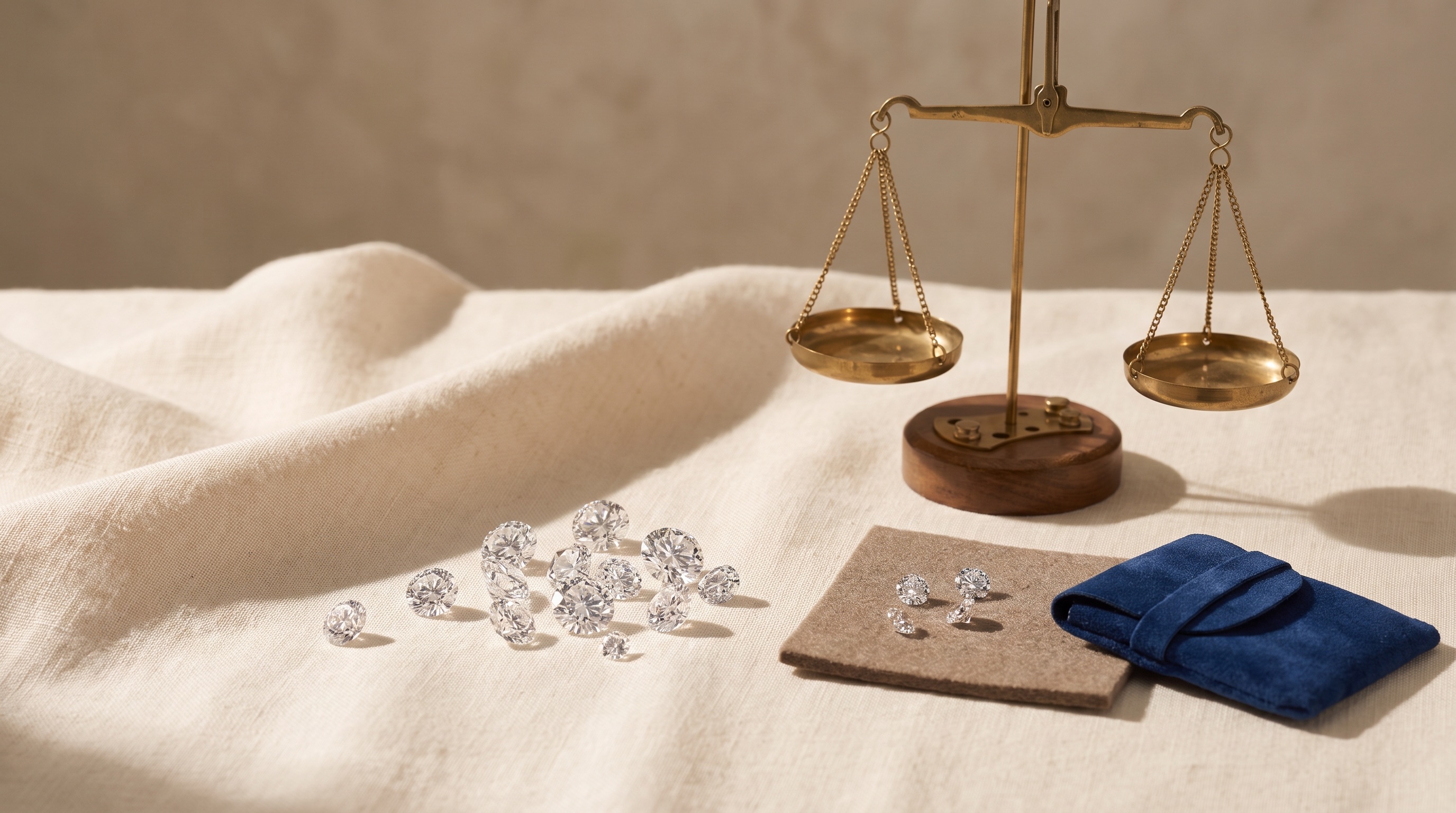
- Weighing and measuring. The stone's carat weight is measured on a calibrated scale, and its physical dimensions — length, width, depth — are recorded using precision measuring equipment rather than visual estimation.
- Proportion analysis. For cut grading, the stone's table percentage, depth percentage, crown and pavilion angles, girdle thickness, and culet (if present) are measured, typically with automated optical scanning equipment that captures these figures far more precisely and consistently than a human grader working by eye alone.
- Color grading. One or more trained graders examine the stone under controlled, standardized lighting, typically comparing it against a set of calibrated master stones representing known points on the color scale, to determine where it falls.
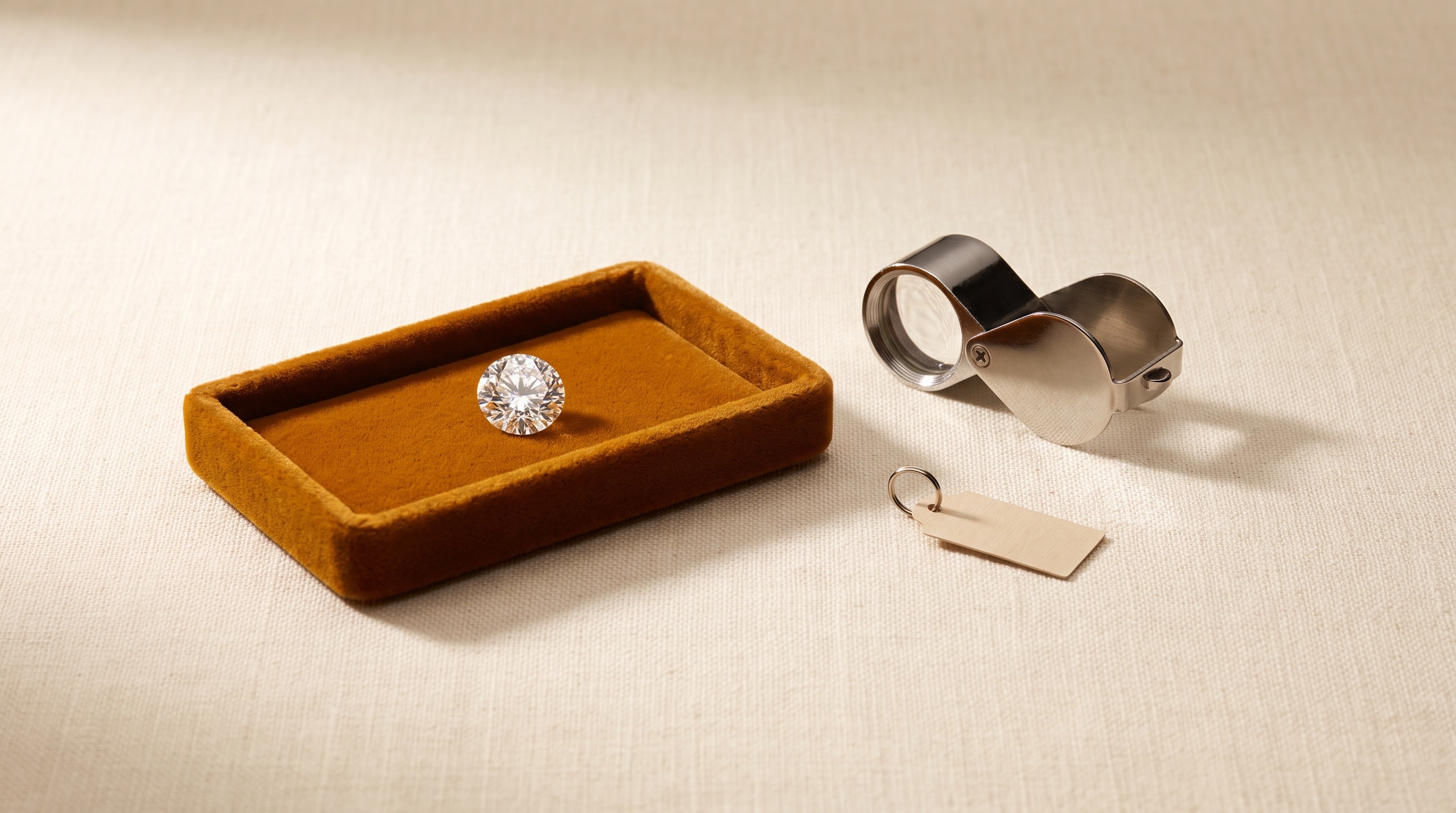
- Clarity grading and plotting. Graders examine the stone under 10x magnification to identify and characterize any internal inclusions or surface blemishes, then map their approximate size, type, and location onto a clarity plot diagram — the diagram included on a full grading report.
- Cross-checking. Reputable labs use more than one independent grader for the more subjective characteristics, particularly color and clarity, and reconcile any disagreement before a final grade is locked in — a structural safeguard against any single grader's judgment driving the outcome.
- Fluorescence and finish grading. The stone's reaction under ultraviolet light is recorded, along with separate polish and symmetry grades describing surface finish and facet alignment.
- Inscription. For most labs, particularly on lab-grown stones, the stone's girdle is laser-inscribed with a report number (and, for lab-grown material, its growth method) so the physical stone can always be matched back to its paperwork.
- Report issuance. All findings are compiled into the final report, which is released to whoever submitted the stone, along with the stone itself, once grading is complete.
None of these steps happen instantaneously, and a buyer submitting stones directly — rather than buying pre-certified inventory — is effectively buying into this entire sequence as part of their own timeline, not just the final report.
How Long Does Diamond Grading Take?
Turnaround time for diamond grading services varies by lab, service tier, stone size, and — significantly — current submission volume at the specific lab location handling the stone. As a general pattern across the major labs, standard service typically runs from roughly a week to a few weeks from submission to report issuance, with expedited or rush service available at most labs for an additional fee when a buyer needs a faster result. Submission volume isn't constant throughout the year; turnaround tends to lengthen around major trade show seasons, when many sellers submit stones at once ahead of a show, and shorten during quieter periods.
Batch submission — sending multiple stones to a lab together, which is common practice for a wholesale supplier or manufacturer rather than an individual submitting one stone at a time — generally offers more efficient per-stone turnaround than submitting stones individually, since the lab can process a batch through its queue more efficiently than the same number of one-off submissions arriving separately. Larger or more complex stones (larger carat weight, more inclusions to plot, fancy shapes requiring additional proportion analysis) can also take longer to grade than a straightforward small round brilliant, independent of overall lab volume.
For a wholesale buyer, the practical takeaway is that grading turnaround isn't a fixed, universal number — it's a range that depends on which lab, which service tier, and when in the calendar a stone is submitted, and it should be budgeted as a real variable in any sourcing timeline that depends on submitting stones directly rather than buying already-certified inventory.
What Does Diamond Grading Cost?
Grading fees are not flat — they scale primarily with carat weight and, secondarily, with service tier (standard versus expedited) and report type (a full report with a clarity plot versus a more compact dossier-style report for smaller stones). As a general rule across the major labs, a small stone costs meaningfully less to grade than a large one, both because a bigger stone takes more grader time to examine thoroughly and because the lab carries a higher insured value while the stone is in its possession. Expedited service adds a premium on top of the standard fee at every lab that offers it.
This cost is typically absorbed into the final price of a certified stone rather than billed to the end buyer as a separate line item — when a jeweler buys a pre-certified diamond wholesale, the certification cost is already built into what the supplier paid to have the stone graded before offering it for sale. A buyer submitting their own stones for grading, by contrast, pays the grading fee directly and separately from whatever they paid (or will pay) for the stone itself, which is one of the direct cost tradeoffs between buying pre-certified inventory and submitting rough or unset stones for grading independently.
Grading a Loose Diamond vs. a Mounted Stone
Grading services generally work best, and most thoroughly, on a loose, unmounted stone — a grader can examine every facet and angle of a diamond from every direction, including the pavilion and girdle, without anything obstructing the view. This is why most wholesale certification, and the grading process described above, assumes a loose stone moving through the lab.
Grading a diamond that's already set into a finished piece — a center stone in a mounted ring, for example — is also possible at most major labs through a jewelry-specific report type, but it comes with real limitations a buyer should understand before requesting one. A setting can partially obscure the pavilion, the girdle, or specific facets depending on how the stone is mounted, which means a jewelry report is typically issued with somewhat more allowance for what the mounting itself makes difficult to inspect fully. For this reason, a mounted stone's grades on a jewelry report are sometimes treated as slightly less definitive than the same stone's grades would be if examined loose — not because the grading process is less rigorous, but because the physical setting genuinely limits what a grader can observe.
For a wholesale buyer, this distinction has a practical consequence: certifying a stone before it's set, whenever that's an option, generally produces a more complete and more confidently comparable report than certifying it after mounting. It's part of why pre-certified loose inventory — graded before it ever reaches a bench — remains the more common path for stones intended for custom work, rather than mounting first and grading afterward.
The Major Diamond Grading Labs: A Services Overview
Several labs offer diamond grading services in the current wholesale trade, and they differ meaningfully as businesses and service providers, not just in report formatting. GIA (Gemological Institute of America) is a nonprofit research and educational institute generally regarded as the strictest and most globally recognized of the major labs, with a broad international lab network and the deepest brand recognition among retail buyers and appraisers. IGI (International Gemological Institute) operates an extensive international network of labs and currently certifies a very high volume of diamonds overall, with a particularly strong position in lab-grown diamond grading specifically. GCAL (Gem Certification & Assurance Lab) is a smaller, US-based lab known specifically for detailed light-performance and cut analysis, often chosen when cut-grade precision is a buyer's top priority. AGS (American Gem Society Laboratories), historically known for pioneering light-performance-based cut grading, was acquired by GIA in 2022 and no longer operates as a fully independent grading service issuing new stand-alone reports, though previously graded AGS stones remain in circulation in the secondary market. For a closer look at any one lab's report format specifically, see GD's guides to the GIA diamond report, IGI diamond certification, and AGS diamond grading.
| Lab | Typical Turnaround | Typical Cost Tier | Service Specialty | International Footprint |
|---|---|---|---|---|
| GIA | Standard to moderate; expedited available at a premium | Generally the highest of the major labs | Strictest overall standard; broadest resale and appraisal recognition | Extensive — multiple countries and trade hubs |
| IGI | Standard, often efficient at high submission volume | Generally more accessible, especially at lab-grown volume | Highest lab-grown grading volume; broad service network | Extensive — multiple countries, strong presence in major trade centers |
| GCAL | Standard; smaller lab network can affect batch timing | Mid-range, reflecting its specialty focus | Detailed light-performance and cut-grade analysis | Primarily US-based |
| AGS Laboratories | Not currently issuing new stand-alone reports | Not applicable — legacy reports only | Historical light-performance cut-grading pioneer | Operations absorbed into GIA (2022) |
These characterizations are general and relative rather than fixed figures — actual turnaround and cost for any specific stone depend on current lab volume, stone size, service tier selected, and the specific lab location handling the submission.
Buying Pre-Certified Inventory vs. Submitting Stones for Grading Yourself
This is one of the more consequential sourcing decisions a jeweler, designer, or manufacturer makes, and it's worth weighing deliberately rather than defaulting to whichever approach a business has always used. Submitting stones for grading directly gives a buyer full control over which lab grades a given stone and when — useful for a manufacturer working with rough or specific parcels who wants a particular lab's report on a particular stone for a particular customer. The tradeoff is that the buyer absorbs the full grading turnaround into their own production or fulfillment timeline, pays the grading fee separately and up front, and carries the logistics of submission, tracking, and pickup themselves.
Buying already-certified inventory shifts that entire process onto the supplier. The stone arrives with its report already issued, its girdle already inscribed, and its grading cost already reflected in the wholesale price — no separate submission, no waiting on a lab queue, and no logistics beyond receiving and reselling the stone. For a jeweler or designer who needs predictable turnaround to fulfill their own customer orders, or a manufacturer building recurring inventory around known certified specs, this generally removes one of the more variable and least controllable steps in the sourcing chain.
Neither approach is universally correct. A manufacturer building custom pieces around rough stock they're sourcing and cutting themselves has little choice but to submit for grading directly. A jeweler or designer restocking standard certified inventory for a showroom or an online catalog, where predictable turnaround matters more than controlling every individual grading decision, is generally better served buying pre-certified stock from a supplier who already carries a choice of labs.
How Grading Turnaround Affects Wholesale Order Fulfillment
Grading turnaround isn't just a lab-side detail — it flows directly into a buyer's own ability to fulfill orders on schedule. A jeweler who submits an uncertified stone for grading as part of filling a custom order is, in effect, adding the lab's current turnaround window on top of every other step in that order's production timeline, and that window can shift depending on the time of year, the specific lab, and how many stones are in the batch. A delay at the grading stage delays everything downstream of it — setting, finishing, and ultimately delivery to the end customer.
This is a meaningful, if sometimes underweighted, planning consideration for a business that takes on custom orders with a promised delivery date. Building in a buffer for grading turnaround — rather than assuming the fastest-case scenario every time — protects against the kind of schedule slippage that's hard to explain to a retail customer waiting on a finished piece. It's also one of the clearest, most concrete reasons a growing number of trade buyers lean toward sourcing pre-certified loose stones for standard inventory and reserving direct lab submission specifically for genuinely custom, one-off pieces where a particular stone's grading has to happen on its own timeline regardless.
What to Check Before Submitting a Diamond for Grading
A few practical checks make direct submission smoother and reduce the odds of a costly surprise. First, confirm the lab's current service tiers and pricing structure directly with the lab or an authorized submission partner before sending a stone, since fee structures and turnaround windows shift over time and vary by lab location. Second, decide on report type up front — a full report with a clarity plot versus a more compact dossier-style report for a smaller stone — since this affects both cost and turnaround, and switching report types mid-process isn't generally an option. Third, if submitting a batch of stones together, confirm the lab's batch-handling process, since larger submissions sometimes move through the queue differently than single-stone submissions. Finally, build the expected turnaround window into your own production or fulfillment schedule with a reasonable buffer rather than the lab's best-case estimate, particularly around trade show season when submission volume across the industry tends to spike.
Sourcing Pre-Certified Diamonds Through Guru Diam
For jewelers and designers who'd rather skip the submission-and-turnaround process described above, Guru Diam sells diamonds already certified through IGI, GIA, and GCAL — all three available across the catalog, in natural and CVD lab-grown stones, standard through antique and exotic shapes. That means the stone arrives with its report already issued, its girdle already inscribed, and its certification lab already matched to the buyer's own preference or end-customer expectations, without the buyer having to submit anything or wait on a lab queue themselves.
Trade buyers can browse current certified inventory through certified diamonds, review fancy color certified stock through fancy color loose diamonds, and source pre-matched certified sets through matching pairs. In-stock inventory ships same-day from Guru Diam's New York and Los Angeles locations, so a jeweler filling an order isn't waiting on certification logistics separately from the physical stone. New trade accounts can apply through trade partner, with current terms and catalog access at the wholesale hub, and custom setting work available through custom jewelry for buyers who want a certified stone set into a finished piece rather than sold loose.
Frequently Asked Questions
What are diamond grading services?
Diamond grading services are the independent lab process — submission, examination, measurement, and report issuance — that produces a standardized document describing a diamond's carat weight, cut, color, clarity, and proportions. They're performed by accredited third-party labs like GIA, IGI, and GCAL, distinct from a monetary appraisal.
How long does it take to get a diamond graded?
Standard service across the major labs typically runs from roughly a week to a few weeks, depending on the lab, current submission volume, stone size, and service tier. Expedited service is generally available at most labs for an additional fee when a faster result is needed.
How much does diamond grading cost?
Grading fees scale primarily with carat weight and secondarily with service tier and report type, so a small stone costs meaningfully less to grade than a large one. This cost is typically built into a pre-certified stone's wholesale price rather than billed separately, but a buyer submitting their own stones pays the fee directly.
Can a diamond be graded after it's already set in jewelry?
Yes, most major labs offer a jewelry report for mounted stones, but the setting can partially obscure certain angles, so grading tolerances are typically described with more allowance than a loose-stone report. Grading a stone before it's set generally produces a more complete, more confidently comparable report.
Should a jeweler buy pre-certified diamonds or submit stones for grading themselves?
It depends on the business: a manufacturer working from rough or specific parcels often has to submit stones directly, while a jeweler or designer restocking standard inventory generally benefits more from pre-certified stock, since it removes grading turnaround and submission logistics from their own fulfillment timeline.
Does grading turnaround affect how fast a jeweler can fulfill a custom order?
Yes. If an uncertified stone needs to be submitted for grading as part of a custom order, the lab's current turnaround window adds directly to the order's overall timeline, and that window can lengthen during high-volume periods like trade show season. Buyers filling time-sensitive orders often build in a buffer for this or source pre-certified stones instead.