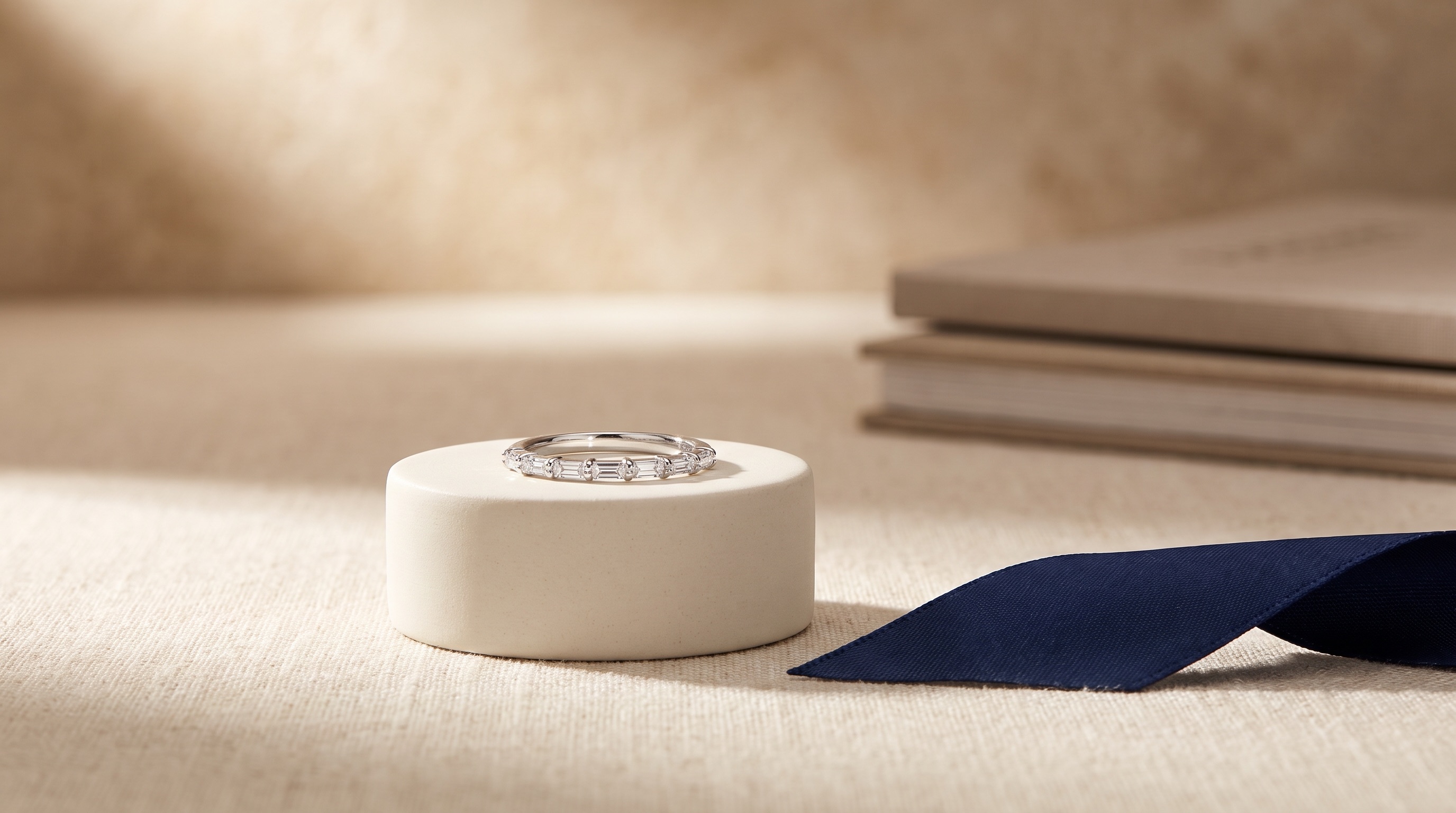
A diamond eternity band is a ring set with diamonds running partway or all the way around the band, and for wholesale purposes it's a band_type variant of the standard wedding band build — full, ¾, or half eternity — not a separate product line. For jewelers stocking or special-ordering these, the real decisions are diamond count, setting style, and how much of the shank actually carries stones, since that's what drives both price and durability.
What "Eternity" Actually Means on a Build Sheet
On a production floor, a diamond wedding band and a diamond eternity band come from the same builder. The only variable that changes is how far the diamond channel or prong-set line extends around the shank. That's a useful distinction to keep in front of retail customers who assume "eternity" is a different category of ring altogether — it isn't. It's a coverage option on the same base product, and pricing it that way (rather than as a bespoke one-off) is what keeps eternity bands profitable to stock in volume.
Three coverage tiers cover the overwhelming majority of retail demand:
- Full eternity — diamonds run the entire circumference of the band, visible from every angle including the underside. Requires the most stones (typically 20-40+ depending on finger size and stone size) and the most labor, since every diamond has to be set and sized consistently on a curved surface.
- ¾ eternity — diamonds cover roughly the top and sides of the band but stop before the underside (the part that sits against the palm). This is the volume workhorse of the category: it reads as a full eternity band when worn, uses meaningfully fewer stones, and can be resized without disturbing a diamond-set section.
- Half eternity — diamonds cover the top half of the band only, typically the front-facing 180 degrees. Lowest stone count, lowest price point, and the easiest to resize, which makes it the best entry-level SKU for a retail counter that wants to offer the eternity look without the full-eternity price tag.
Retailers who don't understand this distinction tend to either overprice ¾ and half eternity (assuming any "eternity" band needs full coverage) or underprice full eternity (not accounting for the resizing and stone-consistency labor). Getting this right in the initial wholesale quote saves a lot of after-the-fact price renegotiation.
Setting Styles and What They Cost in Labor
The setting style matters more for eternity bands than for almost any other jewelry category, because the same setting decision gets repeated 20-40+ times around one ring.
Shared-prong (U-prong)
Diamonds sit in a continuous row of shared prongs, each prong holding two adjacent stones. This is the most common eternity setting because it maximizes visible diamond surface area relative to metal, giving the ring more sparkle per carat. It's also the fastest to set at scale, which keeps wholesale cost down.
Channel setting
Diamonds sit in a groove between two metal rails with no visible prongs. This protects the girdle of each stone (useful for retail customers with active hands) but shows less light through the sides of each diamond, so the same total carat weight looks slightly less bright than a shared-prong equivalent. Channel-set eternity bands also take longer to produce because each stone has to be individually seated and the rail has to be closed evenly.
Bezel setting
Each diamond is wrapped in a thin metal rim. Rare on true eternity bands (it adds significant metal weight and bulk around the finger) but common on half-eternity styles marketed as a more modern, low-profile look. Slowest and most metal-intensive to produce of the three.
Pavé setting
Small diamonds set close together with tiny shared beads of metal holding them in place, common on eternity bands using smaller melee-range stones (0.8mm-2mm) rather than larger individually-selected diamonds. This is where a band's design shifts from "select N diamonds" to "specify a melee grade and let a calibrated parcel fill the band" — a materially different sourcing conversation than prong-set bands built from individually matched stones.
Diamond Sizing: Melee vs. Larger Matched Stones
Eternity bands split into two sourcing paths depending on the stone size the design calls for:
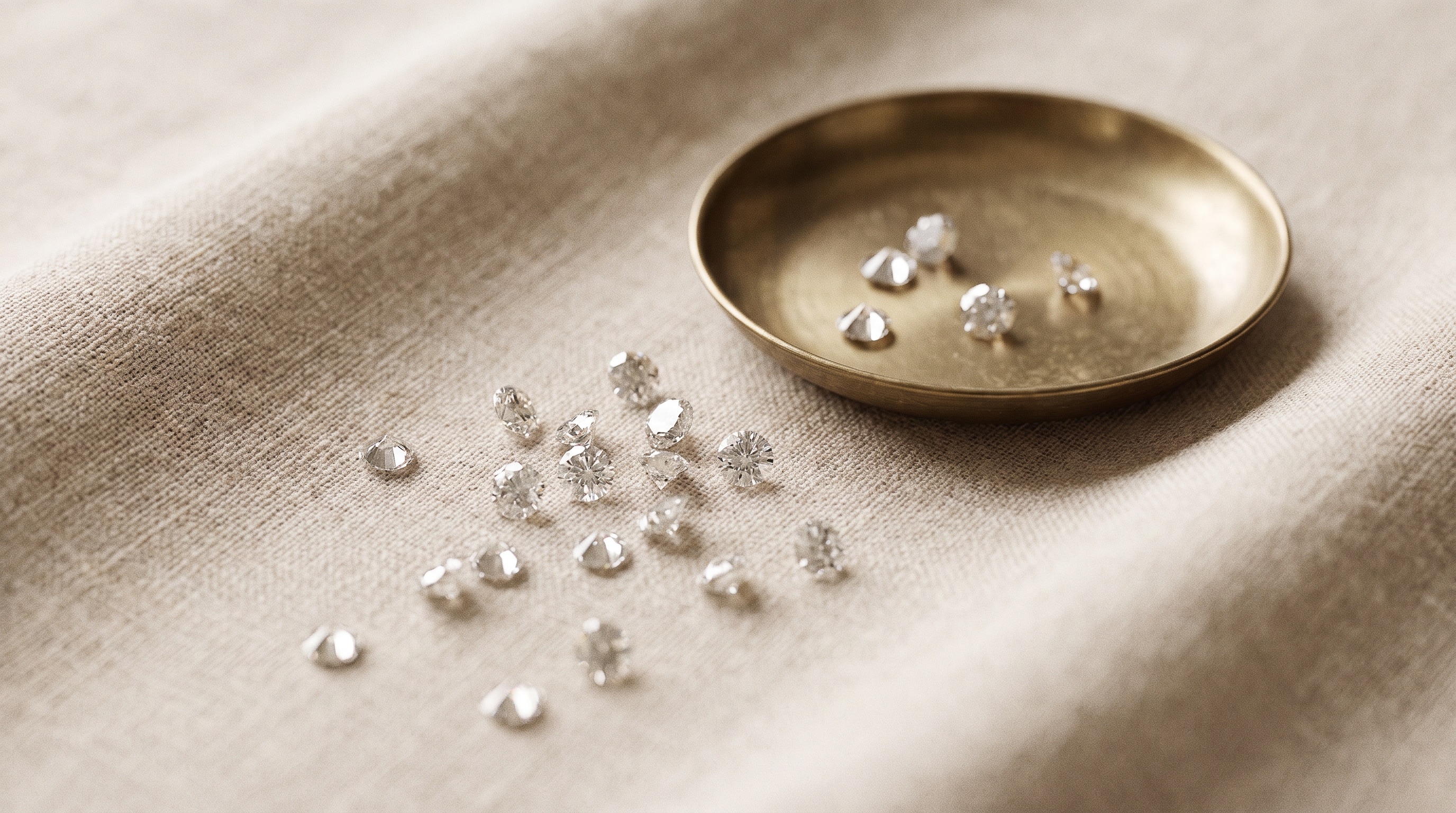
Melee-built bands (typically 0.8mm-2mm stones) are sourced as a calibrated parcel against a clarity/color floor rather than as individually graded stones — melee is not individually or parcel-certified the way a center stone is. A jeweler ordering a full-eternity band in melee is really ordering a parcel count plus a setting job, and the parcel's consistency (size tolerance, color match across the row) matters more than any single stone's grade.
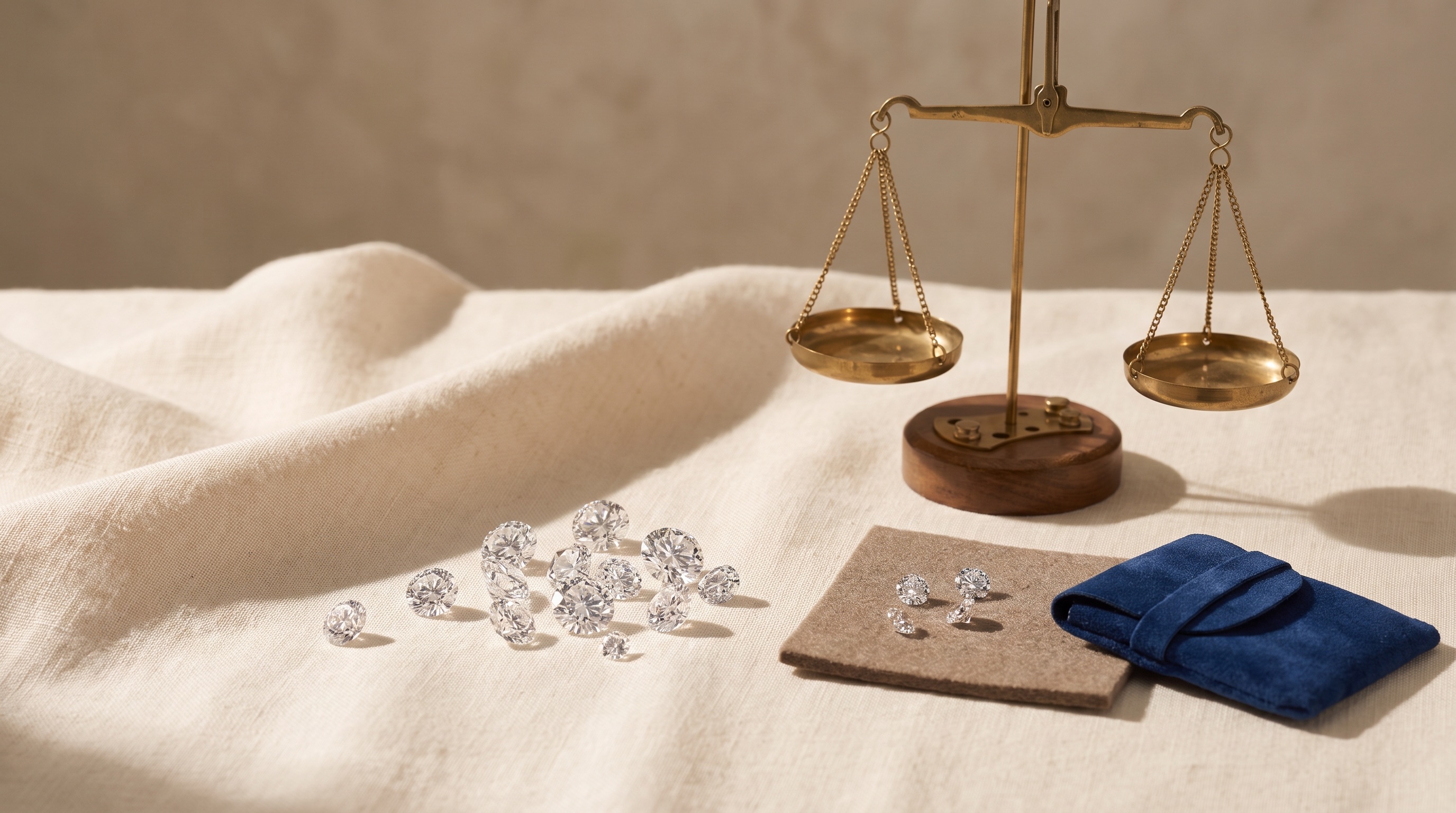
Matched-stone bands (roughly 2mm and up, sometimes running larger diamonds down the shoulders and smaller ones toward the back) require the stones to be selected and matched for size, color, and cut consistency before setting — closer to sourcing a matched pair or a small parcel of near-identical stones than to buying loose melee by weight. This is a slower, higher-touch sourcing process and should be priced and lead-timed accordingly; a jeweler who quotes a matched-stone eternity band at melee-parcel turnaround will consistently miss the delivery date.
Lab-Grown vs. Natural for This Category
Eternity bands are one of the categories where lab-grown CVD diamonds have picked up the fastest share of wholesale volume, for a simple reason: the design uses many stones, so the per-carat savings on lab-grown compound across the whole band rather than applying to one center stone. A retailer who wants to offer a large, visually dramatic full-eternity band at an accessible price point almost always reaches for CVD lab-grown melee or matched stones first.
That said, natural diamond eternity bands remain a meaningful segment, particularly for buyers replacing a decades-old band or matching an existing natural piece in a set. When quoting a natural eternity band, expect a materially higher per-stone cost and, often, a longer sourcing timeline if the design calls for a large quantity of closely matched natural stones in a specific size range — matched natural melee in volume is a much thinner supply pool than lab-grown.
A related question retailers hear often from end customers is whether a lab-grown eternity band will "look different" from a natural one over time — it won't. Because CVD lab-grown diamonds share the same crystal structure, hardness, and optical properties as natural diamonds, there's no aging, clouding, or color-shift difference between the two once a stone is set. The practical differences that matter for an eternity band purchase are all upfront: price per carat, available supply in matched sizes, and lead time, not anything that changes with wear.
Full vs. ¾ vs. Half Eternity: Comparison Table
| Coverage | Typical Stone Count* | Resizing | Relative Wholesale Cost | Best Retail Position |
|---|---|---|---|---|
| Full eternity | 26-42 | Difficult — stones run through the sizing point | Highest | Anniversary upgrade, statement stacking piece |
| ¾ eternity | 18-30 | Straightforward — bare metal section absorbs resizing | Mid-high | Wedding band, most common eternity SKU |
| Half eternity | 10-18 | Easy | Mid | Entry-level eternity look, everyday stacking band |
| Melee pavé (any coverage) | Parcel-based, not per-stone | Depends on coverage tier | Lowest per unit of sparkle | Volume/value SKU, fashion stacking rings |
*Stone count varies with ring size and individual stone diameter; figures assume a standard size 6-7 band in 1.5-2mm stones.
Metal and Band Width Considerations
Eternity bands concentrate more mechanical stress on the shank than a solitaire, because the metal is perforated with settings around its full circumference (for full eternity) rather than at one point. This makes metal choice and band width a durability question, not just an aesthetic one.
- Platinum and 14k/18k white, yellow, or rose gold are all viable, but platinum's density gives it an edge on full-eternity durability since the metal between settings is under the most stress.
- Band width below about 1.7mm on a full-eternity build increases the risk of the shank weakening between prongs over years of wear — a detail worth flagging to retail customers who want the thinnest possible band with maximum diamond coverage, since those two preferences work against each other.
- Comfort-fit interior shaping is worth offering as a standard option on full and ¾ eternity bands specifically, since the exterior of the shank is fully occupied by settings and can't be shaped for comfort the way a plain band's exterior can — a rounded interior profile is the main lever left for improving everyday wearability.
A related, frequently overlooked detail: full and heavily-covered ¾ eternity bands sit differently against an adjacent engagement ring than a plain band does, because the diamond-set surface has more texture and height variation. Retailers selling an eternity band as a stacking piece next to an existing solitaire should confirm the two rings sit flush before the sale, not after — a mismatch in setting height is a common return reason for stacked pairs.
Fancy-Shape and Mixed-Stone Eternity Bands
Round brilliant remains the default stone for eternity bands because round melee sets fastest and most consistently around a curve, but fancy-shape eternity bands (baguette, princess, marquise, and increasingly antique shapes like old mine and kite) have grown as a distinct sub-category. Two sourcing details matter more here than on round-stone builds:
- Orientation consistency. Baguette and other elongated shapes have to be cut to a tight length tolerance and set in a consistent orientation (usually east-west, running perpendicular to the finger) or the band reads as uneven even when every stone is individually well-cut. This is a setting-labor cost, not a stone-cost line item, and it's easy for a buyer comparing quotes to miss.
- Mixed-shape "toi et moi"-style or alternating builds (round alternating with baguette, or a center run of larger stones tapering to melee at the shoulders) require the stone order to specify exact counts per size and shape rather than a single blended parcel spec. Buyers who order these as a single "melee parcel" line item without breaking out shape and size by position often end up with a build that doesn't match the design rendering.
Antique-cut eternity bands (old mine, old European, rose-cut) are a smaller but growing niche, generally sold at a premium price point to retailers positioning the piece as a heirloom-style anniversary or vow-renewal band rather than a everyday wedding band. Sourcing these requires a supplier that stocks antique cuts as a genuine category rather than a novelty SKU, since consistent antique-cut melee in volume is harder to find than standard round brilliant.
Common Wholesale Ordering Mistakes
A few recurring errors show up often enough in eternity band orders that they're worth flagging before a jeweler places a first bulk order:
- Quoting off total carat weight without specifying coverage tier. As covered above, a full and a ¾ eternity band can carry the same total carat weight at very different labor costs — always confirm coverage tier, not just carat total, when comparing supplier quotes.
- Ordering melee parcels without a size-tolerance spec. A parcel described only as "1.5mm-2mm" can still vary enough in diameter to create visible size inconsistency once set in a row. Ask for the tolerance band the supplier sets against, not just the nominal range.
- Assuming ring-size flexibility late in the process. Because full and heavily-covered ¾ eternity bands resize poorly, the customer's actual ring size needs to be locked in before the build starts, not treated as an adjustable detail the way it might be on a plain band.
- Mixing natural and lab-grown claims on one build. If a band uses lab-grown CVD melee with a natural larger accent stone (or vice versa), both the wholesale paperwork and any retail-facing certificate need to state that clearly and separately — never blend the language into one blanket "diamond" claim.
Retail Positioning and Aftercare
Eternity bands sell well as an anniversary upgrade, a stacking piece next to an existing engagement ring, or a standalone fashion band, and retail messaging usually performs better when it leans into one of those occasions rather than presenting the band as a generic wedding-band alternative. Because these bands see continuous daily wear once purchased, retailers should set customer expectations on maintenance up front: full and ¾ eternity bands with prong or shared-prong settings benefit from a professional prong check every 12-18 months, since the many small prongs holding melee in place are more prone to gradual wear than the fewer, larger prongs on a solitaire. Channel-set and bezel-set eternity bands are more forgiving between check-ups but harder to repair if a channel wall does eventually need reopening.
How Retailers Should Price the Category
Because eternity bands are stone-count-driven rather than single-stone-driven, the most common retail pricing mistake is quoting off total carat weight alone without accounting for the labor difference between coverage tiers and setting styles described above. A ¾ eternity band and a full eternity band with the same total carat weight (achieved by using slightly larger stones on the ¾ style) will still cost meaningfully different amounts to produce, because the full-eternity build requires more individual setting operations. Wholesale quotes that separate stone cost, setting labor, and metal weight into distinct line items make it much easier for a retail buyer to build an accurate markup, rather than guessing at a blended per-carat number.
Documentation Wholesale Buyers Should Ask For
Because eternity bands are built from many small stones rather than one certified center stone, buyers sometimes assume there's little paperwork to check. In practice, a few documents are worth requesting on any bulk order:
- Melee QC baseline statement — the clarity/color floor the parcel was screened against (commonly DEF+/VS+ for CVD lab-grown melee), since melee ships as uncertified parcel goods rather than individually graded stones.
- Size-tolerance spec — the diameter range the supplier actually sorts to, not just the nominal size printed on the invoice line.
- Metal purity hallmark and weight — standard for any finished piece, but worth double-checking on full-eternity builds where metal weight is a larger share of total cost than on a solitaire.
- Certificate for any individually certified accent or center stone — if a design pairs melee with one or two larger IGI/GIA/GCAL-certified stones, that stone's certificate should travel with the piece separately from any general parcel documentation.
Asking for this up front avoids a common friction point: a retail customer questioning stone quality months after purchase with no paperwork trail back to what was actually shipped.
Sourcing Diamond Eternity Bands Through Guru Diam
Guru Diam supplies both the loose diamonds and the finished eternity band builds that independent jewelers and designers need to stock this category confidently. On the loose-stone side, CVD lab-grown melee and matched larger stones are IGI, GIA, and GCAL certifiable where certification applies, with same-day shipping on in-stock inventory (before 6pm EST from New York, before 4pm PST from Los Angeles) for jewelers who need to fill a specific coverage tier or stone size fast. On the finished-piece side, custom eternity band builds — full, ¾, or half coverage, any of the setting styles above — are completed in 4-6 days, unbranded by default so retailers can resell them as their own. Diamonds are cut and polished in Guru Diam's Surat, India workshop before final grading and shipment from the New York and Los Angeles locations, giving jewelers a consistent, quality-controlled supply chain behind every band. For jewelers who also carry natural diamond eternity styles, Guru Diam's natural loose and certified stone catalog covers that side of the business from the same account.
Explore the current inventory through the wholesale hub, or set up a trade account through trade partner to get eternity-band-ready melee and matched stones on file. Retailers building custom eternity pieces can start a build through custom jewelry, and jewelers sourcing certified stones for larger matched-stone eternity bands should check certified diamonds and matching pairs for pre-matched sets.
Frequently Asked Questions
What's the difference between a diamond eternity band and a regular diamond wedding band?
They're built on the same base product — the difference is how far the diamond setting extends around the shank. A "wedding band" typically has diamonds on the top face only or none at all, while an eternity band extends the diamond line partway (half or ¾) or all the way (full) around the ring, including potentially the underside.
Can a full eternity band be resized?
It's difficult and sometimes not possible without disturbing the diamond setting, because stones run through the point where a jeweler would normally cut and add or remove metal. This is the single biggest reason retailers steer undecided customers toward ¾ eternity, which leaves a bare metal section that absorbs standard resizing.
Are lab-grown diamond eternity bands as durable as natural diamond ones?
Yes — CVD lab-grown diamonds have the same hardness, brilliance, and wear characteristics as natural diamonds of equivalent clarity and cut, since they're chemically and structurally identical. Durability on an eternity band comes down to setting style, metal choice, and band width, not whether the stones are lab-grown or natural.
How many diamonds are in a typical eternity band?
It depends on ring size, stone diameter, and coverage tier, but a standard size 6-7 full eternity band in 1.5-2mm stones typically runs 26-42 stones. Half and ¾ eternity bands use proportionally fewer.
Should I stock melee-built or matched-larger-stone eternity bands?
Most retail volume runs through melee-built bands (0.8mm-2mm calibrated parcels) because they're faster and less expensive to source and set. Matched-larger-stone bands serve a smaller, higher-price-point segment and require longer lead times since the stones have to be individually matched rather than pulled from a calibrated parcel.
What setting style holds up best for everyday wear?
Channel setting protects the girdle of each stone from everyday knocks, making it a common recommendation for customers who wear their eternity band daily and do manual work with their hands. Shared-prong settings show more light and sparkle but expose slightly more of each stone's edge.
Can eternity bands mix diamond shapes, like round and baguette together?
Yes, and mixed-shape builds are a growing sub-category, but they require the wholesale order to specify exact stone counts and positions by shape rather than a single blended melee parcel, since round and baguette (or other elongated shapes) need different setting approaches and orientation control around the band.
How often should a customer get an eternity band checked for loose stones?
Roughly every 12-18 months for prong and shared-prong builds, since the many small prongs holding melee-range stones in place wear gradually with daily contact against other jewelry, countertops, and fabric. Channel and bezel settings are more protective between check-ups.