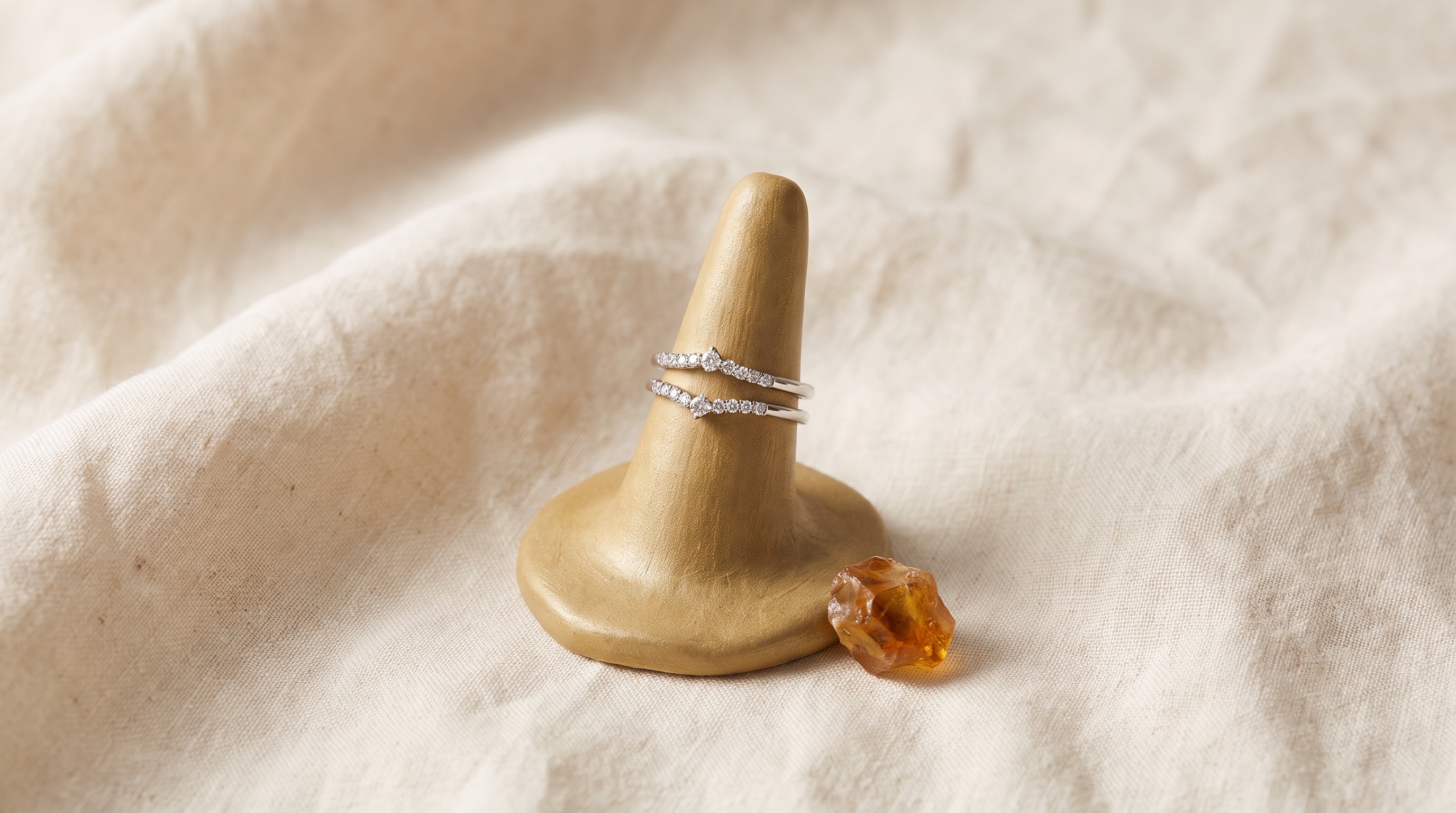
A diamond enhancer ring — also called a ring guard, ring jacket, or wrap — is a separate band, typically set with melee, designed to sit alongside an existing ring (most often a solitaire engagement ring) and visually increase its overall diamond presence without replacing or altering the original piece. For a jeweler or manufacturer, enhancer sourcing is defined by a requirement that doesn't apply to most other melee-set categories: the finished piece has to physically fit and visually complement a customer's existing ring, which means both the melee specification and the ring's internal shaping have to be planned around an item the manufacturer doesn't control the design of.
This guide is written for the trade — jewelers, designers, and manufacturers sourcing loose diamonds and melee to build enhancer rings for their own retail or custom order business. It covers the fit and shaping considerations unique to this category, melee matching against an existing center stone's setting, common enhancer styles, and what to ask a wholesale supplier before sourcing for an enhancer order.
What Makes Enhancer Sourcing Different From Other Melee Categories
Nearly every other melee-set category — a pavé band, a halo ring, a tennis bracelet — is designed and built as a complete, self-contained piece from the outset. An enhancer ring is designed to interact physically and visually with a piece it wasn't originally built alongside, whether that's a customer's existing solitaire engagement ring or a new solitaire sold as part of the same order. This means an enhancer's inner profile has to be shaped to nest against the specific silhouette of the ring it's meant to accompany — a prong-set solitaire, a bezel setting, and a cathedral-style setting each require a different enhancer inner-edge contour to sit flush without gapping or rocking once worn together.
Custom-Fit vs. Standard-Fit Enhancer Construction
Enhancer rings are built one of two ways. A custom-fit enhancer is shaped specifically to match a particular customer's existing ring, usually requiring the original ring in-hand (or precise measurements and photographs) during production to get the contour right — this is the more common approach for a jeweler doing bridal-adjacent custom work, since a poor fit against a specific customer's solitaire is immediately noticeable and a common source of returns. A standard-fit enhancer is manufactured with a more generic curved or notched inner profile designed to accommodate a reasonably wide range of common solitaire setting styles without being tailored to any one specific ring — a more scalable approach for a retailer selling enhancers as a stocked, ready-to-buy item rather than a made-to-order piece.
Melee Requirements for Enhancer Bands
Because an enhancer sits directly beside an existing center stone, the melee used in the enhancer needs to read as a natural extension of the piece it's paired with rather than a visibly separate quality tier — a common and avoidable mistake is quoting an enhancer in a noticeably lower color or clarity grade than the customer's existing ring, which creates a visible contrast in whiteness or brightness once the two pieces sit together. Buyers sourcing enhancer melee should match, or come as close as reasonably possible to matching, the quality tier of the paired ring's own diamonds, and should confirm with a supplier whether that specific grade is available as a consistent lot rather than assuming any DEF+/VS+ melee will look identical once placed directly beside a customer's existing stones.
Typical Enhancer Carat Weight and Stone Count
| Enhancer Style | Typical Stone Count | Common TCW Range |
|---|---|---|
| Single-row curved enhancer | 10–16 stones | 0.15–0.35 TCW |
| Double-row enhancer | 18–28 stones | 0.35–0.65 TCW |
| Enhancer with side accent stones | 12–20 melee + 2 accents | 0.35–0.75+ TCW |
These ranges vary with band width and design complexity, but as with other melee-dependent categories, enhancer pricing and design planning should run on total carat weight against a target rather than stone count alone, particularly since the exact stone count needed can shift once the enhancer's inner contour is finalized against a specific paired ring.
Common Enhancer Ring Styles
Curved/Contour Band
The band curves to follow the specific shape of the paired ring's setting, most common for pairing with a solitaire that has a distinctly rounded or cathedral-style profile. This is generally the custom-fit approach described above, since the curve has to match a specific ring closely to sit flush.
Notched/V-Shaped Band
The band includes a cut-out notch shaped to accommodate a specific prong configuration, commonly used when the paired ring has prominent prongs that a simple curved contour wouldn't clear cleanly. Notched designs require precise measurement of the paired ring's prong placement and height.
Straight Band With Center Gap
A simpler approach using a straight band with a small gap or channel where the paired ring's center stone sits, rather than a contoured inner edge. This style is more forgiving to manufacture at standard-fit scale but generally sits less flush against the paired ring than a properly contoured design.
Certification Approach for Enhancer Diamonds
Enhancer bands are built almost entirely from melee-range stones and ship as graded parcel goods against a stated commercial standard rather than individually certified — the same convention used across other melee-heavy categories. A design that includes a larger side accent stone at 0.30ct or above can have that specific stone certified individually through IGI, GIA, or GCAL, with the surrounding enhancer melee following the standard parcel-grading approach. Buyers should confirm and disclose this certification split clearly to a retail customer, particularly since a customer purchasing an enhancer to pair with an already-certified engagement ring may reasonably expect the same paperwork standard on the new piece unless it's explained otherwise upfront.
What to Ask a Supplier When Sourcing for Enhancer Production
- Can the melee be matched to a specific existing quality tier rather than only offered at one standard commercial grade?
- Is custom-fit contour shaping available, or does the supplier's setting partner only produce standard-fit inner profiles?
- What information is needed from the customer's existing ring to produce an accurate custom fit — physical measurement, the ring in-hand, or detailed photographs and specifications?
- What's the reorder consistency for a specific melee grade, for a retailer stocking a standard-fit enhancer line at multiple grade tiers?
Fit Verification and Returns
Because an enhancer's core value proposition depends entirely on physical fit against another ring, fit verification before final sale is one of the most important quality-control steps in this category, more so than in most other jewelry categories where a piece stands alone. Jewelers offering custom-fit enhancers should build in a trial-fitting step with the customer's actual ring present whenever logistically possible, since photographs and stated measurements — while useful for initial production planning — carry meaningfully more error risk than an in-person fit check before the piece is finished and sold. A clear return or adjustment policy specifically addressing fit issues, communicated to the customer before the sale rather than only if a problem arises afterward, is a reasonable standard practice given how central fit accuracy is to whether the finished piece actually satisfies the customer's original intent.
Enhancer Rings vs. Wedding Bands: A Common Customer Point of Confusion
Customers sometimes conflate an enhancer ring with a standard wedding band, but the two serve different purposes and are sourced differently. A wedding band is designed to be worn as a complete, standalone piece (sometimes alongside an engagement ring, but functioning independently of it), while an enhancer is specifically designed to physically wrap around or sit flush against another ring and generally isn't intended to be worn alone. Retailers should be clear with customers about this distinction upfront, since a customer expecting a wedding-band-style standalone piece may be surprised by an enhancer's dependent, paired-fit design if the difference isn't explained clearly at the point of sale.
Natural vs. Lab-Grown Diamonds for Enhancer Bands
The natural-versus-lab-grown decision for an enhancer often follows the choice already made on the paired ring, since matching origin as well as color and clarity helps the two pieces read as a cohesive, intentional set rather than a mismatched pairing — a natural-diamond engagement ring paired with a CVD lab-grown enhancer can still look visually seamless since the two are optically identical, but some customers specifically prefer origin consistency across a paired bridal set for personal or sentimental reasons, which is worth asking about directly rather than assuming based on the paired ring's origin alone.
Enhancer Rings as an Anniversary Upsell Opportunity
Enhancer rings have a well-established role in anniversary and milestone gifting specifically because they let a customer add meaningful visual value to a ring their partner already wears and values, rather than replacing it with something new — a distinct and often more emotionally resonant gifting proposition than a standalone piece for a customer who wants to mark a milestone without suggesting the original ring wasn't enough on its own. Retailers benefit from actively marketing enhancers around round-number anniversaries (5th, 10th, 25th) rather than waiting for customers to independently think of the category, since many customers aren't aware enhancer rings exist as an option at all until a retailer specifically introduces the idea to them.
Metal Matching Considerations
Beyond diamond quality matching, metal type and color matching between an enhancer and its paired ring matters just as much to the finished look — a white gold enhancer paired with a platinum solitaire can look subtly mismatched in tone even though both are "white" metals, since platinum has a slightly different natural color and wears with a different patina over time than rhodium-plated white gold. Jewelers should confirm the paired ring's exact metal (not just its general color) before sourcing or manufacturing an enhancer, and should set expectations with the customer if an exact metal match isn't practical, since platinum and white gold pieces that start out looking identical can visibly diverge in tone after a few years of separate wear patterns.
Enhancer Rings for Non-Solitaire Center Settings
While solitaire engagement rings are the most common pairing case, enhancers are also built for halo, three-stone, and vintage-style center settings, each of which presents its own fit challenge. A halo-set center ring already has diamonds extending outward from the center stone, meaning an enhancer paired with it typically needs a wider inner gap or a specifically shaped step-down contour to sit beside the halo without either overlapping it or leaving an awkward visible space. Three-stone rings, which already have significant width at the center, often call for a simpler straight-band enhancer rather than an intricately contoured one, since the three-stone ring's own profile already provides substantial visual width without needing the enhancer to closely trace its edge.
Communicating the Enhancer Concept to Customers
Because enhancer rings are a less universally understood category than engagement rings or wedding bands, retailers benefit from a clear, simple explanation at the point of sale — showing a physical or photographed example of an enhancer worn together with a solitaire, rather than relying on a verbal description alone, meaningfully improves customer understanding and confidence in the purchase. Customers frequently ask whether an enhancer can later be resized or re-fitted if their original ring is ever resized, which is a reasonable question to address proactively: a contour built to match a ring at one size may need re-shaping if that ring is later resized meaningfully, and setting this expectation upfront avoids a frustrating surprise well after the original sale.
Common Manufacturing Defects to Screen For
Fit-related defects are the most consequential issue category specific to enhancer rings: a contour that doesn't sit flush against the paired ring, visible gapping at the join point, or a notch cut slightly too shallow or too deep to clear the paired ring's prongs cleanly are all issues that undermine the entire purpose of the piece even if the melee itself is well-matched and well-set. Beyond fit, standard melee-setting defects — uneven spacing, prongs that catch, inconsistent stone depth — apply to enhancer bands the same way they do to any other line-set category and should be checked with the same rigor.
Building an Enhancer Program: Custom vs. Ready-Stock Strategy
A jeweler deciding how to structure an enhancer offering should weigh the tradeoffs between a purely custom-fit, made-to-order approach (higher fit accuracy, longer turnaround, higher labor cost per piece) against a standard-fit, ready-stock approach in a range of common contour styles (faster turnaround and lower per-piece cost, but a real risk of imperfect fit against any specific customer's ring). Many retailers land on a hybrid model — a curated range of ready-stock standard-fit options for walk-in or faster-turnaround sales, alongside a custom-fit option for customers willing to wait for a precisely tailored result — which captures both the speed-focused and precision-focused ends of enhancer demand rather than forcing every single customer into one fulfillment path regardless of what they actually need.
Enhancer Rings vs. Standalone Anniversary Bands: Helping a Customer Choose
A customer deciding between an enhancer ring and a standalone anniversary band is really choosing between two different relationships to their existing ring — an enhancer visually integrates with and depends on the original piece, while a standalone band can be worn independently, stacked loosely, or given as a piece with its own identity separate from the engagement ring. Retailers helping a customer choose between the two should ask directly whether the customer wants the finished look to read as one integrated piece or as two independent pieces that happen to be worn together, since that preference — more than price or carat weight — is usually the deciding factor between the two categories once both options are clearly explained side by side.
Documentation to Keep on File for Custom-Fit Orders
For a retailer running a regular custom-fit enhancer business, keeping organized documentation per order — measurements or a physical mold of the paired ring, photographs from multiple angles, and the specific melee grade and metal used — protects against disputes and speeds up any future adjustment or repair request. This is a modest additional administrative step compared to a standard-fit or standalone piece, but it meaningfully reduces the risk of a costly remake if a fit or matching question arises after the piece has already been delivered and the original reference information would otherwise have to be recreated from memory or a second in-person visit with the customer.
Sourcing Enhancer Ring Diamonds Wholesale
Guru Diam supplies calibrated diamond melee suited to enhancer and ring-guard construction, matchable against a range of common quality tiers, across natural and CVD lab-grown material. As with the rest of Guru Diam's lab-grown catalog, CVD stones are cut and polished at the company's India workshop before final grading and shipment from the New York and Los Angeles locations. Melee ships as consistent, gradable lots at DEF+/VS+ and tighter tiers rather than mixed parcel stock, and larger accent stones for enhancer designs incorporating one can be sourced and certified separately at 0.30ct and above. In-stock inventory ships same-day (before 6pm EST from New York, before 4pm PST from Los Angeles), and trade accounts can browse current melee stock in matching pairs or source certified accent stones in certified diamonds. Manufacturers and jewelers building custom-fit enhancer pieces can start at custom jewelry, and new trade accounts can apply through trade partner, with current terms at the wholesale hub. For melee-sourcing background applicable across this and other line-set categories, see our melee diamonds guide.
Frequently Asked Questions
What is a diamond enhancer ring?
An enhancer ring, also called a ring guard or ring jacket, is a separate band — typically melee-set — designed to sit alongside an existing ring, most often a solitaire engagement ring, to visually increase its overall diamond presence without replacing or altering the original piece.
How is an enhancer ring different from a wedding band?
A wedding band is a complete, standalone piece meant to be worn on its own. An enhancer is specifically designed to physically wrap around or sit flush against another ring and generally isn't intended to be worn alone, which is a meaningful distinction to clarify with customers.
Does an enhancer need to be custom-made to fit my ring?
Not always — standard-fit enhancers with a more generic curved or notched inner profile can accommodate a range of common solitaire settings. A custom-fit enhancer, shaped specifically to a particular ring, gives a more precise result but takes longer and typically requires the original ring or precise measurements during production.
Are enhancer ring diamonds individually certified?
Enhancer bands are built almost entirely from melee-range stones that ship as graded parcel goods rather than individually certified. A larger side accent stone at 0.30ct or above, if included in the design, can be individually certified separately.
Should an enhancer match the natural or lab-grown origin of my existing ring?
It's not required — natural and CVD lab-grown diamonds are optically identical, so a mismatch in origin between a paired ring and enhancer won't be visually apparent. Some customers prefer origin consistency for personal reasons, which is worth asking about directly rather than assuming.
What's the biggest risk when ordering an enhancer ring?
Poor fit against the paired ring is the most consequential and category-specific risk — a contour that doesn't sit flush, visible gapping, or a notch that doesn't clear the paired ring's prongs undermines the entire purpose of the piece even when the melee itself is well-matched.
Can an enhancer ring be adjusted later if the paired ring is resized?
It depends on how significantly the paired ring's size changes. A contour built to fit a ring at one size may need re-shaping after a meaningful resize, so retailers should set this expectation with customers at the point of sale rather than leaving it as a surprise if a future resize is needed.
Guru Diam is a trade-only wholesale diamond supplier with locations in New York and Los Angeles, supplying calibrated diamond melee and certified loose stones — natural and CVD lab-grown — for jewelers and manufacturers producing enhancer rings and other melee-set jewelry. Browse current melee inventory in matching pairs or apply for a trade account through trade partner.