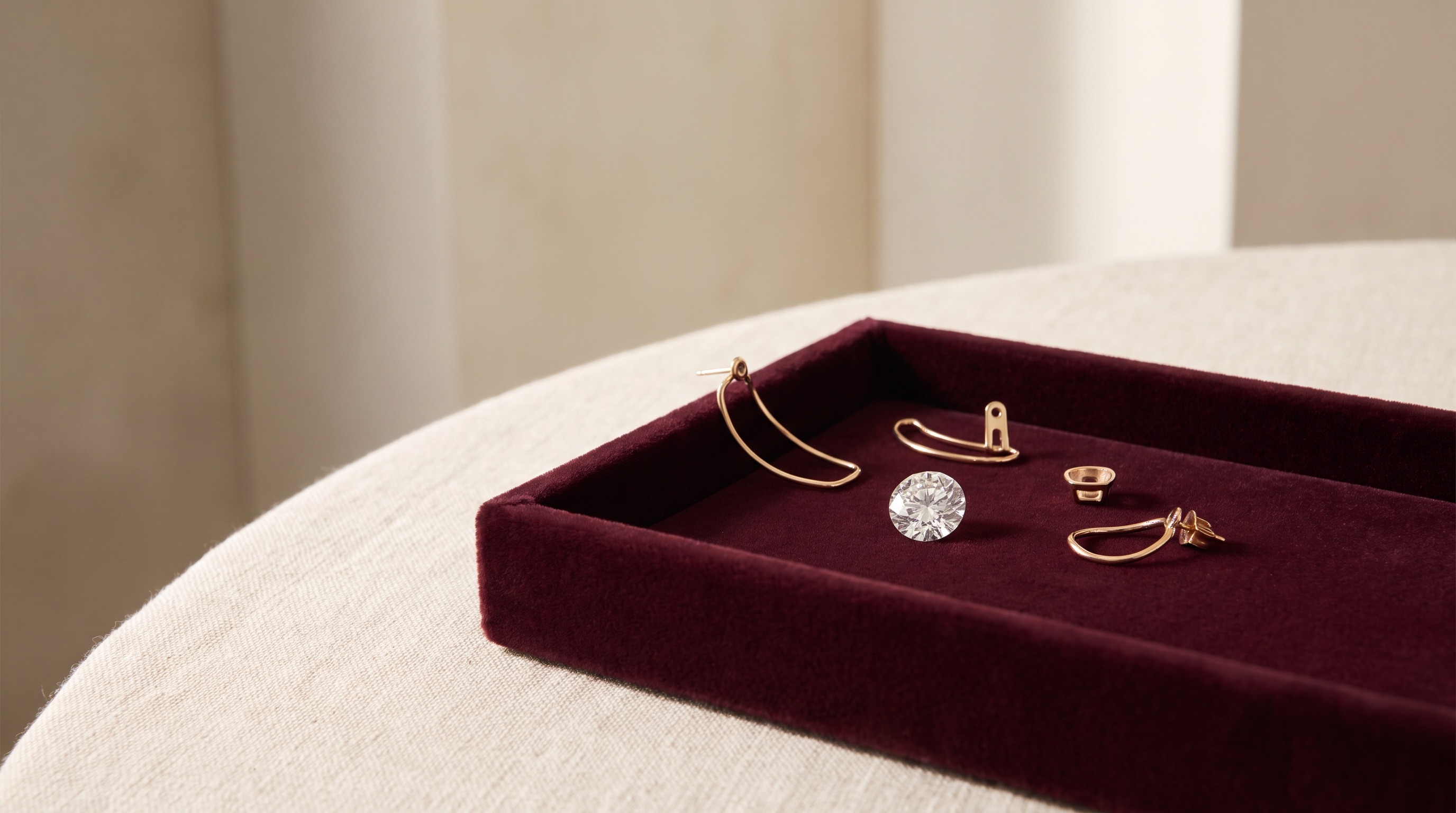
A diamond ear jacket is a two-piece earring accessory that wraps around and sits behind a stud, adding a visible diamond element that frames the earlobe once the jacket is slid into place behind an existing stud earring. For a jeweler, ear jackets are less a standalone product category than an accessory layer built on top of a customer's existing stud collection — which changes how a retailer sources for them: the diamond element needs to read well against a wide range of stud sizes and settings the retailer doesn't control, rather than being designed as part of one fixed, self-contained piece. This guide covers how ear jackets are constructed, what to look for in diamond and hardware sourcing, matched-pair requirements specific to this category, and where ear jackets fit in a broader earring assortment.
This is a trade sourcing guide for retailers, designers, and manufacturers building or expanding an ear jacket line — not a consumer buying guide. It covers construction types, stone shape and sizing conventions, stud-compatibility considerations, and what to look for in a wholesale diamond supplier for ear jacket production.
What Is an Ear Jacket, and How Does It Differ From Other Earring Types
An ear jacket consists of a post that slides through the ear alongside (or through) an existing stud, with a diamond-set element that sits flush against the back of the earlobe or wraps partially around it, becoming visible around the stud once fastened. Unlike a stud, hoop, or drop earring, an ear jacket isn't a self-contained piece — it's designed to be worn with a stud the customer already owns, or one sold alongside it as a pairing. This makes ear jackets fundamentally a layering product, and the sourcing decisions that matter most for this category — stone scale, jacket diameter, and post-gauge compatibility — are all about how well the piece performs across a range of studs it wasn't necessarily designed together with, rather than how it looks as an isolated object.
| Earring Type | Structure | Sourcing Focus |
|---|---|---|
| Stud | Single self-contained piece | Center stone size and grade |
| Ear jacket | Two-piece, worn behind an existing stud | Stud compatibility, jacket diameter, post gauge |
| Drop | Fixed hanging element below the lobe | Matched-pair proportions, hang length |
| Climber/crawler | Follows the curve of the upper ear | Graduated stone sizing, flexible setting |
Common Ear Jacket Constructions
Halo Jacket
A circular or near-circular ring of pavé-set diamonds that frames the entire stud once worn, visible as a full halo around the front piece. This is the most commonly sourced ear jacket construction and works with the widest range of stud sizes since the halo diameter can be scaled independently of the stud it's paired with.
Crescent or Wing Jacket
A partial arc of diamonds, typically pavé-set, that sits below and to the sides of the stud rather than forming a complete circle. This construction reads as more modern and minimal than a full halo and generally uses less total diamond weight for a comparable visual footprint, which affects wholesale cost positioning.
Statement Jacket
A larger, more sculptural jacket design — sometimes asymmetric, sometimes incorporating a secondary shape like a starburst or geometric motif — meant to be a visible style statement in its own right rather than a subtle frame. These carry the most design and setting labor per piece and are typically priced and merchandised as a distinct premium tier.
Stud Compatibility: The Core Sourcing Challenge
Because an ear jacket is sold to be worn with a stud the customer already owns or purchases alongside it, jacket diameter and post gauge need to work across a realistic range of stud sizes rather than one specific pairing. A jacket sized too large for a small stud looks visually disconnected, with an obvious gap between the stud and the halo; one sized too small won't clear a larger stud's setting at all. Retailers building an ear jacket line should source jackets in at least two or three diameter tiers — commonly sized to pair with roughly 0.25-0.50ct, 0.50-1.00ct, and 1.00ct+ stud ranges — rather than a single fixed size marketed as universal, since "universal fit" claims in this category are a frequent source of return and fit complaints when the actual pairing doesn't read well. It's also worth noting that stud setting style, not just carat weight, affects fit: a bezel-set stud sits flatter against the earlobe than a prong-set stud of the same carat weight, and a jacket sized around prong-set assumptions can sit awkwardly behind a bezel stud even when the nominal carat range matches, which is one reason a physical fit check across a few representative stud styles is worth doing before finalizing a diameter tier's specifications.
Diamond Shape and Setting Choices
Round brilliant melee is by far the dominant choice for ear jacket pavé work, since a continuous ring or arc of diamonds reads most cleanly with uniform round stones set in a consistent calibrated size. Baguette-cut melee appears in more geometric, art-deco-influenced jacket designs, typically channel-set in a straight or curved line rather than pavé. Larger single-stone accents — a small marquise or pear tip at the base of a crescent jacket, for example — appear in statement designs but remain a secondary design element rather than the category's primary stone use, since the pavé or channel field carries most of the visual weight in a typical ear jacket.
Matched-Pair Sourcing for Ear Jackets
Ear jackets are sold and worn in pairs, and because both jackets sit in a visually prominent, similarly framed position on either side of the face, mismatches in overall diamond density, halo diameter, or stone color between the left and right piece are noticeable in a way that's harder to disguise than in some other paired-earring categories. Retailers should source pavé melee for jacket pairs from a single calibrated parcel matched on size and color consistency, and confirm that the two jackets in a pair are set with a comparable stone count and density rather than assembled from separate batches that happen to be close in overall carat weight — two jackets built from different melee batches can carry a visibly different sparkle character even at matched total carat weight.
Metal and Finish Considerations
Ear jacket hardware is typically produced in the same core metal options as other fine jewelry — 14k and 18k white, yellow, and rose gold, with platinum available for premium tiers — and retailers should stock jacket finishes that can plausibly match a range of customer stud metals rather than assuming every customer already owns a stud in the exact metal the jacket is sold in. White metal jackets pair most flexibly across a customer's existing stud collection since white gold and platinum studs are the most commonly owned baseline, while yellow and rose gold jackets are typically merchandised alongside a matching stud as a complete pairing rather than sold as a standalone add-on to an unknown existing piece.
Lab-Grown vs. Natural Diamonds for Ear Jacket Programs
Because ear jackets are built primarily from pavé melee rather than one or two large feature stones, they're a strong category for CVD lab-grown material: the visual effect depends on overall density and consistency of the melee field rather than any single stone's provenance, and lab-grown melee lets a retailer offer a fuller, denser halo or crescent at a price point that would be difficult to reach with natural melee at comparable margins. Natural melee remains a valid choice for retailers positioning ear jackets as a premium add-on to an existing natural stud, but for accessible, higher-density jacket designs, lab-grown CVD melee is the more common wholesale sourcing choice.
Wholesale Price Positioning by Construction Type
| Construction | Relative Price Position | Key Cost Driver |
|---|---|---|
| Crescent/wing jacket | Entry to mid | Lower total melee weight, simpler setting |
| Halo jacket | Mid | Full-circle pavé melee weight and consistency |
| Statement jacket | Mid to high | Design complexity and setting labor |
This spread lets a retailer build a coherent ear jacket line that offers an accessible entry point alongside a premium statement tier, using the same core melee sourcing across constructions and varying total stone count and setting complexity to hit different price points, rather than sourcing a completely separate stone tier for each construction type.
Building an Ear Jacket Program: Inventory Planning
- Stock at least two or three jacket diameter tiers sized to common stud carat ranges, rather than a single "universal" size.
- Source pavé melee from a single calibrated, color-matched parcel per pair to avoid visible density or color mismatches between the two jackets.
- Offer white metal as the primary flexible option, since it pairs most easily with a customer's existing stud collection.
- Lean on CVD lab-grown melee for fuller, denser pavé designs at accessible price points.
- Merchandise crescent, halo, and statement constructions as a clear tiered ladder, not an undifferentiated single category.
How Ear Jackets Fit Into a Broader Earring Assortment
Ear jackets are most effective as an attachment-rate product — sold alongside or after an initial stud purchase, rather than as a customer's first earring purchase from a retailer. Merchandising them near stud displays, and specifically calling out stud-and-jacket pairing options at the point of sale, meaningfully increases attach rate compared with merchandising ear jackets as a disconnected standalone category the customer has to discover on their own. Retailers who already sell diamond studs have a natural cross-sell opportunity here that a retailer without an existing stud program doesn't have, which is worth factoring into how much inventory depth to commit to this category relative to a retailer's existing product mix.
Trends Driving Ear Jacket Demand
Ear jackets grew initially as part of the broader curated-ear and multi-piercing trend, where customers build a personalized ear arrangement from several distinct pieces rather than wearing a single matched pair, and jackets offered a way to add visible diamond detail without committing to a second piercing. Demand has since broadened beyond the multi-piercing customer specifically, as jackets became understood as a way to visually upgrade an existing stud for a special occasion without buying an entirely new earring. This has made ear jackets a recurring gifting category, particularly around the holiday season, since they let a buyer add meaningful diamond content to a gift built around a piece the recipient may already own.
Ear Jackets as a Custom and Made-to-Order Category
Because ear jackets depend so heavily on pairing with a specific existing stud, this category lends itself well to a made-to-order or semi-custom sourcing model rather than a purely stocked-inventory approach. A retailer can offer to size a jacket to a customer's own stud on request — measuring the existing stud's diameter and setting profile and producing a jacket to match — rather than asking the customer to choose from a small number of fixed diameter tiers and hope one fits well. This adds turnaround time compared with an off-the-shelf sale, but commands a meaningfully higher price point and reduces the return risk that comes with fixed-tier sizing, making it a natural upsell for retailers who already offer custom or made-to-order services elsewhere in their assortment. Retailers without in-house custom capability can still offer this as a special-order option through a supplier who supports semi-custom jacket sizing, rather than limiting the category entirely to off-the-shelf fixed sizes.
Common Sourcing Mistakes in Ear Jacket Programs
The most frequent sourcing error in this category is stocking a single jacket diameter and marketing it as universal, which leads to visibly poor pairings and return complaints once customers try it against studs outside the size range it was actually designed for. A second common mistake is sourcing pavé melee in inconsistent batches across a production run, which shows up as a visible sparkle or color mismatch between the two jackets in a pair once they reach a customer. A third is under-merchandising the category as a standalone product rather than actively cross-selling it alongside existing stud inventory, which leaves real attach-rate revenue on the table for retailers who already have a stud customer base to sell into. A fourth, less obvious mistake is treating post gauge as an afterthought: a jacket post that's noticeably thicker or thinner than the stud it's meant to sit alongside can feel uncomfortable or unstable in the ear even when the visual pairing looks correct on a display card, and retailers who skip a physical wear-test across their jacket and stud size range are more likely to discover gauge problems from customer complaints than from their own quality control.
Pricing a Wholesale Ear Jacket Order
Wholesale pricing for ear jackets is driven primarily by total melee carat weight and setting labor rather than by any single feature stone, which makes this a category where a retailer can move price meaningfully by adjusting pavé density and jacket diameter rather than by trading up or down a center-stone grade the way a solitaire-based category would. A retailer placing a first wholesale order in this category should request pricing broken out by construction type (crescent, halo, statement) and by diameter tier separately, rather than a single blended per-piece price, since the cost drivers genuinely differ enough between a small crescent jacket and a full statement halo that a blended average price obscures where the real margin opportunity sits. Suppliers who quote per-piece pricing inclusive of metal, melee, and labor as one line item make it harder for a retailer to model their own margin as they adjust construction mix, so it's worth asking for a cost breakdown up front rather than negotiating against an opaque bundled number.
Packaging and Presentation for Ear Jackets
Because ear jackets are sold as a pairing concept rather than a fully self-contained piece, point-of-sale presentation matters more here than in most earring categories — a jacket displayed flat in a standard earring card doesn't communicate how it actually looks worn behind a stud, which is the entire value proposition of the product. Retailers who invest in display cards or counter cards that show a jacket paired with a representative stud (either a photograph or a physical demonstration piece) see meaningfully better sell-through than retailers who merchandise jackets identically to standalone stud or drop earrings. This is also a category where a brief printed or digital sizing guide at the point of sale — showing which jacket diameter pairs with which approximate stud size — measurably reduces both return rates and the amount of sales-floor time needed to talk a customer through the pairing decision.
Comparing Ear Jacket Suppliers
| Evaluation Criterion | What to Look For |
|---|---|
| Diameter tiering | Multiple jacket sizes mapped to stud carat ranges, not one "universal" size |
| Melee consistency | Pavé sourced from a single calibrated, color-matched parcel per pair |
| Post gauge documentation | Clear gauge specs so jackets can be matched to a customer's actual stud posts |
| Metal options | White, yellow, and rose gold plus platinum for premium tiers |
| Certification | IGI, GIA, or GCAL available on any center-accent stones above 0.30ct |
Working through a checklist like this before committing to a first order helps a retailer avoid the two most common first-order regrets in this category: discovering after the fact that a supplier's "one size" jackets don't actually pair well across a real customer base, or discovering that melee consistency across a production run wasn't as tightly controlled as a sample piece suggested.
Sourcing Diamonds for an Ear Jacket Line Wholesale
Guru Diam supplies calibrated CVD lab-grown and natural melee in the consistent parcel sizes ear jacket pavé and channel work requires, alongside loose center-accent stones for statement jacket designs, with IGI, GIA, and GCAL certification available at 0.30ct and above. Trade buyers can review current melee and matched-pair inventory through matching pairs and certified diamonds, and work with Guru Diam's custom jewelry team on jacket sizing and hardware through custom jewelry. In-stock inventory ships same-day from Guru Diam's New York and Los Angeles locations. New trade accounts can apply through trade partner, with current terms available at the wholesale hub. For related sourcing fundamentals, see our diamond stud earrings guide, diamond drop earrings guide, and diamond huggie earrings guide.
Frequently Asked Questions
What is a diamond ear jacket?
An ear jacket is a two-piece earring accessory with a post that slides through the ear alongside an existing stud, with a diamond-set element that sits behind the earlobe and becomes visible around the stud once fastened.
Do ear jackets fit any stud?
Not universally — jacket diameter and post gauge need to be sized to a realistic stud range. Retailers should stock at least two or three diameter tiers rather than marketing a single size as a universal fit.
What diamond shapes are used in ear jackets?
Round brilliant melee is dominant for pavé halo and crescent designs. Baguette melee appears in more geometric, channel-set designs, and larger single stones sometimes accent statement jacket designs.
Should ear jacket melee be lab-grown or natural?
CVD lab-grown melee is common since the visual effect depends on overall pavé density and consistency rather than individual stone provenance, letting a retailer offer a fuller halo at an accessible price point. Natural melee suits premium pairings with an existing natural stud.
How should retailers merchandise ear jackets?
As an attachment-rate product sold alongside or shortly after a stud purchase, with pairing options called out at the point of sale — this drives meaningfully higher attach rates than merchandising jackets as an undifferentiated standalone category.
What is the difference between a halo jacket and a crescent jacket?
A halo jacket forms a complete circle of pavé diamonds around the stud, while a crescent or wing jacket uses a partial arc below and to the sides — crescent designs typically use less total melee weight for a comparable visual footprint.
What drives wholesale price differences between ear jacket constructions?
Total melee carat weight and setting labor are the main cost drivers, not a single feature stone. Retailers should request pricing broken out by construction type and diameter tier rather than one blended per-piece price.
Guru Diam is a trade-only wholesale diamond supplier with locations in New York and Los Angeles, supplying calibrated CVD lab-grown and natural melee alongside certified loose diamonds, with IGI, GIA, and GCAL certification available, for jewelers building earring, ring, and finished jewelry lines. Browse current inventory in matching pairs or apply for a trade account through trade partner.