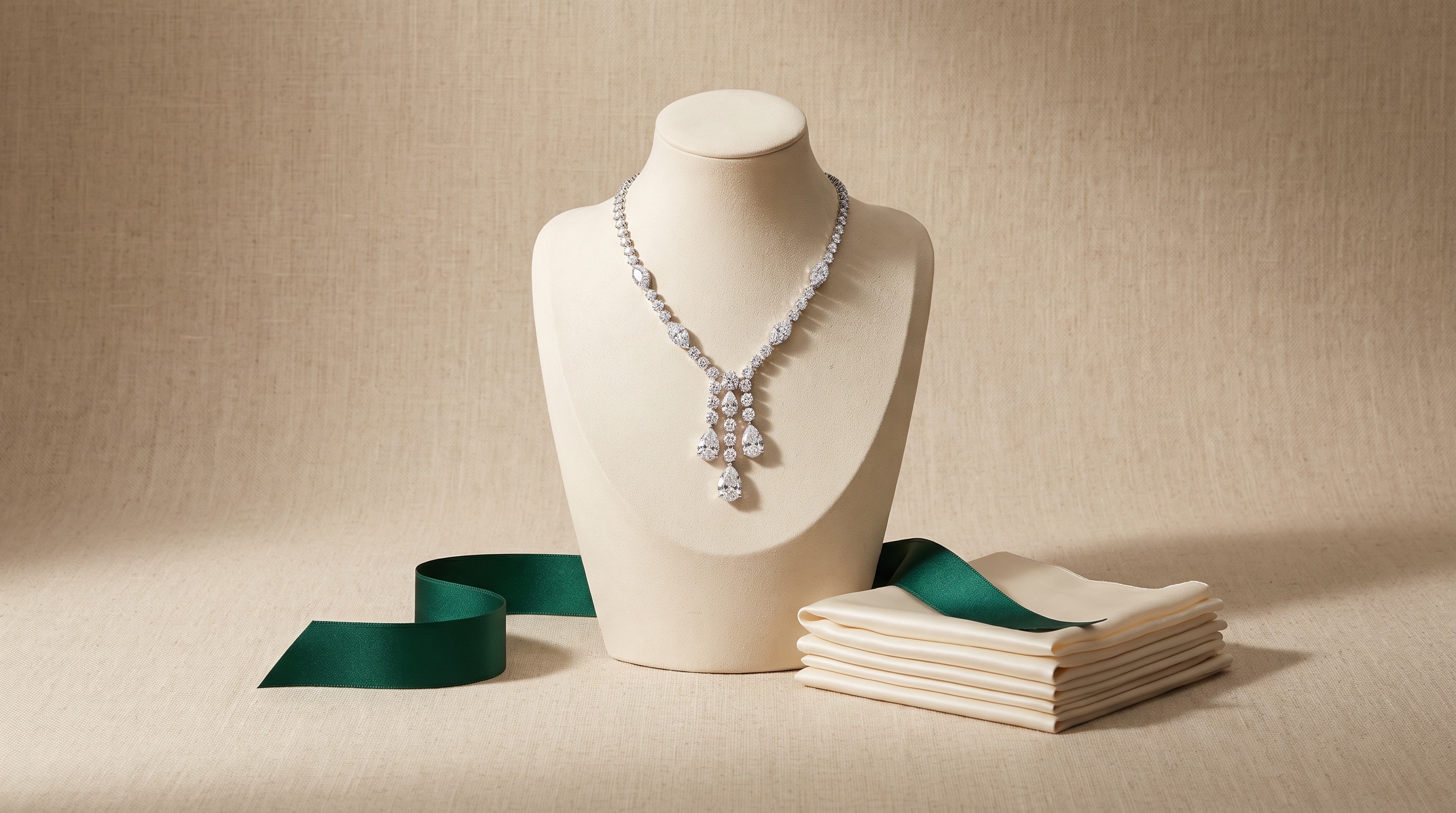
A diamond drop necklace features a pendant element — typically a single diamond or small cluster — suspended from a chain so that it hangs below the collarbone as a distinct focal point, distinguishing it from a diamond-by-the-yard station necklace (which spaces multiple small stones along the chain) or a full diamond tennis necklace (which sets stones continuously along the entire length). For a jeweler, the drop necklace category sits at the intersection of pendant sourcing and chain sourcing — the finished piece's success depends as much on how well a given drop pairs with an appropriate chain length and gauge as it does on the stone itself. This guide covers drop necklace construction types, stone and bail sourcing, chain-pairing conventions, and what to look for in a wholesale diamond supplier for drop necklace production.
This guide is written for the trade — retailers, designers, and manufacturers sourcing loose diamonds to build or expand a drop necklace line — not a consumer buying guide. It covers construction and pendant styles, stone selection, chain-length pairing, and wholesale pricing dynamics for this category.
Drop Necklace vs. Related Necklace Categories
Clear category definitions matter for sourcing, since the stone and chain requirements genuinely differ between related necklace styles even when consumer search terms blur the distinctions. A drop necklace centers on one pendant element hanging at a fixed point below the collarbone. A station or by-the-yard necklace spaces several small stones individually along the chain's length rather than concentrating weight at one point. A tennis necklace sets stones continuously and closely along the full chain. Understanding which category a customer or retailer actually means matters because the sourcing priorities differ: a drop necklace prioritizes one well-chosen feature stone and bail, a station necklace prioritizes consistent small-stone matching across several individually set points, and a tennis necklace prioritizes total melee consistency across a much larger continuous stone count.
| Category | Stone Placement | Primary Sourcing Focus |
|---|---|---|
| Drop necklace | One feature element at a fixed point | Feature stone quality, bail and chain pairing |
| Station/by-the-yard | Several small stones spaced along the chain | Consistent matching across multiple set points |
| Tennis necklace | Continuous stones along the full length | Total melee consistency at scale |
Common Drop Necklace Constructions
Solitaire Drop
A single diamond, prong or bezel-set, suspended from a simple bail. The most classic drop necklace construction, where the feature stone's individual quality carries nearly all of the piece's visual weight.
Cluster Drop
Several smaller diamonds set together to form the pendant element rather than one center stone — a construction that reads as a larger, denser focal point for a given total carat weight than a single stone would, while being more forgiving of minor individual stone variation since the cluster reads collectively.
Halo Drop
A center stone surrounded by a ring of smaller pavé diamonds, combining the visual impact of a larger apparent center stone with the cost efficiency of pavé melee around a smaller actual feature stone.
Bezel or Solitaire-in-Motion Drop
A bezel-set stone mounted with a small amount of play in the bail connection, letting the pendant catch light and move slightly as the wearer moves — a construction that's grown in popularity as part of the same minimalist, everyday-wear trend that's driven demand for bezel-set earrings and rings.
Feature Stone Shape Selection
Round brilliant remains the most commonly sourced shape for drop necklace feature stones, offering the broadest commercial appeal and easiest bail integration. Pear and marquise shapes are a strong secondary choice, since their elongated, tapered silhouette suits a vertical hanging pendant particularly well — a pear-shaped drop with the point facing down is one of the category's most enduringly popular specific styles, mirroring the same shape logic that applies to drop earrings. Oval and cushion cuts appear frequently in more contemporary designs, while emerald and radiant cuts suit a more geometric, minimalist aesthetic that's grown alongside the broader bezel and clean-line jewelry trend.
Bail Construction and Its Effect on Hang
The bail — the small connector joining the pendant to the chain — affects both how a drop necklace hangs and how easily it can be styled with different chains, and is worth sourcing as deliberately as the feature stone itself. A fixed bail, permanently soldered to the pendant, offers a clean, secure connection but limits the pendant to whatever chain it was designed with. A slide bail or enhancer-style connection lets the pendant be moved between different chains, effectively letting a customer restyle one pendant across several necklace looks — a feature increasingly marketed as a value-add in mid-tier and premium drop necklace lines. Retailers should decide deliberately whether a given design is meant to be a fixed, single-chain piece or a movable, multi-chain pendant, since this decision affects both bail construction and how the finished piece should be merchandised and sold.
Chain Length: Pairing Conventions for Drop Necklaces
Chain length materially changes where a drop pendant sits and how it reads visually, and retailers should stock or offer multiple length options rather than a single fixed chain length paired rigidly with every pendant design. An 16-18 inch chain (princess length) sits at or just below the collarbone and suits most everyday drop necklace wear. An 18-20 inch chain (matinee length) sits lower, at or near the neckline of most tops, and is a common choice for layering or for a slightly more dramatic drop presentation. Adjustable chains, with a slider or several clasp positions, have grown in popularity specifically because they let one piece serve a range of customer preferences and necklines without requiring the retailer to stock a full spread of fixed lengths for every pendant design.
| Chain Length | Typical Drop Position | Common Use Case |
|---|---|---|
| 14-16 in (choker/collar) | High, at or above the collarbone | Layering piece, closer to the neck |
| 16-18 in (princess) | At or just below the collarbone | Most common everyday drop length |
| 18-20 in (matinee) | Lower, near most necklines | Layering or slightly more dramatic presentation |
| Adjustable | Variable | One piece serving multiple customer preferences |
Lab-Grown vs. Natural Diamonds for Drop Necklace Programs
Drop necklaces span a wide price range depending on feature stone size and grade, making the category well suited to offering both lab-grown and natural options at different price tiers within the same design. CVD lab-grown diamonds let a retailer offer a larger, more visually dramatic feature stone at an accessible price point, which matters in this category since the drop's visual impact is driven heavily by the single feature stone's apparent size — more so than in a pavé or multi-stone category where overall density matters more than any one stone. Natural diamonds remain a strong choice for premium drop necklaces marketed specifically on provenance, while lab-grown material lets a retailer meaningfully expand the accessible end of a drop necklace program without a proportional drop in visual impact.
Metal Choice and Its Interaction With Chain and Stone Color
Metal choice affects a drop necklace's overall read more than in some other categories, since the chain itself is a continuous visible metal element rather than a small setting around a single stone. White metal (platinum or white gold) is the most common choice and tends to disappear visually against the skin, letting the diamond pendant read as the clear focal point. Yellow and rose gold chains have grown as a distinct styling choice in their own right, and pair particularly well with slightly warmer color-grade stones (I-J range), where the warmth of the metal and the stone complement each other rather than the metal drawing attention to a stone meant to read as colorless.
Wholesale Price Positioning by Construction Type
| Construction | Relative Price Position | Key Cost Driver |
|---|---|---|
| Cluster drop | Entry to mid | Combined melee weight, moderate setting labor |
| Halo drop | Mid | Center stone plus pavé melee surround |
| Solitaire drop | Mid to high | Feature stone size and grade |
| Bezel-in-motion drop | Mid to high | Feature stone quality plus specialized bail hardware |
This spread gives a retailer a coherent product ladder within the drop necklace category alone — a cluster drop as an accessible entry point, a halo drop as a mid-tier bridge offering apparent size beyond the actual center stone, and a solitaire or bezel-in-motion drop as the premium anchor piece built around feature-stone quality.
Building a Drop Necklace Program: Inventory Planning
- Source feature stones with bail integration in mind, confirming a stone's girdle and depth suit the specific bail style planned for the design.
- Stock at least two or three chain lengths, or offer adjustable chains, rather than pairing every pendant with one fixed length.
- Decide deliberately between fixed and movable bail construction per design, and merchandise movable pendants specifically on their multi-chain versatility.
- Lean on CVD lab-grown for larger feature stones at accessible price points, since apparent size drives this category's visual impact.
- Build a clear construction-based product ladder (cluster, halo, solitaire) rather than a flat, undifferentiated assortment.
Layering Trends and Their Effect on Drop Necklace Sourcing
The broader necklace-layering trend — wearing several necklaces of varying lengths and styles together rather than a single piece — has shaped drop necklace demand meaningfully, since layering favors a smaller, more delicate drop pendant that can sit comfortably alongside other pieces rather than a single large statement drop meant to be worn alone. Retailers should stock a meaningful share of smaller, more delicate drop designs (both in feature stone size and overall pendant scale) specifically to serve the layering customer, in addition to larger statement drops for customers seeking a single standalone piece, since these represent genuinely different buyer intents within the same broad category.
Gifting Occasions and Seasonal Demand
Drop necklaces carry a distinct seasonal and occasion-driven demand pattern tied closely to gifting calendars: the holiday season and Valentine's Day drive strong demand across price tiers, while graduation and milestone-birthday gifting tends to concentrate in the more accessible entry and mid-tier price bands. Retailers planning inventory depth for this category benefit from weighting stock toward relevant tiers ahead of each seasonal window, and from ensuring gift-appropriate packaging and presentation are ready well ahead of the holiday and Valentine's Day peak rather than treating packaging as an afterthought to the stone and chain sourcing itself.
Clasp Types and Their Effect on Everyday Wear
Clasp choice is easy to overlook relative to the pendant and chain, but affects a drop necklace's practical everyday usability meaningfully enough to be worth deliberate sourcing rather than a default afterthought. A spring-ring clasp is the most common and least expensive option but can be difficult for a wearer to operate one-handed, which matters for a piece intended for frequent daily wear rather than occasional use. A lobster clasp offers a more secure, slightly easier one-handed operation and has become the practical default for mid-tier and premium drop necklace lines. A magnetic or box clasp offers the easiest operation but carries a higher failure-mode risk for very lightweight pendants, since a light tug can release the clasp more easily than a mechanical catch would — a consideration worth weighing against a design's actual expected wear pattern rather than choosing a clasp purely on cost.
| Clasp Type | Ease of Use | Security | Best Fit |
|---|---|---|---|
| Spring-ring | Lower — difficult one-handed | Good | Entry-tier, cost-sensitive lines |
| Lobster | Moderate to good | Good to very good | Mid-tier and premium everyday-wear pieces |
| Magnetic/box | Highest | Lower for very lightweight pieces | Heavier pendants, convenience-focused lines |
Convertible and Multi-Length Drop Necklace Designs
Some drop necklace lines are built specifically around convertibility — a chain with an adjustable slider, a removable extender segment, or a pendant designed to be worn on more than one chain from the same collection — letting one purchase serve multiple styling occasions. This adds real sourcing and design complexity relative to a single fixed-length piece, since the adjustable or extender hardware needs to be robust enough for repeated use without loosening or catching on clothing, but it also supports a meaningfully higher price point and reduces the number of discrete SKUs a retailer needs to stock to cover a given customer's likely styling needs. Retailers considering a convertible drop necklace line should source adjuster and extender hardware specifically engineered for the purpose, rather than adapting standard fixed-chain components, since generic hardware not designed for repeated adjustment tends to wear and loosen faster than purpose-built adjustable components.
Pairing Drop Necklaces With Matching Earrings
A meaningful share of drop necklace sales happen as part of a matched set with coordinating drop or stud earrings, and retailers who merchandise a drop necklace alongside a genuinely coordinated earring option — matched in stone shape, metal, and overall design language rather than simply displayed nearby — see a measurable increase in average order value from customers purchasing both pieces together as a set. This is worth planning for at the sourcing stage rather than after a necklace design is finalized, since designing the necklace and a coordinating earring pair together lets a retailer use the same stone parcel and setting specifications across both pieces, which is more efficient than retrofitting a matching earring design after the necklace line is already in production. Retailers without in-house design capability to build a coordinated set from scratch can still capture much of this benefit by working with a wholesale supplier who can source matched melee and feature stones across both pieces from the same parcel, ensuring stone color and quality read consistently between the necklace and its paired earrings even if the two pieces are set by different workshops.
Certification and Documentation for Feature Stones
Because a drop necklace's value is concentrated heavily in its single feature stone (more so than in melee-driven categories like tennis necklaces or ear jackets), buyers at the mid-tier and above typically expect certification documentation for the center stone specifically, even when the necklace as a whole is sold as one finished piece rather than the stone and setting being itemized separately. Retailers should ensure feature stones above roughly 0.30ct carry IGI, GIA, or GCAL certification and that this documentation is passed through to the end customer at the point of sale, since a customer purchasing a meaningful drop necklace investment increasingly expects the same certification transparency that's now standard for engagement ring center stones, and a retailer who can't produce that documentation on request is at a competitive disadvantage against one who can. This is worth building into standard order paperwork from the outset — retaining a copy of the feature stone's certificate against the finished piece's SKU — rather than treating certification as something to track down after the fact if a customer specifically asks for it.
Common Sourcing Mistakes in Drop Necklace Programs
The most frequent sourcing error in this category is pairing a pendant design with a single fixed chain length without offering alternatives, which limits the piece's appeal to whatever neckline and personal preference that one length happens to suit. A second common mistake is under-investing in bail construction relative to the feature stone's cost, since a poorly fitted or under-engineered bail affects how the entire piece hangs and can become a point of failure or visible wear well before the stone or chain shows any comparable issue. A third is failing to stock a smaller, layering-appropriate drop tier alongside statement pieces, missing a meaningful and growing segment of necklace buyers who are shopping specifically to add to an existing layered look rather than for a single standalone piece.
Sourcing Diamonds for a Drop Necklace Line Wholesale
Guru Diam supplies loose CVD lab-grown and natural diamonds — round and fancy shapes, sold individually or with matched melee for cluster and halo drop designs — suited to drop necklace production, with IGI, GIA, and GCAL certification available at 0.30ct and above. Trade buyers can review current certified and matched inventory through certified diamonds and matching pairs, and work with Guru Diam's custom jewelry team on bail and chain pairing through custom jewelry, with custom pieces finished in 4-6 days. In-stock loose inventory ships same-day from Guru Diam's New York and Los Angeles locations. New trade accounts can apply through trade partner, with current terms available at the wholesale hub. For related sourcing fundamentals, see our diamond tennis necklace guide, diamond bar necklace guide, and toi et moi necklace guide.
Frequently Asked Questions
What is the difference between a drop necklace and a tennis necklace?
A drop necklace centers on one pendant element hanging at a fixed point below the collarbone. A tennis necklace sets diamonds continuously along the full length of the chain, with no single feature element.
What diamond shapes work best for drop necklace pendants?
Round brilliant is the most common choice for broad commercial appeal. Pear and marquise shapes are a strong secondary choice, since their elongated, tapered outline suits a vertical hanging pendant well.
What chain length is most common for a diamond drop necklace?
A 16-18 inch (princess length) chain, which sits at or just below the collarbone, is the most common everyday length. Retailers should offer multiple lengths or adjustable options rather than one fixed length per design.
Should a drop necklace pendant use a fixed or movable bail?
Both are valid depending on the design goal — a fixed bail offers a clean, secure connection for a single-chain piece, while a movable slide or enhancer-style bail lets a customer restyle the pendant across multiple chains.
Should drop necklace feature stones be lab-grown or natural?
Both work well. CVD lab-grown diamonds let a retailer offer a larger, more visually dramatic feature stone at an accessible price point, while natural stones suit premium pieces marketed on provenance.
Why has demand grown for smaller, more delicate drop necklaces?
The broader necklace-layering trend favors smaller, more delicate pendants that sit comfortably alongside other pieces, rather than a single large statement drop meant to be worn alone.
What clasp type is best for a diamond drop necklace?
A lobster clasp is the practical default for mid-tier and premium everyday-wear pieces, offering secure, relatively easy one-handed operation. Magnetic clasps offer the easiest use but carry more release risk on very lightweight pendants.
Guru Diam is a trade-only wholesale diamond supplier with locations in New York and Los Angeles, supplying loose natural and CVD lab-grown diamonds — sold individually or as matched sets — with IGI, GIA, and GCAL certification available, for jewelers building necklace, ring, and finished jewelry lines. Browse current inventory in certified diamonds or apply for a trade account through trade partner.